An acid CIP cleaner is usually selected to remove mineral-based deposits that an alkaline wash does not dissolve effectively. These deposits may include hard-water scale, milkstone, beerstone, or mineral films left by product and repeated cleaning cycles. It is not a universal replacement for caustic: in most food processing CIP programs, caustic cleaning targets organic soil such as fats, proteins, and carbohydrates, while an acid step addresses inorganic scale.
The right acid CIP cleaner selection starts with three questions: What is the deposit, what materials will the solution contact, and how will the plant prove that the circuit is adequately rinsed afterward? Acid type alone is not enough. Concentration, temperature, exposure time, circulation conditions, water quality, seals, valves, heat-transfer surfaces, and the supplier’s documented operating limits all affect the result.
Start by confirming that the soil is mineral scale
Do not choose an acid wash simply because a surface looks dull, cloudy, or discolored. That appearance can result from residual food soil, detergent residue, surface damage, or a true mineral deposit. Acid chemistry can be ineffective against a predominantly fatty or proteinaceous deposit, and applying it to the wrong problem may add chemical exposure without restoring cleanability.
A practical assessment considers:
- Product composition: Dairy products, brewing materials, mineral-rich ingredients, and products processed with hard water can leave inorganic deposits.
- Water quality: Hardness and dissolved minerals can contribute to scaling in hot circuits, heat exchangers, and repeatedly cleaned lines.
- Location of the deposit: Heat-transfer surfaces, hot product lines, filler circuits, and dead-end areas can foul differently from cold storage circuits.
- Cleaning history: Increasing pressure drop, reduced heat transfer, recurring visual film, or declining CIP performance can indicate scale, but should be investigated rather than assumed.
- Soil sample or inspection evidence: A chemical supplier, qualified laboratory, or technical service provider may help identify difficult deposits before the plant changes chemistry.
In many systems, acid cleaning is periodic rather than part of every cycle. A high-mineral process or hot dairy circuit may need it more often than a cold-water line handling mainly organic soil. The appropriate frequency should come from the plant’s validated cleaning program, deposit trend data, and equipment supplier guidance—not from a generic calendar rule.
Distinguish the roles of caustic and acid cleaning
A reliable CIP program uses each chemistry for the soil it can remove. Trying to make one chemistry do both jobs commonly leads to excess chemical use, repeated cleaning failures, or unnecessary damage risk.
| Cleaning phase | Primary purpose | Typical soil category | Key selection concern |
|---|---|---|---|
| Pre-rinse | Remove loose product and prepare the circuit | Bulk product residue | Drainage, displacement, and recovery arrangement |
| Alkaline wash | Break down many organic residues | Fats, proteins, starches, sugars, oils | Water hardness, foam control, temperature limits, material compatibility |
| Intermediate rinse | Remove alkaline solution before acid | Residual caustic and loosened soil | Prevent chemical carryover and uncontrolled neutralization |
| Acid wash | Dissolve mineral deposits and scale | Milkstone, beerstone, hard-water scale, inorganic films | Acid chemistry, metallurgy, seals, and deposit type |
| Final rinse | Remove residual cleaning chemistry | Remaining chemical solution | Verified rinse endpoint and water quality |
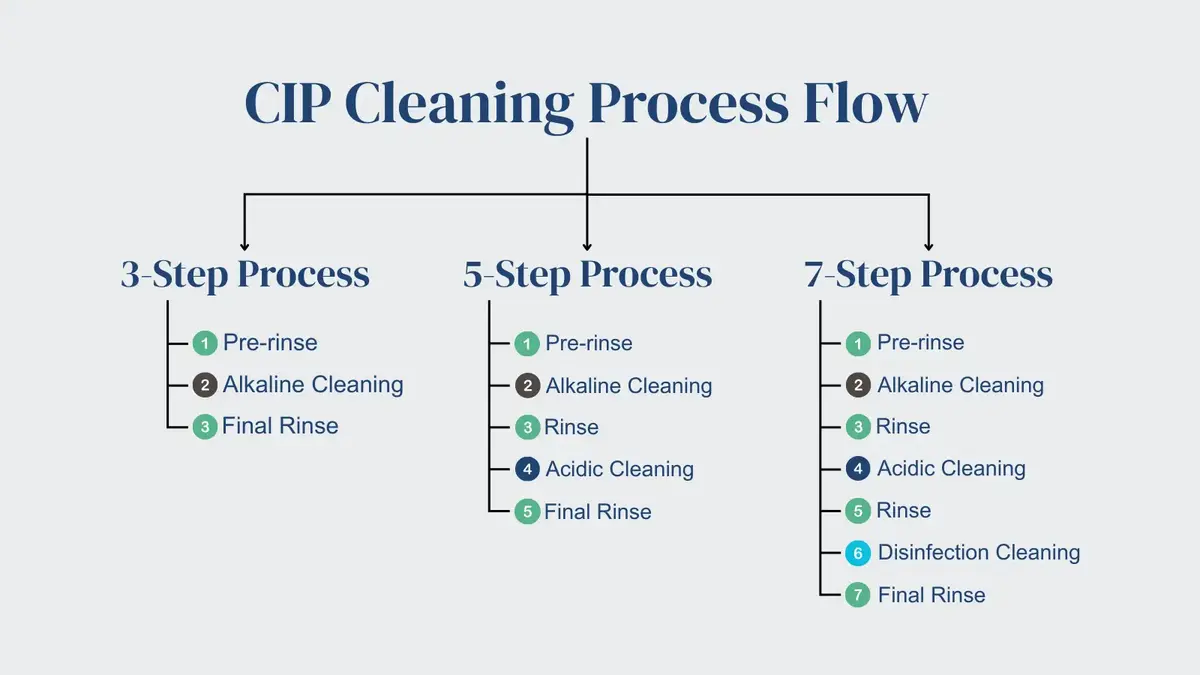
Source: camelsdairymachine
Acid cleaning should not be confused with sanitizing. Cleaning removes soil from surfaces; sanitizing is a separate, validated operation where required by the plant’s process and food-safety program. An acid wash is not automatically a sanitizing step, and a sanitizer should not be expected to remove established mineral scale.
Compare acid families by deposit and system constraints
Food processing acid wash programs often use nitric acid, phosphoric acid, citric acid, or formulated blends. The formulation may also include wetting agents, sequestrants, corrosion-control additives, or low-foam components. Those additions can materially change both cleaning performance and compatibility, so evaluate the finished product rather than the acid name alone.
Nitric-based chemistry
Nitric acid is widely associated with mineral-scale removal in food and beverage CIP. It can be effective on difficult inorganic deposits and is commonly considered for circuits that require strong descaling performance. Its use requires careful review of the specific cleaner’s label, safety documentation, equipment materials, ventilation needs, and handling controls.
Phosphoric acid CIP cleaners
A phosphoric acid CIP cleaner may be selected where the deposit profile and equipment compatibility support it. Phosphoric-based formulations are used for mineral deposits and may be considered when a plant wants an alternative acid chemistry. Their performance depends on the formulation, mineral soil, operating conditions, and water chemistry. Do not assume that a phosphoric product is inherently safe for every metal, gasket, or elastomer.
Citric and other organic-acid formulations
Citric-based or organic-acid blends may be used where a less aggressive acid approach is appropriate for the deposit and materials involved. They may not be the best choice for every heavy or established scale condition. Selection should be based on demonstrated deposit removal at conditions the equipment can safely tolerate, not solely on the perception that an organic acid is automatically gentler or easier to manage.
Build a complete CIP chemical compatibility list
The main process piping may be stainless steel, but it is rarely the only material exposed to an acid cleaning circuit. A useful compatibility review includes every wetted and intermittently wetted component, including parts that are easy to overlook.
Check the compatibility of the proposed acid cleaner with:
- Stainless steel grade, weld condition, surface finish, and any existing corrosion or damage
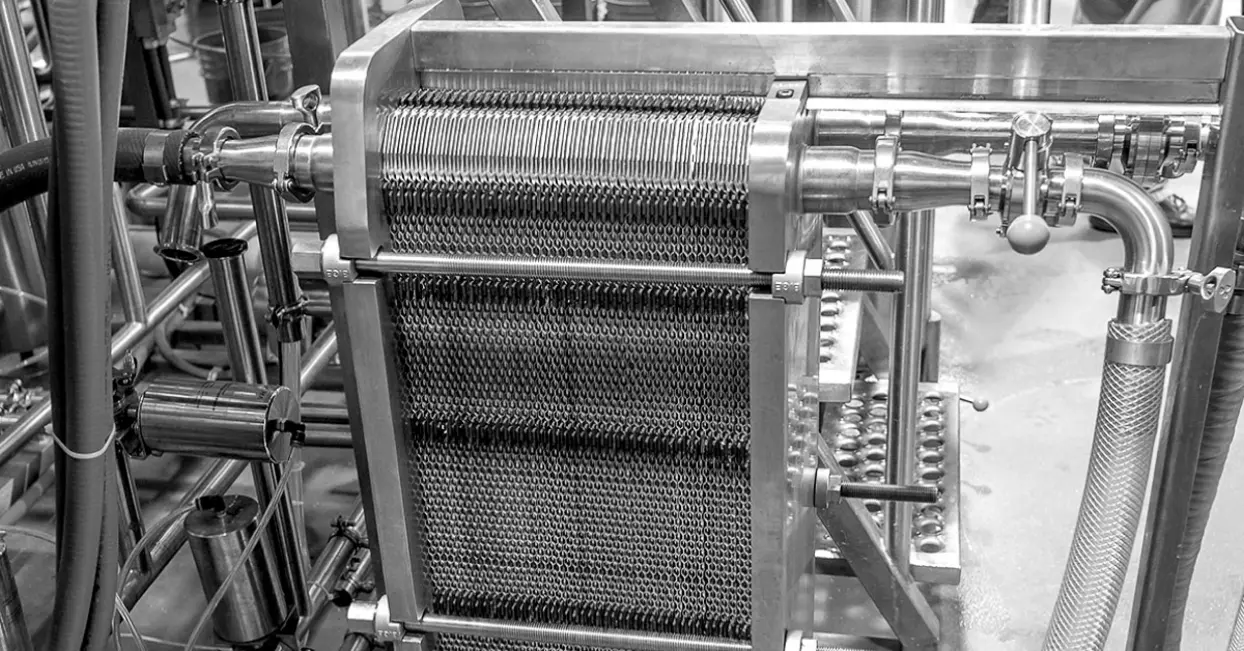
- Heat exchangers, plates, tube bundles, and mixed-metal assemblies
- Pumps, valve bodies, valve seats, sight glasses, instrumentation connections, and spray devices
- Gaskets, O-rings, diaphragms, hoses, elastomeric seals, and flexible connectors
- Plastics, coatings, adhesives, and membrane materials where present
- Copper, brass, aluminum, galvanized materials, or other yellow and light metals
- Chemical storage tanks, dosing pumps, transfer hoses, drains, and recovery tanks
Compatibility is condition-dependent. A material that tolerates a chemical at one concentration and temperature may not tolerate it at a higher concentration, elevated temperature, longer exposure, or repeated use. Frequency matters as well: a component may appear acceptable after occasional exposure but degrade in a daily cleaning routine.
Obtain written confirmation from the chemical supplier for the proposed product and operating window. Then compare it with recommendations from the equipment manufacturer, gasket supplier, membrane supplier, and any relevant hygienic design documentation. Where recommendations conflict, stop and resolve the issue before introducing the chemical into the circuit.
Select operating limits as a system, not as isolated numbers
CIP effectiveness depends on the interaction of chemistry, temperature, contact time, and mechanical action. Improving only one variable does not necessarily correct a poor cycle. For example, extending an acid hold may not remove a deposit if flow is inadequate in part of the circuit, the solution is too weak at the point of use, or the deposit is primarily organic.
For a new or changed cleaner, define and validate the full operating window:
- Chemical concentration: Use the supplier’s documented range and a controlled method for dosing and verification.
- Temperature: Stay within the limits for the chemical and every wetted material, including seals and instruments.
- Circulation time: Establish time based on deposit removal and complete circuit exposure, not convenience.
- Flow and mechanical action: Confirm that pipelines receive adequate turbulent action where required and that tanks receive effective spray coverage.
- Return condition: Monitor relevant indicators such as conductivity, pH, temperature, flow, and return appearance as appropriate to the system.
- Recovery and disposal: Review whether acid is recovered, segregated, neutralized, or discharged under site procedures and local requirements.
Changes to product formulation, water source, production temperature, or equipment geometry can alter the cleaning requirement. A CIP recipe that was adequate for one product line should not automatically be transferred to another.
Control the intermediate rinse and final rinse
Rinsing is a core part of acid CIP cleaner selection because it protects the process from chemical carryover and prevents incompatible chemistry from meeting in the circuit. The rinse between caustic and acid phases is particularly important. Residual alkali can consume acid, shift the intended concentration, create excess heat locally, and reduce cleaning consistency.
Plants commonly use conductivity, pH, volume, time, or a combination of signals to establish phase transitions and rinse endpoints. The right method depends on the design of the CIP set, water quality, chemical recovery arrangement, and validation approach. A single indication should not be treated as universally sufficient without confirming that it reliably represents conditions throughout the full circuit.
A robust rinse-control plan should address:
- How the previous solution is displaced from supply and return lines
- Whether valves, branches, and low points retain chemical solution
- The rinse endpoint used to permit the next phase
- Final-rinse acceptance criteria before the line is released
- How final-rinse water is handled if product-contact requirements apply
- What records demonstrate that the cycle completed as intended
Where chemical residue testing, sensory checks, conductivity monitoring, or other verification is used, the method and acceptance criteria should be defined in the plant’s sanitation procedures and supported by validation.
Common acid CIP selection mistakes
Several recurring decisions create avoidable cleaning and maintenance problems.
Using acid to solve an organic-soil problem. Confirm deposit composition before changing chemistry. Acid is not the primary tool for routine fat or protein removal.
Reviewing only the pipe material. Valve seats, gaskets, heat-exchanger components, sensors, and chemical-handling hardware can be the actual compatibility limit.
Assuming a cleaner is interchangeable because it has the same acid base. Additives, acid strength, inhibitors, foam behavior, and recommended conditions vary by formulation.
Skipping the intermediate rinse. Inadequate separation between alkaline and acid phases can undermine both cleaning chemistry and process control.
Treating rinse time as proof of rinse completion. A timed rinse may be part of a validated recipe, but changes in circuit volume, valve position, flow, or recovery configuration can affect actual displacement.
Increasing concentration or temperature without review. This can increase corrosion, seal damage, and operator hazard while failing to address the real limitation, such as poor flow distribution.
A practical selection checklist
Before approving a food processing acid wash product, document the following:
- Deposit type and evidence supporting the diagnosis
- Process areas and circuits requiring acid cleaning
- Product-contact and non-product-contact materials in each circuit
- Proposed cleaner, supplier technical documentation, and safety documentation
- Approved concentration, temperature, time, and circulation conditions
- Compatibility confirmation for metals, elastomers, plastics, membranes, and instrumentation
- Intermediate-rinse and final-rinse controls
- Chemical dosing, storage, transfer, recovery, neutralization, and disposal procedures
- Validation plan for cleaning effectiveness and rinse removal
- Verification records, corrective actions, and change-control requirements
When to involve suppliers and qualified specialists
Supplier-supported validation is especially important when a plant is changing acid type, adding a new CIP circuit, dealing with recurring scale, operating mixed-metal equipment, or seeing unexplained corrosion, gasket failures, or rinse problems. The chemical supplier can provide product-specific application guidance, while equipment and component manufacturers can confirm material limits. Food-safety and sanitation leaders should ensure that the final cycle is validated and documented within the site’s broader preventive-control program.
The sound choice is not simply the strongest acid cleaner. It is the product and operating window that remove the confirmed mineral soil, remain compatible with the complete CIP circuit, and can be consistently rinsed and verified under normal and worst-case operating conditions.
References
- CIP Chemicals for Food Processing. (n.d.). https://greystone-enterprises.com/feeds/blog/cip-chemical
- Acid-Resistant Stainless Steel for Food & Beverage Applications. (n.d.). https://americanstainlessandsupply.com/resources/acid-resistant-stainless-steel-in-food-and-beverage-applications
- CIP Chemicals for Food Processing: A Complete Guide. (n.d.). https://igchemsolutions.com/cip-chemicals-for-food-processing
- Clean-in-Place (CIP) Systems: Process & Chemistry Guide. (n.d.). https://igchemsolutions.com/clean-in-place-systems
- What Food Processing Cleaning Chemicals Are Used on Equipment?. (n.d.). https://saniprocess.com/what-food-processing-cleaning-chemicals-are-used
- CIP Cleaning: How to Ensure Food Safety Standards | Tractian. (n.d.). https://tractian.com/en/blog/cip-cleaning-how-to-ensure-food-safety-standards
- Clean in Place (CIP): The Complete Guide | Process Types, Chemicals, & Equipment. (n.d.). https://runlaminar.com/blog/clean-in-place
- 3-A Sanitary Standards, Inc. > Knowledge Center > Resource Papers > Cleanability of Equipment. (n.d.). https://my.3-a.org/Knowledge-Center/Resource-Papers/Cleanability-of-Equipment