Ammonia refrigeration safety in a food plant depends on controls that work before a leak becomes an emergency: maintained equipment, reliable detection, clear alarms, practiced evacuation, and a response plan that defines who is authorized to act. A written plan alone is not enough. Operators, maintenance teams, contractors, supervisors, and outside responders need compatible procedures and current facility information.
Ammonia is widely used in industrial refrigeration because it is an effective refrigerant, but a release can create an immediate inhalation and irritation hazard. The safest operating approach is to detect abnormal conditions early, remove nonessential personnel from exposure, isolate or control the release only through trained and authorized responders, and protect surrounding production areas from disruption or contamination concerns.
Start with a practical risk-control flow
A food plant’s ammonia safety program should connect five functions:
- Prevent loss of containment through design control, inspection, maintenance, and controlled work practices.
- Detect a release quickly using fixed detection where required or appropriate, portable instruments for qualified personnel, and routine sensory and operational observation.
- Warn people clearly with recognizable alarms and communication methods that can be heard or seen in noisy processing areas.
- Move people to safety through predetermined evacuation, accountability, and access-control procedures.
- Manage the incident through a defined command structure and coordination with emergency services, refrigeration specialists, and contractors.
These functions should be treated as one system. For example, a detector that activates but does not produce a clear plant-wide action creates uncertainty. Likewise, a well-written evacuation plan may fail if employees do not know which alarm signal represents an ammonia release or where they should report after leaving the area.
Understand where leaks are most likely to develop
Ammonia normally remains contained within interconnected vessels, compressors, evaporators, condensers, valves, and piping. Release risk tends to rise where there are joints, moving components, pressure boundaries, vibration, corrosion exposure, or frequent service activity.
Common areas for inspection and risk review include:
- Compressor seals, fittings, valves, gauges, oil-management components, and connected piping
- Flanges, threaded connections, valve stems, packing, and gasketed joints
- Relief devices and their discharge routing
- Evaporators, unit coolers, pressure regulators, and piping within refrigerated rooms
- Condensers, receiver vessels, accumulators, intercoolers, and oil pots
- Pipe supports, hangers, insulation condition, and locations vulnerable to impact damage
- Areas affected by washdown, corrosive environments, vibration, thermal cycling, or forklift traffic
- Temporary connections or equipment opened during maintenance, charging, oil draining, or shutdown work
A leak can also be an operational symptom rather than a visibly damaged component. Unusual pressure behavior, repeated alarm conditions, unexplained refrigerant loss, abnormal compressor operation, or recurring repairs deserve engineering review rather than routine reset-and-run treatment.
Plan ammonia detector placement around release scenarios
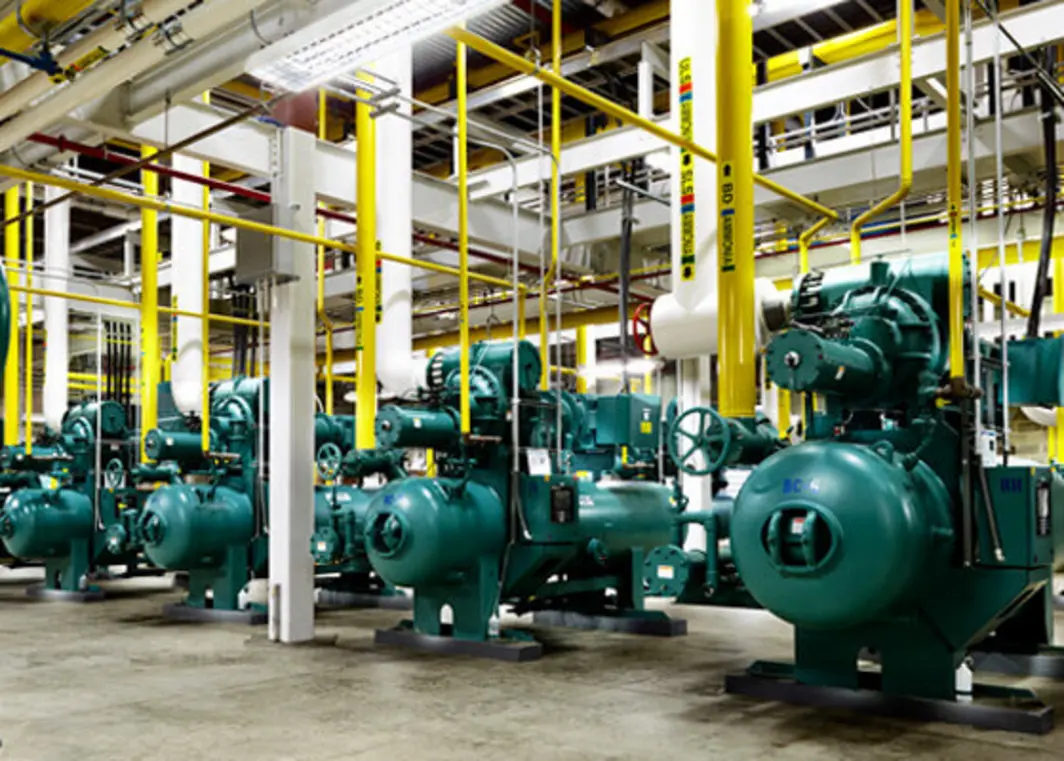
Fixed gas detection is most useful when it is designed for the actual building and refrigeration system rather than installed as a generic compliance item. Detector placement should be determined by a qualified designer or refrigeration safety specialist using the equipment layout, credible leak sources, ventilation pattern, room geometry, operating modes, and applicable codes and standards.
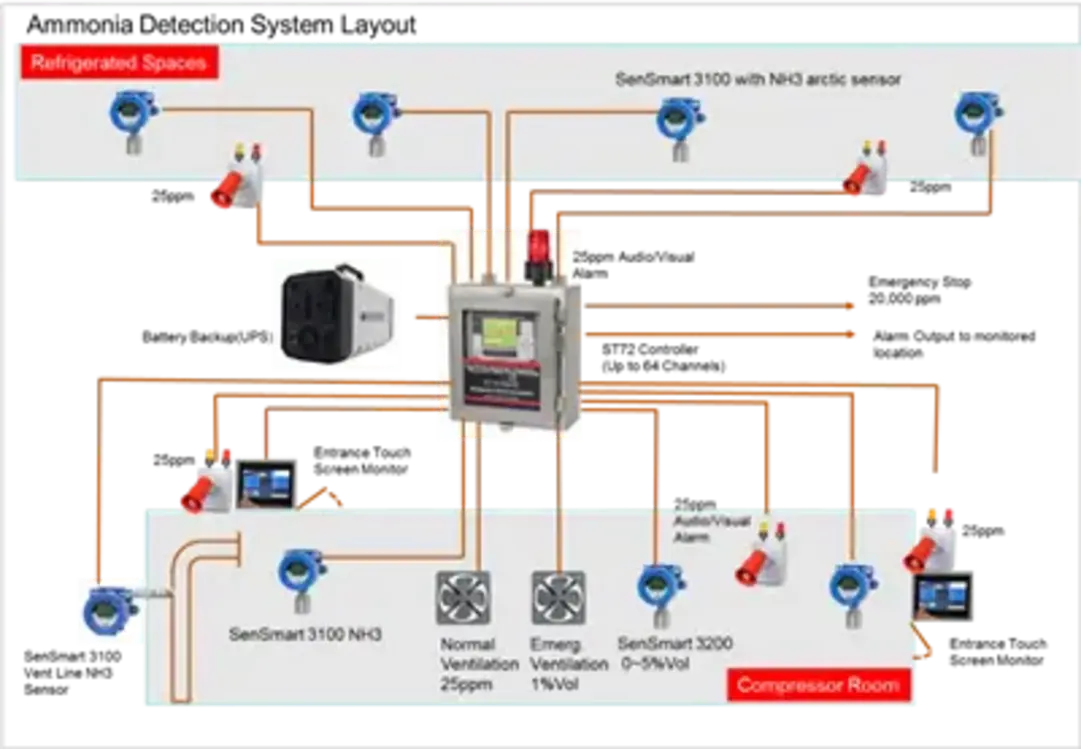
Source: rcsystemsco
Key planning questions include:
- Which rooms contain compressors, vessels, valves, or other likely release points?
- Where could a leak migrate if machinery-room ventilation changes or a door is open?
- How do supply and exhaust airflows move through the room and into adjacent spaces?
- Are there enclosed, elevated, recessed, or obstructed areas where gas could accumulate under particular conditions?
- Which occupied production, warehouse, utility, or office areas may be affected by a release from the refrigeration system?
- What alarm actions should occur at different detection levels, and who receives the notification?
Detector location should not be based on a single rule of thumb. Ammonia’s movement in a building can be affected by temperature, release pressure, ventilation, obstructions, and moisture. A competent assessment may identify the need for coverage near equipment, in ventilation paths, or at other locations specific to the hazard scenario.
Detection equipment also needs a maintenance program. The plant should document functional testing, calibration or bump-testing requirements, sensor replacement intervals, alarm verification, power-loss behavior, and corrective actions. Follow the detector manufacturer’s instructions and the facility’s applicable safety requirements. A detector with expired maintenance records should be treated as a control needing attention, not as proof that coverage is adequate.
Make alarms actionable in production areas
A food plant can be loud, occupied across multiple shifts, and divided by walls, cold rooms, dock areas, and sanitation zones. Alarm planning should therefore account for where people actually work.
Useful alarm-system design principles include:
- Use a distinct audible and, where needed, visual signal for an ammonia-related emergency.
- Ensure signals can be recognized in high-noise locations and by workers using hearing protection.
- Define whether alarms are local, machinery-room-only, area-specific, or site-wide.
- Provide a backup communication method if a public-address system, phone network, or power supply is unavailable.
- Establish who evaluates an alarm and who has authority to order evacuation, sheltering, shutdown, or emergency notification.
- Test alarm communication during drills without creating confusion about whether a real release is occurring.
Plant teams should avoid vague instructions such as “use caution” or “check the leak.” Employees need simple, role-specific direction: evacuate by the designated route, report to the assigned assembly point, account for visitors, or remain clear of the affected zone. Only trained and properly equipped personnel should perform response tasks that involve potential ammonia exposure.
Build an emergency response plan before an incident
The industrial refrigeration emergency plan should distinguish between initial protective actions and technical incident control. In many facilities, the first priority for most employees is notification, evacuation, and accountability—not diagnosis or repair.
Define roles in advance
| Role | Primary responsibility during an ammonia event |
|---|---|
| Employees and visitors | Recognize the alarm or warning, leave by the designated route, report to the assembly location, and do not re-enter until authorized. |
| Supervisors or wardens | Direct evacuation, check assigned areas when safe and within their role, and report accountability information. |
| Incident commander or designated manager | Coordinate the plant response, communications, site access, and decisions with emergency services. |
| Qualified refrigeration responders | Assess system conditions and take only authorized technical actions under the facility response plan. |
| Security or gate personnel | Keep unauthorized people out, direct responders to the appropriate entrance, and preserve emergency access. |
| Contractors | Follow the site’s emergency instructions, provide current work information, and avoid independent action outside their authorization. |
The plan should identify assembly areas that are appropriate for foreseeable release and wind conditions, while allowing the incident commander to redirect personnel when conditions require it. It should also include procedures for visitors, truck drivers, temporary labor, and personnel working alone or in remote areas.
Prepare responders with accurate site information
Local fire, hazardous-materials, and medical responders may not know a plant’s machinery-room layout or refrigeration isolation strategy. Pre-incident coordination can help them understand access points, emergency contacts, system drawings, equipment rooms, shutoff locations, alarm signals, and site hazards.
Keep this information current. A plant expansion, piping change, altered traffic route, new freezer room, or changed contractor arrangement can make an old emergency map unreliable. Emergency information should be controlled so that responders receive the current version, not an outdated drawing from a maintenance file.
Control access and contractor work
Contractor activity is a recurring source of risk because refrigeration systems may be opened, isolated, modified, or worked near during construction and maintenance. Before work begins, the facility should establish who owns the work permit, how equipment status is communicated, what isolation and lockout procedures apply, how line opening is controlled, and what emergency equipment and communications are required.
Contractors should receive site-specific orientation covering alarm signals, evacuation routes, assembly procedures, restricted refrigeration areas, and reporting expectations. The refrigeration team should know when contractors are working on or near ammonia equipment, especially if work could affect detection, ventilation, electrical controls, relief discharge paths, or piping integrity.
No one should bypass alarms, defeat ventilation interlocks, alter relief-device arrangements, or return equipment to service without the plant’s formal approval process. Changes to piping, controls, equipment, operating limits, or procedures may require management-of-change review under the facility’s applicable safety program.
Focus preventive maintenance on mechanical integrity
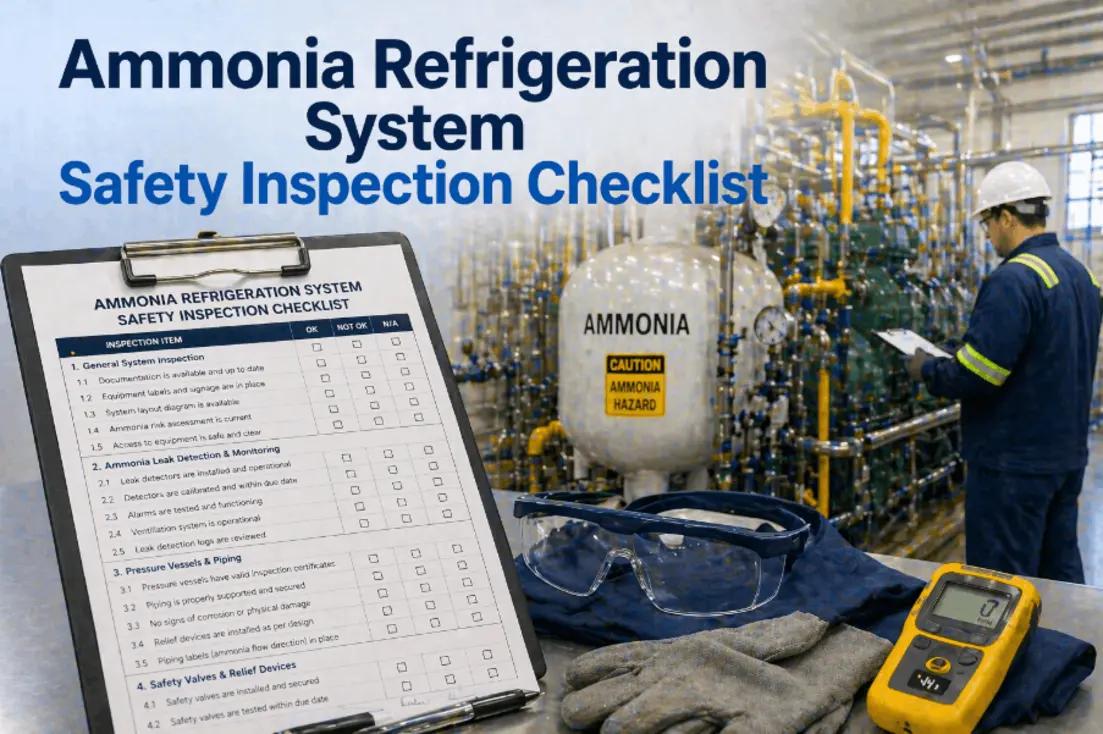
Ammonia system preventive maintenance is not limited to lubricating compressors and recording operating pressures. Its purpose is to keep pressure-containing equipment, safeguards, controls, and emergency systems capable of performing as intended.
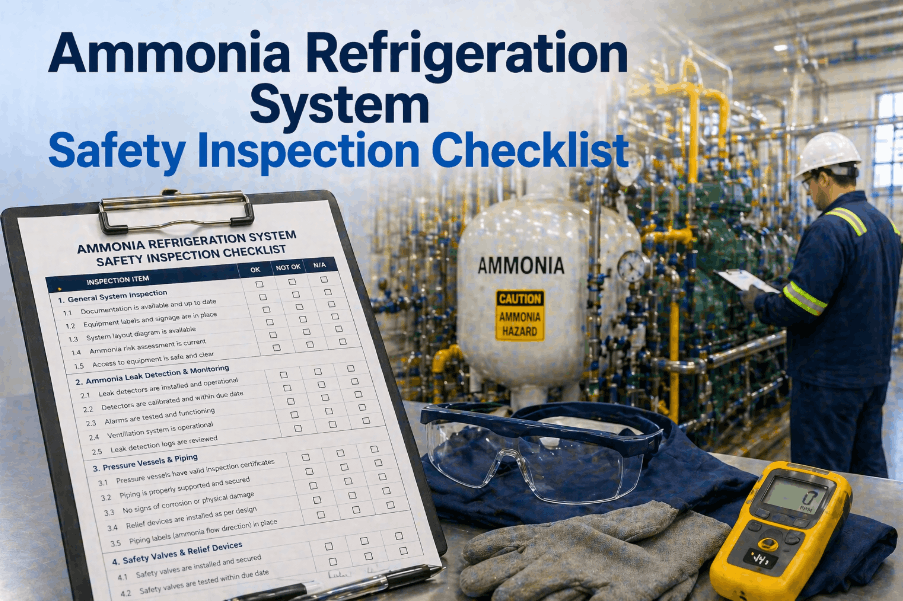
Source: ifactoryapp
A practical maintenance program typically covers:
- Scheduled inspection of piping, vessels, valves, supports, insulation, and corrosion-prone locations
- Maintenance of compressors, pumps, evaporators, condensers, and oil-management equipment according to manufacturer guidance
- Inspection and documented management of pressure-relief devices and discharge arrangements
- Testing and maintenance of gas detection, alarms, ventilation, emergency lighting, and communications equipment
- Verification of emergency shutdown and control functions where installed
- Investigation of recurring leaks, vibration, abnormal noise, or repeat component failures
- Accurate work orders, inspection records, test results, repair history, and overdue-task escalation
The maintenance team should differentiate between routine operating adjustments and defects that require engineering or specialist review. Recurrent gasket failures, damaged supports, corrosion beneath insulation, frequent valve packing repairs, or unexplained pressure excursions can indicate a broader mechanical-integrity problem.
Train, drill, review, and improve
Training should match each person’s expected role. General employees need to recognize alarms and know what to do. Supervisors need accountability and communication responsibilities. Refrigeration personnel need technical operating, shutdown, and emergency procedures appropriate to their authorization. Emergency responders need access to current site information and joint planning where appropriate.
Drills are most useful when they test a specific decision point: a release during sanitation, an alarm on a night shift, an evacuation with delivery drivers on site, a blocked route, or a detector alarm during refrigeration maintenance. After each drill or actual event, document what worked, what caused delay, and which corrective actions have an owner and due date.
Verify the regulatory and technical requirements that apply
Requirements for ammonia refrigeration can depend on refrigerant inventory, process configuration, jurisdiction, building occupancy, and the standards adopted by the authority having jurisdiction. Facilities should confirm their obligations with qualified safety, engineering, legal, and regulatory advisers. OSHA process safety requirements, EPA risk-management obligations, fire-code provisions, and recognized refrigeration standards may all be relevant, but applicability should be verified for the individual site.
The central operating principle is straightforward: prevent releases where possible, identify them early when they occur, protect people through clear emergency actions, and keep system safeguards reliable through disciplined maintenance. In a food plant, those controls protect employees first while also reducing disruption to cold storage, processing, sanitation, and distribution.
References
- Ammonia Refrigeration System Safety Inspection Checklist. (n.d.). https://ifactoryapp.com/industries/food-manufacturing/ammonia-refrigeration-system-safety-inspection-checklist
- New 2021 IIAR Regulations for Ammonia Gas Detection - Pfannenberg USA. (n.d.). https://www.pfannenbergusa.com/new-2021-iiar-regulations-for-ammonia-gas-detection
- Why Regular Leak Detection is Critical for Ammonia Systems | Northstar Refrigeration. (n.d.). https://www.northstarhvacr.com/post/leak-detection
- Safety in Ammonia Refrigeration. (n.d.). https://berg-group.com/blog/safety-in-ammonia-refrigeration
- Staying Informed and Updated on Your Plant’s Ammonia Safety Program - The United Food & Commercial Workers International Union | The United Food & Commercial Workers International Union. (n.d.). https://www.ufcw.org/staying-informed-and-updated-on-your-plants-ammonia-safety-program
- AMMONIA REFRIGERATION IN WAREHOUSES. (n.d.). https://teamstersafety.org/wp-content/uploads/2019/11/ammonia.pdf
- Food Plant Ammonia Refrigeration System Maintenance …. (n.d.). https://oxmaint.com/industries/food-manufacturing/food-plant-ammonia-refrigeration-system-maintenance-psm-compliance
- IIAR Ammonia Refrigeration Education and Training Program. (n.d.). https://www.iiar.org/common/Uploaded%20files/IIAR_Docs/IIAR%20Publications/Videos/Series%202/49054_IIAR_S2Module4.pdf