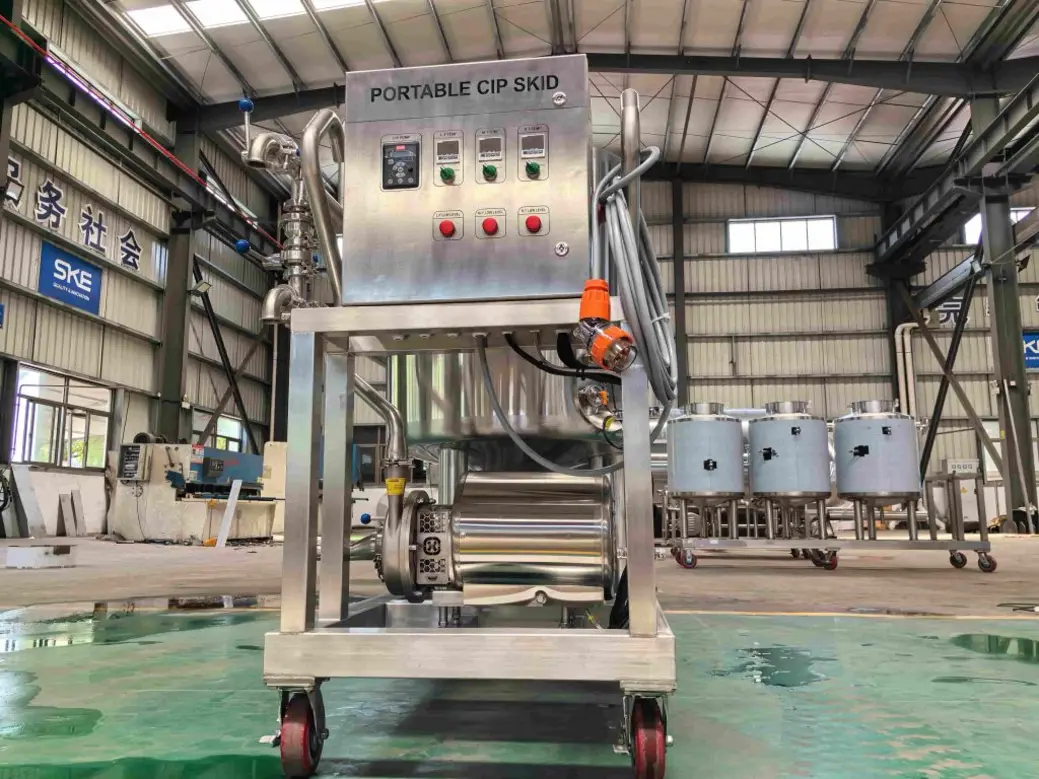
An automated CIP cycle is not verified simply because the controller displays “complete.” Automated CIP cycle verification is the documented decision that the correct circuit and recipe ran, required operating conditions were achieved for the required portions of the cycle, alarms and interruptions were assessed, and the equipment can be released under the site’s validated sanitation program.
Automation provides repeatability and a useful electronic record. It does not compensate for an unsuitable circuit design, a poorly selected recipe, unreliable instruments, wrong valve alignment, or a validation program that has not established what acceptable cleaning looks like. The practical objective is to make abnormal conditions visible, prevent an automatic “pass” after a meaningful deviation, and leave a clear record of who made the release decision and why.
Start with a verified CIP basis
Before configuring alarms or reports, define the approved cleaning basis for each circuit and product or soil family. This work normally connects the cleaning recipe to the actual equipment, product residue, changeover risk, chemical program, and sanitation validation evidence.
A useful CIP master record identifies:
- The circuit or equipment included, including valves, branches, vessels, fillers, heat exchangers, hoses, and any components requiring separate cleaning or inspection.
- The recipe version and the product, product family, or changeover condition for which it is approved.
- The intended phases, such as recovery, pre-rinse, wash, intermediate rinse, acid treatment where applicable, final rinse, and sanitizing where used by the site.
- The critical parameters for each phase and the approved limits or targets established through validation.
- Required verification activities beyond the automated record, such as inspection, chemical checks, rinse checks, swabbing, or periodic teardown, where the sanitation program requires them.
- The required corrective action and release authority when a cycle does not meet requirements.
The important distinction is between a recipe setpoint and a verified requirement. A controller can have a temperature, flow, conductivity, and time setpoint; the plant’s validation and food-safety program determine which values, locations, durations, and tolerances must be achieved before a cycle is acceptable.
Define critical parameters by cleaning phase
CIP critical parameter monitoring should focus on conditions that affect cleaning performance, not every available tag on the PLC screen. Exact requirements vary by product, circuit geometry, chemistry, and validated process. Common parameter categories include the following.
| Parameter | What it helps demonstrate | Common review question |
|---|---|---|
| Time | Required exposure or circulation occurred | Did the qualifying timer run only while required conditions were met? |
| Temperature | The wash or rinse reached the validated thermal condition | Was temperature achieved at the designated measurement point and maintained? |
| Flow or flow proxy | The circuit received sufficient circulation or mechanical action | Did flow remain within the approved operating range for the full qualifying period? |
| Conductivity or concentration | The intended chemical solution was delivered and rinsed out as required | Was the instrument suitable for the chemistry, and was the signal within the established range? |
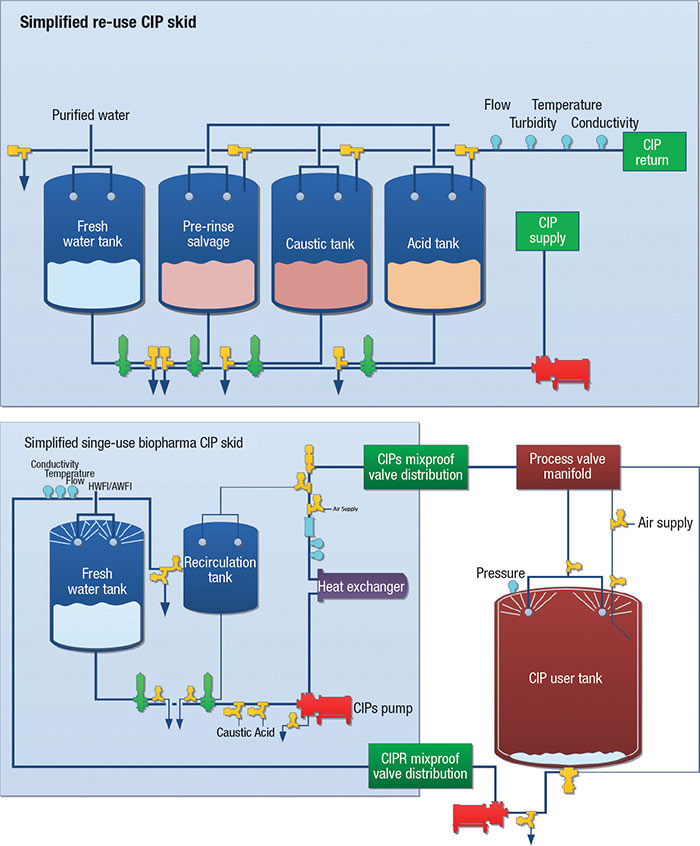
| Return conditions | Return temperature, conductivity, turbidity, pH, or other signals can support phase control | Did the return signal support the expected transition or reveal an abnormal condition? |
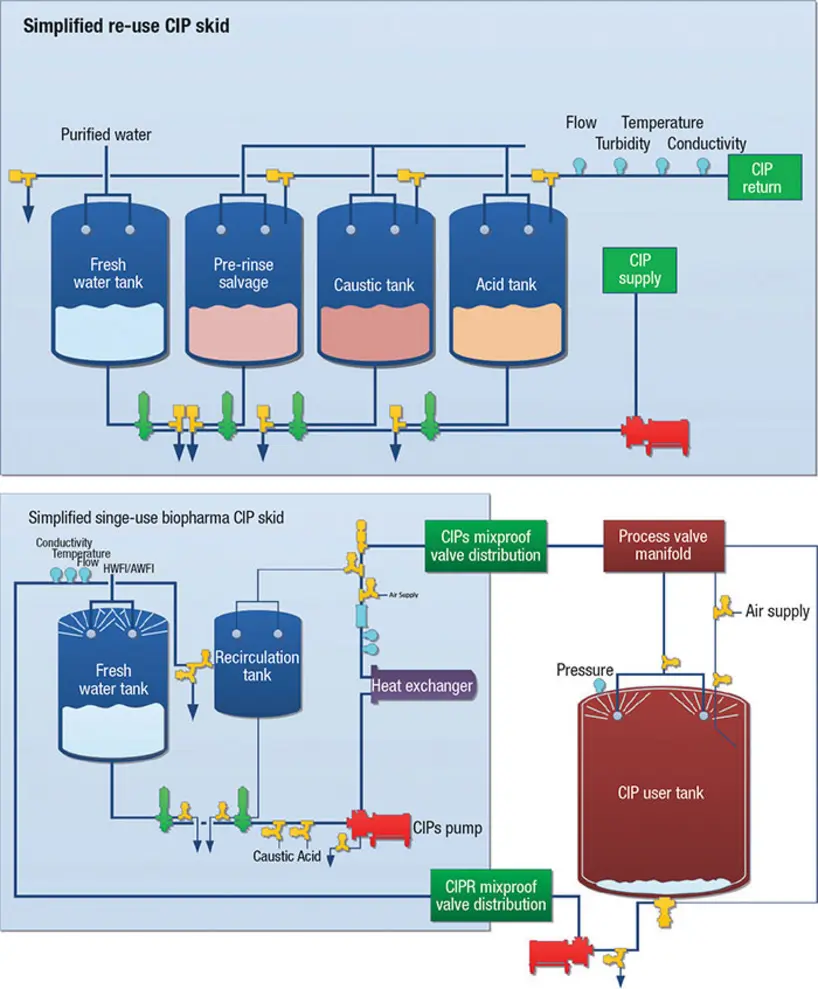
| Valve position and routing | The selected circuit was actually connected and isolated as intended | Were all required paths proven open or closed, with no conflicting path available? |
| Utility status | Heating, water, air, and chemical supply affect execution | Did a utility loss, low supply, or pump fault affect a critical phase? |
A robust sequence avoids crediting time before the relevant conditions are achieved. For example, a wash-phase timer may need to qualify only after flow, temperature, and chemical condition are within the validated range. Whether this is necessary, and how the logic should behave during a brief deviation, must be defined through site validation and risk assessment rather than assumed from a generic recipe.
Source: haskell
Use the right measurement point
A value from the CIP supply header does not necessarily represent conditions at the hardest-to-clean location. Long circuits, dead legs, heat loss, restricted branches, and return-side mixing can make one sensor an incomplete representation of the circuit.
During validation, identify the measurement points that support the claim being made. A supply temperature transmitter may control the skid, while a return temperature or a point closer to a challenging circuit location may be needed to verify performance. Similarly, a conductivity signal can indicate solution strength or phase transition, but it should be checked against the chemical system and periodically verified by an appropriate independent method under the site program.
Configure alarms as decisions, not noise
CIP cycle alarms should distinguish between conditions that stop the cycle, conditions that hold it for review, and advisory events that can be trended without automatically invalidating the run. If every small fluctuation creates a high-priority alarm, operators may acknowledge alarms without meaningful assessment. If limits are too broad, the system may record a nominal completion despite a significant process failure.
A practical alarm philosophy includes these categories:
- Critical fail alarms: Conditions that make the phase unacceptable, such as loss of required flow, inability to establish required temperature, chemical delivery failure, incorrect route confirmation, or an unplanned stop during a qualifying step.
- Hold-for-review alarms: Events that may or may not affect acceptability, depending on duration, phase, and validated logic. These should prevent automatic line release until reviewed.
- Advisory alarms: Maintenance or efficiency signals, such as a slowly degrading pump performance trend, that do not by themselves determine cycle acceptance.
- Data-integrity alarms: Lost communication, unavailable historian data, failed sensor diagnostics, recipe mismatch, or an unapproved manual change. If the evidence needed to verify the cycle is missing, the release process needs a defined response.
For each alarm, document the triggering condition, priority, automatic action, required operator response, required evidence, escalation path, and whether the cycle can resume. Avoid allowing operators to bypass a critical interlock merely to complete a sequence. Any controlled override should be restricted, recorded, and handled under the plant’s approved deviation process.
Review the whole cycle record, not only the final status
CIP cleaning record review should occur before production uses the circuit, at the frequency defined by the sanitation and food-safety program. The reviewer should see more than a green completion flag.
A useful electronic batch record links the CIP event to the circuit, recipe version, start and end times, operator actions, phase history, trends for critical parameters, alarm history, corrective actions, and final disposition. It should also identify missing or substituted data clearly.
The review sequence can be simple:
- Confirm the correct asset, circuit, and approved recipe were selected.
- Confirm each required phase was completed in the intended order.
- Check that critical parameters met their defined acceptance logic, including any required hold time.
- Review alarms, pauses, manual interventions, utility interruptions, and abnormal phase transitions.
- Confirm required secondary checks were completed when applicable.
- Document the disposition: released, released with an approved documented assessment where permitted, reclean required, or held for investigation.
Trend views are especially useful for identifying repeat problems that individual batch records may conceal: gradually declining flow, increasing time to reach temperature, recurring chemical concentration excursions, frequent valve-routing faults, or repeated operator interventions.
Failed CIP cycle response: contain first, then assess
A failed or interrupted cycle should place the affected circuit in a controlled hold status. The right response is not automatically “restart the last step” or “run the full recipe again.” The correct action depends on the phase where the failure occurred, the nature and duration of the deviation, whether the circuit was exposed to product or an uncontrolled condition, and the requirements established in the site’s sanitation program.
A structured failed CIP cycle response generally includes:
- Prevent use of the line. Maintain a clear status in the control system and on the production schedule so the circuit is not returned to service by assumption.
- Preserve the evidence. Save trend data, alarm logs, recipe version, valve states, operator actions, and relevant utility conditions before resetting faults or overwriting records.
- Identify the affected scope. Determine which circuit segments, shared headers, connected equipment, and downstream components may be involved.
- Classify the failure. Separate a process deviation from an instrument fault, mechanical fault, routing error, utility loss, chemical issue, or record failure. Multiple causes can exist.
- Apply the approved corrective action. This may require repair, instrument verification, chemical correction, a complete reclean, a defined recovery cycle, additional sanitation verification, or a documented investigation. The approved program—not convenience—should determine the path.
- Document disposition and release. Record the decision-maker, evidence reviewed, corrective action performed, and any required follow-up.
An interrupted final rinse deserves careful treatment. A system may show no active chemical feed, but the acceptability of the rinse condition depends on the validated process, the chemicals used, and the site’s defined verification method. Do not infer acceptable rinse status from elapsed time alone.
Build a controlled CIP line release procedure
The CIP line release procedure should be separate from recipe completion. It is a controlled handoff from sanitation to production, supported by records and physical status controls.
At minimum, define:
- Who may review and release a circuit, and who may escalate a deviation.
- Which electronic record fields must be complete before release.
- Which failures automatically require recleaning or sanitation management review.
- Which physical checks are required for particular equipment, such as filters, removable parts, fillers, or components not fully covered by the CIP circuit.
- How line status is displayed in the automation system and communicated to production.
- How the first product after cleaning is identified and controlled when the food-safety plan requires it.
- How maintenance work performed after CIP affects release status.
A release should be withdrawn if the line is opened, altered, repaired, connected to an unverified route, or otherwise exposed after the cycle. The practical rule is simple: the release applies to a defined equipment condition. Change that condition, and reassess whether the cleaning status remains valid.
Common configuration mistakes
Several recurring mistakes weaken automated CIP verification:
- Treating a completed sequence as a cleaning result.
- Starting phase timing before critical conditions are achieved.
- Monitoring only supply-side values when return or remote conditions are important.
- Using conductivity as a universal proof of concentration without confirming its suitability for the chemical system.
- Giving operators a restart option without defining when restart is acceptable.
- Allowing alarm acknowledgments to erase the need for documented assessment.
- Failing to review recurring deviations as a trend.
- Assuming all product-contact components are cleanable in place; some equipment may require clean-out-of-place work, inspection, or periodic disassembly.
A practical implementation checklist
Before relying on automated CIP cycle verification, confirm that the plant has:
- A documented, validated cleaning approach for each relevant circuit and product or soil condition.
- Defined critical parameters, measurement locations, limits, timing logic, and acceptance rules.
- Calibrated and maintained instruments appropriate to the measurements used for release decisions.
- Alarm priorities and response instructions that distinguish fail, hold, and advisory events.
- Electronic records that retain trends, alarms, manual actions, recipe identity, and disposition.
- A written failed-cycle workflow with hold controls and authorized release roles.
- Periodic review of trends, chemical checks, sanitation verification results, and equipment condition.
- Change control for recipe edits, sensor replacement, pipework modifications, software changes, and new products.
Automated CIP is most useful when it turns cleaning into a controlled, reviewable process rather than a black-box utility cycle. The controller can execute the recipe and capture evidence. The sanitation program must define what that evidence means, what to do when it is incomplete or abnormal, and who has authority to place the line back into production.
References
- CIP System analytics and Validation: Ensuring Sanitary Processing Every Cycle. (n.d.). https://ifactoryapp.com/industries/food-manufacturing/cip-system-analytics-validation-sanitary-processing
- CIP Clean-in-Place System Validation and Maintenance Checklist. (n.d.). https://oxmaint.com/industries/food-manufacturing/cip-clean-in-place-system-validation-maintenance-checklist
- CIP Cleaning: How to Ensure Food Safety Standards | Tractian. (n.d.). https://tractian.com/en/blog/cip-cleaning-how-to-ensure-food-safety-standards
- Sanitation in Food & Beverage Automation: CIP Systems. (n.d.). https://etechgroup.com/blog/general/make-cip-an-integral-part-of-your-process
- What is CIP in food processing? | Umbrex Explainers. (n.d.). https://umbrex.com/resources/umbrex-explainers/agriculture-food-explainers/cip-in-food-processing
- Optimizing Clean-in-Place (CIP) Systems Through Automation - E2i, Inc.. (n.d.). https://www.e2i.net/resources/blog/uncategorized/clean-in-place-automation
- 3-A Site. (n.d.). https://www.3-a.org/news/sanitary-design-connections-spring-2022
- CIP Validation in Food and Beverage Plants: More Than …. (n.d.). https://www.linkedin.com/posts/alicialomas_are-you-really-validating-your-cips-what-activity-7503463609197510656--eLi