A CCP monitoring plan for food production turns the monitoring instructions in an approved HACCP plan into work that can be completed on every shift. It tells the team what to check, how to check it, when checks are due, who owns them, what record to complete, and what happens immediately if a critical limit is not met.
The practical goal is not to create more paperwork. It is to detect loss of control early enough to stop, contain, and properly assess affected product under the site’s approved corrective-action procedure. The schedule must therefore reflect the actual process, product flow, production rate, equipment behavior, and the time required to respond.
Start with the approved HACCP plan
A shift-level monitoring plan should not create new critical limits or casually change existing ones. Begin with the current, approved HACCP plan and its supporting validation, regulatory requirements, customer commitments, and site procedures.
For each CCP, extract the information that operators and QA staff need to execute during the shift:
- The process step and hazard controlled.
- The approved critical limit or limits.
- What is measured or observed.
- The approved monitoring method and instrument.
- The required CCP check frequency.
- The assigned monitoring role.
- The record to be completed.
- The immediate corrective-action and product-control instructions.
- The verification activity, reviewer, and review timing.
A useful test is simple: could a trained employee on the line use the shift document to perform the correct check and respond correctly without guessing? If not, the plan needs clearer instructions, not just another signature field.
Build the shift around four monitoring moments
Most production shift CCP monitoring plans work best when they are organized around the events that change risk or create a decision point. The exact checks depend on the process; the following structure is a practical framework rather than a substitute for the site’s HACCP plan.
1. Pre-start and startup checks
Startup confirms that the process is ready to begin under controlled conditions. Depending on the CCP and operation, this may include confirming that the required monitoring device is available, identified, functioning as intended, and within its calibration status; checking that the correct program, setpoint, or product parameters have been selected; and confirming that required records are present.
The startup check should also establish the starting point for product accountability. Record the production date, line, product or formulation identifier, lot or batch information, shift, and startup time as required by the site system.
Do not treat equipment readiness, sanitation release, allergen changeover, and CCP monitoring as interchangeable activities. They may be connected operationally, but each must be controlled and documented through its applicable program. A pre-operational inspection, for example, does not replace monitoring of a process CCP.
2. Initial production confirmation
The first product or first completed cycle is often a meaningful point for a CCP check because it confirms that the line is operating as expected after startup. The responsible employee should take the required reading or observation using the approved method and document it at the time it is made.
For batch processes, the monitoring event may be tied to each batch. For continuous processes, the plan may require continuous instrumentation, periodic documented observations, or both. The appropriate approach depends on the approved hazard analysis and the ability of the method to identify loss of control in time.
3. Routine in-process monitoring
Routine checks are the core of production shift CCP monitoring. Schedule them at the frequency specified by the HACCP plan, not merely at convenient calendar times.
For example, a monitoring point may be tied to:
- Every batch, lot, rack, retort load, or production run.
- A defined interval while a line is operating.
- Continuous electronic measurement with documented review.
- Each product change, formulation change, or equipment adjustment that affects the CCP.
- A restart after a stoppage, hold, alarm, loss of utility, or other event covered by the plan.
The interval must be capable of finding a problem before too much potentially affected product proceeds beyond practical control. A once-per-shift entry may be appropriate for a verification activity in some systems, but it is not automatically adequate as a CCP monitoring frequency.
4. End-of-run, finished-product, and handover checks
End-of-run activities close the production record and make the next shift’s position clear. They may include a final required CCP observation, reconciliation of lots or batches, review of unresolved holds, confirmation that all scheduled monitoring entries are complete, and handover of equipment or product status.
Finished-product checks can be useful for confirming identification, packaging condition, code application, or other defined requirements. But a finished-product check should not be used to replace control at the CCP itself. Monitoring must occur at the point and frequency specified by the approved plan.
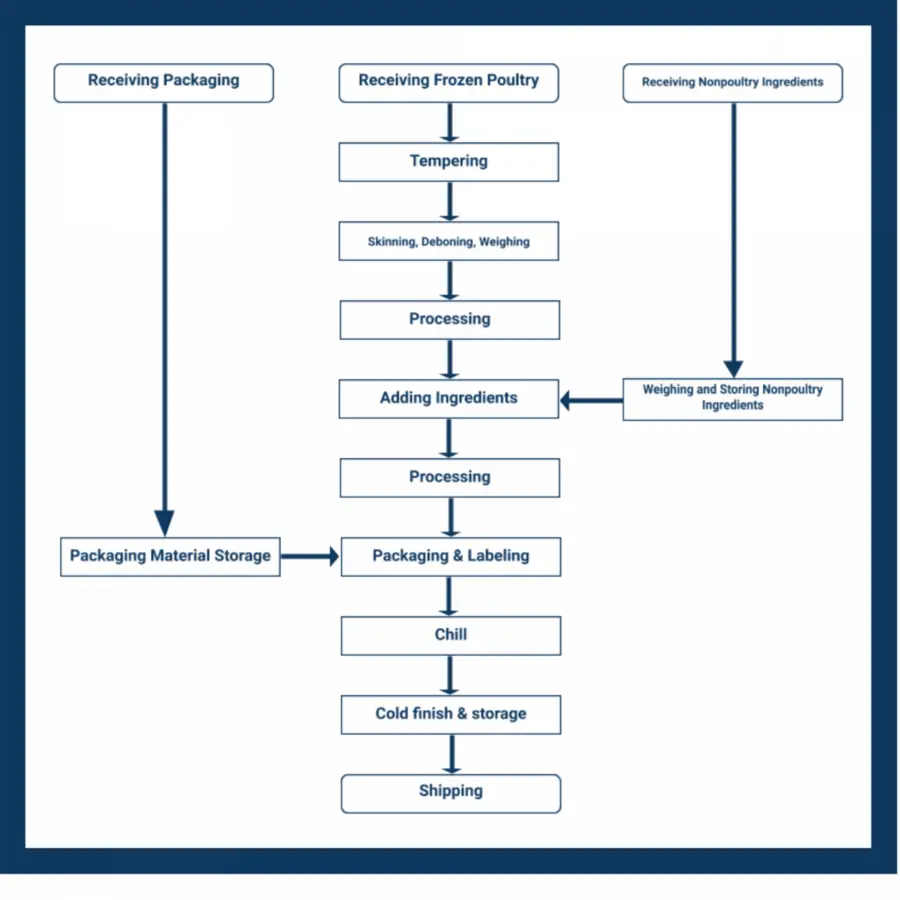
Source: safesitehq
Set CCP check frequency using process risk, not convenience
A practical schedule often fails because it lists a frequency without showing how it fits production. “Every hour” can be clear, for example, but only if the shift form identifies when the first check is due, who performs it during breaks or changeovers, and how missed checks are escalated.
When setting or reviewing CCP check frequency, the HACCP team should consider:
| Question | Why it matters operationally |
|---|---|
| How quickly can the process drift out of control? | Fast-changing conditions may require continuous monitoring or more frequent observations. |
| How much product is made between checks? | This defines the potential scope of product that may need to be held if a deviation is found. |
| How quickly can the line be stopped or product isolated? | Response time affects whether the schedule can contain affected product. |
| Is the measurement automatic, manual, or both? | Automated data still need defined review, alarm response, and data-integrity controls. |
| What happens during startup, changeover, downtime, or restart? | These periods often need explicit checks rather than being left outside the routine schedule. |
| Can the assigned role realistically complete the check on time? | A schedule that conflicts with normal line duties encourages late or reconstructed records. |
If operations want to change a frequency, method, instrument, or responsibility, route the change through the site’s HACCP change-control and validation process. Production convenience alone is not a sufficient basis for reducing monitoring.
Assign clear responsibilities
A reliable plan separates execution, response, and review. One employee may perform more than one role in a small operation, but the responsibilities should still be explicit.
| Role | Typical shift responsibility |
|---|---|
| Line operator or designated process employee | Performs assigned monitoring, records actual observations promptly, and immediately reports a missed limit or equipment concern. |
| Line lead or production supervisor | Ensures checks are completed, supports immediate process control, coordinates product segregation, and maintains shift communication. |
| QA or food safety representative | Reviews deviations, confirms product-control decisions under the approved procedure, conducts scheduled record review, and escalates recurring issues. |
| Maintenance or engineering | Repairs or adjusts equipment under approved controls and communicates when equipment is ready for required rechecks. |
| HACCP coordinator or management designee | Reviews trends, oversees verification, and determines whether a plan reassessment is needed after significant changes or failures. |
Avoid vague assignments such as “production monitors the CCP.” Name the job role, backup role, and escalation contact. The shift plan should also state who acts when the primary person is on break, absent, or occupied with a line problem.
Design records that match the work
Food safety monitoring records should make it easy to reconstruct what happened during a run. Whether paper or electronic, the form should align with the actual monitoring procedure rather than force employees to translate information from several documents.
At minimum, use fields appropriate to the CCP for:
- Date, shift, line, product, and lot or batch identification.
- CCP name and critical limit reference.
- Actual observation or reading, not simply a checkmark where a value is required.
- Time of the observation.
- Monitoring method or equipment identification when relevant.
- Name, initials, signature, or authenticated electronic identity of the person performing the check.
- Deviation reference, product-hold status, and corrective-action record number when needed.
- Reviewer identity and review date or time.
Employees should record observations when they are made. Completing entries later from memory weakens the record and can conceal a late check or missed deviation. Electronic systems can improve timing, task prompts, and traceability, but they still require controlled user access, reliable data capture, and a workable response when the system is unavailable.
Define the deviation response before the shift starts
A CCP monitoring plan is incomplete if it says only “notify QA” or “tell the supervisor.” Notification is important, but it is not the full corrective action.
The approved deviation procedure should instruct the team to take immediate control of the process and affected product. The exact actions depend on the CCP, product, and facility procedure, but the shift document should make the sequence clear:
- Recognize and communicate the deviation. Stop the affected step or place the line in a controlled state when required by the procedure.
- Identify and hold potentially affected product. Use the site’s lot-traceability and product-status controls. The hold boundary should be based on the last known acceptable monitoring point and the approved procedure.
- Correct the immediate cause. This may involve adjustment, repair, replacement, or another approved action. Do not resume normal production until required conditions and rechecks have been met.
- Evaluate product disposition. Authorized personnel should determine whether product may be reworked, released through an approved process, or otherwise handled according to the facility’s documented system and applicable requirements.
- Document the event. Record the deviation, affected product, actions taken, results of rechecks, disposition, and responsible personnel.
- Investigate recurrence. Repeated events, drifting readings, missed checks, or equipment instability may require maintenance action, retraining, procedure review, or HACCP reassessment.
Add mid-shift CCP verification without confusing it with monitoring
Monitoring is the operational activity that detects whether a CCP remains within its critical limit. Verification asks whether the monitoring system is being performed and functioning as intended.
Mid-shift CCP verification can be especially useful on longer runs, complex lines, or operations with several manual checks. A supervisor or QA reviewer may confirm that scheduled entries are current, readings are complete, instruments are in the required status, and any deviations have been controlled and documented.
Verification does not erase a missed monitoring check. If a scheduled observation was not completed, handle that lapse through the site’s documented procedure, including assessment of potentially affected product where required.
Use a one-page shift planning template
A concise shift board, paper log, or digital task view can make the plan usable in real time. For each CCP, include the following columns:
| CCP and process step | What and how to monitor | When due | Responsible role | Record | If out of limit or missed |
|---|---|---|---|---|---|
| Approved CCP identifier | Approved measurement, observation, and instrument or method | Startup, batch, interval, changeover, restart, end-of-run, as applicable | Primary and backup roles | Log or electronic record ID | Stop or control process as required; hold identified product; notify assigned roles; complete corrective-action procedure |
Keep detailed technical instructions, critical-limit rationale, and full corrective-action procedures available through controlled documents. The shift tool should point employees to those documents while remaining fast to use at the line.
Review the plan after real production shifts
The best CCP monitoring plan is tested by routine production, not by a meeting-room walkthrough. Review records for late entries, missing fields, repeated alarms, frequent adjustments, unclear holds, and workload conflicts. Ask operators whether the schedule matches how the line actually runs, particularly at startup, breaks, product changes, and handover.
Update controlled documents only through the facility’s change process. Significant changes to products, equipment, critical limits, monitoring methods, or process flow may require HACCP-plan reassessment and validation by qualified personnel. A practical shift plan should remain stable enough for consistent execution while being reviewed whenever evidence shows that control or usability has weakened.
A well-built plan gives production a repeatable route from startup through finished-product accountability: monitor on time, record actual results, act immediately when control is lost, and verify that the system was followed.
References
- HACCP Monitoring Procedures - A Complete Guide - FoodReady. (n.d.). https://foodready.ai/blog/haccp-monitoring-procedures
- HACCP Plan Template: Free, Complete, and Auditor-Friendly. (n.d.). https://www.tryharmony.ai/haccp-plan-template
- How to Create a HACCP Plan: Steps, Template, Example | IONI. (n.d.). https://ioni.ai/post/basic-haccp-plan-explained-a-step-by-step-guide-for-beginners
- Hazard Analysis Critical Control Point (HACCP) in Food Safety. (n.d.). https://hixson-inc.com/feeds/blog/haccp-food-safety
- USDA FSIS Inspection Readiness: How CMMS Eliminates Noncompliance Records in Meat Plants. (n.d.). https://oxmaint.com/industries/food-manufacturing/usda-fsis-inspection-readiness-cmms-noncompliance-records-meat-plants
- HACCP Principles & Application Guidelines | FDA. (n.d.). https://www.fda.gov/food/hazard-analysis-critical-control-point-haccp/haccp-principles-application-guidelines
- USDA FSIS Compliance Software | Digital HACCP & Traceability. (n.d.). https://sgsystemsglobal.com/usda-fsis-compliance-digital-haccp-traceability
- USDA FSIS Compliance: analytics Requirements for Meat and Poultry Processing. (n.d.). https://ifactoryapp.com/industries/food-manufacturing/usda-fsis-compliance-analytics-meat-poultry-processing