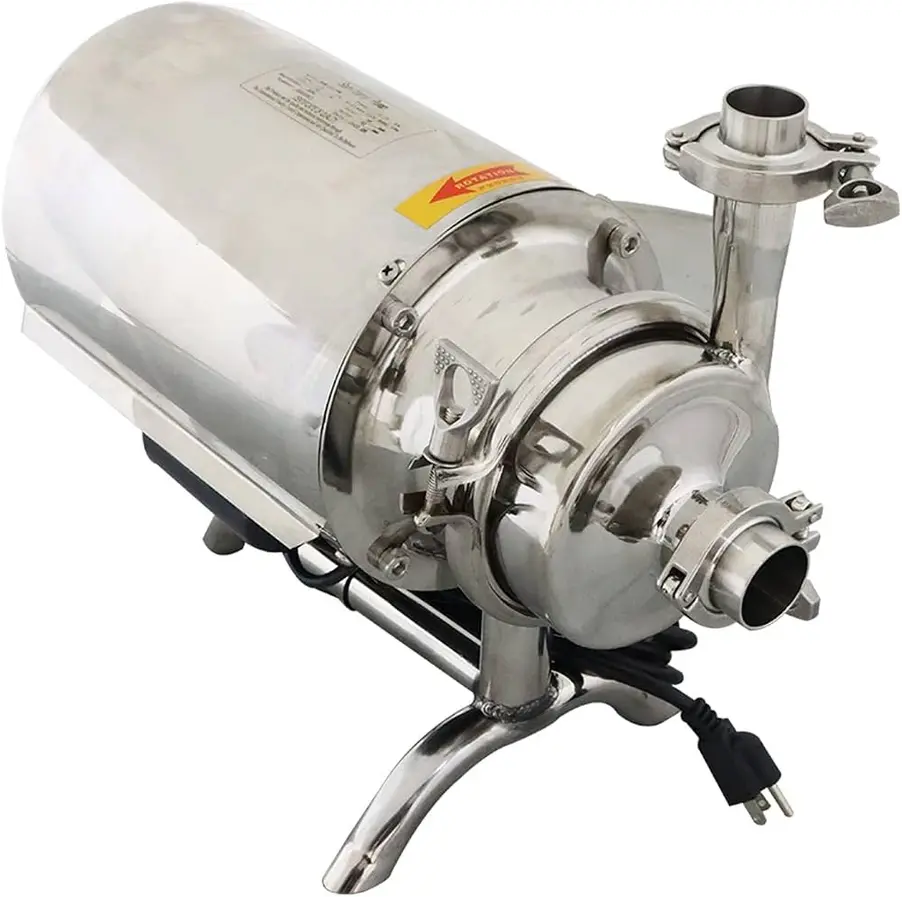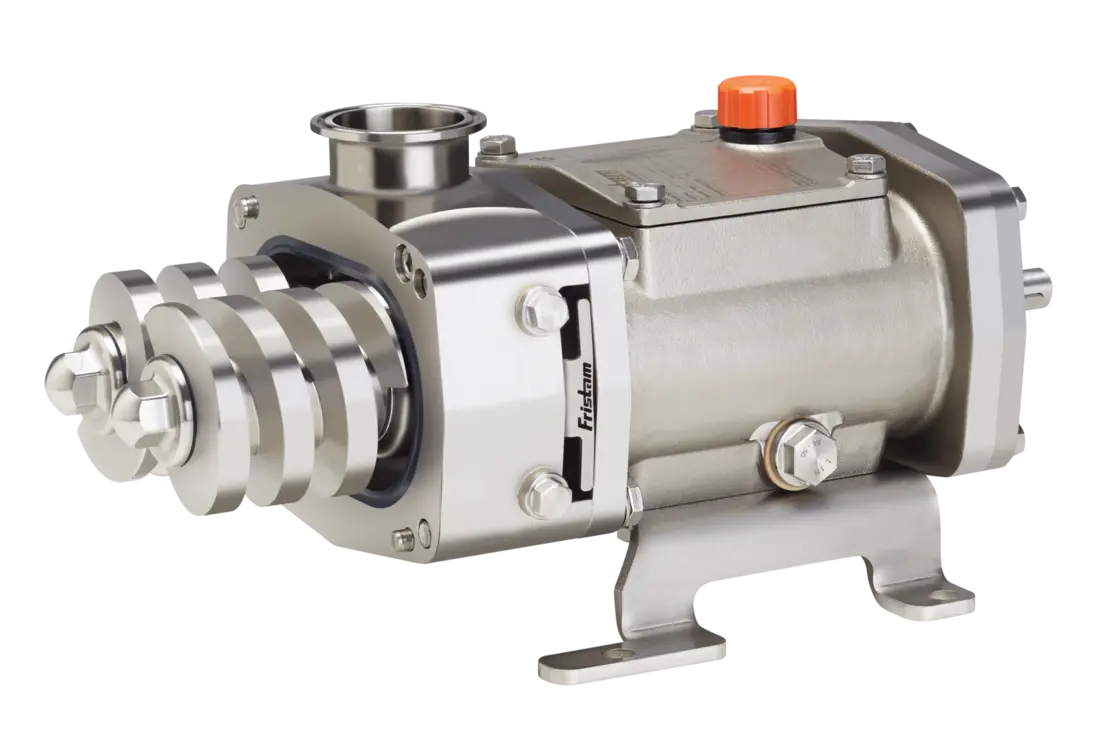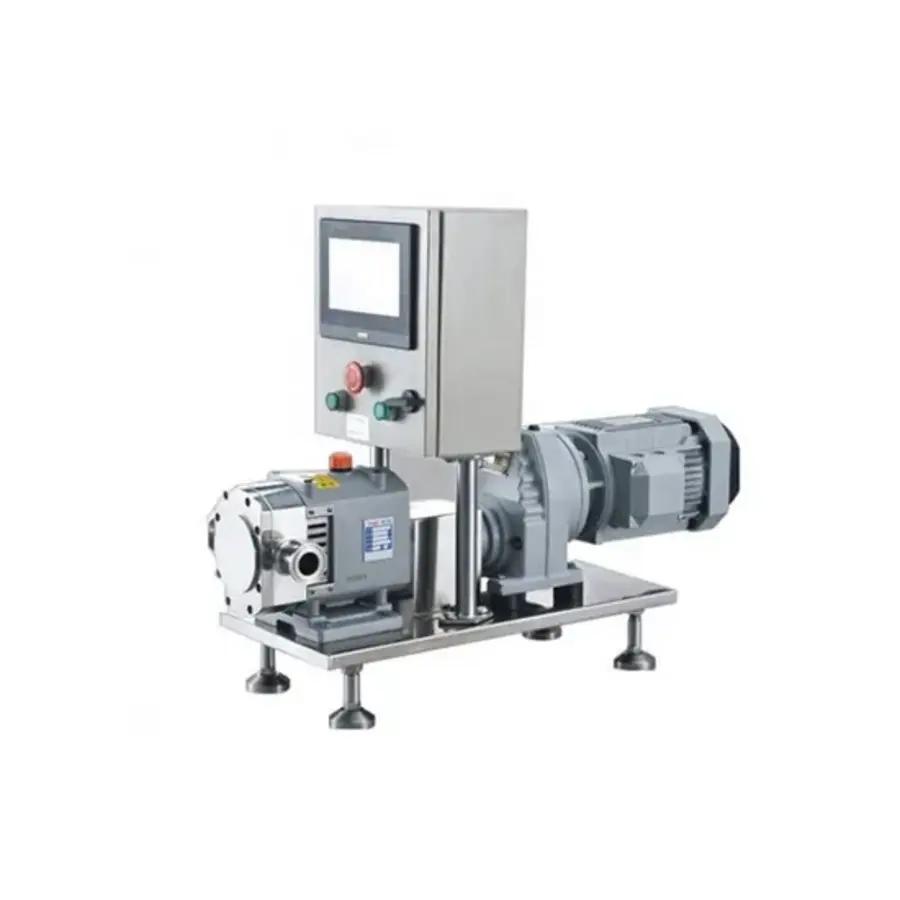
A centrifugal pump is usually the practical choice for high-volume transfer of thin, water-like food liquids in a relatively stable piping system. A positive displacement (PD) pump is usually the better choice for thick products, variable backpressure, controlled low-flow transfer, and products that may be damaged by aggressive pumping. Neither family is universally better: the correct food transfer pump depends on the product, the duty point, the piping system, and the cleaning method.
For a sound centrifugal vs positive displacement pump food processing decision, start with the product at its actual transfer temperature and the full operating range—not just the nominal recipe. Then define required flow, pressure, suction conditions, solids, shear tolerance, cleanability, and controls. A pump supplier can size equipment from that information and verify the selected pump, seals, materials, and relief provisions for the application.
The core operating difference
A sanitary centrifugal pump uses a rotating impeller to add velocity to product. The casing converts part of that velocity into pressure and flow. Its delivered flow changes as system resistance changes. If downstream pressure rises because a valve closes, a filter loads, or a line changes, the operating point moves on the pump curve.
A positive displacement pump repeatedly captures a defined volume and moves it from inlet to outlet. Common sanitary designs include rotary lobe, circumferential piston, twin-screw, progressive cavity, diaphragm, and certain gear pumps. At a given speed, a PD pump delivers a nearly fixed volume per cycle; internal slip means actual output can vary somewhat with pressure, product viscosity, wear, and temperature.
The most important practical distinction is this: a centrifugal pump responds to changing resistance with changing flow, while a PD pump continues to displace product until its drive limit, a relief path, or another control measure intervenes. A PD pump must not be operated against a blocked discharge without properly engineered pressure protection.
Centrifugal and PD pumps compared
| Selection factor | Sanitary centrifugal pump | Positive displacement pump |
|---|---|---|
| Basic action | Impeller adds velocity to liquid | Moving elements trap and displace product volume |
| Best product range | Low-viscosity liquids | Viscous, structured, or difficult-to-move products |
| Flow behavior | Varies with system head | Nearly proportional to pump speed |
| Typical strength | High flow with relatively simple equipment | Controlled transfer at lower flows or higher resistance |
| Viscosity response | Performance generally declines as viscosity rises | Often better suited to increasing viscosity, within design limits |
| Shear potential | Can be significant at high speed or restrictive conditions | Depends strongly on pump design; gentle options are available |
| Solids handling | Depends on impeller, clearance, and solids type | Often better for soft particulates, but capability is design-specific |
| Priming | Standard designs commonly need a flooded suction or priming arrangement | Many designs can self-prime, subject to product and installation conditions |
| Pressure protection | System still needs normal pressure control | A dedicated relief strategy is essential where discharge blockage is possible |
| Maintenance profile | Fewer internal moving components in many designs | More product-contact moving parts, clearances, and wear components to inspect |
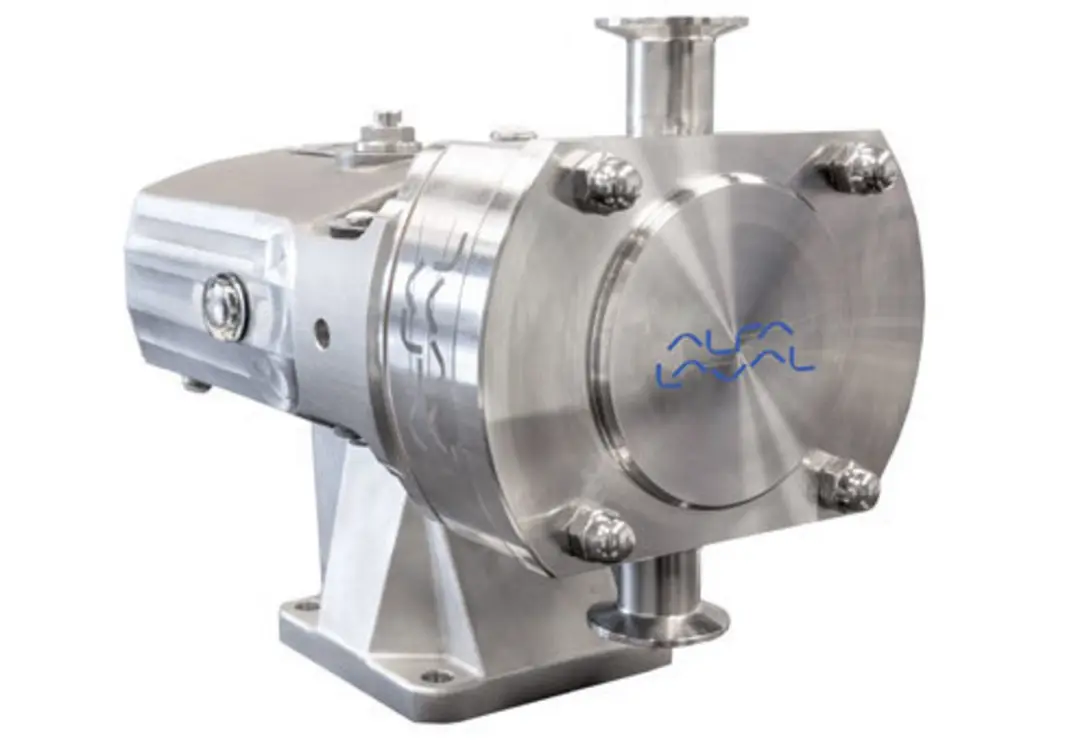
Source: s3.us-east-2.amazonaws
When a sanitary centrifugal pump is the better fit
Choose a centrifugal pump first when the product is thin, the transfer volume is substantial, and the line operates under reasonably consistent conditions. Water, rinse liquid, milk-like products, beverages, brines, and other low-viscosity liquids are common examples, provided the pump is properly designed for the product and process.
Centrifugal pumps are often attractive for these reasons:
- They can move large volumes efficiently in suitable low-viscosity service.
- Their sanitary construction can be relatively simple.
- Variable-frequency drives can provide useful flow adjustment.
- They are often suitable for continuous circulation duties, including process recirculation where the pump curve matches the system.
- Maintenance can be comparatively straightforward because many designs have fewer internal product-contact moving parts than PD pumps.
However, “water-like product” is not enough information to complete selection. A beverage with entrained gas, a liquid prone to foaming, a product transferred near a phase change, or a system with a long suction line may need more careful review. Centrifugal pumps can also suffer loss of performance when operating far from their intended duty point or when suction conditions are poor.
When a positive displacement pump is the better fit
A positive displacement pump for viscous food is often appropriate when product consistency makes centrifugal transfer inefficient or unpredictable. Typical examples include syrups, sauces, cream fillings, chocolate, nut pastes, dough-like mixtures, concentrated fruit preparations, and products containing soft inclusions.
PD pumps are also valuable where flow must be predictable at low rates. Because output is closely related to pump speed, they can support controlled transfer, portion-feed duties, and applications where changing line pressure would otherwise cause unacceptable flow variation.
The PD category is broad. Selecting “a PD pump” is only the start of the decision:
- Rotary lobe pumps are widely used in sanitary processing for transfer of viscous and shear-sensitive products. Their suitability for particulates depends on lobe geometry, clearances, speed, and the nature of the solids.
- Twin-screw pumps can be useful where wide viscosity variation, low pulsation, gentle handling, or process and cleaning flexibility are priorities.
- Progressive cavity pumps can provide smooth, controlled movement of very viscous products, but stator compatibility, wear, and cleaning arrangements require close attention.
- Diaphragm pumps may suit certain difficult, viscous, or solids-containing applications, but pulsation, air supply where applicable, and hygienic design details must be evaluated.
- Gear-style pumps can provide accurate, repeatable transfer for some viscous products, although solids tolerance and shear characteristics must be confirmed.
Do not assume that every PD pump is low shear. Product damage can result from tight clearances, high speed, pressure drop, recirculation, pumping temperature, or the particular pumping mechanism. Ask the manufacturer to assess the actual product and expected operating conditions.
Viscosity: evaluate the product as pumped
Viscosity is often the first decision screen, but it is not a fixed recipe value. It can change substantially with product temperature, solids concentration, batch variation, shear history, and hold time. A sauce that flows easily from a warm kettle may be much more difficult to transfer after cooling in a line or tote.
For centrifugal pumps, higher viscosity usually reduces flow and hydraulic efficiency. For PD pumps, greater viscosity can reduce internal slip and improve volumetric performance, but it can also increase required torque, suction losses, and pressure. The motor, gearbox, coupling, shaft, seals, piping, and pressure-protection system must all be suitable for the worst credible operating case.
Provide the pump supplier with the expected minimum, normal, and maximum viscosity, along with the product temperature range. If laboratory viscosity data do not represent real production behavior, a product trial or representative test may be warranted.
Flow, pressure, and line resistance
Define flow as a range rather than one target number. The maximum rate may be needed to empty a vessel on schedule; the minimum rate may be needed to feed a filler, depositor, heat exchanger, or blending step without disruption. Oklahoma State University’s sanitary pump selection guidance similarly emphasizes defining minimum, maximum, and design flow requirements.
Pressure is not simply the vertical lift. The pump must overcome friction in piping, valves, bends, strainers, heat exchangers, flow meters, filler manifolds, and other downstream restrictions. For PD pumping, pressure can rise rapidly when product is cold, a valve position changes, or a line is obstructed.
For every candidate pump, define:
- Required design flow and allowable operating range
- Static lift and total piping route
- Expected downstream pressure and possible maximum resistance
- Piping diameter and major restrictions
- Suction vessel level and pump elevation
- Whether the pump starts flooded, dry, or after line drainage
- Future line extensions or additional process equipment
A PD pump requires a suitably designed pressure-relief approach. Depending on the system, this may include an integrated relief device, an external relief valve, a bypass route, drive controls, instrumentation, and interlocks. The discharge piping, valves, clamps, hoses, and connected equipment must also be rated and configured for the intended service. Have a qualified engineer or pump manufacturer review the complete protection arrangement; a relief device is not a substitute for correct process design.
Shear, aeration, and solids
Product quality may determine pump selection even when viscosity alone suggests either option. Delicate fruit pieces, cooked vegetables, cultured products, emulsions, whipped products, and products with controlled particle size can all react differently to a pump.
Assess shear in the complete system, not just the pump. High line velocity, restrictive valves, narrow passages, long recirculation periods, and a throttled control valve can affect product texture and appearance. A slower PD pump with suitable internal geometry may be gentler than a centrifugal pump in one duty, but a poorly chosen PD design can still damage product.
For solids-containing products, document particle size range, concentration, firmness, shape, and acceptable breakage. “Handles solids” is too broad for procurement. A pump that moves soft fruit pieces may not handle hard seeds, fibrous material, meat pieces, or abrasive particulates under the same conditions.
Sanitary design and cleaning requirements
Food-grade pump selection includes far more than stainless steel construction. The product-contact design must suit the plant’s cleaning method, product risk, allergen-changeover needs, and maintenance practices.
Ask these questions before specifying a pump:
- Can the pump be cleaned in place under the plant’s validated cleaning procedure?
- Are all product-contact materials compatible with the product and the planned cleaning chemicals?
- Does the selected seal arrangement suit temperature, pressure, product stickiness, and dry-running risk?
- Are there drainability concerns in the installed orientation?
- Can operators inspect and replace wear parts without creating excessive downtime or reassembly error?
- Does the pump have product-contact crevices, dead areas, or clearances that require special cleaning attention?
- Will the pump be used across allergen-containing and non-allergen products, and what cleaning verification is required?
Cleaning parameters, sanitation acceptance criteria, chemical compatibility, and any applicable regulatory or customer requirements should be confirmed with the equipment manufacturer and the plant’s food-safety team. Do not rely on a generic claim that a pump is “CIP capable” without verifying the specific model, installation, cleaning circuit, and validation approach.
Common selection mistakes
Choosing by viscosity alone
Viscosity is decisive, but it does not replace analysis of shear, solids, suction conditions, pressure, and cleaning. Two products with similar measured viscosity may behave very differently in a pump.
Sizing only for today’s normal transfer
A pump selected only for average production can be undersized for cold starts, higher-solids batches, future capacity, or longer pipe runs. Conversely, excessive pump capacity can force throttling, overheating, or difficult control.
Treating a PD pump like a centrifugal pump
A centrifugal pump may tolerate a closed discharge briefly in some arrangements, although this is not generally a desirable operating condition. A PD pump can continue building pressure against a closed outlet. Specify relief protection and operating safeguards from the start.
Ignoring the suction side
A pump cannot compensate for an undersized suction line, restrictive inlet valve, poorly vented tank, excessive lift, or product that does not readily flow to the inlet. Suction problems can cause unstable flow, noise, cavitation-like damage mechanisms, air entrainment, or loss of prime depending on pump type and application.
Selecting a “sanitary” pump without reviewing cleanability
Sanitary connections alone do not prove that the full assembly is appropriate for the plant’s cleaning and changeover requirements. Seals, drain points, bypasses, instruments, and installation orientation matter.
Practical pump specification checklist
Before requesting quotations or trials, prepare a short application sheet containing:
- Product name, ingredients relevant to pump compatibility, and batch-to-batch variation.
- Minimum, normal, and maximum product temperature at the pump inlet.
- Minimum, normal, and maximum viscosity, including how it was measured.
- Particle or inclusion details, if applicable.
- Product sensitivity to shear, aeration, pulsation, or heating.
- Required minimum, normal, and maximum flow rates.
- Normal and maximum discharge pressure, plus downstream equipment details.
- Suction conditions, vessel arrangement, pipe size, pipe length, and available product head.
- Required operating schedule, including continuous operation, intermittent transfer, or frequent starts.
- Cleaning method, chemical compatibility requirements, changeover needs, and drainability expectations.
- Required instrumentation and controls, such as variable speed, pressure monitoring, flow measurement, or dry-run protection.
- Utility, electrical, space, maintenance-access, and noise constraints.
The practical selection rule
Use a sanitary centrifugal pump when the duty is primarily high-flow transfer of low-viscosity liquid through a stable system. Move toward a positive displacement pump when product is viscous, flow must remain controlled as backpressure changes, solids or delicate texture require a purpose-designed pumping method, or suction conditions favor a self-priming PD design.
The final choice should be based on a pump curve or PD performance data matched to the actual system, plus confirmation of hygienic construction, cleanability, seal selection, pressure protection, and product quality requirements. In food processing, the best pump is the one that transfers the product reliably without compromising throughput, cleanability, or the product itself.
References
- Centrifugal Pumps vs. Sanitary Diaphragm Pumps: Food and Beverage Applications. (n.d.). https://blog.unibloctech.com/centrifugal-pumps-vs.-sanitary-diaphragm-pumps-food-and-beverage-applications
- Sanitary Pump Selection | Oklahoma State University. (n.d.). https://extension.okstate.edu/fact-sheets/sanitary-pump-selection
- -Noticias sobre el SECTOR INDUSTRIAL | Q-Pumps. (n.d.). https://www.q-pumps.com/noticias/positive-displacement-pump-vs-centrifugal-pump-key-differences-for-sanitary-industries
- What’s the Difference Between a Positive Displacement Pump vs. Centrifugal Pump?. (n.d.). https://www.aspumps.com/blog/positive-displacement-pump-vs-centrifugal-pump
- Guide to Pump Selection for Food & Beverage Processing. (n.d.). https://blog.craneengineering.net/guide-to-pump-selection-for-food-and-beverage-processing
- Centrifugal Pumps vs Positive Displacement Pumps. (n.d.). https://denverpumps.com/understanding-the-differences-between-centrifugal-and-positive-displacement-pumps
- Centrifugal vs. Positive Displacement Pumps - Lakeside Equipment Corporation. (n.d.). https://www.lakeside-equipment.com/centrifugal-pumps-vs-positive-displacement-pumps
- Differences between Centrifugal Pump and Positive Displacement Pump | inverter.com. (n.d.). https://www.inverter.com/differences-between-centrifugal-pump-and-positive-displacement-pump