Easy-open food packaging tear problems usually come from a mismatch between the film’s tear behavior and the opening feature intended to control it. A notch may be too shallow, misplaced, or inconsistent; a laminate may resist tearing or tear sideways; a seal may be too wide or too strong to separate cleanly. Machine tension, web alignment, and converting variation can make the same package open differently from one production batch to another.
The fastest way to diagnose a package that will not open is to separate the failure into two questions: can the consumer start the tear at the intended point, and does the tear continue along the intended path? Starting failures usually point to the notch, score, seal edge, or grip area. Propagation failures more often point to film structure, orientation, seal geometry, or distortion introduced during pouch making and filling.
Identify the opening failure before changing the line
Collect unopened samples from the affected lot and record exactly how they fail. Do not rely only on a general complaint such as “peel here packaging not opening.” Ask operators, customer-service teams, or test users to classify the outcome.
| Observed symptom | Likely cause category | First checks |
|---|---|---|
| Consumer cannot begin a tear | Notch shape or depth, score depth, inaccessible grip area, thick seal | Inspect notch and score position; compare opening force across samples |
| Tear starts but stops quickly | Tough laminate, inadequate score, seal crossing the tear path | Check film structure and score continuity; inspect seal profile |
| Tear runs sideways into the pouch body | Film orientation, uneven notch, asymmetrical pull, weak directional control | Compare tear direction in machine and cross directions; inspect notch registration |
| Pouch tears through the seal or leaks | Notch too deep, score too aggressive, seal edge too close | Check residual material at notch or score; inspect seal integrity |
| Opening varies from pouch to pouch | Converting variation, web wander, die wear, tension variation, registration drift | Compare samples across reel width, reel length, and production time |
| Package opens only with excessive force | Film construction changed, seal strength changed, incorrect line settings | Confirm approved material and seal setup; review recent changeovers |
A useful first test is simple: open samples manually in a consistent way, using the same grip position and pull direction. Compare pouches from the beginning, middle, and end of a roll, and from both web edges where practical. Variation by roll position often suggests a converting, registration, or tension issue rather than a fundamental package-design issue.
Film structure determines whether a tear can propagate
Flexible film does not automatically tear in a straight line. Multi-layer packaging is selected primarily for barrier, sealing, stiffness, printability, and puncture resistance. Those properties may conflict with easy tearing.
Many films have directional behavior created during manufacture. A film may split more readily in one direction than another, while a laminate containing several layers can resist, deflect, or branch a tear. If the intended tear path does not align with the structure’s preferred propagation direction, a consumer may pull hard without getting a clean opening.
Common film-related causes include:
- High-toughness layers: Barrier or puncture-resistant layers can prevent tear propagation after the notch initiates a small crack.
- Layer imbalance: One layer may stretch while another begins to fracture, producing a jagged or wandering tear.
- Orientation mismatch: The pouch design may ask the film to tear across a direction in which it is relatively strong.
- Material substitutions: A revised gauge, resin, adhesive, coating, or barrier layer can change opening behavior even if the finished pouch looks unchanged.
- Print and coating effects: Surface treatments and coatings can influence crack initiation or make a score less consistent if the feature was developed for a different construction.
When investigating a suspected film problem, obtain the approved material specification and compare it with the current roll documentation. Confirm the film construction, orientation, thickness range, and any approved alternates. A visual check alone cannot verify that a substitute material will perform like the original.
Tear-notch design affects initiation, not just appearance
A tear notch is a deliberate stress concentrator. It should create a reliable place for the tear to begin while leaving enough material to protect the pouch during conversion, distribution, and handling. Tear-notches are commonly placed just below a pouch’s top seal, where opening can also provide visible evidence that the sealed pack has been accessed.
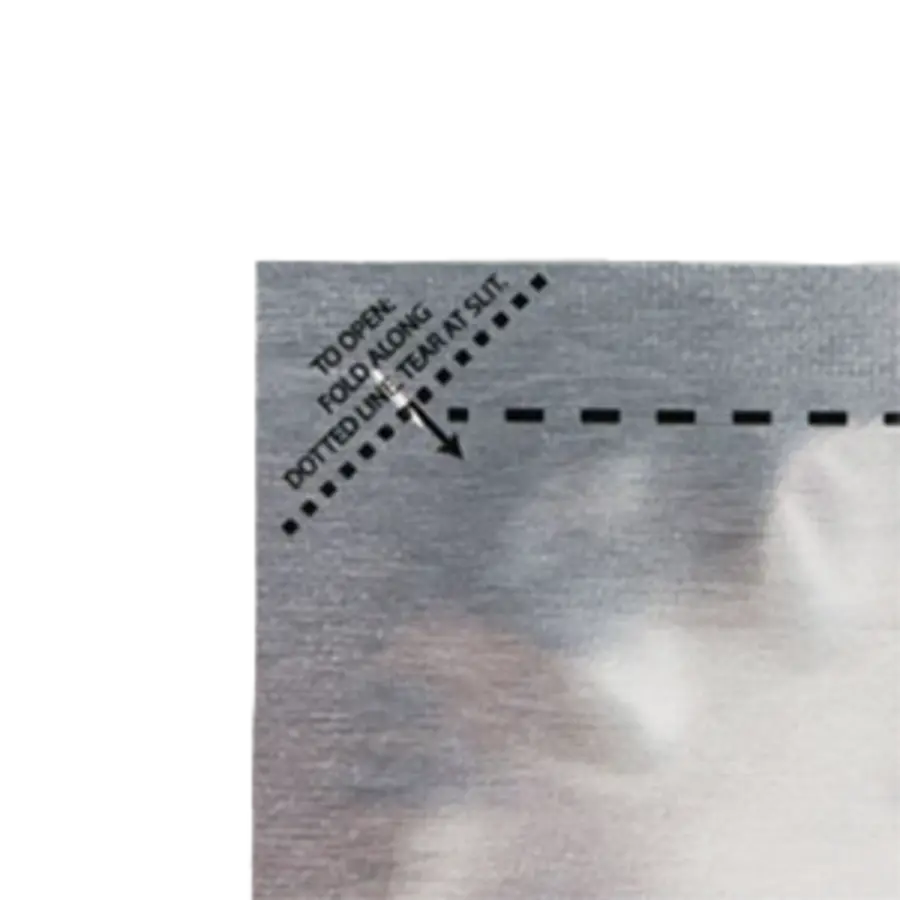
Source: impakcorporation
A notch that is too shallow may not concentrate stress sufficiently. A notch that is too deep can reduce package strength or allow the tear to enter a seal in an uncontrolled way. Position is equally important. If the notch is too close to the seal, the seal can dominate the tear behavior. If it is too far below the intended opening line, the consumer may remove too much of the pouch or struggle to reach the product.
Check these variables systematically:
Notch geometry and condition
Inspect whether the notch has a clean, repeatable profile. A worn punch, damaged blade, or poor cut can leave rounded edges, burrs, crushed material, or uneven depth. These defects can make opening inconsistent even when nominal notch dimensions are unchanged.
Registration to seals and graphics
The notch must be registered to the actual pouch structure, not only to printed artwork. Web drift or pouch-length variation can shift the notch relative to the top seal and intended tear line. If printed “tear here” instructions no longer align with the physical opening feature, consumers may pull from the wrong location.
One-sided versus two-sided initiation
A single notch can work when the film and pouch geometry support a predictable tear. Two-sided notches can provide a more balanced start on some thicker or more technical laminations, but they do not solve an unsuitable film structure. Evaluate them as a package-system change, including transport and seal-integrity testing.
Laser scoring can improve control, but it requires process discipline
Laser scoring creates a deliberately weakened line in the film. It can be used to guide a straight tear, define a peel-away panel, or make an opening feature less dependent on the film’s natural tear direction. Industry descriptions of laser scoring emphasize controlled location and depth as the central advantage; the score must weaken the opening path without compromising the rest of the package.
A score is not simply a deeper cut. If it removes too much material, the package can become vulnerable to pinholes, handling damage, or premature rupture. If it is too shallow or inconsistent, consumers may still be unable to complete the tear. A score may also perform differently after flexing, filling, sealing, distribution, or storage.
For scored easy-open pouch packaging, inspect:
- score location relative to seals, gussets, zipper profiles, and product fill level;
- continuity of the score across the intended tear path;
- variation across web width and throughout the roll;
- whether score depth is appropriate for the current laminate, not only a prior material version;
- opening performance after the normal packaging and distribution sequence.
Laser scoring can be registered to print and applied in either web direction depending on package design. However, it should be validated with the actual production material and final pouch geometry. A controlled score cannot compensate for a seal layout that blocks the opening path.
Seal geometry and machine setup can make an opening feature fail
The opening feature interacts directly with the pouch seal. Excessive seal width, seal encroachment into the tear path, uneven jaw pressure, and unstable film tracking can all change how the pack opens.
On a form-fill-seal line, inspect the package at several stages rather than only after discharge. Watch for web wander, wrinkling, skew, and intermittent registration movement. If the film is pulled unevenly through the machine, the notch or score may be displaced relative to the finished seal.
Pay particular attention to these setup conditions:
- Web tension: Excess tension can stretch or distort the web; insufficient tension can allow wandering, wrinkles, and registration errors.
- Dancer and unwind stability: Fluctuating unwind behavior can affect web tracking and feature registration.
- Seal-jaw alignment: Misalignment can produce uneven seal geometry and shift the practical opening boundary.
- Temperature, pressure, and dwell settings: These must be established for the specific material. Changing settings to solve leaks or wrinkles may unintentionally make an easy-open area harder to tear.
- Fill placement: Product trapped near the upper seal or opening area can alter seal shape and create local stress points.
- Changeover controls: Incorrect film orientation, recipe selection, or registration settings can turn a previously validated design into a difficult-open pack.
Do not reduce seal settings or deepen a notch as a quick fix without checking package integrity. Easy opening and reliable protection must be evaluated together.
A practical validation sequence
Use a controlled sequence before making a permanent design or machine adjustment.
- Retain and label samples. Keep affected packs by date, machine, reel, lane, operator shift, and position within the roll where possible.
- Inspect the physical feature. Compare notch or score position, shape, and condition against an approved reference sample.
- Check material identity. Verify the supplied laminate and film orientation against the approved specification.
- Map opening performance. Open samples from multiple web positions and production times. Record start failure, tear direction, stopping, seal rupture, and opening force impressions.
- Review machine conditions. Compare tension, tracking, registration, sealing settings, and changeover records with the validated setup.
- Run a limited trial. Change one variable at a time, then inspect both opening behavior and package integrity.
- Document acceptance criteria. Define what a clean, accessible opening looks like and how many samples must meet that standard before release.
When to involve the converter or equipment supplier
Escalate early when the failure follows a film change, occurs across multiple machines, varies by reel or web position, or involves a scored structure. The converter may need to review laminate construction, score settings, notch tooling, and registration controls. The packaging-machine supplier or qualified technician may need to assess web handling, registration sensing, jaw alignment, or tension-control behavior.
Stop and contain affected production if the opening feature appears to weaken the package enough to create seal failures, product exposure, or damage during normal handling. Any corrective action should preserve the package’s required barrier and seal performance as well as consumer usability.
Preventing recurring easy-open failures
The most reliable approach is to treat easy opening as a package-system requirement rather than an artwork detail. Specify the intended opening direction, consumer grip location, tear initiation feature, acceptable tear path, and package-integrity requirements during development. Maintain a retained approved sample and include opening checks in incoming-film, startup, and changeover routines.
A tear notch can provide a practical opening start, while laser scoring can offer more directional control where the laminate and application justify it. Neither feature works consistently unless film behavior, seal geometry, converting quality, and machine registration are aligned. When those elements are checked in a structured order, most easy-open food packaging tear problems can be traced to a specific and correctable cause.
References
- What Is Laser Scoring for Flexible Packaging - Yo Den. (n.d.). https://www.yodentw.com/what-is-laser-scoring-for-flexible-packaging
- The moment your customer struggles to open your packaging …. (n.d.). https://www.instagram.com/reel/Da0f2wEsyCF
- What Is a Tear Notch? Meaning, Types & Placement | INNORHINO. (n.d.). https://innorhino.com/blog/packaging-guide/tear-notch-packaging-explained
- Tear at Notch Packaging: Everything You Need to Know | ePac Flexibles. (n.d.). https://epacflexibles.com/tear-notch-packaging
- Satisfying tear when food packaging opens easily. (n.d.). https://www.facebook.com/groups/chefmemes/posts/1228907435384416
- Laser Scoring Creates Easy-Open Packs. (n.d.). https://www.packagingdigest.com/flexible-packaging/laser-scoring-creates-easy-open-packs
- Laser-Scored Pouches Easy-Open Packaging | C-P Flexible Packaging. (n.d.). https://www.cpflexpack.com/products/premade-pouches/laser-scored-pouches-easy-open-packaging
- A Practical Guide to Tear at Notch Packaging: 5 Key …. (n.d.). https://www.beyinpacking.com/tear-notch-packaging-guide