A practical electrical preventive maintenance program for a food plant should do more than schedule panel cleaning. It should identify which electrical and control failures can stop production, create unsafe conditions, compromise a process control point, or damage expensive equipment, then assign the right inspection and testing method to each risk.
For most plants, the best approach separates work into three categories: safe de-energized inspection and cleaning, qualified energized testing and measurement, and controls-data management such as PLC backups and battery replacement. This structure helps maintenance planners build useful PMs without treating every electrical cabinet, sensor, or distribution component as if it has the same failure modes.
Start with a risk-based asset list
Electrical preventive maintenance for food manufacturing begins with an asset hierarchy. A PM route organized only by building area can miss dependencies: a single power supply, network switch, safety relay, or refrigeration control panel may affect several pieces of equipment.
List electrical and automation assets under each process area, including:
- Main distribution equipment, disconnects, motor control centers, and local panels
- PLCs, remote I/O racks, industrial network hardware, HMIs, and control power supplies
- Variable-frequency drives, soft starters, servo drives, and motion-control cabinets
- Machine safety devices and safety control components
- Sensors, switches, transmitters, solenoid valves, actuators, and junction boxes
- Panel air conditioners, filters, fans, heaters, and enclosure drains where installed
- Critical refrigeration, compressed-air, water, wastewater, and utility controls
Then assign a criticality level. Consider production loss, safety consequences, food-quality consequences, availability of a manual fallback, spare-part lead time, operating environment, and history of failure. A packaging-line photoeye may be easy to replace, while a controller managing a thermal process, refrigeration system, or central CIP utility may require stronger backup and verification routines.
Do not use a calendar alone to set PM frequency. Wet environments, washdown exposure, vibration, heat, frequent changeovers, and high switching cycles can justify more frequent attention than a similar device in a dry, low-use area. Use failure history and inspection findings to refine intervals over time.
Define what may be done de-energized and what requires qualified energized work
A strong food plant controls maintenance program makes electrical safety part of planning rather than an afterthought. The work order should state whether the task is visual only, requires a planned shutdown and isolation, or requires energized diagnostic work by qualified personnel under the plant’s electrical safety program.
De-energized work commonly includes inspecting enclosure condition, looking for contamination or corrosion, checking labels, examining accessible wiring and cable support, cleaning as permitted by the equipment manufacturer, replacing approved filters, and confirming that unused openings are sealed.
Energized activities may include voltage checks, load measurements, thermographic inspection, power-quality monitoring, and troubleshooting intermittent faults. These tasks should not be added casually to a general PM route. They require appropriate planning, hazard assessment, procedures, tools, and qualified personnel. The applicable electrical code, workplace electrical-safety requirements, equipment instructions, and site rules should be verified for the plant and jurisdiction.
Never use a PM task to normalize energized work that could reasonably be completed during a scheduled outage.
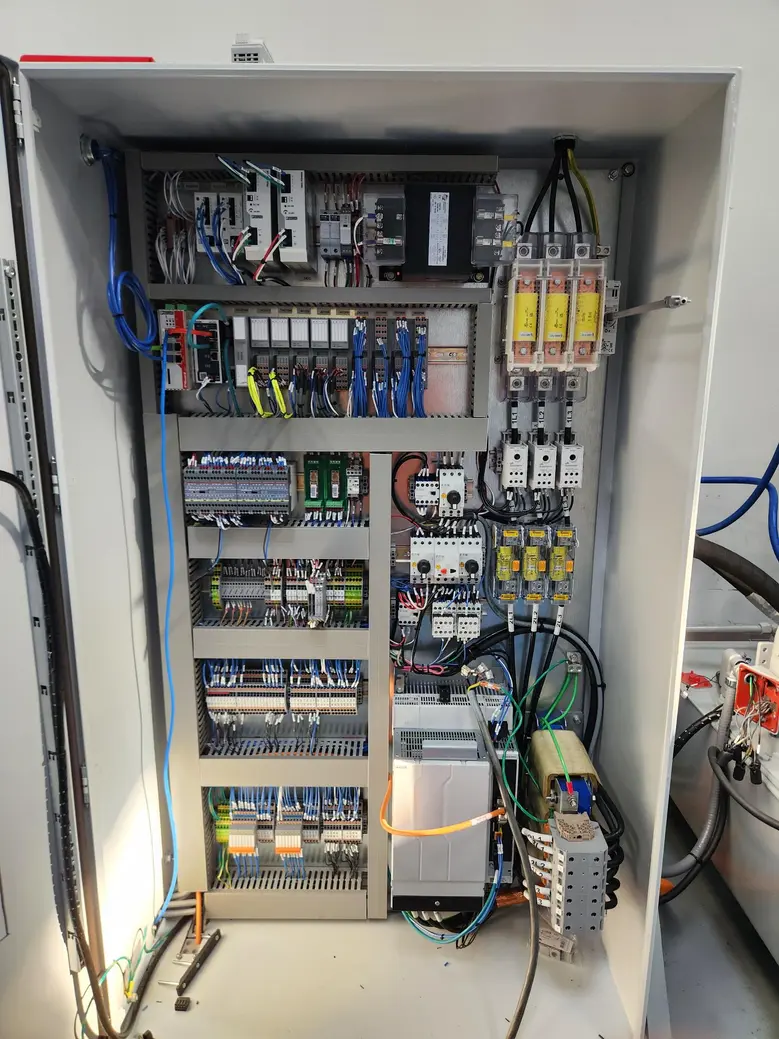
Inspect PLC panels as operating environments, not just cabinets
A PLC can be healthy while its enclosure is slowly becoming unsuitable for reliable operation. PLC panel preventive maintenance should therefore assess the complete environment around the controller, not simply whether indicator lights are on.
Source: airlinestatic.nyc3.cdn.digitaloceanspaces
During a planned de-energized inspection, check the following conditions:
Enclosure integrity
Look for damaged door gaskets, loose latches, cracked viewing windows, unsealed conduit entries, missing hole plugs, and corrosion around seams or fasteners. In food facilities, water, humidity, cleaning chemicals, dust, and product debris can enter through small defects. Note the location and likely source rather than simply replacing a gasket and closing the work order.
Verify that enclosure type and installation remain suitable for the actual area. A panel originally located in a dry space may become exposed after a process change, a modified sanitation practice, or a line rearrangement.
Heat and panel cooling
Check filters, fan guards, air paths, heat exchangers, air conditioners, and cabinet heaters where fitted. Look for blocked airflow, dirty components, unusual noise, water ingress, condensate issues, and signs of repeated high temperature.
Do not assume that adding a fan solves a heat problem. High ambient temperature, undersized enclosure cooling, loaded drives, poor spacing, failed ventilation, and changes in panel contents can each contribute. Compare observed conditions with component and enclosure manufacturer requirements before changing cooling equipment.
Wiring, terminals, and labeling
Inspect for discolored insulation, damaged cable jackets, loose wire duct covers, unsupported conductors, bent terminal hardware, missing end stops, unmarked field wiring, and obsolete jumpers. Check that wire numbers, terminal labels, breaker labels, and drawings match the installed condition closely enough for safe troubleshooting.
Terminal tightening is often included in industrial control panel inspection programs, but it must be performed using the equipment manufacturer’s specified method and torque requirements. Randomly retightening every connection can create damage, mask a problem, or disturb sensitive equipment. Where thermal evidence, vibration, or failure history indicates concern, plan targeted verification.
Contamination and moisture
Record dust, oil film, insect activity, corrosion residue, condensation, or washdown evidence. Cleaning methods matter. Compressed air can push debris deeper into components, while unsuitable liquids or solvents can damage labels, plastics, coatings, and electronics. Follow equipment manufacturer instructions and the site’s sanitation and electrical procedures.
Manage PLC programs, batteries, and spare hardware deliberately
A control system is not maintainable if its current program and configuration cannot be restored after a hardware failure. PLC backup maintenance should be a controlled process, not an occasional file copy stored on one technician’s laptop.
For every critical PLC or controller, maintain:
- A current backup of the application program and configuration
- The programming software version and required licenses or access method
- Network settings, drive parameters, HMI files, and managed switch configurations where relevant
- A record of hardware model numbers, firmware versions, and installed option cards
- A documented restore procedure and responsible owner
- Controlled storage with access appropriate to the plant’s cybersecurity practices
Backups should be updated after approved changes and periodically checked for readability. For high-consequence systems, a planned recovery exercise can reveal missing passwords, incompatible software, undocumented settings, or unavailable cables before a real failure occurs.
PLC battery backup maintenance deserves its own work instruction. Batteries may support memory retention, clock functions, or other controller-specific features, but the consequence of battery depletion varies by platform and configuration. Verify the controller documentation, replacement procedure, expected warning behavior, whether power must remain applied during replacement, and the correct approved battery. Record the replacement date, battery part number, and any diagnostic messages found.
Avoid replacing batteries solely by habit without confirming the controller’s actual need. Conversely, do not ignore battery alarms because the machine still runs. An alarm may indicate a future recovery risk rather than an immediate production failure.
Review power quality and control power on critical equipment
Power quality problems often appear as intermittent PLC faults, communication loss, unexplained drive trips, HMI restarts, sensor instability, or premature power-supply failure. They are easy to misdiagnose because a handheld voltage check may look normal after the event has passed.
For critical or repeatedly troublesome assets, have qualified personnel evaluate:
- Control voltage stability and power-supply loading
- Signs of voltage sag, interruption, transient events, or phase imbalance where applicable
- Grounding and bonding condition according to the facility design and applicable requirements
- Heat at electrical connections through appropriate inspection methods
- Harmonic effects or other power-quality concerns associated with drives and nonlinear loads
- Separation and routing of power and sensitive signal wiring
Use event logs and production history to target testing. For example, if multiple devices restart when a large motor starts, investigate the shared supply and distribution path rather than replacing controllers one at a time. If faults occur only during washdown, inspect enclosure integrity, connections, and local devices before assuming a software issue.
Verify field devices at the process level
Field devices are where clean control logic meets the real production environment. A sensor can be electrically functional but operationally unreliable because of poor mounting, product buildup, vibration, cable damage, misalignment, or an unsuitable sensing principle.
A field-device PM should confirm both physical condition and functional response. Depending on the device and process, this may include checking sensor alignment, mounting security, target condition, cable strain relief, connector seals, actuator travel, valve response, and signal plausibility in the PLC or HMI.
For instruments tied to product quality, utilities, safety, or regulated process records, use the plant’s approved calibration or verification method. Acceptance criteria, test equipment, calibration intervals, and documentation requirements should be defined by the responsible engineering, quality, and regulatory teams. A maintenance technician should not alter a setpoint, scale, alarm limit, or safety function simply to clear a recurring fault.
Build PM routes that produce usable findings
A food plant electrical PM checklist should create evidence that supports action. “Inspect panel” is too broad. A better task states the asset, condition to examine, acceptable condition, method, required safety state, and escalation path.
| PM area | Useful task focus | Typical finding to record |
|---|---|---|
| Control enclosure | Inspect seals, entries, cooling path, contamination, and corrosion | Damaged gasket near washdown side; filter loaded; moisture marks present |
| PLC and HMI | Review diagnostics, backup status, alarms, and battery condition | Battery warning active; program backup out of date; recurring communication fault |
| Power and distribution | Inspect condition and conduct qualified testing as planned | Heat indication at connection; unexplained voltage event; label discrepancy |
| Drives and motors | Check cooling, contamination, fault history, and connections | Fan failure; repeated overload trip; dust accumulation in cabinet |
| Sensors and actuators | Verify mounting, protection, response, and signal plausibility | Photoeye misaligned; damaged connector seal; slow valve response |
| Documentation | Compare drawings, labels, and installed changes | Unmarked field modification; obsolete schematic; missing spare identification |
Use standardized condition codes and attach photos where allowed. Repeat findings such as condensation, dirty filters, nuisance trips, or broken connectors should be trended. A recurring defect is often an engineering or environmental problem, not a technician-performance problem.
Common mistakes to avoid
The most common mistake is making controls PM a cleaning exercise. Clean cabinets matter, but cleaning alone will not identify poor power, missing backups, heat stress, weak field-device mounting, or undocumented changes.
Other avoidable problems include:
- Combining unrelated tasks into one oversized annual shutdown work order
- Assigning electrical diagnostic work to personnel without the required qualifications
- Treating every alarm as a component failure instead of reviewing trends and event timing
- Storing the only PLC backup on a machine or personal computer
- Replacing sensors repeatedly without correcting contamination, alignment, vibration, or cable-routing issues
- Ignoring panel modifications that invalidate drawings, labeling, cooling calculations, or enclosure protection
- Closing PM work orders without documenting defects, corrective work, or follow-up responsibility
A practical rollout sequence
Start with the highest-risk production and utility systems rather than trying to create detailed PMs for every panel at once. Inventory critical assets, collect drawings and program backups, inspect enclosure condition, review available fault history, and identify obvious single points of failure.
Next, write separate job plans for de-energized inspections, qualified energized diagnostics, backup verification, and field-device checks. Pilot the plans on one production area, estimate labor realistically, and improve instructions based on technician feedback.
Finally, use the findings to improve the system. If several cabinets need frequent filter replacement, review the surrounding air quality and cooling design. If controllers repeatedly lose communication, investigate network architecture, cable routing, grounding, and power events. If field sensors fail after sanitation, review equipment suitability, mounting, connector protection, and the approved cleaning process with the appropriate plant teams.
The goal is not a larger PM library. It is a maintenance program that detects degradation early, protects recoverability after a controls failure, and gives planners reliable information for shutdown scope, spares decisions, and corrective projects.
References
- Preventive Electrical Maintenance for Food Manufacturing. (n.d.). https://jbbelec.co.uk/resources/preventive-electrical-maintenance-for-food-manufacturing
- Food Manufacturing Electrical System Maintenance Checklist. (n.d.). https://oxmaint.com/industries/food-manufacturing/food-manufacturing-electrical-system-maintenance-checklist
- Preventive Electrical Maintenance for Manufacturing Facilities. (n.d.). https://hreconstruction.com/blogs/f/preventive-electrical-maintenance-for-manufacturing-facilities
- Preventive Maintenance for Electrical and Controls : r/PLC - Reddit. (n.d.). https://www.reddit.com/r/PLC/comments/18me8jb/preventive_maintenance_for_electrical_and_controls
- Creating a Maintenance Strategy for Industrial Control Panels. (n.d.). https://tavoron.com/resources/blog/creating-a-maintenance-strategy-for-industrial-control-panels
- The Role of Preventive Maintenance in the Food Industry | Tractian. (n.d.). https://tractian.com/en/blog/preventive-maintenance-food-industry
- Electrical Preventive Maintenance Best Practices | ATS. (n.d.). https://www.advancedtech.com/blog/electrical-preventive-maintenance
- Food Plant Electrical System Safety Inspection Checklist. (n.d.). https://ifactoryapp.com/industries/food-manufacturing/food-plant-electrical-system-safety-inspection-checklist