An energy efficient food sterilization machine is not simply the retort with the lowest quoted utility use or the largest advertised savings percentage. The better choice is the system that delivers the required validated process for your actual containers, product mix, loading pattern, and production schedule while using the least steam, water, electricity, and cooling utility per accepted unit of output.
To compare systems fairly, ask each supplier for a complete, documented cycle-utility model and then normalize the results by usable production output. Separate the process itself from startup, standby, cleaning, reject, and cooling demands. A claim such as “uses less energy” is not actionable unless it states the product, package, process, load, utilities, operating assumptions, and measurement boundary behind the claim.
Start with a common comparison basis
Retort energy consumption is affected by much more than the vessel design. Product viscosity, container material and size, headspace, fill weight, required thermal process, load arrangement, initial product temperature, and cooling-water temperature can all change the utility requirement and cycle length.
Before requesting proposals, create one representative operating case for all suppliers to use. It should define:
- Product and package formats to be processed
- Target fill weights and package dimensions
- Basket, crate, tray, or pallet configuration
- Required production rate and operating shifts
- Expected batch size and typical load utilization
- Product temperature at retort entry
- Available steam pressure and condensate-return arrangement
- Available cooling-water source, temperature range, and disposal or recirculation arrangement
- Electrical supply and compressed-air availability where relevant
- Expected product changeovers and sanitation requirements
Also identify whether the machine will run mostly at full load or regularly process partial loads. A retort that performs well on a fully loaded demonstration cycle may be less efficient in a plant where frequent short runs or mixed schedules create substantial idle time.
Compare utility intensity, not percentage-saving claims
The core calculation is utility use divided by accepted output. Depending on your internal accounting, output can be expressed as accepted containers, cases, kilograms, pounds, or another consistent unit. Compare each utility separately before combining them into a cost model.
| Utility or measure | What to request | Why it matters |
|---|---|---|
| Steam | Steam mass per complete cycle and per unit of accepted output | Shows heating demand, venting losses, warm-up losses, and potential heat-recovery value |
| Water | Process, cooling, and makeup water per cycle and per unit output | Distinguishes once-through cooling from recirculated or recovered water systems |
| Electricity | Electricity per cycle, by major load where possible | Captures pumps, circulation, controls, conveyors, air compressors, and cooling equipment |
| Cooling demand | Cooling-water flow, temperature conditions, and heat rejection basis | Cooling can shift costs to towers, chillers, wastewater, or municipal supply |
| Cycle time | Full door-to-door cycle time, including loading and unloading assumptions | A shorter validated cycle may improve throughput and reduce idle utility use |
| Throughput | Net accepted output per hour or shift | Prevents a low-use batch from appearing efficient when it produces less saleable product |
| Standby demand | Utilities used while the machine is ready but not processing | Important for intermittent production and frequent schedule gaps |
Do not accept a single combined “energy per batch” figure without supporting data. A low-energy batch could simply be smaller, lighter, or run under different cooling conditions. Likewise, a lower steam figure may be offset by higher electricity use for pumps, compressed air, or a separate cooling system.
Define the measurement boundary
A supplier may report utility use at the retort connection, while your plant pays for energy upstream at the boiler house, refrigeration system, cooling tower, water-treatment system, and wastewater plant. Both views are useful, but they answer different questions.
For a practical purchase decision, request two boundaries:
- Machine boundary: Utility demand at the equipment connection points, including stated auxiliaries.
- Plant boundary: Estimated site utility demand, including applicable boiler, cooling, water-treatment, and heat-rejection effects.
The supplier may not be able to model every plant-side loss accurately. That is acceptable if assumptions are transparent. Your engineering or utilities team can then apply site-specific factors, fuel costs, water charges, sewer charges, and electrical tariffs.
Understand where a retort uses energy and water
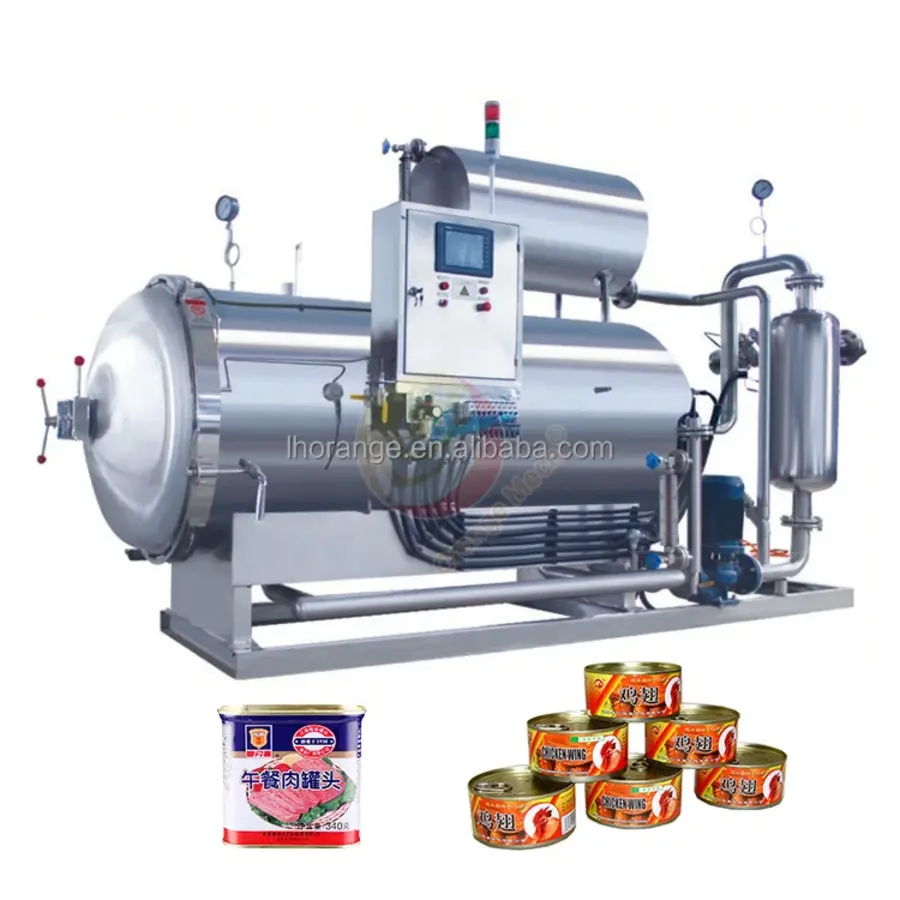
In a batch retort, utility demand typically arises during vessel heat-up, air removal or venting where applicable, process holding, cooling, pressure control, and post-cycle readiness. The exact pattern depends on whether the system uses saturated steam, steam-air, water immersion, water spray, cascading water, or another approved thermal-processing approach.
Steam systems can be operationally straightforward, but steam quality, air removal, condensate management, and venting are process-critical matters, not optional energy-saving opportunities. Applicable requirements for thermally processed commercially sterile products include provisions addressing air removal, venting documentation, and condensate removal. Any proposed reduction in venting, draining, come-up procedures, or other process functions must be evaluated and approved through the appropriate process authority and regulatory framework; it should never be treated as a simple utility optimization.
Water-based systems may consume electricity for recirculation pumps and may require significant cooling water. Their potential advantage can depend on package type, overpressure needs, water-reuse arrangement, and how effectively the system recovers or recirculates heat and water.
Ask how heat recovery actually works
Heat recovery can reduce net site energy demand, but its value depends on where recovered heat goes and whether that receiving demand exists when the retort operates.
Useful supplier questions include:
- What stream provides the recoverable heat: condensate, hot process water, exhaust, or another source?
- What is the expected temperature range of the recovered stream?
- What equipment is included: heat exchanger, storage tank, controls, pumps, filtration, and instrumentation?
- Is recovered heat reused within the retort cycle or exported to another process?
- What receiving load is assumed, and how often is it available?
- How will fouling, maintenance, and sanitation requirements affect performance?
- Is the stated recovery value based on a full production schedule or an individual cycle?
A heat-recovery package can be valuable, but only if it matches the plant’s operating profile. For example, heat sent to a wash-water loop has limited value if the wash system does not need heat during retort production. Treat recoverable heat as a separate line item from guaranteed reductions in purchased steam or fuel.
Compare cycle time carefully
Cycle time influences both capacity and efficiency, but the shortest cycle is not automatically the best selection. The relevant figure is a complete, validated operating cycle, including loading, door closure, heat-up, process control, cooling, depressurization where applicable, unloading, and preparation for the next load.
Ask suppliers to break the cycle into stages rather than providing one total number. This reveals whether a claimed improvement comes from mechanical automation, faster loading, reduced heat-up losses, different cooling assumptions, or an altered process condition that requires review by the scheduled process authority.
For each machine, compare:
- Average cycle duration at the defined product condition
- Number of cycles achievable per staffed shift
- Time between batches when production is continuous
- Time needed for format changeovers
- Utility use during warm-up and after prolonged idle periods
- Output losses from damaged packages, handling issues, or rework
A machine with moderately higher energy per cycle may have lower energy per accepted unit if it handles more product reliably or reduces idle periods between batches.
Evaluate automation as an operating-efficiency feature
Automation does not automatically reduce energy use, but it can reduce variability. Consistent fill, loading, recipe selection, valve sequencing, water management, and cycle timing may prevent unnecessary reprocessing, excessive hold periods, and avoidable utility use.
Request a clear description of what the control system records and what is available for export. At a minimum, useful records may include cycle identification, recipe selection, stage timing, relevant temperatures and pressures, alarms, utility meter inputs, and operator actions. The required records and controls must be determined by the applicable regulations and your process authority, not by a generic machine specification.
For energy management, prefer equipment that can accept or provide verified signals from steam, water, electricity, and cooling meters. Without metering, a plant often has no practical way to distinguish machine performance from changes in product mix, boiler operation, or seasonal cooling conditions.
Build a total-cost model from site data
Once comparable utility data is available, convert it into an annual operating model. Use your own utility rates and expected operating hours rather than a supplier’s generic cost assumptions.
Include:
- Fuel or purchased steam cost
- Electricity cost, including demand charges where relevant
- Water supply and wastewater charges
- Cooling tower, chiller, or heat-rejection cost
- Water-treatment chemicals and blowdown implications where applicable
- Labor associated with loading, unloading, and monitoring
- Maintenance needs for pumps, valves, seals, heat exchangers, and controls
- Lost production from long changeovers, downtime, or limited vessel availability
A food processing energy audit is especially helpful when replacing older retorts. Meter the existing process over representative production periods, then divide consumption by accepted output for each major product family. This establishes a baseline that reflects actual plant behavior rather than nameplate assumptions.
Questions to ask every supplier
Use the same written questionnaire for each bidder. It should request evidence, assumptions, and exclusions rather than broad assurances.
- What utility use is predicted for the defined product, package, load, and cycle?
- Are the values measured, calculated, guaranteed, or estimated from another installation?
- Which utility connections and auxiliary systems are included in the figures?
- What conditions are assumed for steam, cooling water, incoming product, and ambient environment?
- How are startup, warm-up, standby, partial-load, and changeover conditions treated?
- What metering is supplied as standard, and where are measurement points located?
- What heat-recovery equipment is included, and what receiving load is assumed?
- What maintenance tasks are required to preserve water, steam, and pumping performance?
- Can the supplier provide operating data from a comparable application, with enough context to assess relevance?
- Which process parameters must be confirmed by the processor’s process authority before production use?
Common selection mistakes
The most common error is comparing utility use per cycle without comparing net output. Other frequent mistakes include accepting savings percentages without a baseline, overlooking cooling and wastewater costs, assuming nominal capacity equals actual shift output, and treating reduced process time as automatically acceptable.
Another mistake is buying a technically efficient retort that does not fit the production schedule. A highly insulated vessel and efficient recirculation system may offer limited benefit if the line spends much of the day waiting for packaging, operators, or upstream cooking equipment. Look at the entire production cell, including material handling and downstream cooling or packing constraints.
A practical decision rule
Select the thermal sterilization system that can document the required process performance and deliver the lowest site-relevant utility cost per accepted unit under your real operating conditions. Require transparent cycle data, define the utility boundary, measure the installed system after commissioning, and keep food-safety process requirements separate from routine energy optimization.
That approach gives processors a defensible way to compare retort energy consumption, food sterilizer steam use, retort water consumption, and throughput—without relying on unsupported claims of percentage savings.
References
- Thermal Processing in Food Preservation: A Comprehensive Review of Pasteurization, Sterilization, and Blanching | Auctores. (n.d.). https://auctoresonline.org/article/thermal-processing-in-food-preservation-a-comprehensive-review-of-pasteurization-sterilization-and-blanching
- Strategies to Boost Energy Efficiency in Food Sterilization …. (n.d.). https://ebeammachine.com/strategies-to-boost-energy-efficiency-in-food-sterilization-equipment
- Retort Technology for Ready-to-Eat Products. (n.d.). https://www.retort-sterilizer.com/news.html?id=44261
- eCFR :: 9 CFR Part 431 – Thermally Processed, Commercially Sterile Products. (n.d.). https://www.ecfr.gov/current/title-9/chapter-III/subchapter-E/part-431
- Minimize Energy Use in Autoclave Sterilization. (n.d.). https://eureka.patsnap.com/report-minimize-energy-use-in-autoclave-sterilization-techniques-compared
- Thermal Processing Equipment Guide | Sterilization Solutions …. (n.d.). https://www.innovaster-tech.com/thermal-processing-equipment-guide.html
- Understanding retort processing: A review - PMC. (n.d.). https://pmc.ncbi.nlm.nih.gov/articles/PMC10916645
- Energy Efficiency Measures for Batch Retort Sterilization in …. (n.d.). https://www.researchgate.net/publication/311494785_Energy_Efficiency_Measures_for_Batch_Retort_Sterilization_in_the_Food_Processing_Industry