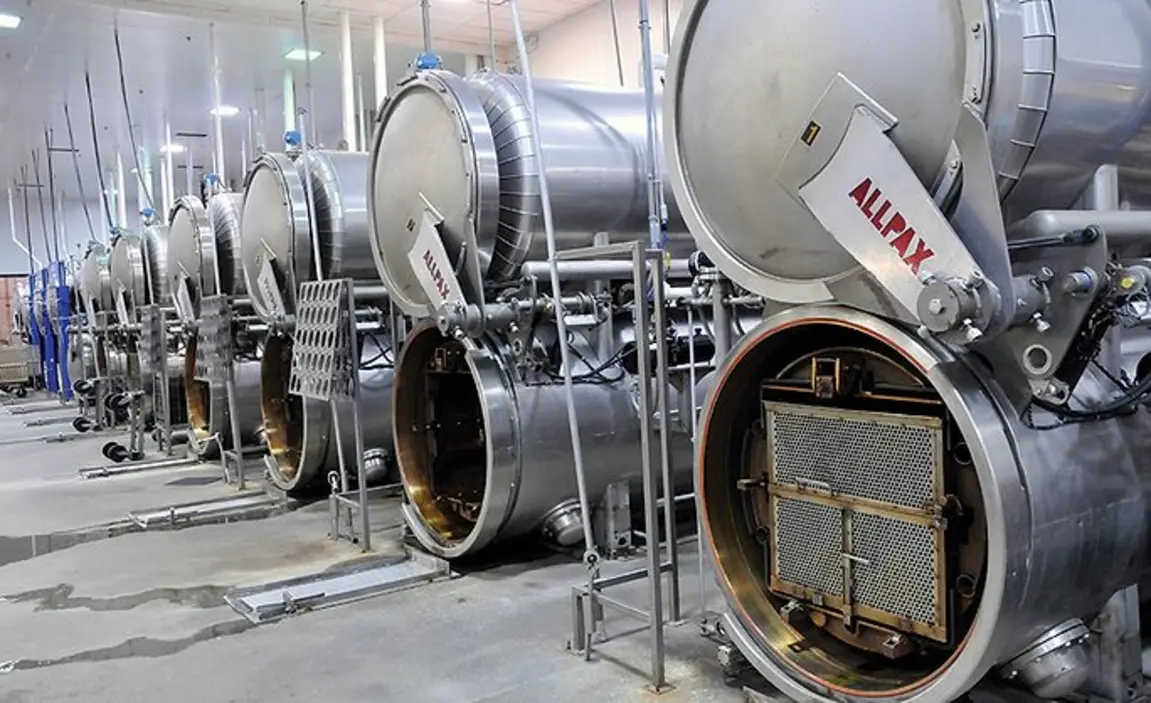
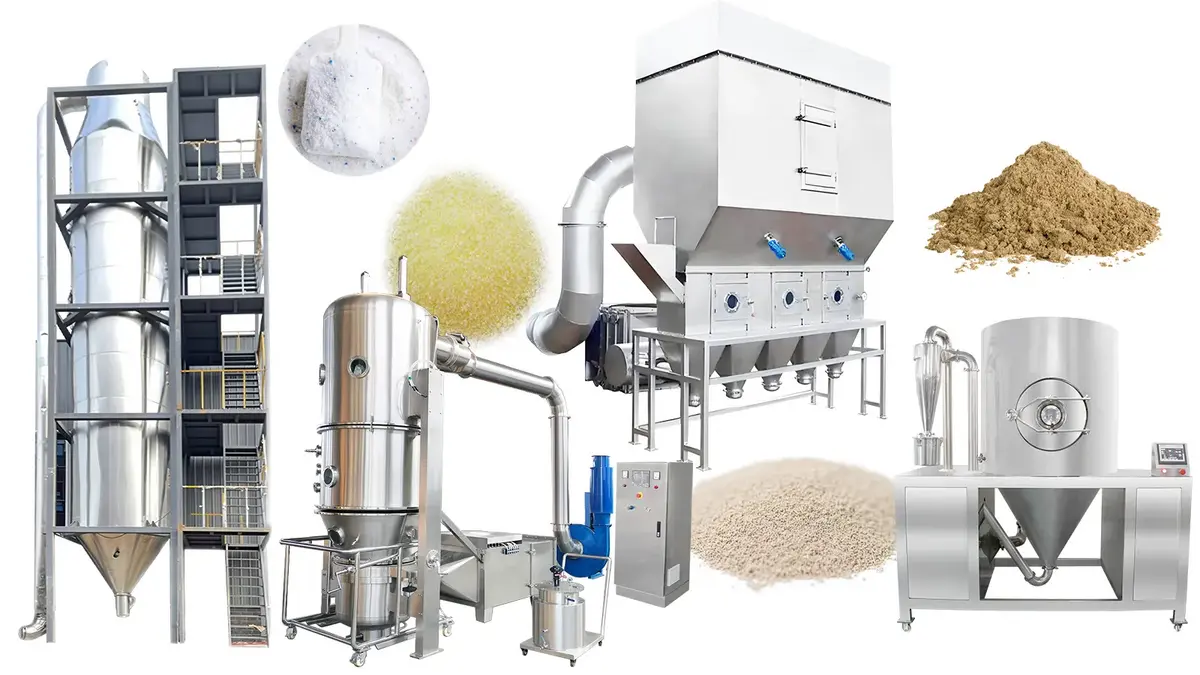
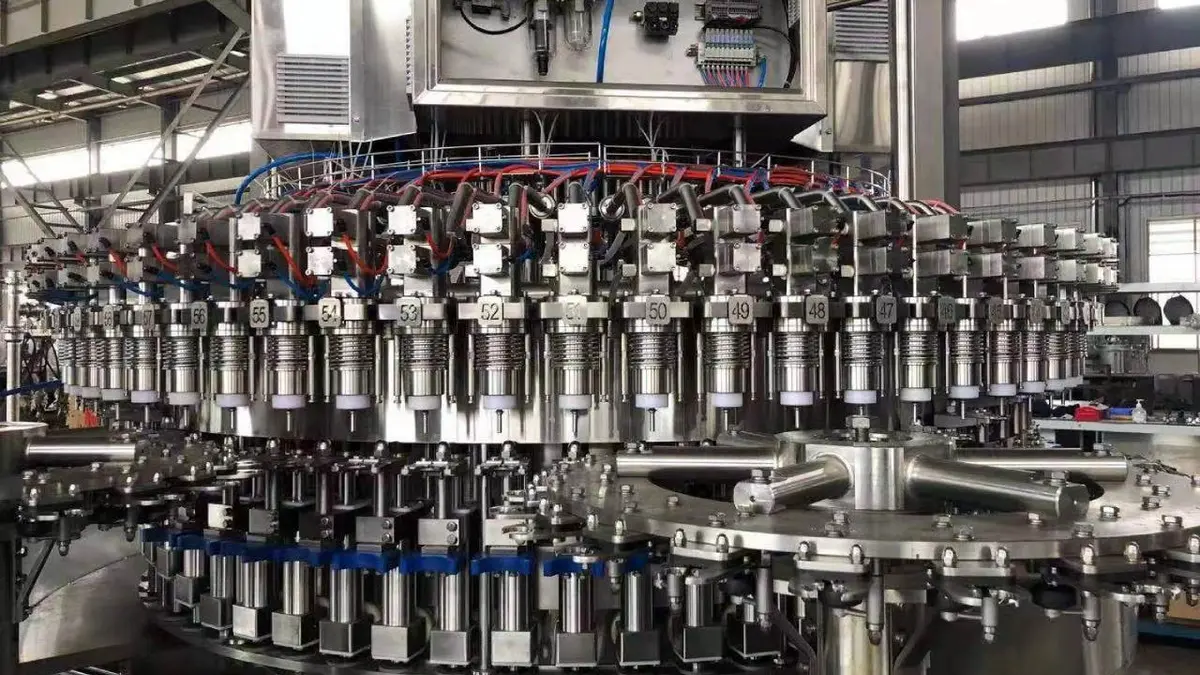
Food and beverage PLC programming is not one control method applied everywhere. A conveyor-fed cartoner may need mostly discrete inputs, outputs, timers, and machine interlocks. A cooker, pasteurizer, fermenter, blending skid, or CIP system may need closed-loop control, recipes, phase logic, records, and coordination across several pieces of equipment.
The practical question is not whether a line should use a PLC. It is which PLC control strategy matches the process risk, product variability, and required operating consistency. Simple logic works well when equipment moves through defined states. PID loops are appropriate when a measured variable must be held near a target. Sequencing and batch control become important when production depends on ordered steps, verified conditions, and repeatable recipes.
The three main control approaches
Most food manufacturing automation controls combine the following approaches rather than selecting only one.
| Control approach | Best suited to | Typical food and beverage examples | Main programming concern |
|---|---|---|---|
| Discrete or simple machine control | On/off devices and repeatable mechanical motion | Conveyors, fillers, case packers, slicers, labelers | Correct states, timing, permissives, and fault handling |
| PID process control | Continuously measured variables that must be regulated | Temperature, flow, pressure, vessel level, mixing speed | Stable response without excessive cycling or overshoot |
| Sequencing and batch control | Ordered operations with product- or recipe-dependent steps | Mixing, cooking, batching, CIP, transfer, changeover | Clear phases, verified transitions, traceable parameters |
A well-designed system may use all three. For example, a sauce line could use discrete logic to operate a transfer conveyor, PID control to regulate jacket temperature, and a sequence to add ingredients, mix, cook, discharge, and prepare for cleaning.
Simple PLC control for packaging and machine automation
Simple control does not mean careless control. It means the production task can be described primarily as a set of discrete conditions: a photoeye sees a package, a cylinder reaches its position, a motor is available, a guard circuit is healthy, or an operator requests a cycle.
This is common in packaging areas, where the PLC runs equipment through defined machine states such as stopped, ready, starting, running, held, faulted, and resetting. Typical logic includes:
- Starting and stopping conveyors or drives.
- Tracking package presence through sensors.
- Controlling pneumatic actuators and motorized mechanisms.
- Coordinating infeed and discharge equipment.
- Rejecting products when an upstream inspection system reports a fault.
- Managing jam detection, low-material warnings, and fault recovery.
- Preventing a downstream machine from starting until it is ready to receive product.
For these applications, the most important design work is often state management and interlocking rather than advanced mathematics. The program should make it clear what conditions permit a machine to start, what causes it to stop, and what must be corrected before it can restart.
Why explicit machine states matter
A packaging machine can appear simple until it must recover from a brief sensor interruption, a depleted carton magazine, or a blocked discharge conveyor. Logic that consists only of scattered start and stop commands can become difficult to troubleshoot.
A state-based approach gives each operating mode a defined purpose. For example, a machine may enter a controlled stop when downstream accumulation reaches a limit, then resume only after the discharge path is available and relevant motion is safely reset. This is usually easier for operators and maintenance teams to understand than a collection of unrelated timer conditions.
Safety functions should be designed and validated separately by qualified personnel using the applicable safety architecture, equipment documentation, and local requirements. Standard PLC logic should not be treated as a substitute for required machine safeguarding or safety-rated controls.
When food processing PID control is the better choice
PID control is used when the PLC must regulate a continuously changing process variable instead of merely switching equipment on or off. PID stands for proportional, integral, and derivative control. In practical terms, the loop compares a measured value with a target setpoint and adjusts an output to reduce the difference.
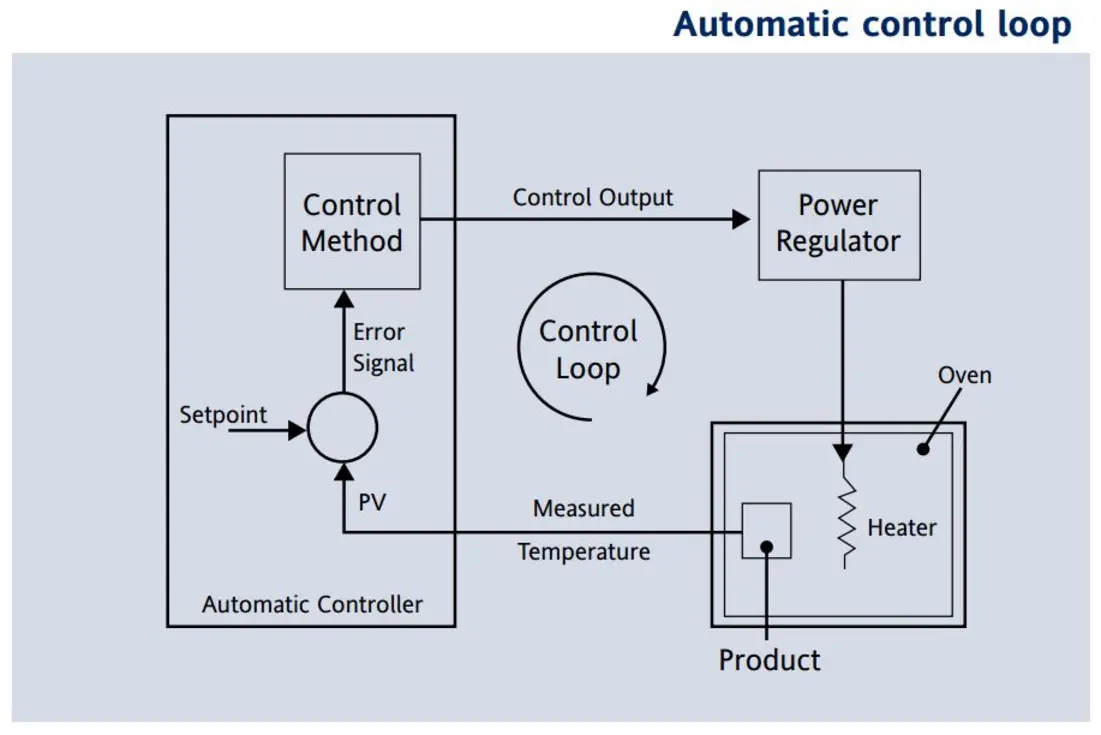
Source: eurotherm
A temperature control loop food processing application might read a vessel temperature from an instrument, compare it with the recipe target, and modulate a steam valve, electric heating output, cooling valve, or related final control element. Similar loops can regulate flow, pressure, tank level, humidity, or mixer speed.
Common PID applications include:
- Heating or cooling product in tanks, kettles, cookers, and heat exchangers.
- Maintaining a target flow rate during transfer, dosing, or filling.
- Controlling vessel pressure where the process requires it.
- Holding liquid level in a balance tank or surge vessel.
- Adjusting agitation or pump speed in response to a process measurement.
- Controlling utility conditions that affect a process, such as heating or cooling media flow.
A PID loop needs a controllable process
PID is not automatically the right answer just because a temperature or level transmitter exists. The process must have a meaningful control action. If a tank heater is either fully on or fully off and the temperature can tolerate a broad operating band, simple on/off control may be adequate. If product quality depends on minimizing variation or the process changes gradually, PID control is more likely to help.
The loop also depends on sound instrumentation and a suitable final control element. A poorly located sensor, an incorrectly sized valve, a sticking actuator, or a pump that cannot respond smoothly can make a well-written PID block perform badly.
Tuning is part of commissioning, not a one-time software setting
PID tuning determines how aggressively the controller reacts to error. Excessive gain can produce oscillation. Slow integral action can leave the process off target for too long. Derivative action can be useful in some processes but may amplify noisy measurements if applied without care.
Controls teams should tune loops against the real process while considering product behavior, equipment response, measurement quality, operating range, and normal disturbances. Changes should be documented and controlled, particularly where the loop supports a product-critical process.
For thermal processes, validated operating limits, sensor requirements, hold conditions, diversion actions, and recordkeeping obligations should come from the processor’s approved process authority, regulatory requirements, and internal food-safety plan. They should not be inferred from generic PLC programming guidance.
PLC sequencing food production steps
Sequencing is used when the order of actions matters. Unlike a packaging machine cycle that repeats quickly, a process sequence may move through longer phases such as fill, heat, mix, hold, cool, transfer, and clean.
A basic sequence has three parts:
- Entry conditions — What must be true before the step begins?
- Actions — What valves, pumps, drives, or controls run during the step?
- Exit conditions — What measured condition, confirmation, or operator action allows the sequence to advance?
Consider a blending tank. A batch process PLC programming structure may require the system to verify that the tank is available, select the recipe, add designated ingredients, run the agitator, control temperature if needed, confirm mixing completion, and authorize discharge. Each phase can have its own permissives, alarms, timing logic, and operator display.
This structure is preferable to a long chain of timer-only logic. Timers may still be used, but important transitions should normally rely on meaningful process confirmations where appropriate, such as a level indication, flow total, valve feedback, motor status, or confirmed temperature condition.
Recipes and batch control: more than stored setpoints
A recipe is often described as a collection of setpoints, but useful recipe management usually includes more than target values. Depending on the process, a recipe may define:
- Ingredient quantities or target totals.
- Temperature, speed, flow, pressure, or level targets.
- Which equipment path to use.
- Mixing, heating, cooling, or hold phases.
- Allowable operator adjustments and authorization levels.
- Product name, batch identifier, and reporting fields.
- Cleaning or changeover requirements between product families.
Recipe management should distinguish between values that operators may adjust during routine production and protected values that require authorized review. That distinction matters where changes could affect product consistency, labeling, allergen management, process validation, or required records.
A batch system also needs a clear response to interruptions. If power is lost or a pump faults during a transfer, the controller should preserve enough state information for qualified personnel to determine whether the batch can resume, requires rework, or must be handled under the plant’s established procedures.
Interlocks, permissives, and alarms
Interlocks prevent incompatible actions. Permissives identify conditions that must be satisfied before an action starts. Alarms communicate abnormal conditions requiring attention. These concepts overlap in daily use, but separating them in the program helps make behavior predictable.
Examples include:
- A pump may be permitted to start only when the selected source and destination path are confirmed.
- A filler may be interlocked from running when a downstream conveyor is unavailable.
- A heating command may require a minimum product level or confirmed circulation, if the equipment and approved process design require it.
- A sequence may pause when an instrument signal is unreliable rather than continuing on an assumed value.
Good alarm design focuses on actionable information. Repeated nuisance alarms encourage operators to ignore messages, while vague messages slow troubleshooting. Each alarm should identify the affected equipment or process condition, its operational consequence, and the appropriate response within the plant’s procedures.
Choosing the right approach for a new or upgraded line
Use this decision framework during project definition:
Use mostly simple control when:
- The operation consists mainly of mechanical movement, indexing, conveying, filling, or packaging.
- Inputs and outputs are primarily discrete.
- Product quality does not depend on tightly regulating a continuously measured variable.
- The main needs are synchronization, fault recovery, and machine availability.
Add PID loops when:
- Temperature, flow, pressure, level, speed, or another analog value must remain near a target.
- The process has meaningful variation that simple on/off switching cannot manage adequately.
- The sensor, actuator, and process response can support stable closed-loop control.
- The target and permitted operating range have been established through the processor’s technical and quality systems.
Use sequencing and batch structures when:
- Production requires a defined order of operations.
- Multiple ingredients, tanks, valves, or process skids must be coordinated.
- Product variants require controlled recipes and changeovers.
- Operators need clear phase status and guided recovery from interruptions.
- Batch records, traceability data, or process-event history are required by the facility’s procedures.
A practical programming architecture
Food and beverage PLC programming is easier to maintain when it separates equipment control from production coordination. A common structure includes device-level blocks for motors, valves, and instruments; equipment modules for a tank, conveyor, or filler; and higher-level sequences or recipes that command those modules.
This approach reduces duplication and makes testing more focused. A valve block can handle feedback, faults, manual control rules, and status in one consistent place. The batch sequence then decides when that valve should open, rather than recreating valve diagnostics inside every recipe step.
The HMI should reflect the same structure. Operators need a clear view of current mode, active step, setpoint, measured value, permissives, alarms, and required actions. Maintenance personnel need diagnostics that identify whether a problem is a sensor, device, communication, sequence condition, or operator command.
The main limitation: control logic cannot correct an undefined process
A PLC can execute a recipe consistently, but it cannot decide whether the recipe is technically valid. It can regulate a temperature, but it cannot compensate for an unsuitable sensor location, poor heat transfer, an uncalibrated instrument, or a process target that has not been properly established.
The strongest automation projects begin with a clear process description: product paths, equipment states, required measurements, operating limits, cleaning and changeover expectations, exception handling, and ownership of recipe changes. From there, simple logic, PID control, and sequencing can be applied where each offers the most value.
For packaging machinery, start with dependable states and interlocks. For continuous process variables, use properly designed and tuned PID loops. For multi-step production and cleaning operations, use explicit phases, verified transitions, and controlled recipe management. That combination gives plant teams a control system that is easier to operate, troubleshoot, and improve.
References
- PLC Programming in the Food and Beverage Industry. (n.d.). https://www.plcdepartment.com/blogs/plcblog/plc-programming-in-the-food-and-beverage-industry
- Quick Guide to Using PLC in Food and Beverage Industry. (n.d.). https://plc-direct.com/blogs/news/quick-guide-to-using-plc-in-food-and-beverage-industry
- PLC Programming for Food Processing - Disruptive Process Solutions丨DPS. (n.d.). https://dpsfoodeng.com/blog/plc-programming-for-food-processing
- Food Processing PLC Programming Guide | Food Automation 2026. (n.d.). https://plcprogramming.io/blog/food-processing-plc-programming-guide
- PLC in Food Processing: Automation and Efficiency - Blog Crouzet. (n.d.). https://blog.crouzet.com/industry/plc-in-food-processing-automation-and-efficiency
- Process Control for Food and Beverage | Eurotherm. (n.d.). https://www.eurotherm.com/food-and-beverage-cpg/process-control
- Which PLC Is Better for Your Process Control Needs? - RealPars. (n.d.). https://www.realpars.com/blog/right-plc-for-process-control
- How do PLCs work in food processing industries? - CoNet. (n.d.). https://conet.nl/news/process-it/how-do-plcs-work-in-food-processing-industries