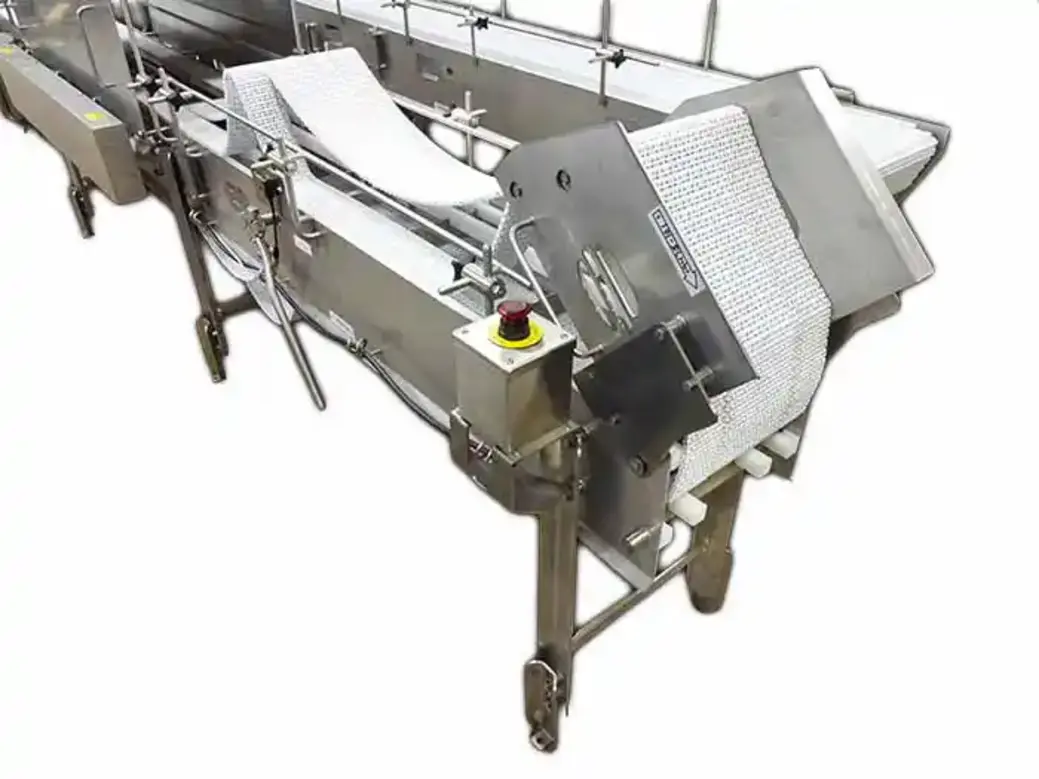
Cleaning and sanitizing are separate jobs. Cleaning removes food residue, fats, proteins, mineral deposits, and other soil from food-contact equipment. Sanitizing follows cleaning and reduces microorganisms on a clean surface to an appropriate level. A sanitizer cannot reliably work through product buildup, detergent residue, or inaccessible deposits.
For food contact equipment cleaning and sanitizing chemicals, the practical selection rule is simple: choose the cleaner for the soil, choose the sanitizer for the validated food-contact application, and control both exactly as the supplier label, site sanitation procedure, and applicable regulations require. Do not assume that a household cleaner, alcohol, vinegar, or a chemical used elsewhere in the plant is suitable for a food-contact surface.
Start with the correct sanitation sequence
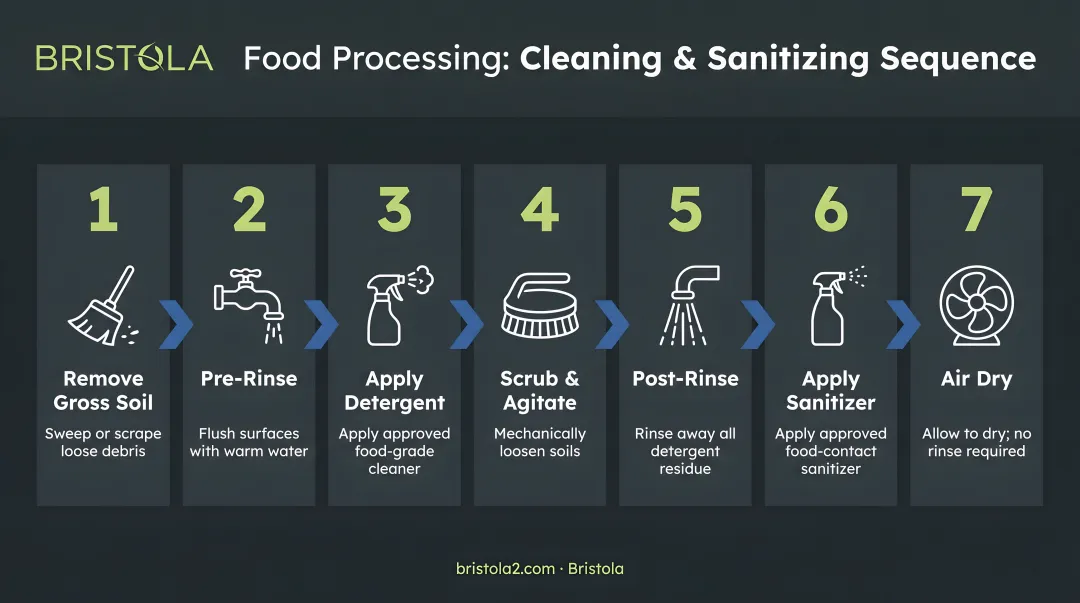
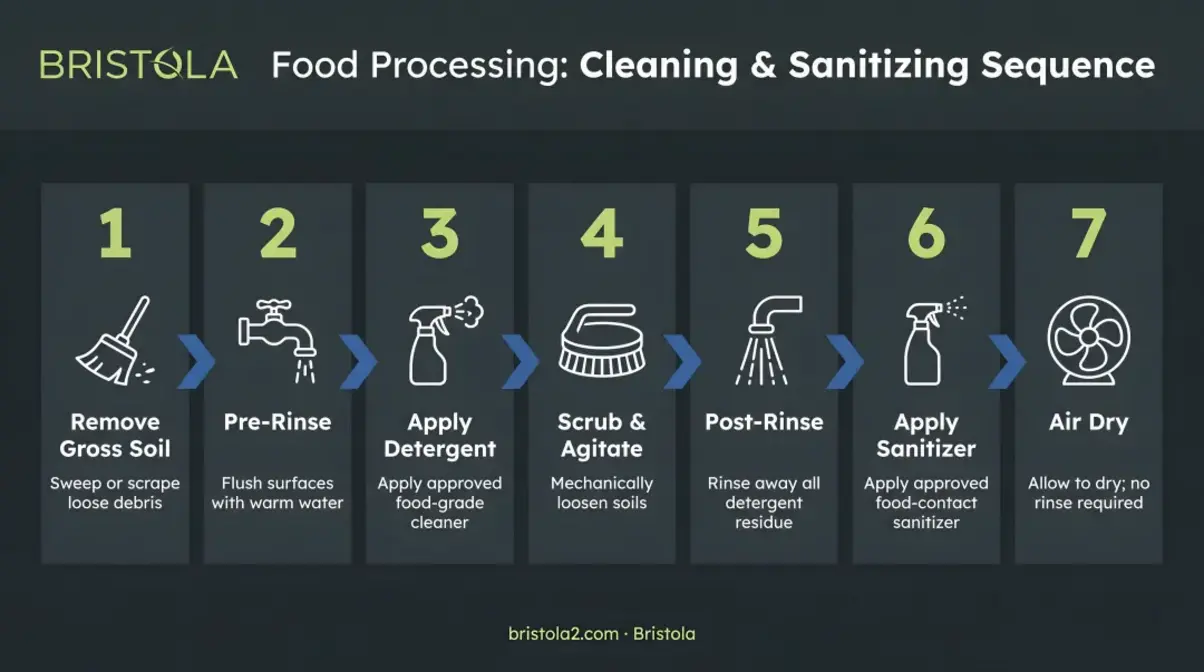
A typical food-contact sanitation procedure follows this order:
- Remove gross debris. Empty product, scrape where appropriate, and disassemble equipment according to the approved procedure.
- Pre-rinse or pre-flush. Remove loose and soluble soil without setting protein soils or spreading residues into protected areas.
- Clean with the selected detergent. Use the specified mechanical action, circulation, foam, brush, spray, or soak method.
- Rinse as required. Remove loosened soil and detergent residues before sanitizing.
- Inspect. Check product-contact zones, seals, guards, valves, dead ends, and other difficult-to-clean locations.
- Apply sanitizer. Use the approved concentration, temperature range, contact time, and application method stated in the product instructions and site procedure.
- Drain and dry where required. Avoid recontaminating cleaned equipment during reassembly or storage.
The University of Florida guidance describes cleaning as complete soil removal under recommended detergent conditions. It also cites a food-contact sanitizing benchmark of a 99.999% reduction in contamination in 30 seconds. That benchmark does not replace a chemical product label or plant-specific validation. The approved label directions and the facility’s written sanitation program determine how a particular sanitizer must be used.
Source: file-host.link
Cleaning versus sanitizing food equipment
| Activity | Main purpose | Typical chemistry | Key control question |
|---|---|---|---|
| Cleaning | Remove soil that can shelter microorganisms or interfere with sanitation | Alkaline, acid, neutral, enzymatic, or specialty detergents | Does the chemistry match the soil, water, surface, and cleaning method? |
| Rinsing | Remove dissolved soil and cleaner residues | Potable or otherwise approved process water | Is the surface free of detergent carryover before sanitizing? |
| Sanitizing | Reduce microorganisms on an already clean food-contact surface | Approved chemical sanitizer or heat process | Is the sanitizer used at its labeled concentration and contact time? |
| Disinfecting | Higher-level microbial control for defined applications | Product-specific disinfectants | Is this application appropriate for the zone and approved by the site program? |
A visual check matters, but appearance alone is not proof of effective cleaning. Films can remain inside fillers, nozzles, pipework, belt undersides, valve seats, gaskets, threads, and poorly drained areas. Conversely, a sanitizer may leave a surface looking clean while failing to deliver the intended microbial reduction because soil remained in place.
Select the cleaner by soil and equipment
The cleaner should be selected for the material to be removed, not by habit or brand preference. Product type, water quality, cleaning method, and equipment construction all affect the choice.
Organic soils: fats, proteins, and carbohydrates
Alkaline detergents are commonly used against many organic food soils. They can be effective on fats and protein residues when used under the specified conditions. Their usefulness depends on concentration, temperature, circulation or scrubbing action, and time. Strong alkaline products can present material-compatibility and worker-safety concerns, so the procedure must identify suitable equipment materials, personal protective equipment, mixing controls, and rinse requirements.
Mineral scale and stone
Acid detergents are used where mineral deposits develop, including deposits associated with hard water or certain dairy and beverage processes. The supplied research notes that acid cleaning is often used sequentially with alkaline cleaning and can help remove mineral stone films. Acid selection must consider stainless steel grade, elastomers, seals, coatings, and nearby metals. Never substitute an acid cleaner into a system without an approved procedure.
Mixed or difficult soils
Some products leave a combination of fats, proteins, sugars, starches, and mineral deposits. In these cases, a single detergent may not be enough. A sanitation provider or qualified plant team may specify an alkaline wash, an acid cycle, or a specialty detergent as part of a validated cleaning-in-place (CIP) or clean-out-of-place program.
Water quality is part of chemical selection
Hardness can reduce cleaning and sanitizing performance. Minerals in water can consume detergent, form deposits, interfere with some sanitizer chemistries, and complicate concentration control. If results vary between shifts or seasons, review the incoming-water condition alongside chemical use, not only the equipment and operator steps.
Select a sanitizer only for its approved food-contact use
Food plant sanitizer selection begins with the product label and the intended application. A product may be suitable for floors, drains, walls, foaming equipment exteriors, or environmental surfaces but not be approved for direct food-contact surfaces. The reverse can also be true: a food-contact sanitizer may have specific rinsing, drainage, or use restrictions.
Before approving a sanitizer, confirm:
- The product is authorized for the intended food-contact application in the plant’s jurisdiction.
- The supplier’s label identifies the relevant surface, application method, dilution range, contact time, and rinse instruction.
- The sanitizer is compatible with the equipment’s stainless steel, plastics, elastomers, seals, adhesives, and coatings.
- The site’s water quality and residual detergent conditions do not impair performance.
- The product can be measured and verified with available test methods.
- The sanitation procedure defines who mixes it, who checks it, where records are kept, and what happens when a check fails.
Common sanitizer families can include chlorine-based products, quaternary ammonium compounds, peracetic acid systems, iodine-based products, and chlorine dioxide products. Their permitted applications, material effects, odor, water sensitivity, organic-load tolerance, and rinse instructions differ. Selection should therefore be application-specific rather than based on a general claim that one chemistry is “stronger.”
The University of Florida material notes chlorine dioxide applications at low parts-per-million ranges, but exact use conditions vary by formulation and application. Plants should use only the concentration and contact conditions stated on the approved product label and in their own written program.
Are ethanol, isopropyl alcohol, or vinegar suitable?
These materials are often misunderstood in food plants.
Ethanol sanitation for food equipment
Ethanol may be used in certain controlled applications, but “alcohol” alone is not a food-contact sanitation program. Effectiveness depends on formulation, concentration, surface condition, wet contact time, evaporation rate, soil load, and label authorization. Fast evaporation can make it difficult to maintain the required contact period on a large or complex surface. Alcohol products also introduce flammability, storage, ventilation, and worker-exposure considerations that require formal site controls.
Isopropyl alcohol in food processing
Isopropyl alcohol may be used for certain maintenance, laboratory, or limited surface-cleaning tasks where approved. It should not be treated as a universal food-contact sanitizer. Confirm whether the specific formulation is allowed on the specific food-contact surface and whether rinsing is required before production. Never transfer a maintenance chemical into food sanitation use based only on its general cleaning reputation.
Vinegar food plant sanitation
Vinegar is not a substitute for an approved commercial cleaner or sanitizer program. Its acidity may help with limited household-scale deposits, but it does not establish that it will remove plant soils, achieve the required microbial result, protect equipment materials, or meet food-contact sanitation requirements. A food plant should not use vinegar on production equipment unless it is explicitly part of an approved and documented procedure.
Control concentration, contact time, and rinsing
A correctly selected chemical can still fail when it is mixed, applied, or rinsed incorrectly. The critical controls are usually more operational than theoretical.
Concentration
Use the product’s specified dilution method. Do not estimate by color, odor, or capfuls. Use calibrated proportioning equipment where practical, and verify working solutions using the test strips, titration method, conductivity check, or other method specified for that chemistry. Record results at the frequency established in the sanitation program.
Over-concentration can create residues, corrosion, worker hazards, and unnecessary chemical cost. Under-concentration can leave a surface insufficiently cleaned or sanitized. Both are process deviations.
Contact time and coverage
The sanitizer must reach the entire intended surface and remain in contact for the prescribed period. Missed zones are common around framework joints, filler heads, conveyor returns, under guards, hose ends, valves, and manually handled tools. In CIP systems, coverage also depends on flow, circuit design, spray devices, return conditions, and the absence of blocked paths.
Rinse decisions
Some products require a potable-water rinse after use; others may be labeled for no-rinse use when applied according to precise directions. Do not generalize from one product to another. Follow the label and approved sanitation standard operating procedure. A required rinse that is skipped can leave chemical residue; an unnecessary or poorly controlled rinse can dilute or remove sanitizer and reintroduce contamination.
Verify the process, not just the chemical
A sanitation program should include checks that confirm both execution and outcome. Useful verification activities may include:
- Pre-operational visual inspection of food-contact zones.
- Review of chemical concentration records and corrective actions.
- Direct observation of cleaning, disassembly, reassembly, and chemical handling.
- Inspection of hard-to-clean equipment features and damaged surfaces.
- Swab, rapid hygiene, or microbiological testing selected by the plant’s risk-based program.
- Trend review of sanitation failures, product defects, environmental findings, and recurring residue locations.
Testing should be interpreted carefully. A passing result at one point does not prove every location was cleaned, while a failed result requires investigation of the whole process: soil type, equipment access, water, chemical concentration, contact time, operator practice, and potential recontamination after sanitation.
Practical chemical-control checklist
Before production starts, confirm that the plant can answer these questions:
- Is the chemical clearly identified, in date, and stored according to its safety requirements?
- Is the product approved for this food-contact use?
- Does the written procedure identify the correct dilution, application method, contact time, and rinse instruction?
- Has the working solution been checked with the approved verification method?
- Were all product-contact parts cleaned, including seals, utensils, transfer hoses, and difficult access points?
- Was detergent residue removed before sanitizer application?
- Is equipment fully drained and protected from recontamination?
- Are deviations documented and corrected before food is exposed to the equipment?
Common causes of chemical misuse
Several recurring mistakes weaken food-contact surface sanitizing programs:
- Treating cleaning and sanitizing as one step.
- Using a sanitizer on visibly soiled equipment.
- Mixing chemicals from different systems or transferring them into unmarked containers.
- Assuming a product approved for environmental use is automatically approved for food contact.
- Failing to verify dilution after a dispenser change, water-pressure change, or new chemical drum.
- Ignoring hard-water effects, worn seals, blocked spray devices, or poor equipment drainage.
- Using alcohol or vinegar as an informal substitute for an approved procedure.
- Reassembling or handling equipment in a way that recontaminates cleaned surfaces.
The most dependable approach is a controlled system: documented chemistry selection, equipment-compatible procedures, trained operators, measured working solutions, defined rinse steps, and routine verification. Cleaning removes the conditions that support microbial survival; sanitizing works only when that cleaning step has been completed well.
References
- FS14/FS077: Basic Elements of Equipment Cleaning and Sanitizing in Food Processing and Handling Operations. (n.d.). http://edis.ifas.ufl.edu/fs077
- FS14/FS077: Basic Elements of Equipment Cleaning and Sanitizing in Food Processing and Handling Operations. (n.d.). https://ask.ifas.ufl.edu/publication/FS077
- FS14/FS077: Basic Elements of Equipment Cleaning and Sanitizing in Food Processing and Handling Operations. (n.d.). https://edis.ifas.ufl.edu/pdf%5CFS%5CFS077%5CFS077-7648840.pdf
- FS14/FS077: Basic Elements of Equipment Cleaning and Sanitizing in Food Processing and Handling Operations. (n.d.). http://edis.ifas.ufl.edu/pdffiles/FS/FS07700.pdf
- Basic Elements of Equipment Cleaning and Sanitizing in Food …. (n.d.). https://seafood.oregonstate.edu/sites/agsci.oregonstate.edu/files/snic/basic-elements-of-equipment-cleaning-and-sanitizing-in-food-processing-and-handling-operations.pdf
- Cleaning and Sanitizing Basics for Food Plants. (n.d.). https://www.vikan.com/us/knowledge-center/the-vikan-blog/cleaning-and-sanitizing-basics-for-food-plants
- Guide to Cleaning and Sanitation in the Food Industry. (n.d.). https://www.alleratech.com/blog/cleaning-and-sanitation-in-food-industry
- What you need to know about Cleaning and Sanitizing in Food Processing and Beverage Plants - Chemicals Global Industrial Chemical Suppliers. (n.d.). https://chemicalsglobal.com/what-you-need-to-know-about-cleaning-and-sanitizing-in-food-processing-and-beverage-plants