Food contact surface requirements for processing equipment should be written as a complete, inspectable specification—not as a general request for “food-grade stainless steel.” The practical objective is to ensure that every product-contact area is made from a suitable material, finished and welded without harborage points, shaped for access or validated cleaning, and supported by records that confirm what was supplied.
For most stainless-steel food equipment, the selection starts with 304/304L or 316/316L stainless steel, then moves to the actual operating environment: product acidity, salt or chloride exposure, cleaning chemistry, temperature, abrasion, and whether the equipment will be cleaned in place or opened for manual cleaning. Material grade alone does not make a surface hygienic. Finish, welds, seals, geometry, drainage, and maintenance access determine whether that material can remain cleanable in service.
Use a specification hierarchy, not a single material callout
A purchase specification is more reliable when it separates the requirements that suppliers must meet and document.
- Define the contact zone. Identify direct product-contact surfaces, splash zones, product-adjacent areas that can drain or drip into product, and non-product areas. Do not assume a part is non-contact simply because it sits outside the main vessel.
- Describe the process environment. Include product type, acidity, salt content, particulate abrasiveness, temperature range, cleaning method, cleaning agents, rinse conditions, and exposure to chlorides or other corrosive contaminants.
- Select material by exposure. Specify the permitted alloy or approved alternatives for each product-contact component, including tubing, sheet, fittings, valves, fasteners, agitator parts, and repair pieces.
- Set finish and fabrication criteria. State the required roughness value where applicable, the required weld condition, and whether polishing, passivation, or electropolishing is required.
- Specify cleanability and drainage. Require accessible surfaces or a cleaning approach appropriate to the equipment’s intended method of cleaning. Include requirements for continuous joints, avoidance of crevices, and complete drainage where relevant.
- Require documentation and acceptance checks. Material traceability, finish records, weld procedures, declarations of conformity, and inspection access should be addressed before purchase order release.
This approach avoids a common failure: buying equipment that appears sanitary in a quotation but contains rough internal welds, unverified materials, trapped volumes, unsuitable elastomers, or inaccessible areas after installation.
Choose materials for the product and cleaning environment
Austenitic stainless steels are widely used for food-contact fabrication because they are durable, non-absorbent, and can provide good corrosion resistance when correctly selected, fabricated, cleaned, and maintained.
304 and 304L stainless steel
304 and low-carbon 304L are common choices for many general food-processing applications. They can be appropriate where exposure conditions are relatively moderate and corrosion risks are controlled. The “L” grades are often selected for welded construction because their lower carbon content can be advantageous in welding applications.
316 and 316L stainless steel
316 and 316L contain molybdenum and are commonly considered where the process or cleaning environment has a higher corrosion burden, including some acidic or chloride-containing conditions. They are not universal solutions: concentrated residues, poor drainage, damaged passive films, unsuitable cleaners, or contamination from fabrication can still cause corrosion.
The right question is not “Is 316 better than 304?” It is: “Which material will remain compatible with this product, cleaning regime, and service environment over the equipment’s intended life?” Ask the supplier and, where necessary, a qualified materials specialist to evaluate unusual products, aggressive cleaners, or mixed-metal assemblies.
Other food-contact materials
Some applications require polymers, elastomers, glass, ceramics, coatings, or specialty alloys rather than stainless steel. These materials should be specified by their food-contact suitability, chemical compatibility, temperature limits, mechanical duty, cleanability, and resistance to cracking, swelling, chipping, or migration under actual conditions of use.
Do not accept a generic “FDA approved” statement as a substitute for a defined material specification. The supplier should identify the exact material or compound, its intended use, and relevant supporting documentation. Verify the applicable food-contact regulatory requirements for the jurisdiction and process.
Specify surface finish as a measurable requirement
Surface finish affects how readily a surface releases product residues and how easily it can be cleaned. It also affects corrosion behavior: scratches, pits, embedded contamination, and rough fabrication marks can retain product and cleaning residues.
For many hygienic stainless-steel product-contact applications, a surface roughness requirement of Ra 0.8 µm (32 µin) or smoother is commonly used in 3-A-oriented specifications. However, this should not be treated as a universal regulatory rule for every machine, product, or jurisdiction. The applicable equipment standard, customer requirement, and cleaning validation approach should determine the final requirement.
When specifying finish, include all of the following:
- The surface roughness limit and measurement unit, such as Ra in µm or µin.
- The surfaces to which it applies: vessel interior, piping bore, valve wetted parts, agitator, chutes, hoppers, and fittings.
- Whether the limit applies before or after welding and finishing.
- Whether a mechanical polish, electropolish, or another finish process is required.
- The inspection method, sampling approach, and records required.
A named finish alone, such as “No. 4,” can be ambiguous because finishing practices vary. Pair the finish description with a measurable roughness requirement and a requirement that surfaces be free of visible defects that can compromise cleanability.
Lower roughness is not an excuse to ignore geometry. A polished surface inside a dead-end pocket remains difficult to clean. Likewise, a very low Ra value does not prove that a CIP circuit reaches every product-contact area with adequate flow and drainage.
Treat welds as product-contact surfaces
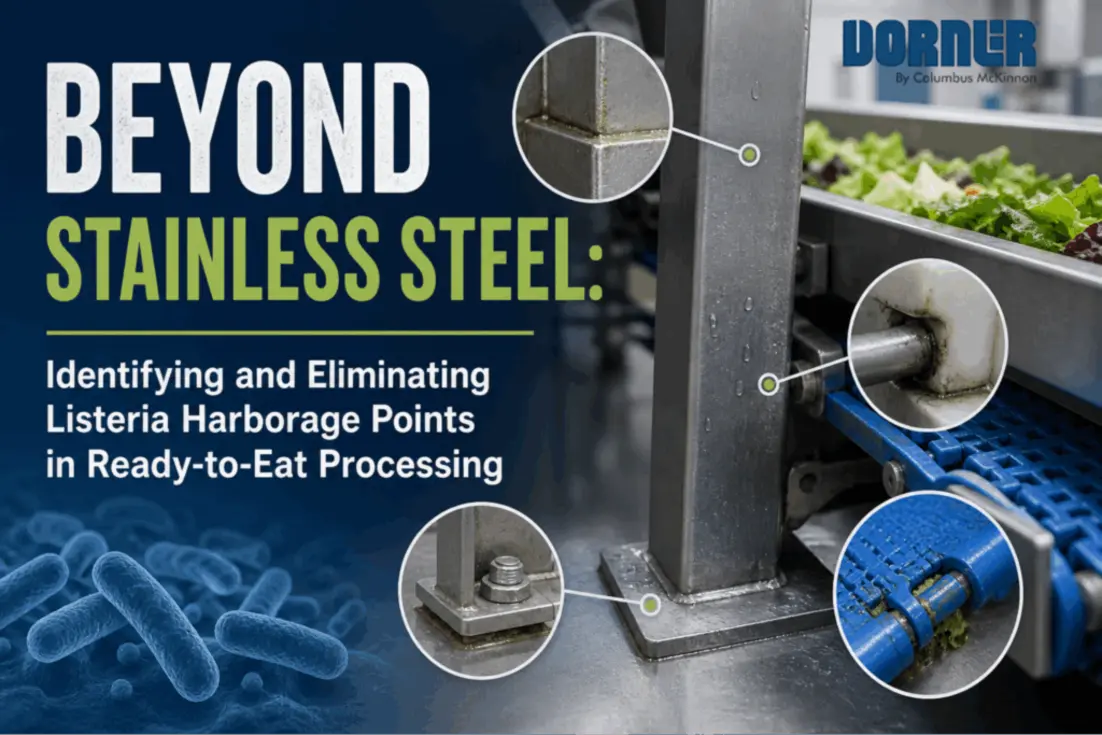
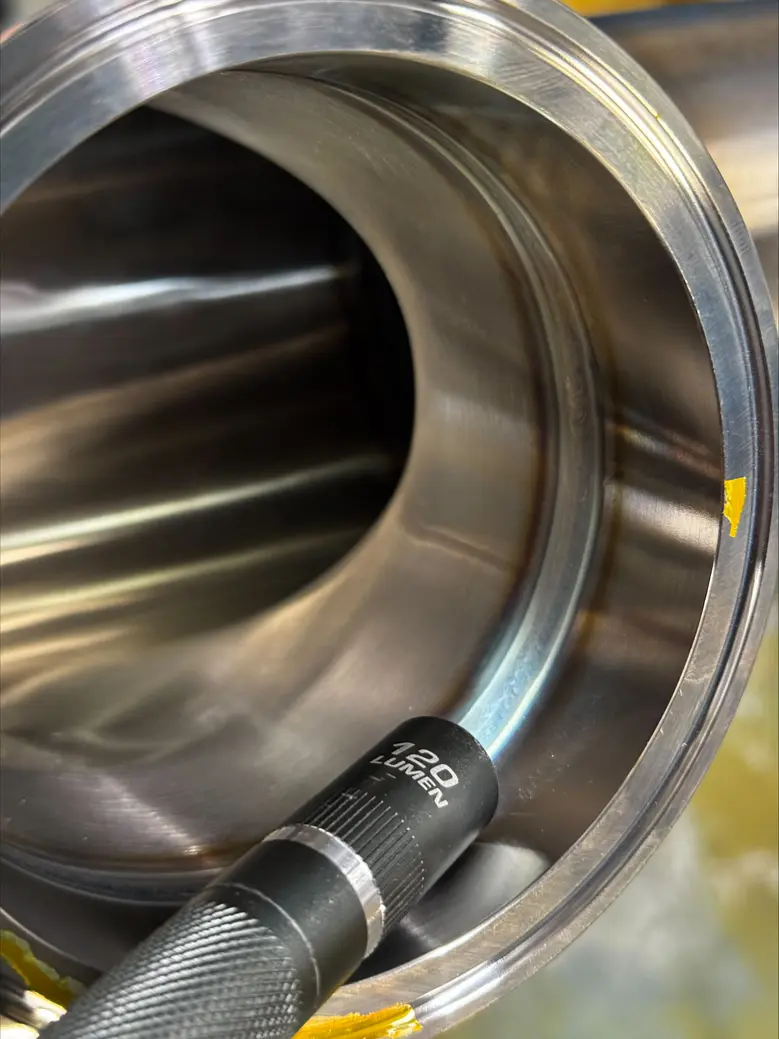
Weld quality is one of the most important and most frequently overlooked elements of hygienic equipment construction. An otherwise suitable vessel can become hard to clean if internal welds are rough, undercut, porous, cracked, discolored, unblended, or left with a crevice at an attachment point.
Source: deutscheequipment
For product-contact welds, specify that joints are continuous where needed to prevent product ingress, smoothly finished, and free from conditions that create harborage. Internal seams should be accessible for inspection before final assembly when practical. Where welding is performed on stainless steel, the supplier should control procedures to avoid surface damage and restore corrosion resistance as appropriate after fabrication.
A useful specification asks for:
- Continuous, smooth product-contact welds where seams are present.
- No cracks, pinholes, overlaps, sharp edges, unblended starts and stops, or inaccessible crevices.
- Weld finishing to the stated product-contact surface requirement.
- Weld procedure and welder qualification records when appropriate to the equipment and project.
- Identification of any orbital welding, manual welding, grinding, polishing, passivation, or electropolishing steps.
- A defined process for repair welds and post-repair inspection.
Avoid specifying a cosmetic external weld appearance as a proxy for internal hygienic quality. The internal contour, root condition, cleanability, and documentation matter more than an attractive exterior bead.
Design geometry for cleaning, inspection, and drainage
Cleanable food processing equipment design depends on more than smooth materials. Product-contact surfaces must be reachable by the intended cleaning method and must not include features that trap soil, water, or cleaning chemicals.
Review the equipment for these practical details:
| Design feature | What to look for | Why it matters |
|---|---|---|
| Corners and transitions | Smooth radii and blended connections | Sharp or poorly blended transitions can retain product residues. |
| Seams and attachments | Continuous joints without gaps | Gaps can allow product or moisture to enter areas that cannot be cleaned. |
| Dead ends and pockets | Minimized lengths and accessible configurations | Stagnant product or cleaning solution can remain in poorly designed branches. |
| Drainage | Sloped, drainable product-contact zones where applicable | Standing liquid increases corrosion and sanitation-management concerns. |
| Gaskets and seals | Correct material, retained securely, accessible for inspection | Damaged or poorly seated seals can create contamination traps. |
| Fasteners | Kept out of product zones when possible | Threads and exposed hardware are difficult to clean thoroughly. |
| Covers and guards | Removable or designed for cleaning access | Enclosures can hide product accumulation around shafts, hinges, and frames. |
For CIP equipment, ask the supplier to explain how each wetted path is cleaned, vented, drained, and inspected. For COP or manual-cleaned equipment, confirm that operators can access the necessary surfaces without unsafe disassembly or improvised tools.
Account for corrosion before it becomes a sanitation problem
Corrosion on a food-contact surface can lead to roughness, pitting, staining, loss of cleanability, and potential foreign-material concerns. It is usually a system issue rather than simply a material-grade issue.
Common contributors include incompatible product or cleaning chemistry, chloride exposure, residual moisture, poor drainage, cross-contamination from carbon-steel tools or dust, damaged finishes, and fabrication practices that leave the stainless surface in poor condition.
During supplier review, ask how the equipment will be protected during fabrication, transport, installation, and startup. Stainless components should not be treated casually around carbon steel. Verify whether pickling, passivation, or electropolishing is proposed, why it is needed, and how the finished condition will be documented.
Also review nearby components. A corrosion-resistant tank can still have a sanitation weakness if its gaskets, seals, valve seats, sensor housings, coatings, or dissimilar-metal fittings are unsuitable for the product and cleaning environment.
Request documentation that supports acceptance and future maintenance
Documentation turns a hygienic design claim into something the processor can inspect, maintain, and defend during an audit. The exact package should match the machine’s risk and complexity, but procurement teams commonly request:
- Material test reports or traceability records for specified product-contact metal components.
- A product-contact material list, including polymers, elastomers, coatings, and lubricants where relevant.
- Surface finish certificates or roughness measurement records for designated areas.
- Weld maps, weld procedures, and inspection records where appropriate.
- Drawings that identify product-contact zones, drain points, seals, and disassembly points.
- Cleaning and maintenance instructions, including limits on chemicals or practices that may damage surfaces.
- Declarations or certification documents required by the applicable customer, market, or equipment standard.
If 3-A, NSF/ANSI, EHEDG, or another hygienic design standard is invoked, identify the exact standard, equipment scope, and edition that apply. A broad statement that a machine is “designed to” a standard is not the same as a defined, documented conformity claim.
Supplier acceptance checklist
Before approving equipment for shipment or site acceptance, confirm the following:
- Product-contact materials match the approved specification and records.
- All wetted surfaces have the required finish and no obvious pits, scratches, embedded debris, or damage.
- Product-contact welds are smooth, continuous where required, and free of visible defects.
- Seals, gaskets, and nonmetallic contact parts are identified and compatible with the intended service.
- Equipment can be cleaned by the planned CIP, COP, or manual method.
- Product-contact areas drain as intended and do not retain liquid in avoidable pockets.
- Access is available for inspection, maintenance, and replacement of wear parts.
- Supplier documentation is complete before final release.
Common specification mistakes
The most common mistake is simply stating “stainless steel construction.” That phrase leaves alloy grade, surface finish, weld treatment, seal materials, internal geometry, and documentation open to interpretation.
Other weak specifications include calling for an external polished finish while omitting internal surface requirements; specifying a low Ra value but not requiring cleanable welds; selecting 316L without checking cleaning chemical compatibility; and assuming certification language applies to every assembly on a custom machine.
A stronger specification connects the food-contact surface to actual operating conditions and gives the supplier objective criteria to meet. The finished result should be a surface system that is smooth, corrosion-resistant for its intended environment, free of avoidable harborage points, accessible or cleanable by the validated method, and traceable through documentation.
References
- Stainless Steel for Food Processing Equipment. (n.d.). https://drametal.com/blog/stainless-steel-food-processing-equipment
- Food Processing Equipment Sanitation via Laser Cleaning Systems. (n.d.). https://arcuscnc.com/food-processing-laser-cleaning-systems
- Stainless Steel in Food Processing: FDA, 3-A Sanitary Standards, and Surface Finish - Knowledge - Jinie Technology. (n.d.). https://www.jnalloys.com/info/stainless-steel-in-food-processing-fda-3-a-s-103570586.html
- Best Stainless Steel Finishes for Food Processing Equipment. (n.d.). https://feeds.trinupowdercoating.com/blog/surface-finishes-high-acid-food-processing-equipment
- Food Contact Surfaces - an overview. (n.d.). https://www.sciencedirect.com/topics/agricultural-and-biological-sciences/food-contact-surfaces
- Best Stainless Steel Finishes for Food Processing Equipment. (n.d.). https://trinupowdercoating.com/feeds/blog/surface-finishes-high-acid-food-processing-equipment
- Food Contact Surface: Best Practices For Safety & Compliance. (n.d.). https://foodtech.folio3.com/blog/food-contact-surface-best-practices
- Food Processing Equipment FDA & USDA Approved. (n.d.). https://fmmachine.com/precision-manufacturing-tips/food-processing-equipment-sanitary-design