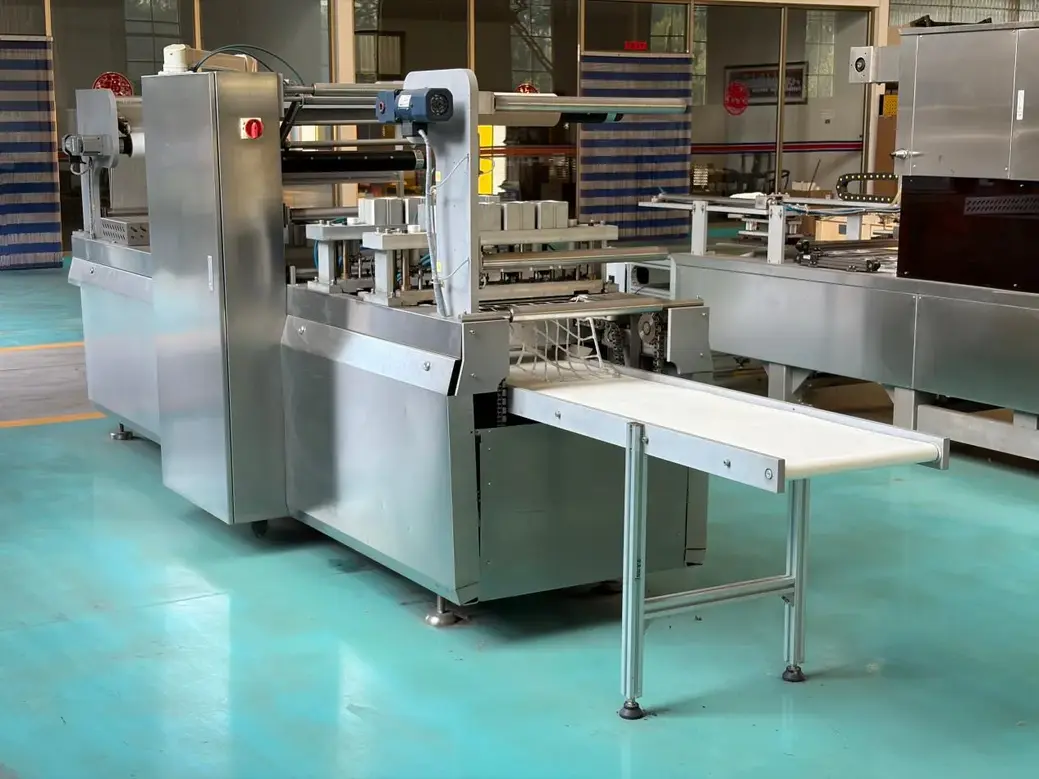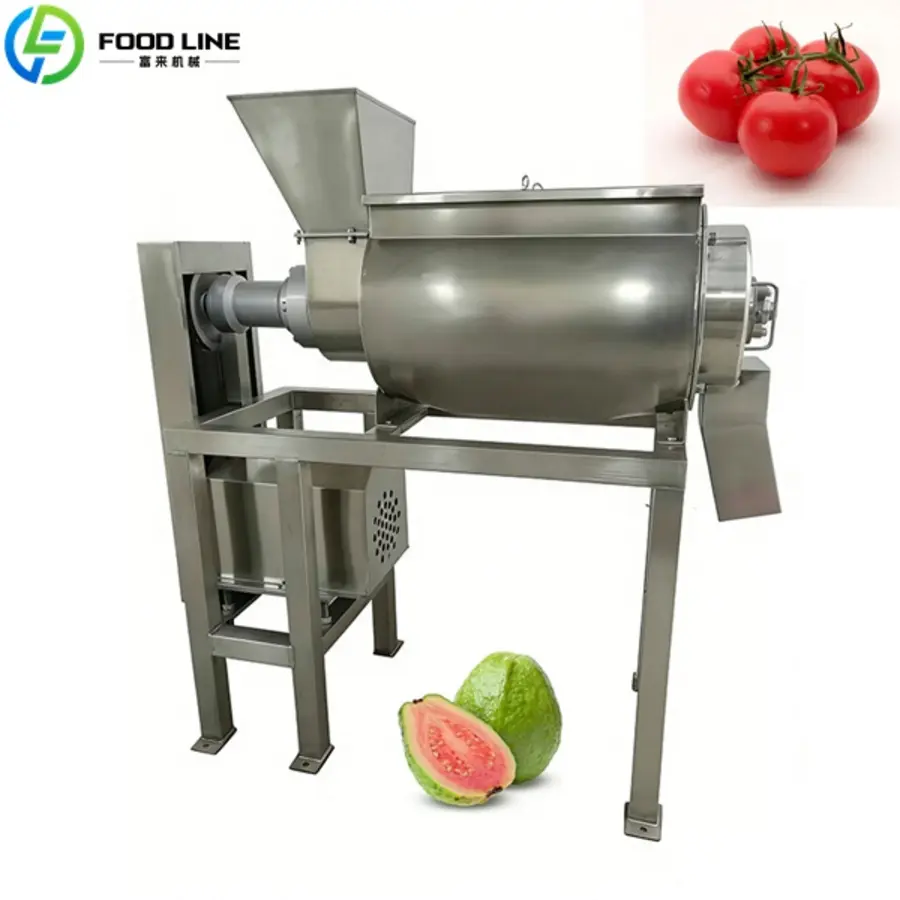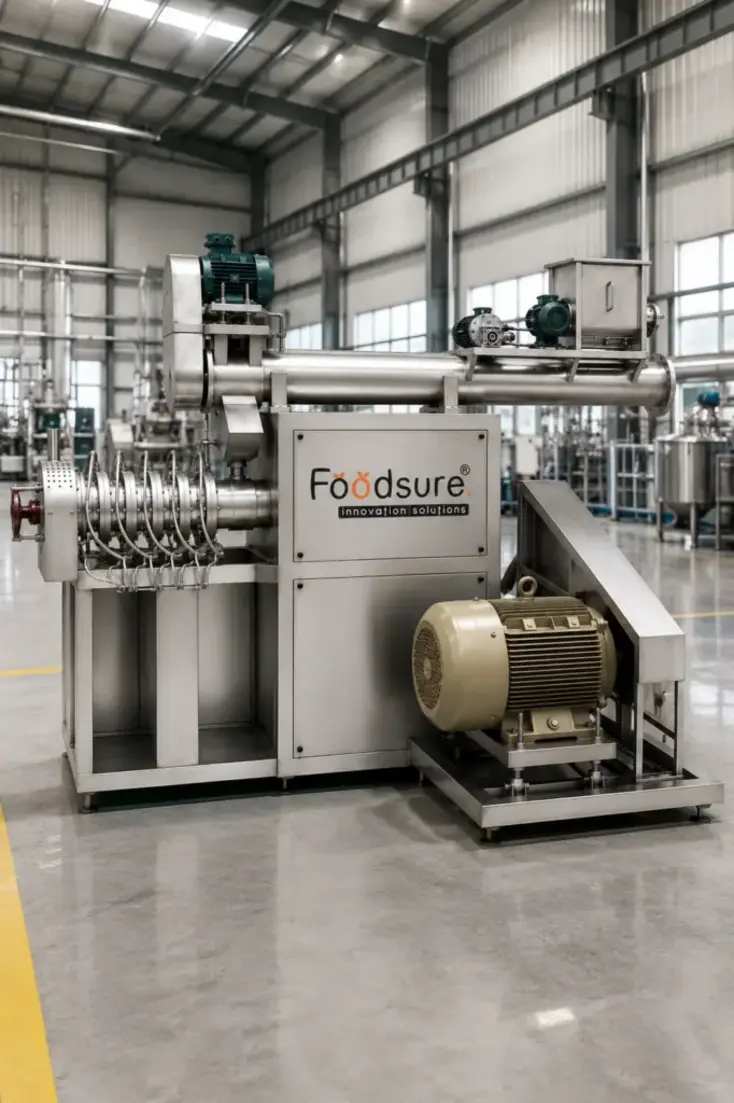
For most food extruder selection decisions, a single-screw machine is a sensible fit for stable, relatively simple dry formulations and a limited product range. A twin-screw system is usually the better choice when recipes vary, ingredients are difficult to convey or blend, moisture must be adjusted across a wider range, or the plant needs more consistent control of cooking, texture, and expansion.
The best choice is not automatically the machine with two screws. Start with the product and process: ingredient behavior, target moisture, density and shape, required output, acceptable changeover time, and the equipment needed before and after the extruder. An extruder that appears adequate on nominal throughput can still be the wrong line if its feeder, preconditioner, die, cutter, dryer, or controls cannot support the product specification.
How a food extruder works
A food extruder continuously conveys a prepared ingredient mix through a barrel using one or more rotating screws. As material moves forward, it is subjected to mechanical shear, pressure, added water or steam where applicable, and controlled heating or cooling through barrel zones. At the die, pressure drops rapidly as the product exits. Depending on the formulation and process conditions, this can create expansion, set a dense shape, or form a strand that is cut, dried, baked, fried, or otherwise finished downstream.
The extruder is therefore both a transport device and a process unit. It influences mixing, hydration, starch transformation, protein structuring, viscosity, pressure, residence time, and final shape. The die defines the exit profile, but the upstream process determines whether that profile holds its shape and delivers the intended texture.
Single-screw vs twin-screw extruder: the practical difference
A single-screw extruder uses one screw rotating in a barrel. It is mechanically simpler and commonly suited to established products made from consistent, free-flowing raw materials. It can generate substantial pressure and can be highly effective when the recipe and operating window are well understood.
A twin-screw food extruder uses two screws, commonly intermeshing in food applications. Their geometry provides more active conveying and mixing, helping the machine move material that is sticky, variable, high in fat, high in fiber, or difficult to hydrate evenly. Modular screw elements can also give processors more ways to configure conveying, mixing, kneading, venting, and pressure-building sections.
| Selection factor | Single-screw extruder | Twin-screw extruder |
|---|---|---|
| Best starting point | Stable, simpler recipes | Complex, variable, or developing recipes |
| Feeding behavior | Usually favors consistent, free-flowing input | Better able to handle challenging or less uniform blends |
| Mixing and dispersion | More limited in-barrel mixing | Stronger distributive and dispersive mixing potential |
| Moisture and ingredient flexibility | Narrower practical operating window in many applications | Generally broader adjustment range and easier liquid incorporation |
| Process control | Effective for a proven, stable process | More tools to manage shear, mixing, and residence behavior |
| Changeover and product development | Best when product family is limited | Better suited to multiple SKUs and formulation development |
| Capital and mechanical complexity | Typically lower and simpler | Typically higher, with more components and setup decisions |
| Wear management | Fewer primary processing elements | More elements to inspect, configure, and replace |
These are tendencies, not absolute rules. Screw design, barrel configuration, feeder accuracy, preconditioning, die restriction, and operator control can change the capability of either machine substantially.
Choose by formulation before choosing by product category
“Snack,” “cereal,” and “pet food” are useful market labels, but they are not enough to specify an extruder. Products in each category can range from simple cereal-based expanded pieces to dense, high-protein, meat-containing, fiber-rich, or fat-containing formulas.
Ingredients that favor a single-screw system
A single-screw system can be appropriate when the dry mix is uniform, flows consistently, and has a proven processing history. Examples may include a narrow range of cereal snacks, simple breakfast-cereal shapes, or established dry pet-food recipes with controlled raw-material variation.
It is particularly worth considering when the plant values straightforward operation, lower initial complexity, and a dedicated product line rather than frequent recipe changes. The key condition is that the process remains stable without requiring intensive in-barrel mixing or frequent correction of feed variability.
Ingredients that often favor a twin-screw system
Twin-screw equipment deserves close consideration when the formulation includes several ingredients that must be uniformly dispersed, or when the raw materials do not convey predictably. This can include blends with higher levels of protein, fiber, fats, fresh or moist ingredients, functional inclusions, or significant recipe variation.
For pet food, twin-screw systems are commonly considered for premium or highly differentiated kibble ranges, especially where texture, expansion, density, and coating performance must be kept consistent across multiple formulations. For snacks and cereals, they are useful where processors need frequent shape, texture, ingredient, or moisture changes from one line.
Do not assume that a twin-screw system solves formulation problems on its own. Poor particle size control, inaccurate dosing, inconsistent ingredient moisture, or unsuitable downstream drying will still create variable product.
Evaluate the full process line
Extruder selection should begin with a line layout and material balance, not a brochure comparison. The following equipment often has as much influence on product consistency as the screw configuration.
Feeding and dosing
Each major dry ingredient needs a feeding method appropriate to its flow behavior. Loss-in-weight or gravimetric dosing can improve control where recipe accuracy matters, while simpler volumetric feeders may be acceptable for stable ingredients and less demanding products. Consider how the system will handle powders, grits, sticky materials, minor ingredients, rework, and allergens.
Ask suppliers to define which ingredients can be metered directly into the barrel and which require preblending or preconditioning. A feeder that bridges or pulses will make stable extrusion difficult, regardless of screw type.
Preconditioning
A preconditioner mixes dry ingredients with water, steam, and sometimes liquid ingredients before the product enters the extruder. It can improve hydration, begin thermal treatment, reduce load variation, and support more consistent cooking.
Preconditioning is especially important to assess for pet food and products with demanding cooking or texture requirements. Confirm the intended retention behavior, mixing method, liquid injection points, cleanout access, and whether the preconditioner can manage the expected changes in formulation and moisture.
Barrel, screws, and thermal zones
Request a proposed screw and barrel configuration for each product family rather than accepting a generic arrangement. The supplier should explain where material is conveyed, mixed, compressed, vented, and prepared for the die.
Also review the heating and cooling arrangement. Barrel-zone control helps establish repeatable processing conditions, but the useful question is whether the system can remove or add heat as needed for the intended product. Monitorable process variables should include at least feed rate, screw speed, relevant temperatures, die pressure, and motor load or torque where provided.
Die and cutter
The die is a wear component and a product-quality component. Hole geometry, open area, land length, material, temperature management, and restriction all affect pressure, shape, surface appearance, and expansion.
For cut products, match the cutter design to the product. Verify blade access, speed range, synchronization with extrusion rate, and the ability to hold consistent cut length. If multiple shapes are planned, include die changes and cutter adjustments in the changeover estimate rather than treating them as minor tasks.
Drying, cooling, and coating
An expanded snack, cereal piece, or kibble leaving the die is not a finished product. Conveying, drying, cooling, screening, coating, and packaging must preserve the target moisture, texture, and appearance.
Specify the dryer based on the actual load entering it, including product size, bulk density, surface condition, and moisture variation. For coated pet food, assess where fat, digest, powders, or other surface applications occur and whether the cooling and packaging system can handle the finished product without damaging it or creating unacceptable carryover.
A specification checklist for food extrusion equipment
Use this checklist when comparing proposals or preparing a factory acceptance trial:
- Product list: shapes, piece size, density, texture, moisture target, and finished use.
- Formulation range: starches, proteins, fibers, fats, liquids, fresh ingredients, rework, and minor additions.
- Production requirement: average and peak output, annual operating hours, and planned growth.
- Feeding plan: storage, screening, dosing accuracy, flow aids, preblending, and ingredient traceability needs.
- Preconditioning: water and steam addition, mixing, residence behavior, access, and drainage.
- Extruder design: screw diameter, motor and drive arrangement, screw configuration, barrel zones, venting, and instrumentation.
- Die and cutting: die-change method, die inventory, cutter adjustment, blade access, and scrap handling.
- Downstream line: conveying, drying, cooling, coating, screening, metal detection where required, and packaging interface.
- Changeovers: expected frequency, time required, cleaning access, and procedure for product or allergen transitions.
- Utilities and footprint: electrical supply, steam, water, compressed air, cooling, extraction, drainage, headroom, and maintenance access.
- Maintenance: expected wear parts, supplier lead times, service support, and procedures for screw and barrel inspection.
- Controls and data: recipe management, alarm handling, operator access levels, production records, and integration with plant systems.
Common selection mistakes
The first mistake is sizing only for maximum kilograms per hour. Throughput should be tied to the required product specification, not simply the rate at which material can be pushed through a barrel. A line may produce more material at conditions that no longer meet density, expansion, cutting, drying, or appearance requirements.
The second is selecting a twin-screw system solely because it is more flexible. Flexibility is valuable only if the business will use it. A dedicated line making one stable product may not recover the added complexity of a more configurable machine.
The third is selecting a single-screw system based solely on lower purchase cost. If the recipe is likely to evolve toward higher protein, higher fiber, more liquids, or multiple product forms, restricted processing flexibility can become an operating constraint.
The fourth is treating cleaning and changeover as an afterthought. Inspect access to feeders, preconditioners, barrels, dies, cutters, conveyors, dryers, and coating equipment. The plant should define and validate its own sanitation, allergen-control, and product-change procedures for the actual recipes and regulatory requirements.
Which extruder is the better fit?
Choose a single-screw extruder when the formulation is stable, raw materials are predictable, the product range is narrow, and the process does not depend on intensive mixing or a broad moisture range. It is often the practical option for established, straightforward products.
Choose a twin-screw food extruder when ingredient behavior is more difficult, recipes change regularly, liquid incorporation and mixing are critical, or product quality depends on tighter control of the extrusion process. It is generally the stronger platform for varied snack, cereal, and pet-food portfolios.
Before placing an order, run representative formulations through a properly configured trial line and evaluate the complete result: extrusion stability, product dimensions, density, texture, drying behavior, coating response, waste rate, and changeover practicality. The right machine is the one that produces an acceptable product consistently within a workable operating window—not the one with the highest stated capacity or the most features.
References
- Single vs Twin Screw Food Extruder: Choosing the Best Extruder for Fish & Pet Food. (n.d.). https://zhuohengextruder.com/single-vs-twin-screw-food-extruder
- Twin-Screw Food Extruder Guide for Process and Scale-Up Decisions. (n.d.). https://shengtumachinery.com/blog/twin-screw-food-extruder-guide
- Double screw extruder selection criteria and extrusion technology principle-Jinan Dayi Extrusion Machinery Co., Ltd.. (n.d.). https://www.dayimachinery.com/industry-news/double-screw-0.html
- Single-Screw vs. Twin-Screw Extruders: A Detailed Comparison - puffed snack food extruder machine. (n.d.). https://chunmu.cc/single-screw-vs-twin-screw-extruders-a-detailed-comparison
- Key Features of a Food Extruder Machine for Pet Food Processing | Zhuoheng® Extruder. (n.d.). https://zhuohengextruder.com/key-features-food-extruder-machine
- Single vs Twin Screw Extrusion: Which Is Better for Food?. (n.d.). https://petreatsmachine.com/single-vs-twin-screw-extrusion-food
- Twin-Screw Food Extruder Energy Consumption Guide. (n.d.). https://petreatsmachine.com/twin-screw-extruder-energy-use
- Comparison between single screw extruder and twin-screw extruder - Wanplas. (n.d.). https://wanplas.com/industry-blogs/comparison-between-single-screw-extruder-and-twin-screw-extruder