A failed gear or shaft should not automatically become an in-house machining job, nor does every damaged component need a full OEM replacement. The practical decision depends on whether the team can establish the failure mechanism, verify the repaired component’s material and geometry, preserve hygienic suitability, and document a safe return to service. If any of those points cannot be demonstrated, use an OEM, gearbox specialist, or qualified machine shop.
For food machinery gear and shaft repair, the threshold for outside support rises when a failure affects a safety-critical drive, a sealed gearbox, food-zone equipment, sanitary barriers, machine timing, or a component with specialized tooth geometry, heat treatment, coatings, or fit requirements. A quick repair that restores rotation but leaves misalignment, contamination, or an unknown material condition in place can create a repeat failure and a longer shutdown.
Start with a repairability decision, not the visible damage
The broken tooth, scored journal, or sheared shaft is evidence, not necessarily the root cause. Before deciding where to repair, preserve information from the failure:
- Record the machine, drive identification, operating condition, product being run, and recent maintenance history.
- Photograph tooth damage, bearing positions, shaft surfaces, housings, seals, keys, couplings, and lubrication condition before cleaning parts.
- Retain damaged pieces, lubricant samples, filters, and bearing fragments when practical.
- Check whether the failure followed a jam, overload, washdown event, lubrication change, vibration increase, bearing replacement, or speed/process change.
- Compare the failed drive with similar machines, including load, temperature, vibration, and maintenance records where available.
Common gearbox failure pathways include lubrication problems, contamination, overload, misalignment, heat, vibration, and progressive wear. These mechanisms can overlap. For example, a bearing failure can change shaft position, degrade gear mesh, generate debris, and then damage gears that initially appeared healthy. Replacing only the visibly failed gear may not correct the underlying condition.
A practical in-house versus specialist decision table
| Decision factor | In-house repair may be suitable when | Use a specialist, OEM, or qualified machine shop when |
|---|---|---|
| Damage scope | Damage is limited, accessible, and clearly understood | Damage extends to gear teeth, bearing seats, housings, splines, or multiple parts |
| Component design | The part is standard and its dimensions, material, and tolerances are known | The gear or shaft is custom, obsolete, hardened, ground, coated, or poorly documented |
| Failure cause | A specific, correctable cause has been confirmed | The cause is uncertain or the machine has repeated failures |
| Measurement capability | The plant can accurately inspect critical fits, runout, backlash, endplay, and alignment | Required measurement, inspection, or gear-analysis capability is unavailable |
| Repair method | The repair is within approved internal procedures and personnel competence | Welding, heat treatment, gear cutting, grinding, reverse engineering, or precision rebuilding is needed |
| Food plant suitability | The work can preserve cleanability, sealing, material compatibility, and foreign-material control | The repair could compromise hygienic design, product protection, or sanitation procedures |
| Verification | The plant can test and document a controlled return to service | The drive needs specialist testing, load validation, or warranty-backed rebuilding |
The table is a screening tool, not a substitute for the equipment manufacturer’s instructions or the plant’s engineering, food-safety, and maintenance requirements.
Repairs that are commonly manageable in-house
An experienced maintenance department may reasonably handle limited corrective work when the equipment design and acceptance criteria are known. Examples can include replacing an externally mounted coupling element, key, standard bearing, seal, or complete OEM shaft assembly; correcting an identified mounting or alignment issue; and replacing a complete geared motor or gearbox using the manufacturer’s specified unit.
In-house work is most defensible when it does not require the team to infer critical original specifications. A plant may have the tools to remove and install a shaft, but that is different from having the capability to manufacture or restore one. Shaft journals, bearing fits, spline profiles, keyways, surface finish, straightness, and concentricity can all affect bearing life and gear engagement.
Before releasing an internal repair, confirm that the repair procedure addresses:
- Correct part identification and revision level.
- Approved replacement materials and lubricant.
- Bearing, seal, and fastener installation requirements.
- Coupling and drive alignment.
- Gear backlash and shaft endplay where applicable.
- Guarding, torque reaction supports, and mounting integrity.
- Inspection for loose fragments or foreign material before closure.
- Controlled run-in and condition monitoring after restart.
Do not improvise a repair because the machine can be made to turn. A repaired drive must also operate predictably under its expected load and remain appropriate for its installed environment.
When shaft repair should go to a machine shop
A machine shop repair for food equipment can be appropriate when the shaft damage is understood and the shop can work to a defined drawing, OEM specification, or properly developed engineering requirement. Typical examples include restoring a bearing journal, manufacturing a replacement shaft for obsolete equipment, replacing a damaged keyway, or producing a shaft with an established material and heat-treatment requirement.
However, a shaft is not simply a piece of round stock. Its function may depend on fatigue resistance, surface hardness, transition radii, geometry, balance, gear location, bearing-seat fit, and interaction with seals or product-zone barriers. A repair that changes these characteristics can reduce service life or shift failure elsewhere in the drive.
Send shaft work outside when any of the following apply:
- The shaft is bent, cracked, severely scored, or has failed in service without a confirmed overload event.
- The shaft carries an integral gear, worm, timing component, or precision spline.
- The repair requires welding, metal build-up, thermal processing, straightening, grinding, plating, or coating.
- The original material, hardness, dimensions, or tolerances cannot be verified.
- The shaft interfaces with a hygienic seal, product-zone component, or a location difficult to clean and inspect.
- The plant cannot inspect final runout, critical diameters, surface condition, and fit before installation.
Ask the repair provider what inspection records it can supply. At a minimum, the plant should know what was repaired or replaced, what dimensions were checked, what material assumptions were used, and how the completed component was accepted.
Gear damage usually demands a higher bar
Gear repair is often more specialized than shaft repair. Tooth profile, lead, backlash, contact pattern, center distance, hardness, and surface condition work together. Replacing a damaged gear with one that appears similar can produce excessive noise, heat, poor load distribution, or rapid tooth distress.
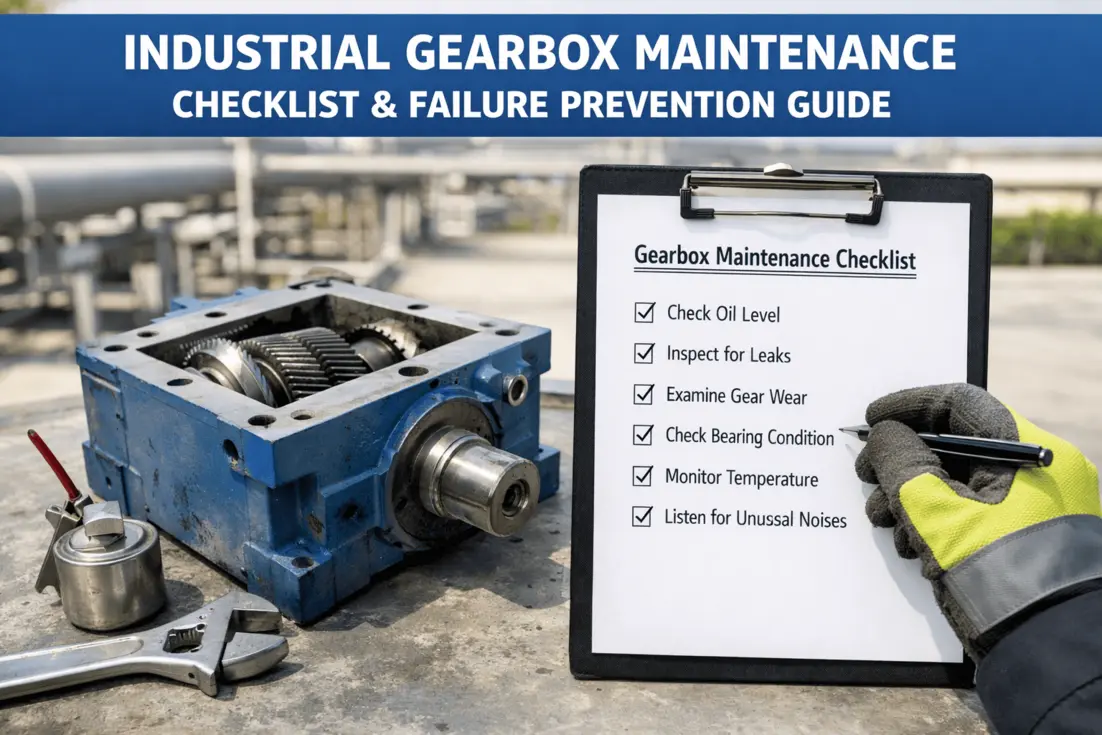
Source: oxmaint
Use specialist support when gears have broken teeth, pitting, scuffing, heavy wear, cracking, or unexplained contact patterns. A qualified gearbox repair facility may have gear measurement, gear cutting, grinding, machining, and heat-treatment resources, or established control of those processes. This becomes particularly important for legacy drives where OEM parts are unavailable and reverse engineering is necessary.
If a specialist proposes an improved replacement design, ask for a clear explanation of what is changing and why. An improved material or tolerance may be appropriate, but it should not be an undocumented substitution that changes torque capacity, gear mesh, lubrication needs, or compatibility with mating components.
Food-plant concerns that change the decision
A repair suitable for a general industrial environment may not be suitable for installed food machinery. Maintenance and food-safety teams should jointly assess whether the repair affects cleanability, corrosion resistance, seals, lubricant containment, or the risk of debris entering adjacent product areas.
Key questions include:
- Is the drive in, above, or near an exposed product area?
- Could damaged metal, abrasive residue, seal fragments, or lubricant have reached product-contact or food-zone surfaces?
- Does the work disturb hygienic covers, shaft seals, drain paths, or enclosed guarding?
- Are replacement materials and lubricants approved under the plant’s applicable specifications?
- Can the equipment be cleaned and inspected effectively after maintenance?
- Does the plant’s preventive controls, sanitation program, or customer standard require additional release steps?
The necessary response depends on the equipment location and the plant’s documented programs. Do not assume that a standard industrial repair is acceptable around food. Verify applicable requirements with internal food-safety personnel, the equipment manufacturer, and relevant regulatory or customer requirements.
Repeated gear failure is a root-cause problem
A repeated gear failure should trigger a broader investigation before another component is ordered. Recurrent damage may indicate that the gear is the weak link, but it may also show that the drive is seeing conditions outside its intended design.
Check the complete power path: motor, variable-speed drive settings if used, coupling, reducer mounting, torque arm, gearbox, driven shaft, conveyor or process load, bearings, and controls. Review whether jams, product buildup, washdown intrusion, belt tension, chain tension, or process changes have increased loading. Examine lubricant condition and contamination sources. Verify alignment and support rigidity.
A useful root-cause record states the observed evidence, the most likely failure mechanism, contributing conditions, corrective action, responsible owner, and verification plan. “Replaced failed gear” is a repair record, not a root-cause conclusion.
What to require from an outside repair provider
When specialist support is needed, provide the fullest possible equipment history and ask for a repair scope before authorizing work. A capable provider should be able to explain how it will inspect the unit, identify failed components, assess related damage, and document the finished repair.
Request clarity on:
- Disassembly findings and probable failure mechanism.
- Whether the repair uses OEM parts, newly manufactured parts, or repaired components.
- Material, heat-treatment, and dimensional-control approach for replacement gears or shafts.
- Inspection of housing bores, bearing fits, seals, and mating components.
- Gear mesh, backlash, shaft endplay, and alignment checks as applicable.
- Lubricant and sealing recommendations for the installed environment.
- Test procedures, acceptance documentation, and any repair warranty terms.
- Recommendations to prevent recurrence at the machine level.
For obsolete gearboxes, a specialist with in-house machining and gear-manufacturing capability can be valuable, especially when an original part is unavailable. Still, reverse-engineered components should be controlled as engineered replacements, with drawings, revision records, and inspection evidence retained by the plant.
Return-to-service checklist
Before restarting a repaired drive, confirm that maintenance, operations, and food-safety responsibilities are complete:
- The underlying cause has been corrected or a documented interim risk decision is in place.
- All parts, tools, debris, and temporary materials have been removed.
- Guards, covers, seals, fasteners, and mounting hardware are correctly installed.
- Lubrication type, quantity, and fill condition have been verified against the applicable equipment requirements.
- Alignment, rotation direction, and mechanical clearances have been checked.
- Cleaning and inspection requirements for the affected area have been completed.
- The startup plan includes observation for noise, heat, vibration, leakage, abnormal load, and product-impact concerns.
- Repair records, part traceability, measurements, and follow-up inspection requirements are filed.
The best decision is not simply the least expensive repair or the fastest path to restart. In-house work is appropriate when the failure is bounded, the specifications are known, and the plant can verify the result. Specialist repair is the better choice when critical geometry, material condition, hygienic suitability, or root cause remains uncertain. That distinction helps maintenance teams restore production without converting a single failure into a recurring one.
References
- Industrial Gearbox Repair: Process, Timeline, and What to Expect. (n.d.). https://www.industrialgearbox.net/industrial-gearbox-repair-process-timeline-and-what-to-expect.html
- What Makes a Quality Gearbox Repair? | Chalmers & Kubeck. (n.d.). https://www.candk.com/blog/gearbox-repair
- What should I expect from an industrial gearbox repair …. (n.d.). https://www.quora.com/What-should-I-expect-from-an-industrial-gearbox-repair-service
- Root Cause Analysis of Gearbox Failure. (n.d.). https://www.tryharmony.ai/root-cause-of-gearbox-failure
- Industrial Gearbox Repair, Rebuilding & Emergency Services. (n.d.). https://hardchromesolution.com/industrial-gearbox-repairs-services.html
- Common causes of industrial gearbox failure and how to …. (n.d.). https://gearsolutions.com/features/common-causes-of-industrial-gearbox-failure-and-how-to-identify-them
- How to Inspect a Gearbox. (n.d.). https://www.machinerylubrication.com/Read/28765/how-to-inspect-a-gearbox-
- Gearbox Failure Root Cause Analysis: Identify and Prevent. (n.d.). https://www.linkedin.com/posts/jitendra-kumar-singh-5bba48244_root-cause-analysis-rca-of-gearbox-failure-activity-7430170472509566976-g17i