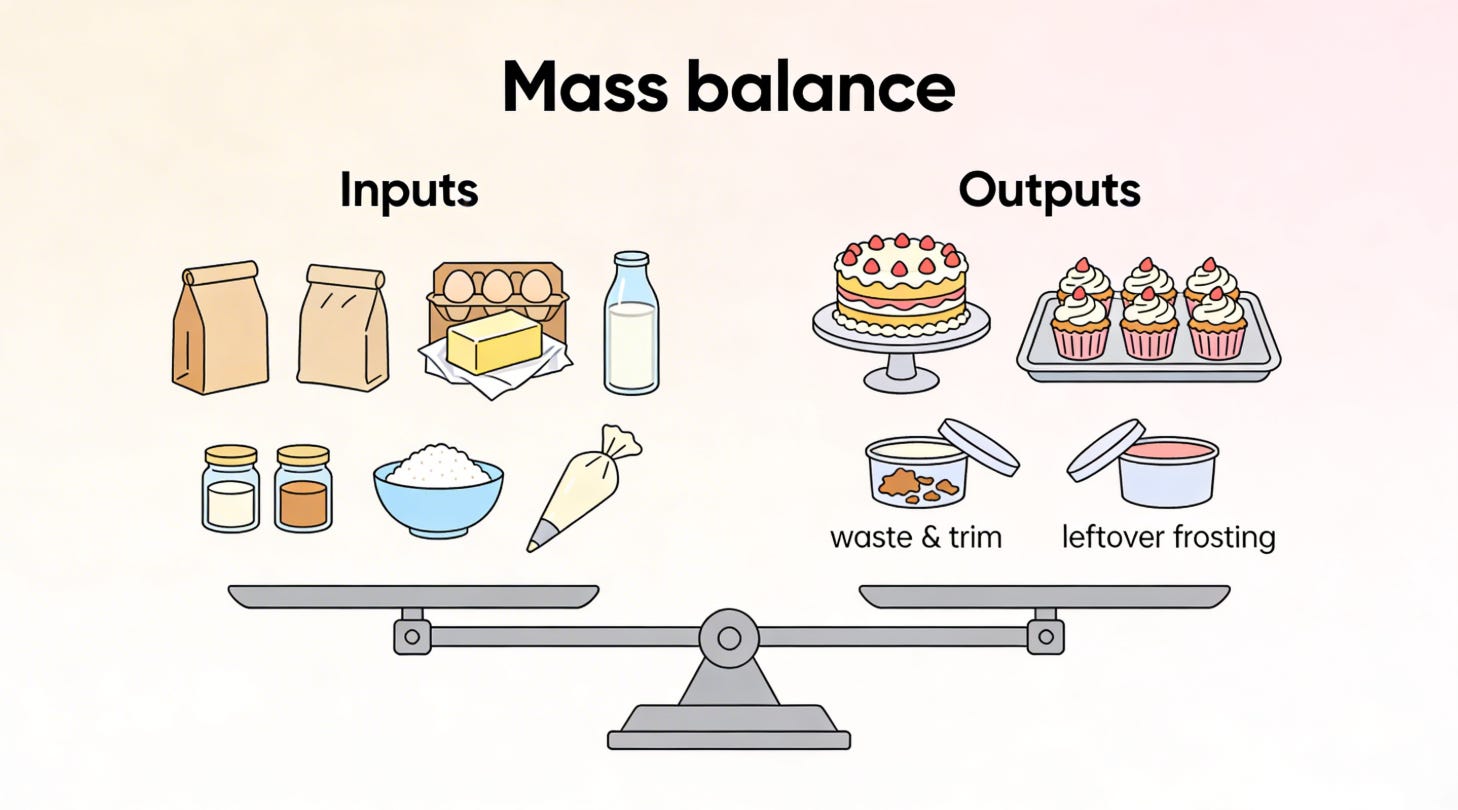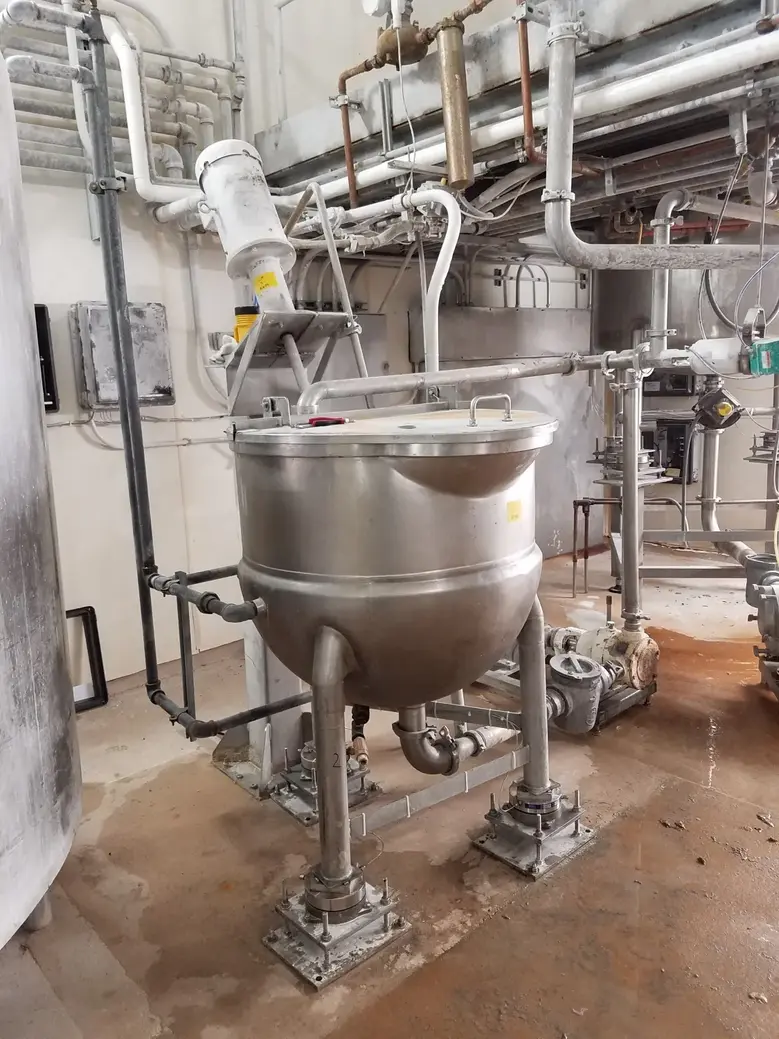
A practical food manufacturing mass balance is built from ordinary plant data, provided the data represent the same process boundary and time period. Start by defining where the balance begins and ends, then measure all inputs, finished outputs, known losses, rework movements, and the change in work-in-process (WIP) held inside that boundary. The difference is not automatically “waste.” It is an unexplained variance that should be investigated.
For a batch, shift, or production run, the basic relationship is:
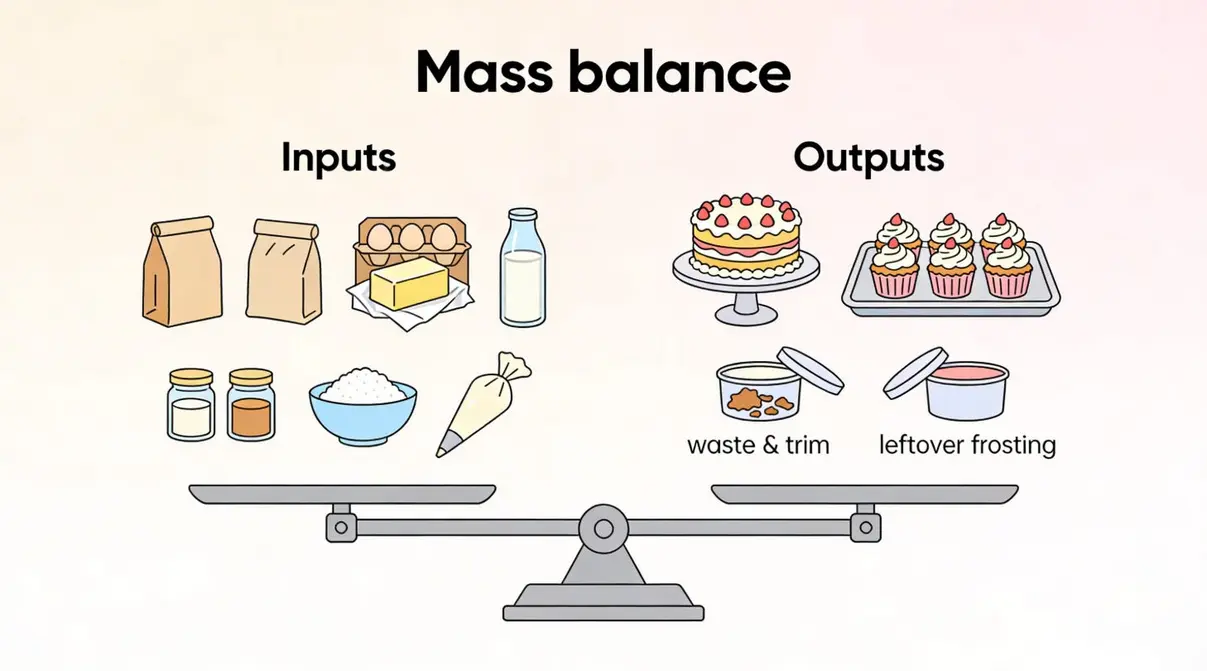
Inputs = saleable output + rework output + recorded waste/loss + ending WIP − starting WIP + unexplained variance
The exact format can vary, but the principle does not: materials entering a defined system must be accounted for as product, a documented exit stream, or material still held in the system. The Commission for Environmental Cooperation’s mass-balance guidance similarly emphasizes inputs, outputs, and stocks as the foundation of a balance.
Begin with a boundary that operators can actually use
A whole-site balance is useful for inventory and environmental reporting, but it is often too broad to locate a process problem. For yield work, create nested boundaries:
- Receiving to ingredient storage: delivered quantity, accepted quantity, damaged or rejected material, and stock movement.
- Batch or line staging: ingredients issued to a batch, returned material, and unopened containers.
- A process step: trimming, grinding, mixing, cooking, filling, freezing, or another measurable operation.
- Packing line: bulk product in, packed good product out, overfill, rejects, and retained product in hoppers or pipes.
- Finished-goods warehouse: product transferred in, shipped out, quarantined stock, and inventory adjustment.
Choose one time window for every number. A batch balance might close when the line is cleared. A shift balance requires a reliable beginning and ending WIP count. A weekly inventory balance may be adequate for finding a broad variance, but it rarely identifies the point at which loss occurred.
Define what each category means before collecting data
Plants often have data but cannot reconcile it because categories overlap. For example, a rejected package may contain recoverable product, while an off-spec batch may become approved rework later. Establish clear, locally understood definitions for:
| Category | What to record | Common source |
|---|---|---|
| Input | Net ingredient or bulk material entering the boundary | Receiving scale, dispensing scale, feeder totalizer, batch record |
| Good output | Accepted finished product transferred to finished goods | Checkweigher totals, case scale, pallet scale, ERP transaction |
| Rework | Material deliberately recovered and returned to an approved process | Rework tote scale, barcode transaction, batch record |
| Product waste | Product discarded, downgraded, or sent to a non-product route | Waste bin scale, reject counter plus average weight, disposal log |
| Packaging waste | Empty or unusable packaging material | Roll inventory, scrap-bin scale, supplier pack count |
| WIP and hold-up | Product remaining in tanks, pipes, hoppers, freezers, or fillers | Tank level, vessel weight, line-clearance estimate |
| Water and utility streams | Water added, steam condensate where relevant, washdown or effluent product loss | Flowmeter, wastewater sampling program, utility record |
Do not combine product mass and packaging mass without stating which basis is being used. A finished case weight can include corrugate and film; a recipe yield normally concerns edible product. Both measures can be useful, but they answer different questions.
Map every point where material changes custody or state
Walk the process with production, warehouse, quality, maintenance, and sanitation personnel. Follow the material rather than the paperwork. Mark each point where it is weighed, pumped, held, rejected, sampled, spilled, reworked, or discharged.
Source: substackcdn
A simple flow map should show:
- Receiving: gross, tare, and net weights; lot identity; rejected loads; damaged packaging; and supplier returns.
- Storage and dispensing: silo drawdown, tote issue, minor-ingredient additions, and material returned to storage.
- Processing: vessel charges, water or oil additions, trim, screening losses, filter cake, samples, spills, and product retained in equipment.
- Intermediate storage: tank transfers, level changes, heel volume, and cross-line transfers.
- Packaging: bulk feed, good packs, underweight or damaged rejects, overfill, product recovered from rejects, and end-of-run residual.
- Disposition: rework, animal feed or other approved non-saleable routes where applicable, disposal, and wastewater.
This walkdown frequently exposes unrecorded streams: a drain-down during changeover, product washed from a filler, material retained in a transfer hose, or containers set aside without a disposition entry.
Select the right measurement method for each stream
The best instrument is not necessarily the most sophisticated one. It is the one that measures the stream at a practical control point and produces a traceable record.
Weighing systems
Scales are usually the primary measurement tool for solids, packages, bins, and batch additions. Useful applications include truck and floor scales at receiving, platform scales for totes, load cells beneath tanks, loss-in-weight feeders, and checkweighers at packaging.
For each scale, document its location, capacity, resolution, unit of measure, calibration or verification status, and how operators record the result. A scale can be technically sound yet create poor data if operators estimate tare weights, weigh only some bins, or record totals after material has already been combined.
Flowmeters and totalizers
Flowmeters can measure liquids such as water, oil, syrup, milk, brine, or product slurry. They are especially valuable when a liquid is continuously added or transferred. The production record should identify the meter, the start and end totalizer readings, the product or line served, and the density basis used if a volume must be converted to mass.
Volume is not mass. If a balance is performed in pounds or kilograms, use a controlled density conversion where necessary and identify the temperature or product condition on which that conversion depends. A changing formulation, entrained air, or variable solids content can make a fixed conversion unreliable.
Tank levels and vessel hold-up
Tank-level data are useful for WIP, but level alone is only a proxy for mass. A level-to-volume chart, vessel geometry, density assumption, and known dead volume are needed to estimate tank contents. Load cells under a vessel can simplify this task, although they still require operational checks for piping loads, buildup, and other installation effects.
Treat line hold-up separately. Product left in piping, pumps, hoses, fillers, and heat exchangers may explain a meaningful share of an apparent shortfall at the end of a run. Record whether the line was fully recovered, flushed, drained, or left filled for the next run.
Build a production record that supports reconciliation
A good mass-balance worksheet or digital record should capture facts at the time they occur rather than depend on memory at shift end. At minimum, include:
- Production date, line, product code, formula or revision, batch or lot number, and shift.
- Start and end times for the selected boundary.
- Ingredient lots, target quantities, actual quantities, and units.
- Finished-product quantities accepted, held, rejected, or transferred.
- Rework generated, rework added, its source lot, and its destination.
- Waste by reason and destination, such as trim, spill, start-up loss, off-specification product, package reject, or cleanout.
- Beginning and ending WIP, including bulk material in vessels and product remaining on the line.
- Meter and scale identifiers, manual entries, corrections, and approval of the final reconciliation.
Barcode scans, MES records, PLC totals, and ERP transactions can reduce transcription, but automation does not remove the need for definitions and verification. Systems should use controlled units of measure and prevent the same material from being counted as both waste and rework.
Calculate yield at the level where action is possible
A plant-wide yield is useful for management review. Line and step yields are more useful for finding causes.
A basic food production yield calculation is:
Yield (%) = acceptable output mass ÷ input mass × 100
For a process step, use only the mass entering and leaving that step, adjusted for the expected change. Cooking, drying, freezing, brining, evaporation, and water addition can change total weight without indicating a mistake. In these cases, track the appropriate basis:
- As-is mass: suitable for many packaging and inventory questions.
- Dry-solids basis: useful where water content changes materially.
- Ingredient-specific yield: useful for high-cost ingredients or variable raw-material quality.
- Pack-out yield: compares bulk product available to finished product packed, including rejects and overfill.
Avoid comparing yields across products with different formulations, moisture targets, package sizes, or rework rules unless the calculation basis is consistent.
Separate known losses from unexplained variance
Known losses are not desirable, but they are measurable and actionable. Examples include trim, sieve screenings, filter residue, start-up scrap, declared packaging rejects, samples, and documented product remaining in equipment.
Unexplained variance is the residual after known movements and WIP are accounted for. Investigate it in a consistent order:
- Check timing. Did all records cover the same batch, shift, or inventory cut-off?
- Check units and conversions. Look for pounds versus kilograms, gross versus net weight, volume-to-mass conversion errors, or duplicate entries.
- Check WIP. Confirm tank heels, line hold-up, open containers, and product awaiting quality disposition.
- Check dispositions. Verify that rework, rejects, returns, and disposal were recorded once and assigned to the correct run.
- Check measurement points. Compare scale readings, flowmeter totals, and packaging counts with independent observations where possible.
- Inspect the process. Look for leaks, overflowing vessels, damaged transfer hoses, drain losses, buildup, incorrect filler settings, or unrecorded cleanout material.
Food plant leakage measurement should distinguish a true physical leak from an accounting gap. A sudden change in a flowmeter-to-scale comparison, wet areas near transfer equipment, abnormal wastewater loading, or recurring shortfall at one step can justify a focused inspection. Do not assume that all loss to a drain is a leak; it may be planned flushing, washdown, or product recovery activity that has not been allocated correctly.
Include wastewater and sanitation-related losses carefully
Wastewater is often the least visible output stream. Product can reach drains through spills, rinse-out, equipment flushing, separator discharge, or cleaning operations. Measuring it directly may require a site-specific effluent flow and sampling approach, which is not always practical for routine line reconciliation.
A workable alternative is to record the event that created the loss: a weighed spill container, a measured purge, a known vessel heel, or a documented product washout. Where wastewater measurements are used, define whether the figure represents total wastewater mass, estimated food solids, or an allocated product equivalent. These are not interchangeable.
Sanitation and changeover can also change the balance boundary. If the run ends before recovery and cleaning, the remaining product should be counted as WIP or documented hold-up. If cleaning removes it to waste, record that disposition in the closing balance.
Use trends to improve the system, not just close the books
A reconciliation is most useful when reviewed by product, line, shift, supplier lot, and loss reason. Trend the following measures over time:
- Yield versus standard or recent baseline.
- Unexplained variance as a percentage of input.
- Waste by process step and reason code.
- Rework generated and rework used.
- Packaging rejects and average product recovered or lost per reject.
- Difference between process-scale output and packaged good output.
Investigate sustained changes rather than reacting to one imperfect record. A stable, small variance may indicate a predictable hold-up estimate that should be formalized. A rising or erratic variance indicates that the measurement method, operating practice, or physical process needs attention.
The practical goal is not a spreadsheet that balances only after manual adjustments. It is a repeatable record in which operators can explain where material went, production teams can identify the largest loss points, and inventory movements agree with the physical process.
References
- Mass Balance in Food Processing – Control Yield & Waste. (n.d.). https://sgsystemsglobal.com/mass-balance-food-processing
- Mass Balance – Inputs = Outputs + Losses. (n.d.). https://sgsystemsglobal.com/glossary/mass-balance
- Mass Balance in Food Processing – Control Yield & Waste. (n.d.). https://sgsystemsglobal.com?p=6528
- Mass Balance - Why and How to Measure Food Loss and WasteWhy and How to Measure Food Loss and Waste. (n.d.). https://www.cec.org/flwm/method/mass-balance
- Mass Balance & Yield Calculations in Food Plants. (n.d.). https://www.linkedin.com/posts/tech4serve-food-business-consultants_foodprocessing-foodindustry-manufacturing-activity-7443179793585512448-me9m
- Smarter Yield Management In Food Production: A Practical Guide. (n.d.). https://foodtech.folio3.com/blog/yield-management-in-food-production
- What is mass balance in food production?. (n.d.). https://umbrex.com/resources/umbrex-explainers/agriculture-food-explainers/mass-balance-food-production
- How to Perform a Mass Balance: Step‑by‑Step Guide + …. (n.d.). https://therottenapple.substack.com/p/how-to-perform-a-mass-balance-stepbystep