A food manufacturing OT cybersecurity risk assessment should begin with the production process, not with a generic office-IT checklist. The objective is to identify where a cyber event could change, interrupt, conceal, or prevent control of a process that affects employee safety, product quality, product disposition, utilities, or production continuity.
For a practical assessment, build a verified inventory of PLCs, HMIs, SCADA servers, industrial networks, remote-access paths, and critical process parameters. Then map how those assets communicate, identify credible failure and misuse scenarios, and prioritize safeguards that can be implemented without creating unacceptable operational risk. IEC 62443 provides a useful framework for organizing this work, particularly its focus on risk, zones, conduits, and lifecycle responsibilities.
What makes OT risk assessment different in a food plant
Operational technology controls physical equipment. A workstation in a packaging room may display a line status, but it may also provide a path to PLC logic, recipe settings, alarm limits, or a variable-frequency drive. A remote connection intended for a machine vendor may provide access to an entire line if it is poorly designed or poorly governed.
The consequence is not limited to data loss. Depending on the process, unauthorized changes or loss of visibility can affect refrigeration, environmental controls, thermal processing controls, ingredient dosing, filling, labeling, clean-in-place functions, batching, conveyance, or packaging inspection. The exact safety and quality implications must be evaluated by plant process, food safety, engineering, and maintenance personnel; they should not be assumed from an IT asset list alone.
An OT assessment also has practical constraints. Some PLCs, HMIs, and older industrial devices cannot tolerate aggressive network scanning, unplanned patching, endpoint agents, or automatic restarts. The assessment should therefore favor passive discovery, configuration review, controlled validation, and planned maintenance windows.
The overall assessment flow
A workable food manufacturing OT cybersecurity risk assessment can be run in seven stages:
- Define scope and assign plant ownership.
- Build an industrial control system asset inventory.
- Map network zones, communications, and remote pathways.
- Identify safety-, quality-, and continuity-critical process functions.
- Develop realistic threat and failure scenarios.
- Evaluate existing safeguards and rank residual risk.
- Create a risk treatment plan, test it, and repeat the assessment after material changes.
The output should be more useful than a high-level maturity score. It should show which assets and connections matter, why they matter, who owns each action, what operating constraints apply, and how the plant will confirm that the corrective action works.
1. Define the scope around production functions
Begin with a manageable area if the full site is large. A filling line, a refrigeration system, a batching area, or a packaging cell can be a sensible first scope. Include the systems that support that area, not just the visible machines.
For each area, name accountable representatives from operations, controls engineering, maintenance, food safety or quality, IT, and, where relevant, the equipment integrator. Their perspectives differ:
- Operations can explain what stops production and what can safely run in manual mode.
- Controls engineers can identify PLCs, safety-related controls, recipes, interlocks, and programming pathways.
- Maintenance can identify legacy assets, service laptops, spare parts, and vendor dependencies.
- Quality and food safety personnel can identify parameters, records, alarms, and disposition decisions that require protection.
- IT can explain identity management, perimeter controls, logging, backups, and enterprise connectivity.
Set a rule at the outset: no change, scan, test, or access-control modification should be performed on production equipment without plant authorization and a documented change process.
2. Create an industrial control system asset inventory
An industrial control system asset inventory is the foundation of the assessment. A spreadsheet is adequate to start, provided it is maintained and linked to plant ownership. Passive network monitoring and existing engineering documentation can help, but they do not replace physical and engineering validation.
For every relevant asset, record:
- Asset name, function, location, and responsible owner.
- Manufacturer, model, operating system or firmware where known, and lifecycle status.
- Network address, switch or wireless connection, VLAN or zone, and known communication protocols.
- Whether the asset is a PLC, HMI, SCADA server, historian, engineering workstation, industrial firewall, managed switch, drive, refrigeration controller, vision system, or another connected device.
- Whether it supports a quality-critical, safety-related, utility, or production-critical function.
- How it is administered, including local accounts, shared accounts, removable media, and vendor tools.
- Backup location, restore method, and the date the restore capability was last verified.
Do not overlook equipment that is often outside the main automation project: panel PCs, unmanaged switches, wireless bridges, remote I/O gateways, label printers, industrial cameras, building-management interfaces, refrigeration controllers, and temporary vendor laptops.
Identify critical process parameters and dependencies
The asset inventory should be connected to process consequences. For each control system, identify what it can change, what indication it provides, and what happens if it becomes unavailable or unreliable.
Examples may include temperature control, ingredient sequencing, recipe values, fill settings, package coding, alarm thresholds, refrigeration operation, or batch records. Whether any parameter is safety- or quality-critical depends on the validated process and plant programs. The assessment should use the plant’s approved hazard analysis, process authority, quality procedures, and equipment documentation to determine the consequence of a change.
3. Map networks, zones, and conduits
Network diagrams should show actual communication paths, not only the intended architecture. Start at the enterprise network and trace connections toward SCADA systems, engineering workstations, HMIs, PLCs, and field devices.
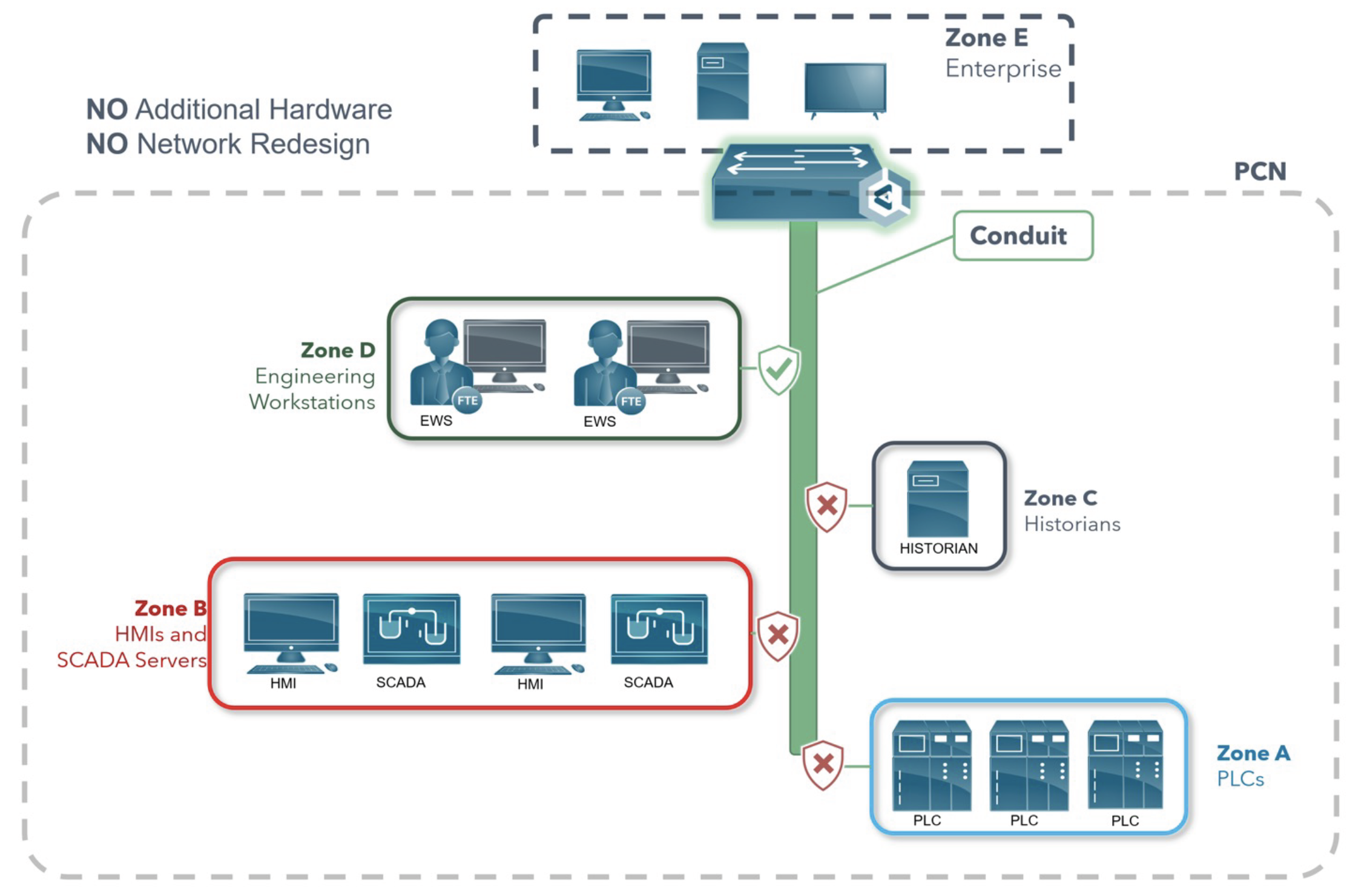
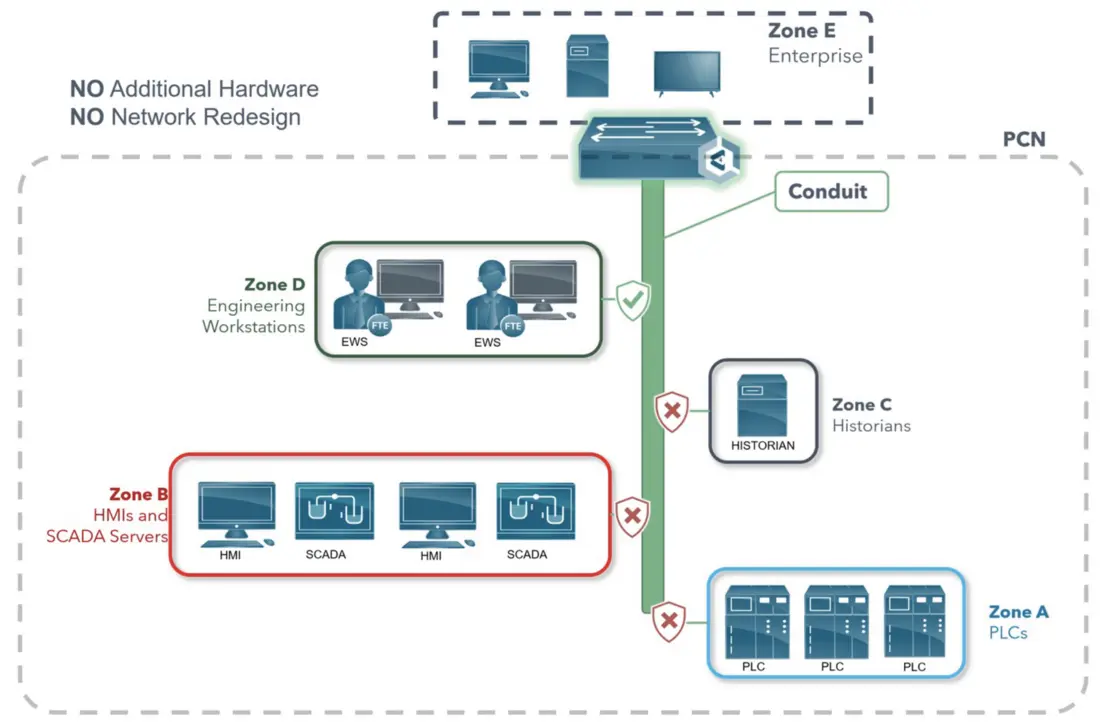
IEC 62443 commonly uses the concepts of zones and conduits. A zone groups assets with similar security needs. A conduit is a controlled communication path between zones. In a food plant, typical zones may include business IT, an industrial demilitarized zone (DMZ), plant supervisory systems, individual line or cell networks, and safety-related systems where applicable.
Source: elisity
For each conduit, document:
- Source and destination zones.
- Business or operational purpose.
- Protocols and ports in use.
- Whether traffic is one-way, scheduled, continuous, or initiated only when needed.
- Authentication method and user accountability.
- Firewall rules, jump hosts, or other controls that enforce the connection.
- Whether the route is still necessary.
A common finding is that flat plant networks make it possible for a compromise of one device to reach many unrelated systems. Segmentation is not simply adding a firewall. It requires a defined operational purpose for each allowed route, rules that support that purpose, and a method to maintain the design when equipment changes.
4. Examine remote vendor access closely
Food plant vendor remote access security deserves separate review because equipment suppliers often need occasional support for PLCs, drives, vision systems, packaging equipment, or refrigeration controls. Remote support can be operationally valuable, but unmanaged access can create a persistent path into production systems.
Assess each vendor connection against these questions:
- Is access enabled only when needed, or is it continuously available?
- Does each person use a unique account with multifactor authentication where feasible?
- Does the connection terminate in a controlled remote-access gateway or jump host rather than directly on a PLC or HMI network?
- Is the session approved by a plant owner and monitored by a responsible employee?
- Are vendor activities logged, and can the plant review what systems were accessed?
- Are permissions restricted to the equipment and functions required for the task?
- Is access removed promptly when a contract, project, or support need ends?
Shared credentials, unmanaged remote desktop tools, consumer-grade remote-access software, and undocumented cellular connections should be treated as high-priority review items. Do not disconnect a connection without understanding its role in support, warranty, or operations; replace it with an approved path under a controlled change plan.
5. Build realistic OT threat scenarios
The assessment should consider both malicious activity and ordinary operational pathways that can introduce risk. Useful scenarios are specific enough to test controls but do not need to speculate about every possible attacker technique.
Examples include:
| Scenario | Potential plant consequence | Safeguards to assess |
|---|---|---|
| Ransomware reaches a supervisory workstation from the business network | Loss of HMI or SCADA visibility, delayed production recovery, loss of records | Segmentation, backups, recovery procedures, least-privilege access |
| Unauthorized PLC programming change | Changed sequence, alarms, setpoints, or equipment behavior | Restricted programming access, approved change control, logic backups, independent process safeguards |
| Vendor credentials are misused | Unapproved access to a line or control network | Time-limited access, multifactor authentication, session logs, jump host controls |
| Infected removable media is connected to an engineering station | Malware or unauthorized files reach OT assets | Removable-media procedures, controlled scanning, dedicated engineering media, user training |
| Network failure or firewall misconfiguration blocks a needed control path | Loss of communication, alarms, or production coordination | Tested network changes, documented dependencies, rollback plans, redundant design where justified |
For each scenario, rate consequence and likelihood using the plant’s risk method. Consider impacts separately: personnel safety, food safety or quality, regulatory or customer obligations, production availability, equipment damage, and recovery effort. The purpose is to direct attention to the highest-risk combinations, not to create false numerical precision.
6. Review the core safeguards
Most early improvements fall into a few practical control areas.
Access and account control
Remove unnecessary local administrator rights. Eliminate shared accounts where a system can support named access. Protect engineering workstations and programming software especially carefully, since they can directly alter controller configurations. Maintain a process for emergency access, but ensure it is accountable and reviewed afterward.
Secure configuration and change management
Keep current copies of PLC programs, HMI projects, SCADA configurations, network-device configurations, recipes, and supporting documentation. Record authorized changes, test them in an appropriate environment when possible, and retain a rollback plan. A backup file that cannot be restored to compatible equipment is not a dependable recovery measure.
Backup and recovery readiness
Back up OT configurations separately from general office data. Protect backups against unauthorized alteration and make them available during a network outage. Periodically test restoration under controlled conditions. The test should confirm not only that files exist, but that the plant can locate the right version, restore it safely, and validate operation afterward.
Monitoring and incident response
OT monitoring should prioritize visibility with minimal interference. Establish who reviews alerts, how an abnormal event is escalated, and who can make production decisions. Incident plans should include operations and engineering contacts, vendor support contacts, criteria for isolating affected systems, communications responsibilities, and recovery priorities.
Avoid treating an infected OT asset exactly like a conventional office computer. Immediate shutdown, reboot, or isolation can have process consequences. The response plan should identify qualified decision-makers and safe containment options before an incident occurs.
7. Prioritize and maintain the risk register
Convert findings into a plant-owned register. Each item should state the affected asset or zone, scenario, consequence, current controls, gap, recommended action, responsible owner, target date, and method of closure verification.
Prioritize actions that reduce broad exposure while respecting uptime constraints. For many plants, high-value early actions include documenting assets and connections, removing unknown remote access, protecting engineering workstations, separating business and control networks, validating backups, and formalizing response procedures.
Review the assessment after a line expansion, controls upgrade, network redesign, acquisition of connected equipment, major software change, or cybersecurity incident. OT risk changes with the plant. A risk assessment that is not updated after changes becomes an archive rather than an operating tool.
A concise plant walkthrough checklist
Before closing an assessment, confirm that the team can answer the following:
- Do we know every PLC, HMI, SCADA server, engineering workstation, and network path in the scoped area?
- Can we identify the systems that affect approved process parameters, product records, utilities, and production availability?
- Is there a current diagram showing IT-to-OT and vendor-access routes?
- Are plant networks segmented according to operational need, with controlled conduits between zones?
- Can the plant account for every remote user and every remote-access method?
- Are controller programs, configuration files, and network configurations backed up and recoverable?
- Are changes to PLC logic, recipes, alarm limits, and network rules authorized and traceable?
- Does the incident plan include operations, maintenance, controls engineering, IT, and critical vendors?
A sound food manufacturing OT cybersecurity risk assessment does not require turning every production asset into an IT endpoint. It requires understanding the production consequences of digital access and applying controls that preserve both security and reliable operations. The strongest programs make cyber risk part of normal engineering, maintenance, change-management, and recovery work.
References
- IEC 62443 OT/ICS Risk Assessment Checklist for Food & Beverage Manufacturing | Shieldworkz. (n.d.). http://www.shieldworkz.com/regulatory-playbooks/iec-62443-based-ot-ics-risk-assessment-checklist-for-food-beverage-manufacturing-sector
- IEC 62443 OT/ICS Risk Assessment Checklist for Food & Beverage Manufacturing | Shieldworkz. (n.d.). https://shieldworkz.com/regulatory-playbooks/iec-62443-based-ot-ics-risk-assessment-checklist-for-food-beverage-manufacturing-sector
- IEC 62443 OT/ICS Risk Assessment Checklist for Food & Beverage Manufacturing | Shieldworkz. (n.d.). https://www.shieldworkz.com/regulatory-playbooks/iec-62443-based-ot-ics-risk-assessment-checklist-for-food-beverage-manufacturing-sector
- Reddit - The heart of the internet. (n.d.). https://www.reddit.com/r/OT_Cyber_Security/comments/1rr0b9n/otics_risk_assessment_checklist_for_food_beverage
- Food Manufacturing Cybersecurity: Protecting Connected Production Systems. (n.d.). https://ifactoryapp.com/industries/food-manufacturing/food-manufacturing-cybersecurity-connected-production-systems
- Cybersecurity in Food and Beverage Manufacturing: Protecting the Heart of Operations | Food Engineering. (n.d.). https://www.foodengineeringmag.com/articles/101706-cybersecurity-in-food-and-beverage-manufacturing-protecting-the-heart-of-operations
- Food Sector IEC 62443 and OT Cybersecurity Guide. (n.d.). https://www.cagripolat.com/iec62443/en/iec-62443-cybersecurity-food-beverage-sector
- IEC 62443: Ultimate OT Security Guide | Rockwell Automation | US. (n.d.). https://www.rockwellautomation.com/en-us/company/news/blogs/iec-62443-security-guide.html