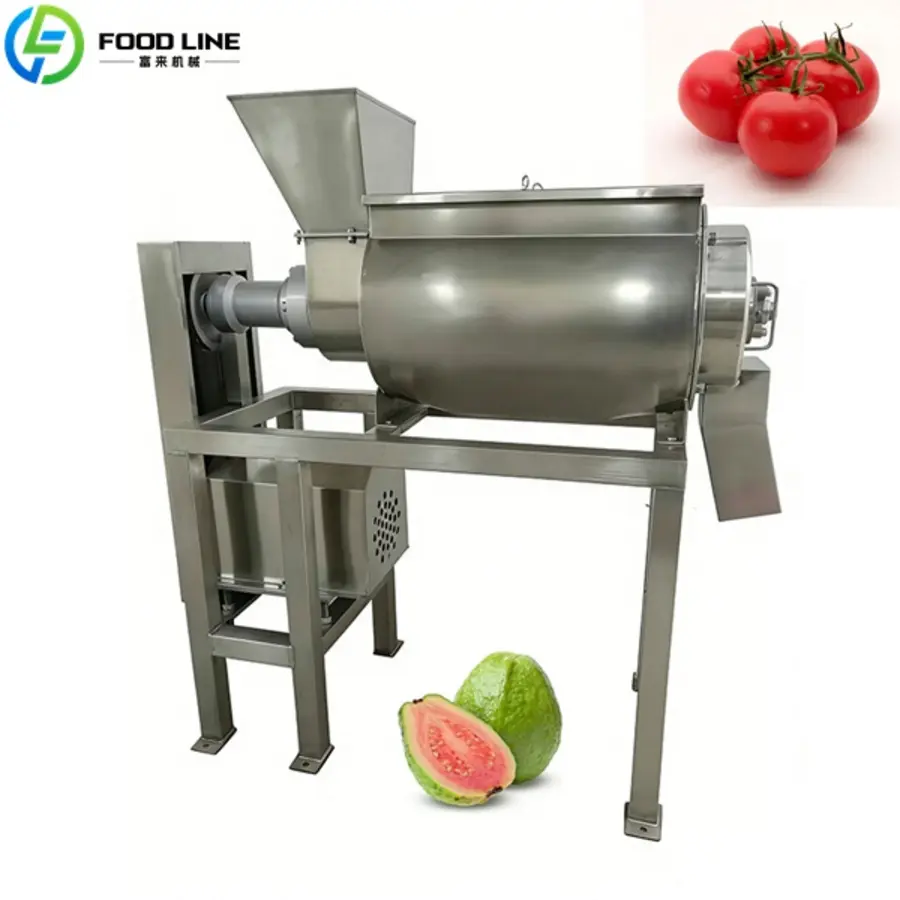
For food mill vs grinder for tomato processing, the deciding question is simple: do you need to remove skins and seeds as part of the operation? A grinder reduces the size of the entire tomato mass. A food mill, tomato strainer, or dedicated pulper-finisher pushes soft pulp through a screen while retaining larger skins, seeds, and other coarse material.
For a small processor making rustic sauces, salsas, or products where seeds and skins are acceptable, a grinder may be sufficient. For smooth tomato sauce, seed-reduced puree, baby-food-style fruit puree, or a consistent ingredient for further processing, a mill or pulper-finisher is usually the more appropriate machine. The equipment should be selected around the required finished product, not simply around the available motor size.
The functional difference: grinding versus separating
A grinder uses cutting, crushing, shearing, or plate action to break ingredients into smaller particles. Depending on the machine, tomatoes may be chopped, crushed, or turned into a coarse slurry. But everything entering the grinder generally remains in the product stream unless another separation step follows.
A food mill performs a different task. Soft material is worked against a perforated screen or similar separating surface. Fine pulp passes through the openings, while skins, seeds, fibrous pieces, and other oversize material are held back or discharged separately. Manual food mills perform this in batches; electric mills and continuous-feed units apply the same broad principle at higher production rates.
A dedicated industrial tomato mill is more accurately described as a pulper or pulper-finisher. These machines typically use a rotating beater, paddle, brush, or rotor inside a perforated screen. The rotor moves and presses softened tomato flesh against the screen. Usable pulp passes through, while pomace exits separately.
Food mill, grinder, or pulper-finisher: comparison
| Equipment type | Main action | Seed and skin separation | Typical texture | Best fit | Main limitation |
|---|---|---|---|---|---|
| Grinder or crusher | Cuts, crushes, or shears product | No, not by itself | Coarse to fine slurry, depending on machine | Rustic sauce, pre-crushing, general fruit preparation | Does not create a clean, screened puree without added equipment |
| Small food mill attachment | Presses soft product through a screen | Yes, within the screen size and product condition | Smooth but batch-dependent | Small farm batches, test production, seasonal processing | Limited duty cycle and feed rate |
| Electric food mill or tomato strainer | Continuous or semi-continuous screening and pressing | Yes | Smooth puree with reduced skins and seeds | Higher-volume small processing | May struggle with poor preparation or very high solids loads |
| Industrial tomato pulper-finisher | Rotor-assisted pulping and screening | Yes, designed for continuous separation | Controlled puree for sauce, juice, or further finishing | Commercial tomato and soft-fruit processing | Requires more space, cleaning discipline, and maintenance planning |
| Colloid mill or high-shear mixer | Fine particle reduction and dispersion | No, unless used after screening | Very fine homogeneous puree | Refining already-separated pulp | Can break down seeds and skins if used before separation |
Why a grinder can create the wrong tomato texture
Grinding tomatoes before separation can be useful, especially when whole tomatoes need to be broken up for pumping or feeding. However, it can also make later separation more difficult if skins and seeds are aggressively fragmented.
Finely broken skin particles can pass through a downstream screen or remain suspended in the puree. Crushed seeds may contribute visible dark specks, a gritty sensation, or flavor changes that do not suit the target product. The result may be acceptable for a rustic sauce but unsuitable for a smooth retail puree.
This does not mean a grinder has no place in a tomato line. In larger systems, a crusher may be installed ahead of a pulper to open the fruit and create a pumpable feed. The important point is that crushing is not a replacement for finishing. If the finished specification calls for tomato seed and skin separation, include a screening step designed for that purpose.
When a food mill attachment is enough
A small food mill attachment can be a practical starting point when production is seasonal, limited in volume, or still being validated. It can work well for soft, ripe tomatoes and many cooked or softened fruits, provided the operator can keep up with feeding, collection, cleaning, and screen changes.
Choose an attachment or small electric mill when these conditions apply:
- Batches are relatively small and not continuous throughout the day.
- The product is soft enough to pass without excessive force or repeated rework.
- A modest amount of retained skins and seeds is acceptable in the waste stream.
- Operators can manually monitor feed consistency and screen buildup.
- Production can tolerate pauses for cleaning and clearing.
- The business needs flexibility more than automated throughput.
The limitation is usually not whether the attachment can produce acceptable puree. It is whether it can do so consistently over a production shift. Small machines may require frequent attention as screens load, product feed varies, or fibrous material accumulates around the working parts.
When a dedicated tomato pulper-finisher is justified
A dedicated pulper-finisher becomes easier to justify when puree quality and production flow matter more than low initial equipment cost. It is generally the better choice when tomatoes are a regular production input rather than an occasional seasonal job.
Consider a dedicated industrial tomato mill when you need:
- Continuous production rather than small batches.
- Repeatable texture across multiple lots.
- A defined separation outcome for skins, seeds, and coarse pulp.
- Better integration with washers, crushers, pumps, tanks, cookers, or fillers.
- Screen options for different puree grades.
- Faster processing during a short harvest window.
- Equipment designed for routine washdown and service access.
A pulper-finisher is also valuable when a processor handles more than tomatoes. Soft fruits such as berries, stone-fruit flesh, mango, guava, pumpkin, and cooked vegetables may require pulp separation before blending, concentration, filling, or freezing. The suitability still depends on each product’s fiber level, pit size, ripeness, and required yield.
Select by finished-product specification first
The most useful purchase specification is not “a tomato machine.” It is a description of the finished puree and the incoming product.
Before comparing machines, define the following:
1. Required separation level
Decide whether the product can contain seeds, skin fragments, and coarse fiber. A grinder may meet the requirement if a textured product is acceptable. If the product must be visibly smooth and seed-reduced, specify a milling or finishing stage.
Screen selection has a direct effect on texture, yield, and reject volume. A finer screen may produce a smoother puree but can also reduce flow or send more pulp into the pomace stream. Ask suppliers what screen options are available and how each option changes the expected product result.
2. Product condition at the inlet
Tomato ripeness, variety, temperature, solids level, and damage all affect how easily pulp separates. Soft, ripe tomatoes generally pass more readily than firm or under-ripe fruit. Product containing stems, leaves, field debris, stones, or other foreign material can damage equipment or create screen blockage.
A practical line usually includes receiving, sorting, washing, and inspection before crushing or pulping. The exact arrangement depends on incoming raw-material condition and the processor’s hazard-control program.
3. Throughput and operating pattern
Do not select only from a headline capacity figure. Ask whether the stated rate applies to tomatoes, what preparation was assumed, what screen was used, and whether the number represents feed rate or finished-pulp output.
A machine that matches average daily volume may still be too small if the facility receives fruit in short harvest-driven windows. Conversely, an oversized unit can increase cost, cleaning burden, and product hold-up. Consider peak receiving periods, shift length, planned downtime, and whether the machine must feed downstream equipment continuously.
4. Motor duty and mechanical design
Tomatoes are soft, but a finishing machine still works under load. Skin buildup, variable fruit condition, and restrictive screens can change torque demand. Confirm that the drive, bearings, screen support, discharge arrangement, and motor duty are appropriate for the intended product and operating schedule.
For a small food processor tomato equipment purchase, verify whether the machine is intended for intermittent batches or sustained commercial operation. Household-style attachments and light-duty countertop machines may not be suitable for extended production runs.
5. Cleanability and changeover
Puree equipment should be evaluated as much for cleaning access as for processing performance. Screens, rotors, seals, chutes, covers, and discharge areas need to be accessible for inspection and sanitation. Product can accumulate in joints, dead areas, and difficult-to-reach surfaces if the machine is poorly designed or improperly reassembled.
Ask for the cleaning procedure, disassembly requirements, recommended inspection points, and replacement-part list before purchase. Cleaning chemicals, water conditions, cleaning parameters, and sanitation verification should be established through the processor’s own validated sanitation program and applicable regulatory requirements.
A practical equipment path for small processors
For many small producers, the sensible progression is not grinder versus pulper as an absolute choice. It is a staged line that separates tasks.
- Wash and sort the tomatoes. Remove unsuitable fruit and obvious foreign material before it reaches cutting or screening equipment.
- Break or crush the tomatoes if needed. Use a coarse crusher only when it improves feeding, pumping, or heat treatment.
- Condition the product if the process requires it. Some tomato processes use heating before or around pulping to influence texture and downstream behavior. The appropriate method should be developed for the specific product and verified against the processor’s food-safety plan.
- Pulp and finish. Use a food mill or pulper-finisher to separate usable puree from skins, seeds, and coarse material.
- Refine only after separation when necessary. A blender, high-shear mixer, or colloid mill can improve uniformity after skins and seeds have been removed.
- Move promptly to the next controlled process stage. This may be cooking, filling, cooling, freezing, or another validated preservation step, depending on the product.
Common selection mistakes
Buying a grinder because it has a larger motor
Motor power does not indicate whether a machine can separate skins and seeds. A high-powered grinder can produce a very fine whole-product slurry while still leaving all seed and skin material in the product.
Specifying a screen without testing the actual crop
Tomato varieties and harvest conditions can materially change pulping behavior. When possible, arrange a product trial using representative fruit, target screens, and the intended process sequence. Review both puree quality and pomace discharge, not just feed rate.
Ignoring pomace handling
A finishing operation produces a separated solids stream. Plan where skins, seeds, and retained pulp will go, how it will be collected, and how operators will remove it without interrupting production.
Treating cleanup as an afterthought
A machine may look simple until the screen, rotor, seals, and discharge passages need to be cleaned between runs. Favor designs with clear access, documented disassembly, and available spare wear parts.
Using a finisher to solve every texture problem
A pulper-finisher controls separation and coarse texture. It does not automatically provide the same result as homogenization, cooking, concentration, deaeration, or emulsification. Define the full product target before adding downstream equipment.
Bottom line
Use a grinder when the objective is size reduction and a textured tomato product is acceptable. Use a food mill or tomato strainer when you need small-scale puree production with skins and seeds removed during processing. Choose a dedicated pulper-finisher when smooth, consistent puree, continuous throughput, repeatable separation, and commercial cleanability are central requirements.
For most growing processors, the key distinction is this: grinding makes particles smaller; milling and finishing create a separated puree. If tomato seed and skin separation is part of the finished-product specification, select equipment built to perform that separation rather than expecting a grinder to do it indirectly.
References
- Tomato Strainer vs Food Mill: What’s the Difference?. (n.d.). https://reluctantgourmet.com/tomato-strainer-an-great-tool-for-home-cooks
- Food Mill vs Food Processor | What Each One Does Better. (n.d.). https://www.gofoodservice.com/blog/food-mill-vs-food-processor-what-are-the-differences
- Is a food mill better than a blender?. (n.d.). https://www.lkmixer.com/blog/is-a-food-mill-better-than-a-blender
- Ever noticed any difference between grinding tomato mix …. (n.d.). https://www.facebook.com/groups/145634399426355/posts/1811094059547039
- r/tomatoes - Food mill. (n.d.). https://www.reddit.com/r/tomatoes/comments/1ix5fyv/food_mill
- What is tomato puree making machine?. (n.d.). https://www.dtfoodmachine.com/what-is-tomato-puree-making-machine
- Tomato Press or Food Mill - Do I really Need One?. (n.d.). https://www.houzz.com/discussions/1929052/tomato-press-or-food-mill-do-i-really-need-one
- Food Mills Guide - Styles, Uses & Purchasing Considerations. (n.d.). https://www.webstaurantstore.com/guide/555/food-mills-buying-guide.html