A dry-cleaning changeover can be an effective way to control allergen cross-contact in a food mixer, but only when the mixer, tools, sequence, and verification method have been assessed for the specific product. A clean-looking vessel is not enough. The process must remove residue from product-contact surfaces and the less obvious locations where powder, paste, inclusions, or fines can remain.
Food mixer allergen cleaning validation establishes evidence that a defined cleaning method can repeatedly reduce allergen residue to the plant’s acceptable standard before an unlabeled or different-allergen product is made. The practical approach is to map residue traps, choose dry cleaning or wet cleaning according to the product and equipment, write a controlled changeover sequence, and verify that the procedure continues to work in production.
Start with the changeover risk, not the cleaning tool
The first question is not whether a mixer can be brushed, vacuumed, or washed. It is whether the preceding product can transfer an allergen to the next product at a meaningful point in the process.
Build a changeover assessment around the following factors:
- Allergens present in the previous and next formulations, including ingredients added manually.
- Whether the next product declares the same allergen.
- Product form: free-flowing powder, sticky dough, hydrated batter, fat-based paste, seeds, particulates, or liquid.
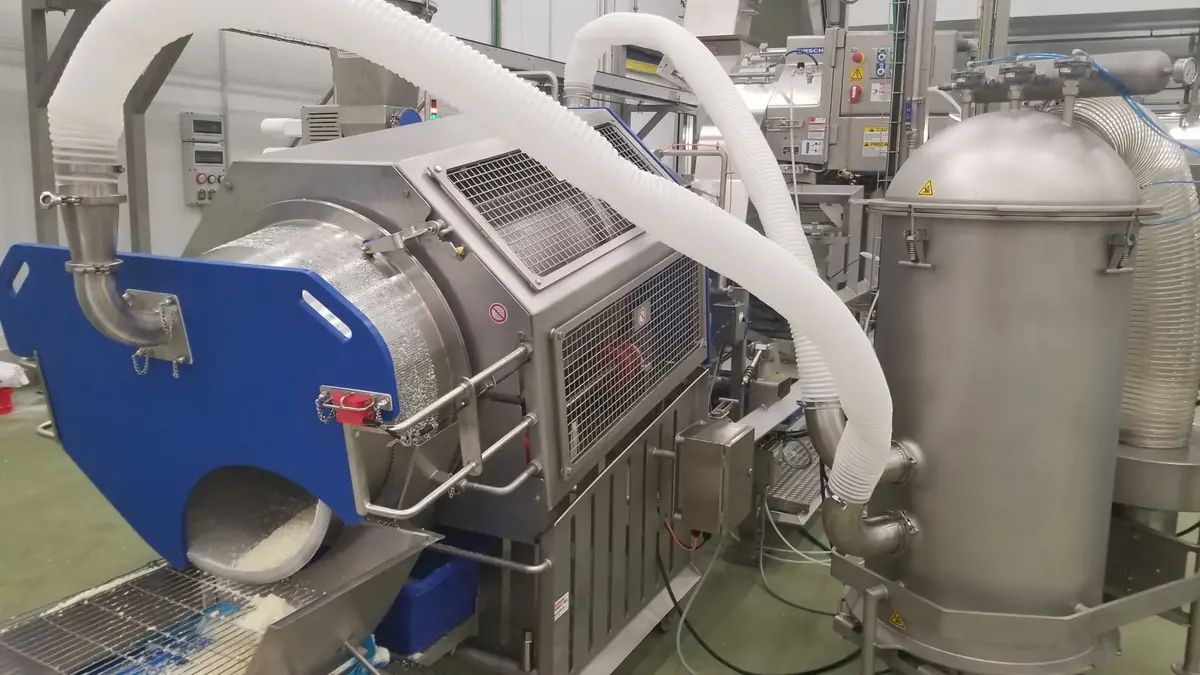
- Mixer design, including the agitator, shaft seals, discharge valve, lid gasket, spray devices, access doors, and any attached feeder or transfer equipment.
- Whether residue can move downstream through a shared discharge chute, conveyor, tote, or packaging interface.
- How often the changeover occurs and whether operators have enough access and time to perform it consistently.
This assessment should include more than the mixer bowl. A mixer may be clean while residual material remains in an ingredient hopper, bag-dump station, dust-collection connection, flex hose, valve body, or product discharge transition.
Find the residue traps in the mixer
Residue generally accumulates where product is compressed, shielded from cleaning access, or retained after discharge. The exact locations vary by mixer type, but several areas deserve deliberate inspection.
Ribbon blenders and paddle mixers
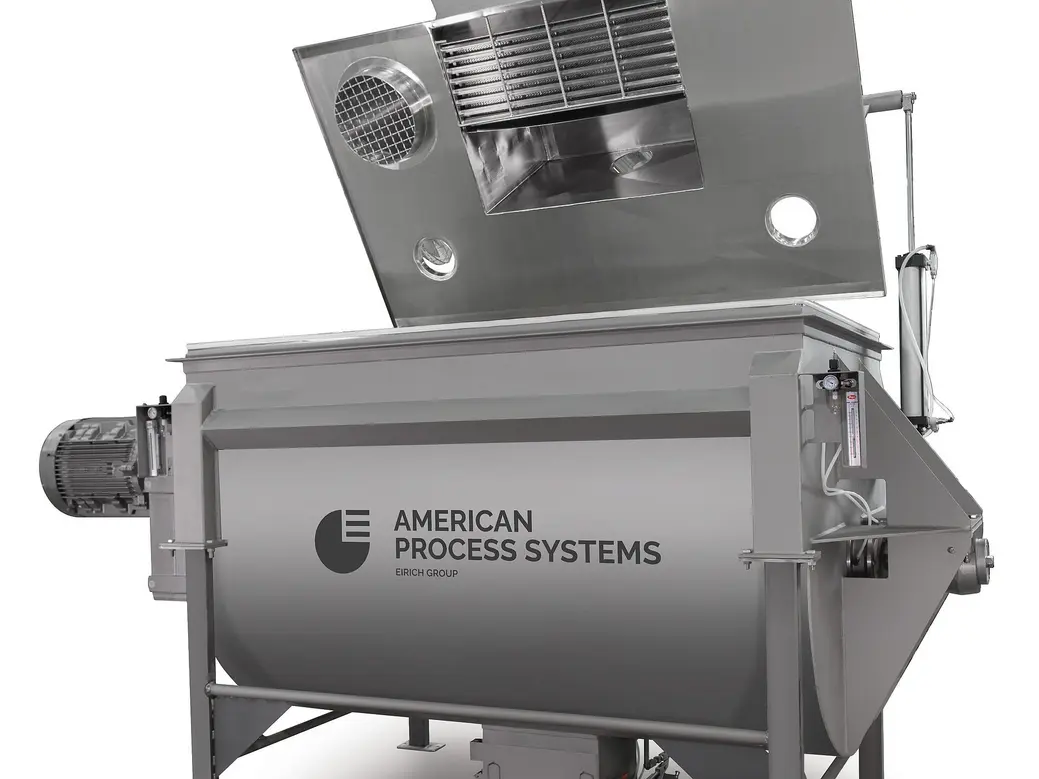
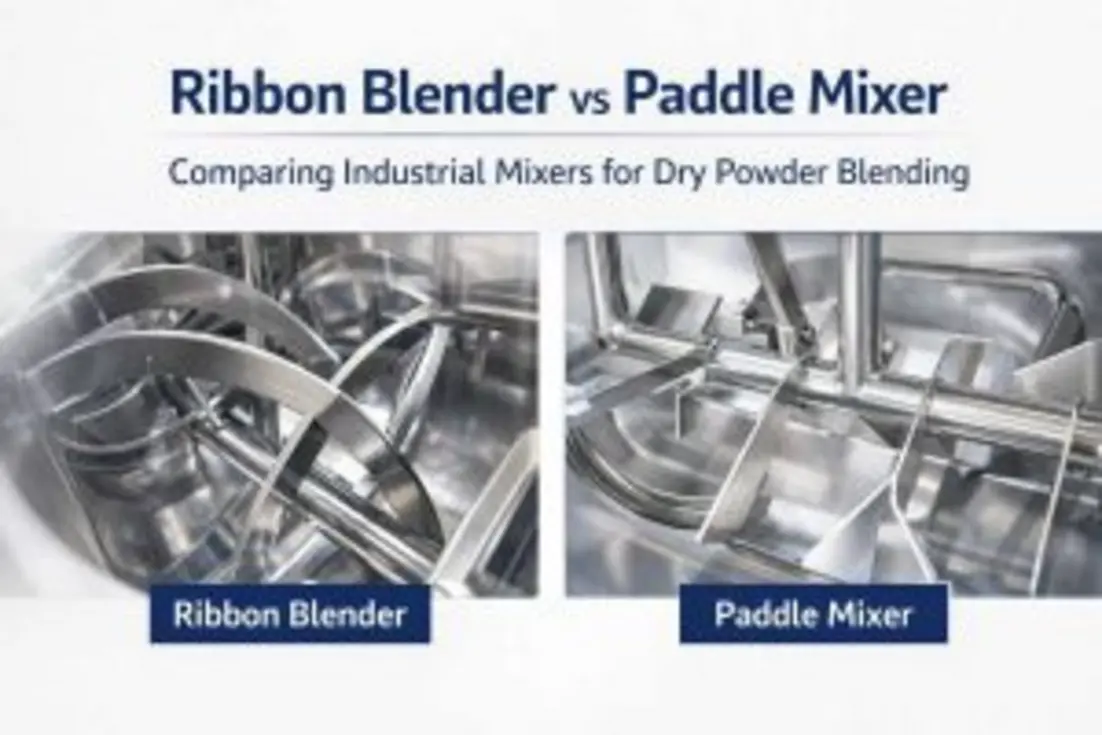
In horizontal mixers, inspect the ribbon or paddle attachment points, the underside of the agitator shaft, end-wall clearances, shaft seals, lid gasket grooves, and the full discharge assembly. Product may bridge above or behind the discharge gate, especially where a valve does not fully clear material from its seat or housing.
Planetary and vertical mixers
For vertical mixers, inspect the attachment hub, beater or dough-hook joints, bowl rim, bowl-lift contact areas, splash guard, lid components, and discharge pathways. Sticky materials can remain in attachment geometry even when the bowl itself appears clean.
High-shear and vacuum mixers
High-shear heads, chopper housings, rotor-stator assemblies, seals, ports, vacuum connections, and recirculation loops need special attention. These components can have confined spaces that are difficult to dry clean adequately. Disassembly may be necessary where the equipment design does not permit reliable access.
Source: jmindustrial
Connected equipment and the surrounding area
Do not treat the mixer as an isolated control point. Dust deposited on external ledges, electrical enclosures, scales, hand tools, or operator platforms can be transferred back into the product area. Cleaning practices should control this indirect route as well as residue inside the product zone.
When dry cleaning is appropriate—and when it is not
Dry cleaning commonly suits dry products where introducing water would create a product-quality problem, delay restart, or create an additional sanitation burden. Controlled dry removal can also reduce the risk of spreading allergen-containing slurry through a large area.
Typical dry-cleaning methods include:
- Emptying the mixer completely through its normal discharge route.
- Using dedicated or controlled dry brushes, scrapers, and non-shedding wipes where suitable.
- Vacuuming residue with equipment designed for the application and managed to avoid redistributing material.
- Removing accessible components for detailed cleaning.
- Wiping targeted surfaces when the wipe method does not smear or spread the residue.
Dry cleaning is not automatically suitable for every product. A sticky, oily, hydrated, or highly adherent formula may remain attached to seals, shafts, blades, and valve surfaces after brushing and vacuuming. In those cases, a wet-cleaning procedure, a partial disassembly, or a different production sequence may be required.
Compressed air deserves particular caution. Uncontrolled air can disperse allergen-containing dust into the room, onto nearby equipment, and into difficult-to-clean spaces. If air is considered at all, its use should be evaluated within the site’s allergen-control program and supported by a method that prevents residue migration.
A practical dry-cleaning changeover sequence
A written sequence turns cleaning from an individual judgment call into an operating control. The following structure can be adapted to the mixer and product family.
1. Schedule the run to reduce cleaning burden
Where practical, run products in an allergen sequence that moves from non-allergen or lower-risk products toward products with more or different allergens. Scheduling does not replace cleaning, but it can reduce the number of high-risk transitions.
Confirm the next product, its label status, and its allergen profile before cleaning begins. This avoids starting a changeover based on an incorrect production assumption.
2. Stop, isolate, and remove bulk product
Follow the plant’s equipment isolation and worker-safety procedures before entering, disassembling, or cleaning the mixer. Remove remaining product from the bowl, agitator, discharge, and connected transfer points. Record or otherwise account for retained material according to site procedure.
The objective at this stage is complete bulk removal, not simply running the mixer until product flow slows.
3. Disassemble the defined access points
Open the access doors and remove components identified in the risk assessment. Depending on the design, this may include agitator attachments, covers, screens, gaskets, discharge parts, flexible connectors, or small ingredient-addition fittings.
A procedure should identify what must be removed, what may remain installed, and how operators inspect areas that cannot be directly seen.
4. Clean from high to low and from clean-adjacent areas toward residue collection
Use the approved dry tools and method to remove material without redistributing it. Clean the highest-risk product-contact surfaces first, then the surrounding zones that could reintroduce residue during reassembly.
Tool control matters. Brushes, vacuums, scrapers, and cloths used on an allergen line can become transfer vehicles. Sites commonly address this through dedicated tools, controlled cleaning and release of shared tools, clear identification, and protected storage.
5. Inspect while the mixer is still open
Visual inspection is useful because it finds obvious retained product, damaged gaskets, inaccessible areas, and incomplete disassembly. FDA guidance notes that visual examinations may be part of written cleaning validation procedures and should be conducted while equipment remains disassembled after cleaning.
However, visual inspection alone should not be the sole basis for concluding that an allergen cleaning process is effective. Residue can remain in seams, under seals, and in surfaces that look clean.
6. Reassemble, protect, and release the equipment
Reassemble the mixer using the approved parts and confirm that product-contact components are correctly installed. Remove cleaning tools and waste from the area. Before production restarts, complete the site’s documented release steps, including any required inspection, test result review, or supervisor signoff.
Validation, verification, and monitoring are different jobs
These terms are often used interchangeably, but they answer different questions.
| Activity | Main question | Typical use in a mixer changeover |
|---|---|---|
| Validation | Can this cleaning method reliably control the identified allergen risk? | A planned study of the written cleaning process under challenging conditions. |
| Verification | Did the method work on this changeover? | Inspection, documented checks, and where appropriate, targeted allergen testing. |
| Monitoring | Was the procedure followed as required? | Confirming required disassembly, tool use, inspection, and records during routine operation. |
A validation study should represent the real operating condition, including difficult product residues, normal operators, the actual mixer configuration, and the expected interval between production and cleaning. The worst case may be the stickiest recipe, the highest-allergen load, the longest campaign, a product with fine dust that enters seals, or a changeover involving the most sensitive unlabeled next product.
FDA materials on allergen cleaning describe written validation procedures, when necessary, that can specify visual examinations, test methods, and verification frequency. They also identify events that warrant reassessment, such as introducing an allergenic ingredient, changing equipment or cleaning procedures, or reducing cleaning frequency. Your facility should confirm the applicable regulatory and customer requirements for its market and certification program.
Build a defensible test plan
Testing should be selected for the allergen, product matrix, surface material, and purpose of the study. Rapid tests, swabs, rinses, and product testing can each provide useful evidence, but none should be used outside its intended scope or without understanding its limitations.
A practical validation plan usually defines:
- The allergen and product transition being assessed.
- The specific mixer model, configuration, and connected equipment included.
- The cleaning steps, tools, disassembly level, and operator instructions.
- Sampling locations selected from the residue map.
- The analytical method, sample collection procedure, and acceptance criteria.
- The number and conditions of runs needed to demonstrate repeatability.
- Actions to take when a result or inspection does not meet the established requirement.
Target sampling locations where residue is likely to persist, not only broad, easy-to-access stainless-steel surfaces. For example, a shaft seal, discharge gate interior, lid gasket channel, or difficult agitator junction may provide more meaningful information than the center of an open bowl wall.
If the first production after cleaning is included in the validation strategy, define how that batch is controlled until results are reviewed. The approach should be established by the facility’s qualified food-safety team and align with its hazard analysis and disposition procedures.
Common changeover failures
Several weaknesses recur in mixer allergen programs:
- Relying on appearance alone. A bright stainless surface does not demonstrate removal from hidden interfaces.
- Cleaning the vessel but not the discharge path. Product retained below the mixer can contaminate the next batch immediately.
- Using poorly controlled shared tools. A brush or vacuum hose can transfer residue between lines.
- Skipping disassembly to save time. If a seal or valve body cannot be cleaned in place, the time saving is not a valid control.
- Copying a method from another mixer. Similar equipment can have different seals, clearances, access points, and residue behavior.
- Failing to reassess after changes. A new formula, altered agitation setting, replacement gasket, or different cleaning tool can change the risk profile.
Keep the procedure effective over time
Once the cleaning method has been validated, maintain it through routine verification, operator training, record review, and periodic reassessment. Trends matter: repeated visual failures at one valve, recurring positive test results at a seal, or unusually long cleaning times can indicate an equipment-design issue rather than an operator problem.
Where a mixer repeatedly retains allergen material, consider practical engineering improvements such as better access covers, more cleanable valve geometry, removable components, improved gasket design, reduced ledges, or dedicated product-contact parts. In some cases, product scheduling or dedicated equipment will be more reliable than increasingly complex cleaning.
The goal is not the shortest possible changeover. It is a repeatable, evidence-based changeover that prevents allergen cross-contact without adding unnecessary wet-cleaning downtime. A residue map, an accessible mixer design, controlled dry-cleaning tools, documented inspection, and risk-based validation together provide a stronger control than a visual check alone.
References
- Know: Allergen Cleaning Validation - Food Industry Hub. (n.d.). https://foodindustryhub.com/food-industry-knowledge-centre/know-allergen-cleaning-validation
- Allergen Cleaning Validation Guide | PDF | Verification And Validation | Quality. (n.d.). https://www.scribd.com/document/165303519/Allergen-Cleaning-Validation-Verification
- Cleaning and other control and validation strategies to prevent allergen cross-contact in food-processing operations. (n.d.). https://www.academia.edu/52962211/Cleaning_and_other_control_and_validation_strategies_to_prevent_allergen_cross_contact_in_food_processing_operations
- importance of sanitation and allergen preventive controls. (n.d.). https://vtechworks.lib.vt.edu/bitstreams/64605b49-d7dd-4af0-ad31-79572a334b9a/download
- [PDF] appendix 10: cleaning and sanitation for the control of allergens - FDA. (n.d.). https://www.fda.gov/media/129671/download
- [PDF] Draft Guidance for Industry - Chapter 11: Food Allergen Progr - FDA. (n.d.). https://www.fda.gov/media/172318/download
- Webinar | Cleaning Validation for Allergen Control in Food Manufacturing. (n.d.). https://www.vikan.com/us/knowledge-center/webinars/cleaning-validation-for-allergen-control-in-food-manufacturing
- Webinar | Cleaning Validation for Allergen Control in Food Manufacturing. (n.d.). https://www.vikan.com/au/knowledge-centre/webinars/cleaning-validation-for-allergen-control-in-food-manufacturing