Compressed air can be a contamination route when it touches food, food-contact surfaces, or the inside of primary packaging. The practical starting point for food plant compressed air quality is not a broad claim that the plant uses “food-grade air.” It is a documented map of every air-use point, the realistic route by which contamination could transfer, and the air-quality controls required at that point.
A sound program follows the air from intake to use: locate clean intake air, manage compressor-generated contaminants, remove water and oil through suitable treatment, protect critical points with final filtration, control condensate, verify performance by testing, and document maintenance. The required quality level should come from the facility hazard analysis, product and process risks, customer specifications, and applicable regulatory or certification-scheme requirements.
Start by classifying every air-use point
Compressed-air systems often serve many functions from one header. Those functions should not automatically receive the same air specification. A pneumatic actuator in a remote utility area does not present the same risk as air used to convey powder or blow debris from the inside of a container before filling.
Build an air-use register for every production area, packaging line, and utility connection. Record the equipment, purpose, location, air source, downstream treatment, and whether air can enter a product or packaging zone. Then assign a risk category.
| Use category | Typical examples | Main control question |
|---|---|---|
| Direct product contact | Product conveying, aeration, ingredient handling, product blow-off | Can contaminants in the air transfer directly into food? |
| Direct primary-packaging contact | Blowing out bottles, drying the inside of containers, package inflation | Does air touch the inside or food-contact side of packaging before filling or sealing? |
| Indirect contact or adjacent exposure | Pneumatic exhaust near open product, air knives near food-contact equipment, packaging-area blow-off | Can exhaust or airborne residue settle onto exposed product or food-contact surfaces? |
| Non-product-contact utility use | Actuators in enclosed equipment, maintenance tools, remote controls | Is there a credible path from this air to product or a food-contact surface? |
The classification should account for normal operation, startup, cleaning, maintenance, line stoppages, and unusual operating conditions. A line that is enclosed during production may expose packaging interiors during setup. Likewise, an actuator may be low risk until its exhaust is redirected toward an open product zone.
Document the reason for each classification. That record is often more useful than a generic statement about plant air because it shows that the facility has evaluated actual contamination paths.
Set the air-quality target before choosing equipment
ISO 8573-1 is widely used to describe compressed-air purity in terms of particles, water, and oil. Its class format gives teams a common way to state and compare a target. It does not, by itself, determine whether air is suitable for a particular food application or replace a hazard analysis.
For each risk category, the air-quality specification should define:
- The applicable particle, water, and oil limits or ISO 8573-1 classes.
- Whether the point requires a terminal filter or a validated sterile air barrier.
- The sampling point used for verification.
- Any product-specific concerns, such as odor transfer, sensitive powders, or packaging applications.
- The responsible owner for monitoring, corrective action, and review.
Higher purity is not automatically better if it is not needed, but under-specifying direct-contact air can leave an uncontrolled food-safety risk. A plant may use different quality targets on separate branches of the same system, provided the distribution design prevents lower-quality air from reaching controlled use points.
Control contamination at the air intake and compressor
Air treatment begins before the dryer and filters. The compressor intake should be located away from likely contamination sources such as vehicle traffic, exhaust discharge, dust-generating operations, chemical vents, or wet process emissions. Intake conditions can change after building modifications, seasonal ventilation changes, or nearby construction, so intake location deserves periodic review.
The compressor itself can introduce oil, wear particles, heat, and moisture into the system. Oil-free compression can reduce one source of contamination risk, but it does not eliminate the need for hazard-based downstream treatment. Ambient particles and water still enter through the intake, and contamination can arise from receivers, drains, piping, connections, and point-of-use equipment.
Oil-lubricated compressors can also be used in food facilities when the system is designed and maintained to achieve the required air specification. The lubricant strategy, separator performance, downstream filtration, and verification plan should be part of the documented design basis. “Food-grade lubricant” is not equivalent to verified compressed-air purity.
Remove bulk water before it becomes a distribution problem
Compressed air cools as it moves through the system. That cooling can cause water to condense in receivers, piping, drops, filters, and machine connections. Standing condensate creates corrosion, can overload filters, and may support contamination within the distribution system.
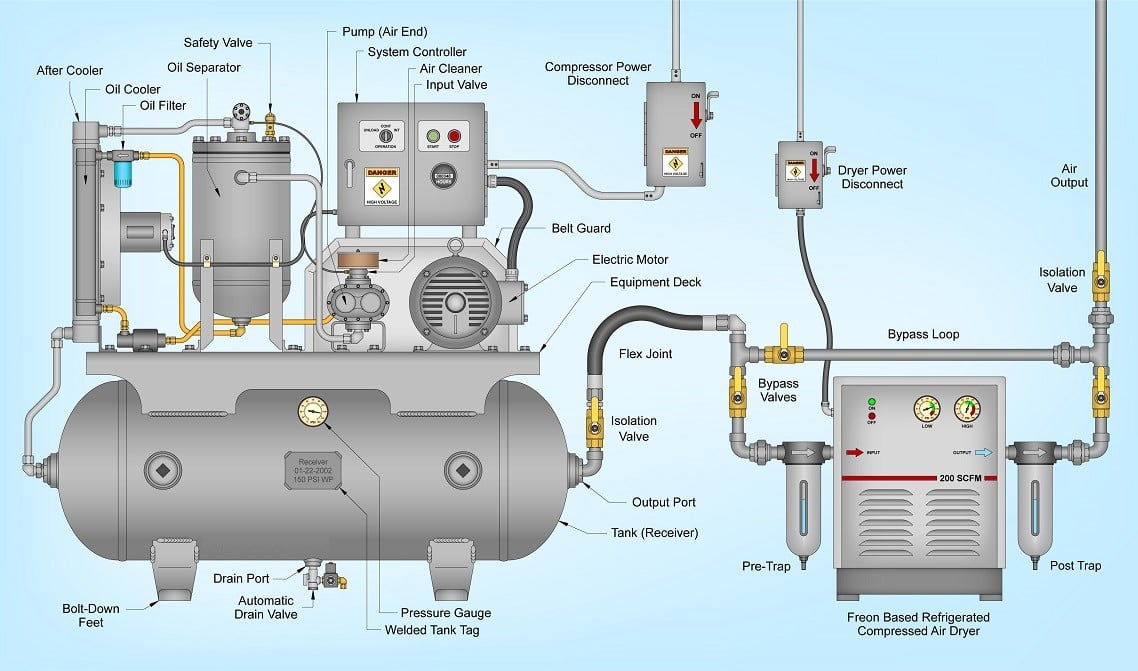
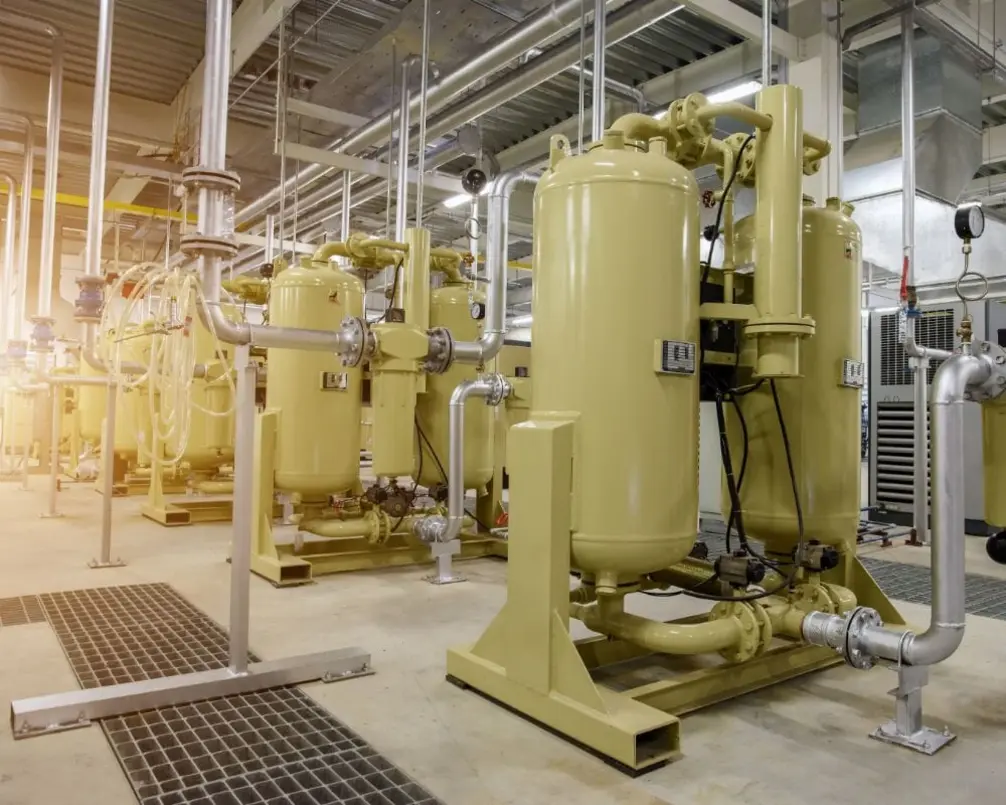
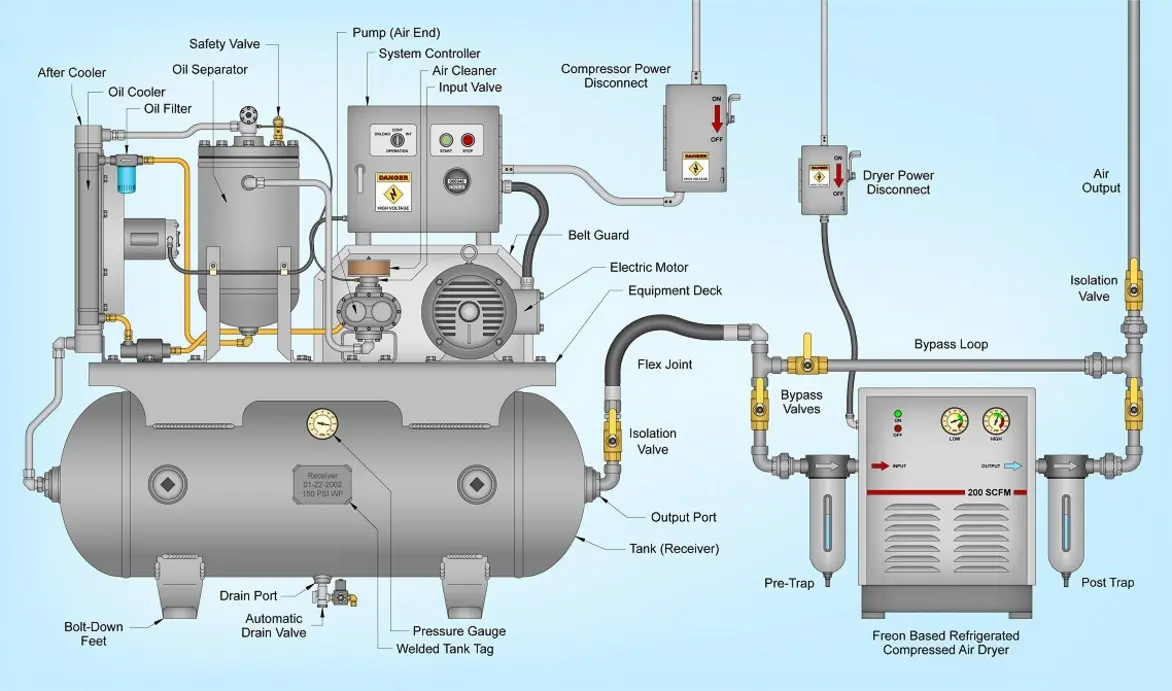
A typical treatment train uses aftercooling and moisture separation upstream, then a dryer selected for the required pressure dew point and local operating conditions. Refrigerated and desiccant dryers serve different purposes. The appropriate choice depends on the required water-control target, process environment, pressure, flow variation, and the consequences of moisture at the use point.
Source: aircompressors
For food-contact applications, do not select a dryer solely by its nominal capacity. Confirm the required pressure dew point under actual inlet temperature, ambient conditions, pressure, and demand profile. Also determine how dryer alarms, regeneration performance where applicable, and bypass arrangements will be controlled. A bypass that can supply untreated air to a critical branch requires clear physical control and written procedures.
Receivers and low points need effective condensate management. Use drains suitable for the service, inspect their operation, and route collected condensate for handling in accordance with site environmental and safety procedures. Manual draining without a defined frequency and record is rarely a dependable long-term control.
Build filtration in stages and protect the point of use
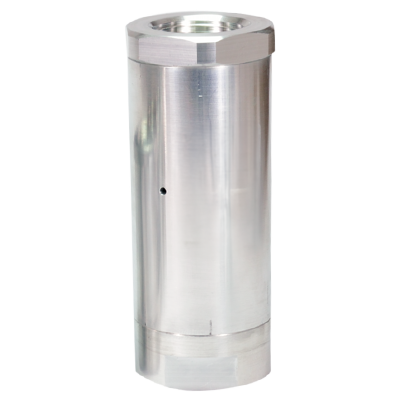
Filters have different jobs. A bulk particulate filter may protect a dryer; a coalescing filter can reduce oil aerosols and fine particles; an adsorption stage may address oil vapor or odor where required. A final point-of-use filter can protect a high-risk application from contamination picked up in downstream piping.
The exact sequence depends on the target quality and the equipment manufacturer’s requirements. Common design errors include placing a fine filter where it is exposed to excess liquid water, assuming a coalescing filter is a microbial barrier, and installing an adsorption stage without suitable upstream protection.
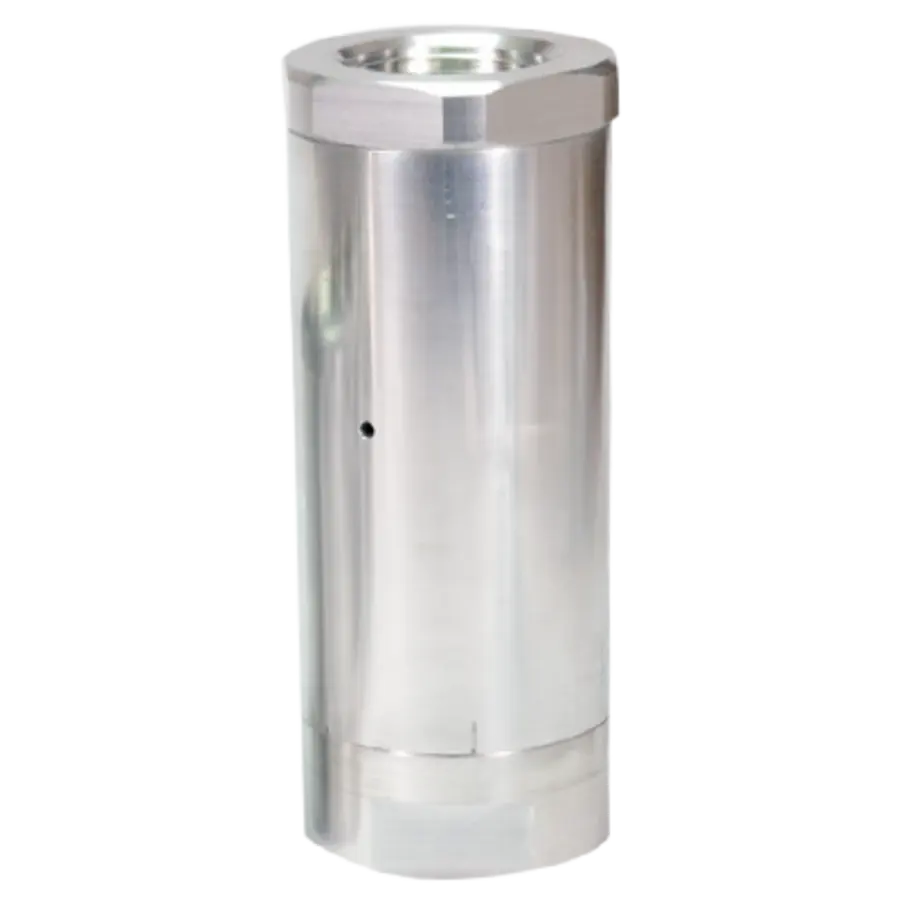
At direct-contact and relevant packaging-contact points, the final treatment should be located as close as practical to the use point. Long pipe runs after the final filter can reintroduce risk through corrosion, residue, condensate, hoses, couplings, or unauthorized connections.
Point-of-use protection checklist
- Identify each direct and indirect contact point on the line drawing.
- Install final treatment only after confirming the upstream air is adequately dried and prefiltered.
- Use housings, elements, seals, and connections appropriate for the operating pressure and process environment.
- Ensure filter housings can be serviced without creating an uncontrolled contamination path.
- Mark critical branches and prevent cross-connections with general utility air.
- Maintain differential-pressure or other condition indicators where they are part of the filter-control strategy.
- Include hoses, quick-connects, regulators, and exhaust silencers in the inspection scope.
Source: proportionair
Treat distribution piping as part of the food-safety control system
A well-specified compressor room cannot compensate for poorly maintained distribution piping. Piping should be arranged to minimize moisture accumulation and allow drainage from low points. Dead legs, seldom-used branches, corroded sections, and temporary hoses deserve attention because they can retain water and debris.
Keep the system layout current. A simple drawing should show compressors, receivers, dryers, filtration stages, main headers, critical branches, sampling ports, drains, and points where air can contact product or packaging. When a new machine is installed, review whether its demand affects pressure, dryer loading, filtration capacity, or the quality delivered to existing critical users.
Use dedicated, clearly identified branches for controlled air where practical. This reduces the chance that maintenance personnel connect general shop air to a food-contact application during a repair or changeover.
Verify air quality at the point that matters
Testing should verify delivered air, not only the condition leaving the compressor room. The most meaningful sampling points are generally at critical use points or at representative locations downstream of the final treatment.
A testing plan may include particles, water or pressure dew point, and total oil in alignment with the facility specification and relevant ISO 8573 test methods. Where the hazard analysis identifies a microbiological concern, determine with qualified food-safety and technical personnel whether microbiological testing, terminal-filter integrity verification, or another control is appropriate. The method, sampling approach, handling, and interpretation should be defined before testing begins.
Test frequency should be risk-based. Consider direct-contact status, product vulnerability, operating history, maintenance changes, system modifications, customer requirements, and prior adverse results. Test more than once when establishing a baseline for a new system or after a significant change; a single favorable result does not prove long-term control.
Keep records that connect each result to:
- Sampling location and production area.
- Date, operating condition, and relevant system configuration.
- Test method and laboratory or instrument details.
- Required limit or target specification.
- Result, review decision, and any corrective action.
An out-of-specification result should trigger a defined response. Depending on the use point and risk assessment, that may include stopping use of the affected air, isolating the branch, assessing potentially affected product and packaging, investigating the cause, restoring control, and documenting release decisions through the site food-safety system.
Make maintenance preventive rather than reactive
Compressed-air quality deteriorates gradually when drains stick, dryer performance declines, filters load, seals age, or unauthorized modifications bypass controls. Maintenance therefore needs scheduled work as well as condition-based checks.
A practical maintenance program covers compressor service, lubricant management, separator elements, receiver inspection, dryer performance, drain operation, filter changes, point-of-use housing condition, piping repairs, and leak repairs. Follow the equipment manufacturer’s maintenance instructions, but do not treat a calendar interval alone as proof of control. Review pressure drop, dew point trends, alarms, test results, and changes in operating demand.
For critical filters, record the installed element type, installation date, lot or traceability information when available, service reason, housing inspection, and post-service checks. Confirm that replacement parts match the approved design. A visually similar filter element may not provide the same performance.
Common weak points in food plant compressed air programs
Several problems recur across food facilities:
- Calling all plant air “food grade” without mapping use points and contamination routes.
- Testing only at the compressor room rather than at direct-contact endpoints.
- Specifying ISO 8573 classes without stating the class order, sampling point, or test method.
- Assuming oil-free compression removes the need for dryers and filters.
- Installing a final filter but allowing long, poorly drained piping downstream.
- Ignoring pneumatic exhaust near exposed food or the interior of primary packaging.
- Treating filter replacement as sufficient while failing to verify dryer and drain performance.
- Adding temporary hoses, regulators, or machine branches without food-safety review.
A practical implementation sequence
- Create a complete compressed-air use map.
- Classify each point as direct contact, indirect exposure, or non-product contact.
- Set a written target specification for each risk group through the hazard analysis and applicable requirements.
- Review intake location, compressor type, receivers, dryers, filters, drains, piping, and final-use protection against those targets.
- Install representative sampling points and establish a baseline through suitable testing.
- Define monitoring, maintenance, test frequency, corrective actions, and record ownership.
- Reassess the program after line changes, new products, packaging changes, compressor work, repeated alarms, or failed tests.
The goal is not to make every air line identical. It is to demonstrate that air used around food and packaging is understood, appropriately controlled, and verified where contamination could realistically occur.
References
- Meet SQF Air Quality Standards for Food Safety. (n.d.). https://www.donaldson.com/en/resources/technical-articles/meet-sqf-compressed-air-standard
- Compressed Air Quality Testing Checklist for Food Manufacturing. (n.d.). https://ifactoryapp.com/industries/food-manufacturing/compressed-air-quality-testing-checklist-food-manufacturing
- [PDF] Reducing Contamination Risks of Compressed Air in Food Plants. (n.d.). https://www.foodengineeringmag.com/ext/resources/WhitePapers/Compressed-Air-for-Food-GMPs.pdf
- ISO 8573 IN THE FOOD AND BEVERAGE INDUSTRY. (n.d.). https://airtesting.com/wp-content/uploads/2012/02/TRI_AirTesting_ISOFoodBev_Brochure_web.pdf
- ISO 8573-1 Guide to the quality of food-grade compressed air | Hengst Filtration. (n.d.). https://www.hengst.com/en/solutions/know-how/iso-8573-1-guide-to-the-quality-of-compressed-air-for-food-production
- FSANZ Compressed Air for Food: HACCP + ISO 8573-1.2.1. (n.d.). https://compressedairsolutions.com.au/resources/fsanz-food-compressed-air
- Compressed air quality testing | ISO-8573 for food and beverages | Process and sterile filtration - liquids, compressed air and gas, steam | Hengst Filtration. (n.d.). https://www.hengst.com/en/products/productgroups/1740-process-and-sterile-filtration/2133-compressed-air-test-according-to-iso-8573
- Compressed air quality testing | ISO-8573 for food and beverages | Process and sterile filtration - liquids, compressed air and gas, steam | Hengst Filtration. (n.d.). https://hengst.com/en/products/productgroups/1740-process-and-sterile-filtration/2133-compressed-air-test-according-to-iso-8573