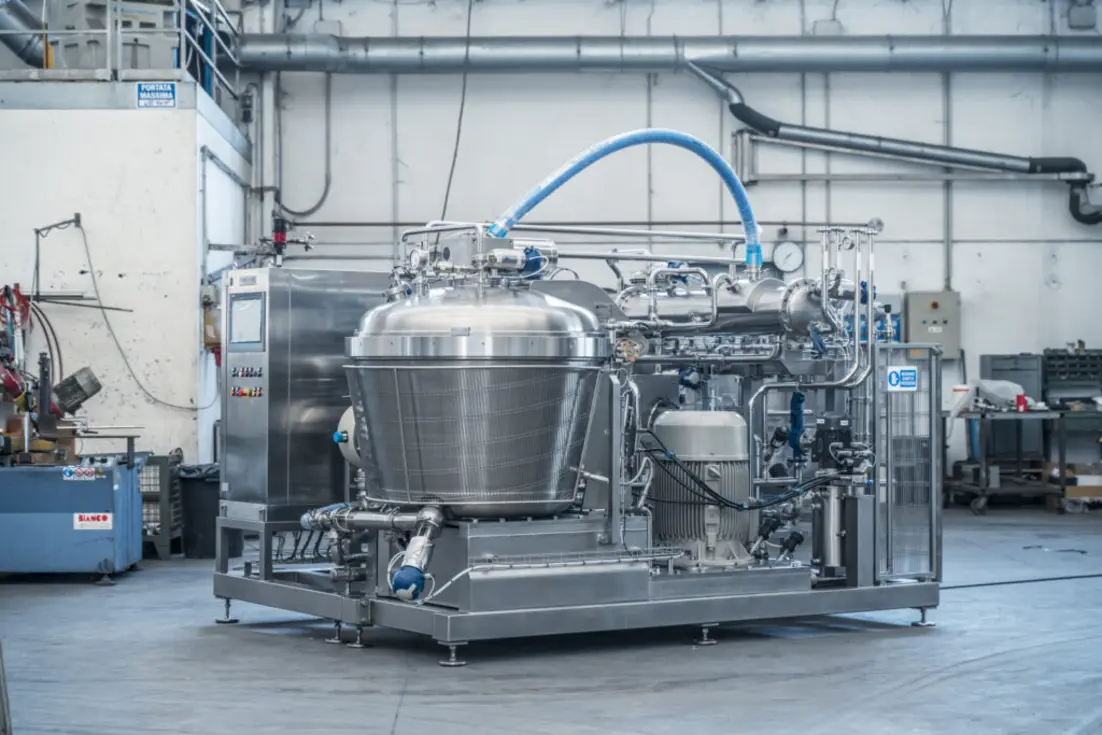
Improving the food processing equipment manufacturing process is usually less about making every department work faster and more about making work move reliably from released drawings to factory acceptance testing. The strongest gains typically come from reducing waiting, missing information, material searching, late engineering changes, and defects that are discovered only after a machine reaches final assembly.
For manufacturers of sanitary conveyors, mixers, fillers, cookers, packaging systems, and custom process skids, the objective is clear: increase throughput without weakening hygienic construction, weld quality, traceability, documentation, or final machine performance. A practical improvement program starts by mapping the real fabrication-to-FAT flow, then placing clear controls at the points where work most often stops or returns for rework.
Start with the complete fabrication-to-FAT flow
Do not map only the welding department or final assembly area. Follow one representative machine or order from engineering release through shipment. Include physical material movement and information movement: drawings, bills of materials, revision notices, inspection records, purchased components, test procedures, and customer approvals.
A typical food equipment fabrication workflow includes:
- Engineering release and bill-of-material verification.
- Material receiving, identification, and stainless steel storage.
- Cutting, punching, forming, machining, and purchased-part kitting.
- Frame and sheet-metal fabrication.
- Welding, grinding, finishing, and cleaning or passivation where specified.
- Inspection of fabricated assemblies.
- Mechanical, pneumatic, electrical, and controls subassembly.
- Final machine assembly.
- Functional testing, documentation review, and factory acceptance testing.
- Packaging, preservation, and shipment release.
The map should show more than process sequence. Record queue time, handoffs, batch sizes, travel distance, common shortages, approval delays, and the reasons jobs leave the planned route. In many shops, the actual touch time on a component is relatively short compared with the time it waits for material, a welder, a drawing clarification, inspection, or space in final assembly.
This approach follows the basic lean principle of identifying waste and improving flow rather than treating utilization as the only measure of performance. Lean manufacturing guidance for food operations similarly emphasizes removing waste while improving value flow.
Find bottlenecks before adding capacity
A bottleneck is not simply the busiest department. It is the resource, process, or decision point that limits the rate at which completed machines can move to the next stage. It can be a laser cutter, a highly skilled sanitary welder, an electrical panel builder, a single test bay, or an engineering approval process.
Look for these signals:
- Work-in-process accumulates consistently before one operation.
- Downstream teams frequently wait for the same part type or approval.
- Expediting occurs repeatedly around the same department.
- Jobs bypass the planned sequence to recover a late schedule.
- Overtime is concentrated in one function while other areas wait.
- Final assembly discovers recurring fit-up, finish, or documentation problems.
Measure the constraint using completed, acceptable output rather than pieces started. A welding cell that produces many frames but sends several back for correction is not providing its nominal capacity to the rest of the factory.
Once identified, protect the bottleneck. Ensure it has released drawings, confirmed material, suitable tooling, realistic job sequencing, and a clear inspection plan before work begins. Avoid loading the constraint with low-priority work merely to keep it busy. Its schedule should reflect the needs of final assembly and committed shipment dates.
Create a release standard before fabrication starts
Many equipment manufacturing bottlenecks originate upstream. A job released with incomplete dimensions, unresolved options, unavailable purchased components, or an uncertain control layout will create disruption later, even if fabrication begins on time.
Use a formal production-release checklist. The checklist should confirm that the shop has the current drawing revision, bill of materials, material specifications, weld and finish requirements, critical purchased components, electrical and pneumatic information, inspection criteria, and FAT requirements.
For custom machinery, separate what is fully defined from what remains customer-dependent. If a customer decision is still open, identify the affected assembly and prevent the uncertainty from quietly reaching the shop floor. A visible hold point is generally easier to manage than a partially fabricated assembly that later requires redesign.
Control engineering changes by impact, not by email volume
Late changes cannot always be avoided, especially on engineered-to-order equipment. What can be controlled is how the change is evaluated and released.
Each change should answer four questions:
- Which parts, assemblies, documents, and purchased items are affected?
- Has the original revision already been cut, formed, welded, wired, or installed?
- Does the change affect hygienic design, cleanability, safety functions, or FAT scope?
- Who must approve the revised work before production resumes?
A change notice should reach the work area in a controlled form. Remove or clearly invalidate superseded prints and work instructions. Informing teams of a change without controlling old documents is a common source of avoidable rework.
Improve stainless steel material flow and identification
Stainless steel is often a high-value, high-handling part of food machinery production. Poor storage and identification practices create shortages, incorrect-grade risk, cosmetic damage, and wasted labor spent searching for remnants or cut parts.
Set up material flow around the actual production route. Separate incoming stock, released stock, cut blanks, formed parts, weld-ready kits, and finished assemblies. Use durable identification that stays with the material or container through the next operation. For critical material, the identifier should connect the part to its drawing, revision, grade, and job or assembly.
Material choices should be verified against the intended product and cleaning environment. For example, the supplied material notes that 304 is commonly used in relatively mild environments, while 316 may be selected where salt, acids, or chloride exposure is a concern. The correct alloy, finish, and weld treatment should be defined in the design and purchasing requirements rather than decided informally on the shop floor.
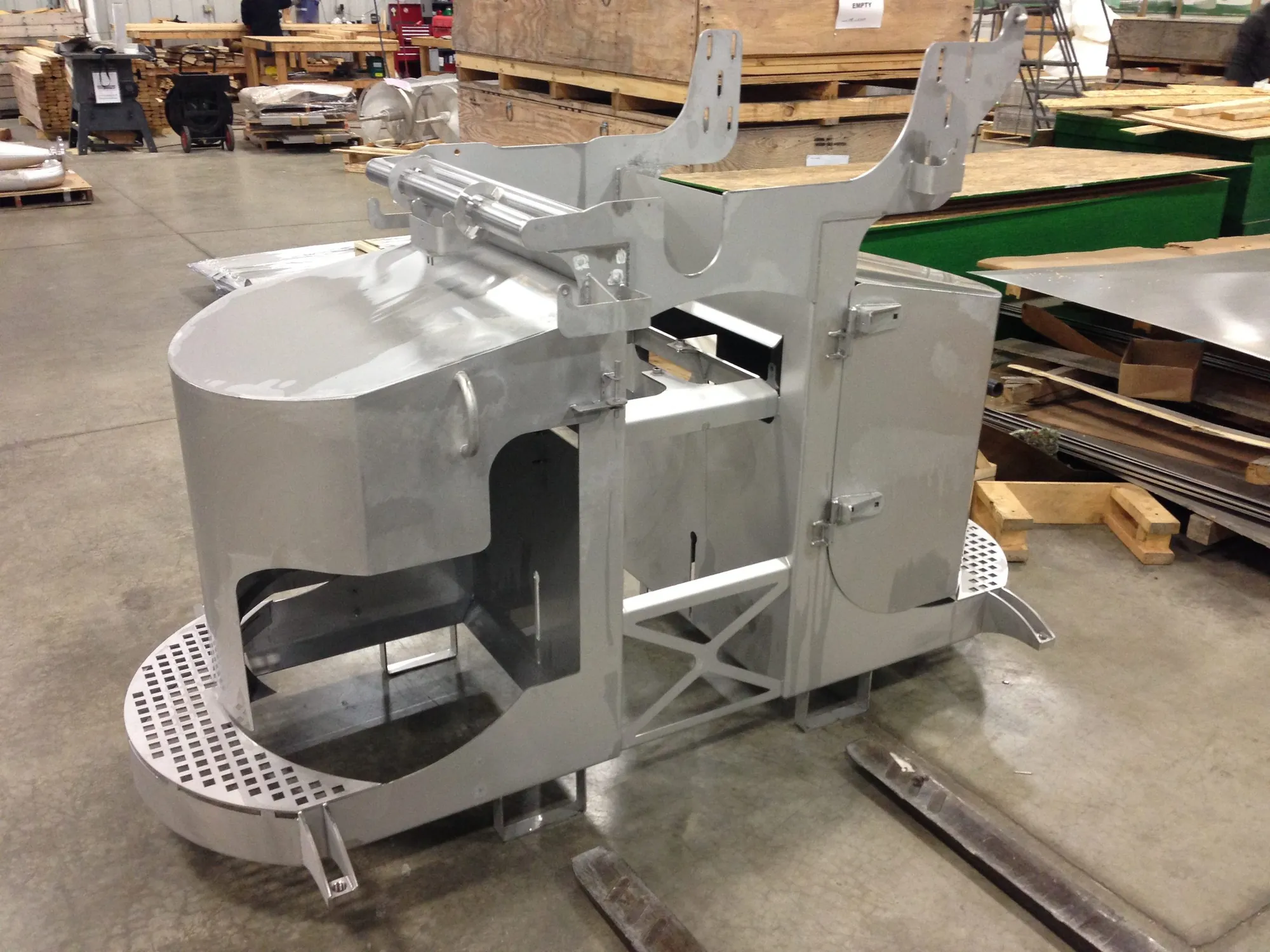
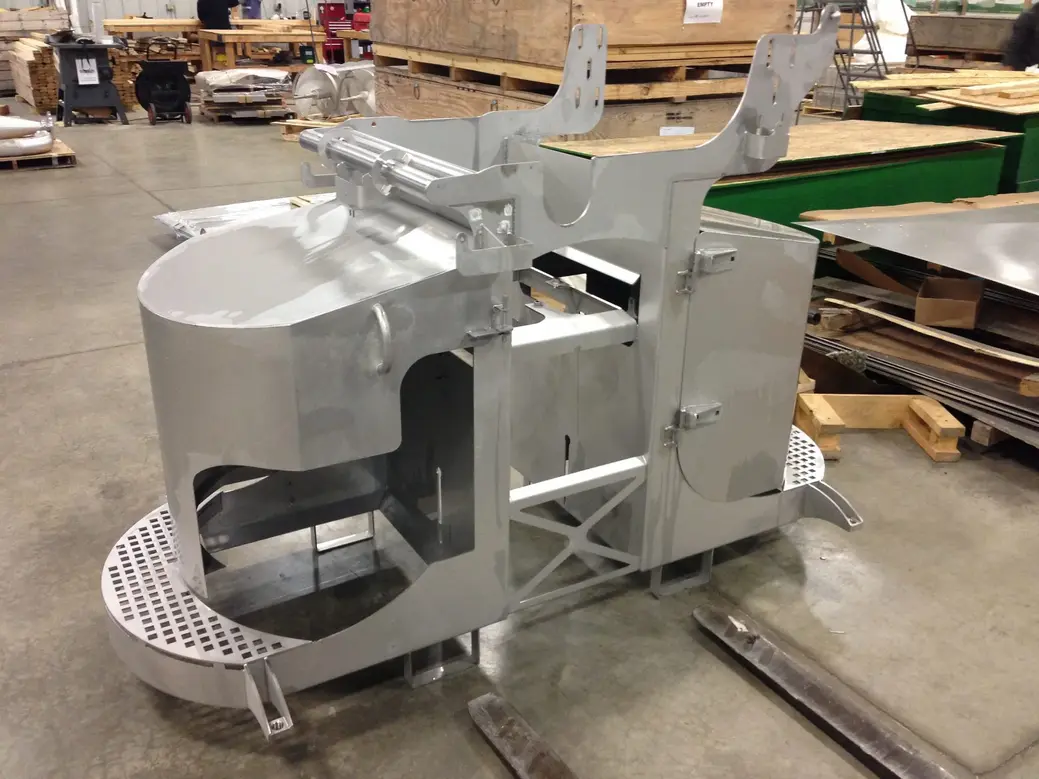
Protect stainless surfaces from contamination and damage during storage and fabrication. Keep carbon-steel work, abrasive residue, and handling practices under control according to the manufacturer’s quality system and customer requirements. Where passivation, polishing, or a specific finish is required, plan it as a scheduled operation with an inspection point, not as a last-minute cosmetic task.
Source: media.northernmfg
Standardize repeatable assemblies without treating every machine as identical
Custom food machinery still contains repeatable work. Frames, guards, leg assemblies, conveyor modules, pipe supports, control-panel layouts, cable routing methods, pneumatic manifolds, and washdown enclosures can often be standardized even when the complete machine is unique.
Standard work does not mean removing skilled judgment. It means documenting the best known sequence, tools, parts presentation, acceptance criteria, and key measurements for work that recurs. This gives experienced technicians a stable baseline and helps newer employees produce consistent results.
Useful standardization tools include:
- Modular bills of materials for common assemblies.
- Fabrication drawings that identify critical fit-up dimensions and finish zones.
- Weld maps and visual acceptance examples where appropriate.
- Assembly fixtures for repeated frames, guards, and conveyor sections.
- Predefined hardware kits labeled by assembly and revision.
- Photo-based work instructions for concealed or hard-to-reach components.
- Electrical and pneumatic checklists that match the machine configuration.
Standardize interfaces first. A common mounting pattern, sensor bracket, guard attachment, or panel connection can reduce downstream fitting work without limiting the engineering team’s ability to build a custom system.
Move quality checks upstream
Final inspection should confirm that a machine is ready; it should not be the first time basic fabrication issues are found. Rework costs rise sharply when a defect is discovered after components are painted, polished, wired, plumbed, or installed in a completed machine.
Use quality gates at meaningful transition points.
| Stage | Quality gate | Typical purpose |
|---|---|---|
| Material receiving | Material and documentation verification | Prevent incorrect or damaged material from entering production |
| Post-cutting and forming | Part identification and dimensional check | Catch revision, orientation, and forming errors before welding |
| Post-welding | Weld, fit-up, finish, and cleanability review | Prevent difficult corrections during assembly |
| Subassembly completion | Functional and configuration verification | Confirm the module is complete before installation |
| Final assembly | Mechanical, electrical, pneumatic, and documentation check | Confirm machine readiness for testing |
| FAT release | Test record and open-item review | Ensure testing reflects the agreed configuration |
The exact inspection method should match the product, drawing requirements, customer specifications, and applicable internal procedures. Avoid assuming that one visual standard or one finish requirement applies to all machines.
Schedule to protect flow into final assembly
Food machinery production scheduling often fails when departments are scheduled independently. Fabrication may optimize sheet yield, welding may group similar jobs, and electrical may work from its own priority list, while final assembly waits for one missing bracket, panel, or drive component.
Schedule around machine-level completion needs. Break each machine into major deliverable assemblies and define the latest practical date each must reach final assembly. Then work backward through fabrication, purchased-part delivery, inspection, and subassembly.
A short-interval schedule can help teams manage daily priorities, but it needs realistic readiness checks. Do not schedule a job into a critical work center if the material, drawings, tooling, or predecessor operation is not ready. That creates the appearance of a full schedule while increasing work-in-process and expedites.
Limit the amount of work released at one time, particularly before constrained processes. Excessive work-in-process hides problems, consumes floor space, and makes it harder to see which job actually needs attention.
Treat FAT readiness as a production milestone
Factory acceptance testing should be planned early, not treated as the final week’s activity. The test bay can become a major constraint when machines arrive incomplete, controls are not commissioned, utilities are unavailable, or test documentation has not been prepared.
Define FAT readiness in advance. Depending on the equipment, it may include:
- Mechanical assembly complete and inspected.
- Required guards, sensors, drives, and controls installed.
- Electrical and pneumatic systems checked according to the project plan.
- Software or control configuration at the intended test revision.
- Test materials, utilities, instruments, and customer witness requirements arranged where applicable.
- Open items reviewed and clearly separated from test-critical issues.
- Documentation package assembled to the required level.
Use FAT results to improve upstream work. If the same problems appear repeatedly during testing—misaligned sensors, missing fittings, incorrect motor data, software configuration gaps, or documentation mismatches—assign corrective action to the process where the issue originated. Do not simply add more end-of-line inspection.
Build a practical improvement routine
A sustainable food processing equipment manufacturing process improvement program is usually managed through a small number of visible measures. Useful examples include on-time completion of fabrication kits, first-pass inspection acceptance, rework hours by cause, schedule adherence at the constraint, incomplete assemblies entering final assembly, FAT first-pass completion, and overdue engineering changes.
Review the measures frequently with engineering, production, quality, supply chain, and project management together. The point is not to create a reporting burden. It is to identify where work is waiting, why it is returning, and which countermeasure has an owner and due date.
Start with one machine family or one recurring flow problem. Map it, remove a clearly defined source of delay, test the new standard, and measure whether the improvement holds. In food-equipment manufacturing, better flow is not achieved by relaxing sanitary or documentation requirements. It is achieved by making those requirements visible and controllable before they become late-stage rework.
References
- How Lean Manufacturing is Transforming the Food Industry. (n.d.). https://efficiencyworks.com.au/how-lean-manufacturing-is-transforming-the-food-industry
- Lean manufacturing in the food industry | KAIZEN™ Article. (n.d.). https://kaizen.com/insights/lean-manufacturing-food-industry
- Food Processing & Manufacturing - Boschert USA. (n.d.). https://www.boschertusa.com/industries/food-processing-manufacturing
- Lean operations improvements: Examples from food manufacturing - CRB. (n.d.). https://www.crbgroup.com/insights/oi-savings
- Drive Efficiency With Lean Management in Food Processing. (n.d.). https://www.linkedin.com/pulse/drive-efficiency-lean-management-food-processing-zjq6c
- Stainless Steel Food Processing Equipment: Grades & Standards. (n.d.). https://loyalfoodmachines.com/stainless-steel-food-processing-equipment
- 6 Continuous Improvement Habits Food Manufacturers …. (n.d.). https://www.worximity.com/blog/6-continuous-improvement-habits-food-manufacturers-should-have
- Stainless Steel Fabrication for Food Processing Equipment - R Parra Steel Fab Inc.. (n.d.). https://rparrasteelfab.com/blog/stainless-steel-fabrication-for-food-processing-equipment