Repeated breakdowns usually continue because the team restores function before it preserves evidence and tests the failure mechanism. A practical food processing equipment root cause analysis method treats the repair as only one part of the job: define the event, collect evidence, identify the physical and system causes, install corrective actions, and confirm that the failure does not return.
The goal is not to identify a person to blame or to create a long report for every stoppage. It is to stop a known failure mode from consuming production time, spare parts, and maintenance labor again. For a recurring fault, the most useful question is not “What part failed?” but “What conditions caused this part, component, or function to fail at this point in time?”
When a repeat failure deserves formal investigation
Not every short interruption needs a full investigation. Use a more disciplined maintenance failure investigation when one or more of these conditions apply:
- The same asset or subsystem fails repeatedly.
- A repair restores operation only briefly.
- The event causes substantial lost production, product loss, or quality holds.
- A safety, sanitation, or product-contamination concern is involved.
- A critical spare is repeatedly consumed.
- The failure appears after cleaning, changeover, a new product, a controls update, or another operating change.
- Different technicians apply different fixes to the same problem.
Start with the repeat pattern, not just the most recent event. A single failed bearing may be random. Several bearing failures at the same location suggest a mechanism such as alignment, loading, lubrication, washdown ingress, installation damage, an unsuitable component specification, or a process condition outside the equipment’s intended duty.
The practical RCA workflow
A useful food plant breakdown analysis has seven stages:
- Stabilize the equipment and preserve evidence.
- Describe the failure precisely.
- Collect the operating and maintenance history.
- Separate symptoms, failure modes, causes, and contributing conditions.
- Test the most credible cause paths.
- Correct the physical cause and the management-system gap.
- Verify effectiveness and retain the learning in the maintenance record.
The sequence matters. Teams often jump from symptom to solution: “The conveyor stopped, so replace the motor.” If the motor stopped because a product buildup overloaded the conveyor, replacing it can make the next failure look like bad luck rather than an unresolved process problem.
1. Make the situation safe and preserve the evidence
Follow the site’s isolation, lockout, sanitation, and product-disposition procedures before inspection or repair. Do not keep a failed machine running merely to collect more data, and do not bypass guards, interlocks, alarms, or protective devices to prove a theory.
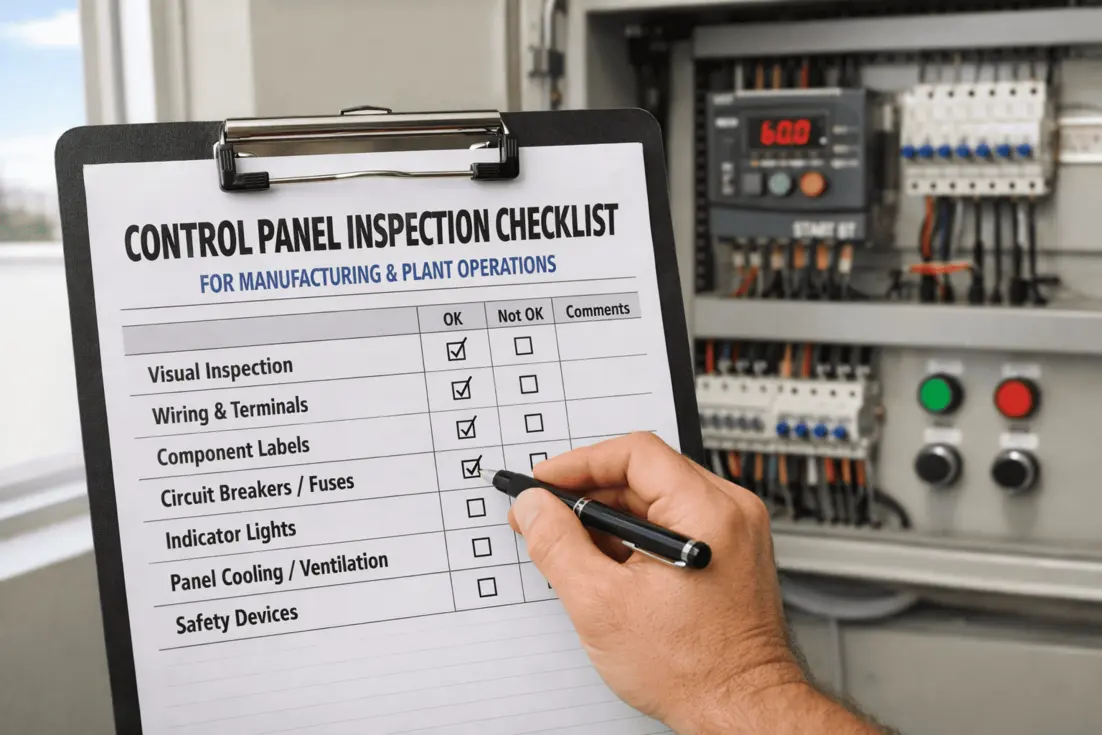
Before disassembly, capture what can disappear during repair:
- Time and date, line, asset ID, product, and operating mode
- Alarm messages, operator-panel status, and relevant setpoints
- Photos of the equipment condition, product buildup, leaks, wear marks, and broken parts
- Position of adjustments, sensors, guides, belts, chains, valves, and guards
- Operator observations: noise, vibration, odor, temperature change, intermittent behavior, and events immediately before the stop
- Parts removed, including their orientation and installation condition
- Cleaning, changeover, maintenance, or process changes preceding the event
Source: oxmaint
A failed part is evidence. Tag it and retain it when practical, especially if the same component has failed before. A replacement part may restore production, but it cannot explain whether the original part was misapplied, contaminated, misaligned, overloaded, incorrectly installed, or damaged by its environment.
2. Define the problem in operational terms
Avoid broad statements such as “the filler keeps failing” or “the packaging line is unreliable.” A clear problem statement establishes what failed, where, when, and with what consequence.
For example:
The infeed conveyor drive on Line 2 stopped three times during the same product run. Each event followed a gradual increase in product accumulation at the transfer point. The drive overload alarm was active, and restarting without clearing the accumulation did not restore stable operation.
This is better than “conveyor motor failure” because it distinguishes the shutdown condition from the suspected component.
A good statement includes:
| Element | What to record |
|---|---|
| Asset and location | Equipment tag, line section, and subsystem |
| Failure mode | What function was lost or degraded |
| Conditions | Product, speed, shift, recipe, cleaning state, ambient conditions, and operating mode |
| Frequency | Number of events and interval since prior events |
| Consequence | Downtime, reduced rate, scrap, rework, or quality impact |
| Temporary repair | What was done to resume operation |
3. Reconstruct the timeline and the repeat-failure history
Review CMMS work orders, operator logs, downtime codes, parts records, inspection results, and production data. The objective is to find patterns that an individual shift may not see.
Look for common triggers:
- Does the failure occur after washdown or sanitation?
- Does it appear only on a certain product, package format, or recipe?
- Did frequency change after a component substitution or supplier change?
- Does it follow a planned maintenance task, belt change, bearing replacement, or software update?
- Is it limited to one shift, operating speed, or operator adjustment practice?
- Does it occur at a similar elapsed runtime or production count?
The maintenance history should distinguish corrective work from preventive work. “Replaced bearing” is not enough. Record the bearing location, observed condition, likely damage pattern, lubricant condition where relevant, shaft and housing observations, alignment checks, and any associated changes. Over time, this creates a repeat-failure record rather than a list of isolated repairs.
4. Separate the symptom from the cause chain
A root cause investigation becomes more useful when the team uses consistent terms.
- Symptom: What was observed. Example: the machine stopped on an overload alarm.
- Failure mode: How the function was lost. Example: conveyor drive could not overcome resistance.
- Direct physical cause: The immediate mechanism. Example: product accumulation created excessive resistance at a transfer point.
- Contributing cause: A condition that made the event more likely. Example: worn guide rails increased friction.
- Systemic or latent cause: A gap that allowed the condition to persist. Example: the inspection standard did not define acceptable guide-rail wear or require verification after changeover.
This prevents a common error: treating the first answer to “why?” as the root cause. A damaged seal may be the physical cause of a leak, but the deeper corrective action may concern washdown exposure, seal material selection, installation practice, missing guards, an incorrect cleaning method, or an unrecognized pressure condition.
5. Analyze cause paths with evidence, not preference
A small cross-functional group is often more effective than maintenance working alone. Include the technician who repaired the equipment, the operator who saw the failure, a production representative, and engineering, quality, sanitation, or automation personnel when their systems are involved.
Use a simple method that fits the problem:
Five Whys
Use this for a relatively direct chain of cause and effect. At each question, verify the answer with records, inspection, or observation. Do not use it as a prompt to assign personal fault.
Fishbone diagram
Use this when multiple categories may interact. Typical food-plant categories include machine condition, materials or product behavior, methods and settings, people and training, measurement and controls, and environment or washdown conditions.
Fault tree
Use this for complex failures where several combinations could produce the same event, such as repeated machine stops caused by controls, sensors, mechanical resistance, utilities, or product flow.
The chosen tool matters less than the discipline of testing assumptions. If the theory is “washdown water is entering the gearbox,” inspect seals, drain paths, enclosure condition, cleaning practices, and the timing of failures. If evidence does not support the theory, reject it rather than building the corrective action around it.
6. Design corrective actions at more than one level
A durable corrective maintenance root cause analysis usually produces actions in two categories.
Containment actions restore acceptable operation now. They may include replacing a damaged part, adjusting a guide, cleaning accumulation, restoring a sensor position, or repairing a leak.
Permanent corrective actions eliminate the mechanism or reduce the likelihood that it can recur. Depending on the evidence, these may include:
- Revising component specifications for the actual load and environment
- Correcting alignment, support, guarding, drainage, or product transfer geometry
- Adding an inspection point for early signs of degradation
- Changing a preventive maintenance task from calendar-based replacement to condition verification where appropriate
- Improving a work instruction, torque sequence, alignment procedure, or post-maintenance functional check
- Training and qualifying personnel for a critical task
- Updating spare-parts records so that an unsuitable substitute is not installed
- Revising cleaning or changeover procedures after review by responsible sanitation, quality, and engineering personnel
Assign each action an owner, due date, required resources, and acceptance criterion. “Monitor the machine” is not a corrective action unless the team defines what will be monitored, how often, what constitutes an abnormal condition, and who acts on the result.
7. Verify that the corrective action worked
Closing a work order is not proof that the failure is eliminated. Verification should be planned when the action is assigned.
Use measures that match the problem, such as recurrence count, operating time between events, unplanned downtime, rejected packages, repeated alarms, component condition at inspection, or maintenance hours spent on the same failure mode. Compare performance under the operating conditions that previously produced the breakdown.
Verification should also confirm that the correction did not create a new problem. A modification that improves throughput but makes cleaning difficult, interferes with access, or changes product handling may require review by the appropriate plant functions before it becomes standard practice.
If the failure returns, do not simply reopen the old work order and repeat the same repair. Reassess the cause tree. The original analysis may have identified a contributor rather than the governing mechanism, or the corrective action may not have been implemented as intended.
Make repeat-failure history usable
The final record should be concise enough that technicians will use it during the next event. Include the equipment and failure-mode code, problem statement, evidence retained, confirmed cause chain, corrective actions, parts affected, updated job plans, and verification result.
Link related work orders and use consistent asset names and failure codes. Otherwise, “jam,” “stoppage,” “motor issue,” and “conveyor fault” can describe the same recurring problem without appearing together in reports.
A short repeat-failure review can be valuable for critical assets. Review open corrective actions, failures that have recurred after a supposed permanent fix, parts with unusually frequent replacement, and changes in downtime patterns. This shifts maintenance effort from repeatedly restoring equipment to improving the conditions under which it operates.
Common RCA mistakes in food plants
- Replacing the failed part and calling that the cause. The failed component may be evidence, not the source of the problem.
- Starting after cleanup and disassembly. Lost alarms, part positions, and product conditions weaken the investigation.
- Ignoring sanitation and operating conditions. Moisture, cleaning exposure, product accumulation, temperature changes, and changeover settings can be central to the failure mechanism.
- Using vague downtime descriptions. Specific failure modes produce better data and better corrective actions.
- Stopping at human error. Ask what procedure, design, training, access, workload, or verification gap made the error possible.
- Closing actions without effectiveness checks. A completed task is not necessarily a solved problem.
A simple field checklist
Before closing an investigation, confirm that the team can answer these questions:
- What exactly failed, and under what conditions?
- What evidence supports the identified physical mechanism?
- What made that mechanism possible or likely?
- Which actions contain the immediate problem?
- Which actions prevent recurrence?
- Who owns each action, and how will completion be checked?
- What operating or maintenance data will demonstrate that the correction worked?
- Have the CMMS history, procedures, spare specifications, and inspection plans been updated where needed?
Root cause analysis is most effective when it becomes a normal part of corrective maintenance for repeat failures. The repair returns the line to service. The investigation changes the conditions that made the repair necessary.
References
- Root Cause Analysis of Equipment Failures in Food and …. (n.d.). https://datacalculus.com/en/blog/food-and-beverage-manufacturing/maintenance-technician/root-cause-analysis-of-equipment-failures-in-food-and-beverage-manufacturing
- Root Cause Analysis in Food Manufacturing. (n.d.). https://oxmaint.com/industries/food-manufacturing/root-cause-analysis-food-manufacturing-recurring-failures
- Root Cause Analysis for Food and Beverage Equipment Failures. (n.d.). https://www.forgereliability.com/root-cause-analysis-food-beverage
- Root Cause Analysis in Food Manufacturing: Preventing …. (n.d.). https://oxmaint.ai/industries/food-manufacturing/root-cause-analysis-food-manufacturing-recurring-failures
- Root Cause Analysis for Equipment Breakdowns: A 2025 Guide. (n.d.). https://f7i.ai/blog/beyond-the-quick-fix-the-definitive-2025-guide-to-root-cause-analysis-for-equipment-breakdowns
- Root Cause Failure Analysis in Manufacturing | ATS. (n.d.). https://www.advancedtech.com/blog/root-cause-failure-analysis-process
- Equipment Failure Analysis: RCA, FMEA & CMMS Guide. (n.d.). https://oxmaint.com/blog/post/blog-post-equipment-failure-analysis-root-cause-methods
- Root Cause Analysis in Food Manufacturing. (n.d.). https://foodindustryhub.com/root-cause-analysis-in-food-manufacturing