A food processor drive coupling failure is likely when the motor base runs normally but the blade, spindle, or other attachment does not turn, turns intermittently, or slips under load. The coupling and attachment interface should be checked before assuming that the motor or gearbox has failed. In many machines, the drive coupling is the intentional weak link between the motor-side drive and the removable processing tool.
Start by separating the fault into two questions: does the motor base produce drive motion, and does that motion reach the attachment? With the machine isolated from power, inspect engagement, coupling teeth or splines, the attachment hub, and the visible shaft surfaces. A stripped interface, loose hub, damaged key, or attachment that is not fully seated can create nearly identical operator complaints, but the repair decision is different in each case.
What the symptoms usually indicate
The drive path commonly runs from motor to gearbox or reduction drive, then through a coupling, drive hub, spindle, and attachment. Designs vary considerably by processor, so use the correct model parts diagram and service instructions when identifying components. Replacement couplings are model-specific; parts suppliers also commonly require a compatibility check rather than treating a similarly shaped coupling as interchangeable.
| Operating symptom | Likely fault area | What to check first |
|---|---|---|
| Motor will not start | Safety interlock, power supply, controls, thermal protection | Bowl and lid engagement, control response, applicable manual |
| Motor runs but attachment remains still | Stripped coupling, disengaged attachment, broken spindle connection | Drive hub motion and attachment seating |
| Attachment turns empty but stops in product | Worn coupling faces, rounded hub, overload, slipping key or shaft | Contact surfaces, fasteners, load history |
| Rattle, vibration, or wobble | Loose attachment, worn hub, bent shaft, bearing or gearbox issue | Attachment fit, shaft runout signs, damage at interfaces |
| Drive works with one tool but not another | Attachment-specific hub or spindle damage | Compare the failed tool with a known-good compatible tool |
| Grinding or noise from inside the base | Gearbox, internal shaft, bearing, or coupling damage | Stop operation and arrange qualified inspection |
A working motor does not prove that the gearbox is healthy. It does, however, move the initial inspection toward the mechanical drive path. Conversely, a machine that will not energize at all should not be diagnosed as a stripped coupling until interlocks and electrical causes have been ruled out.
Safe fault-isolation sequence
Do not defeat bowl, lid, or guard interlocks to test rotation. Isolate electrical power before removing bowls, tools, covers, or attachments. Follow the site lockout procedure where it applies, and use the manufacturer’s service documentation for any work that requires opening the motor base or gearbox.
1. Confirm the complaint and product conditions
Ask the operator what happened immediately before the failure. Dense doughs, frozen ingredients, hard inclusions, overfilled bowls, a jammed blade, and abrupt starts can all overload the drive train. Note whether the attachment stopped suddenly, slipped progressively, or was noisy beforehand.
Also establish whether the failure occurs with every approved attachment or only one. If a second compatible attachment operates normally, the motor base is less likely to be the primary issue. The failed attachment, its hub, or its seating arrangement becomes the leading suspect.
2. Check attachment seating and interlock engagement
Remove the attachment after isolation. Look for product debris, damaged locating tabs, distorted locking features, missing spacers, and incorrect assembly order. A tool can appear installed while sitting high enough that its hub only partly engages the drive.
Reassemble according to the model instructions. Do not force an attachment onto a shaft or coupling. Resistance may indicate debris, a burr, a bent component, or an incompatible tool. Forcing it can turn a simple engagement problem into a damaged hub or shaft.
3. Inspect the motor-side coupling or drive hub
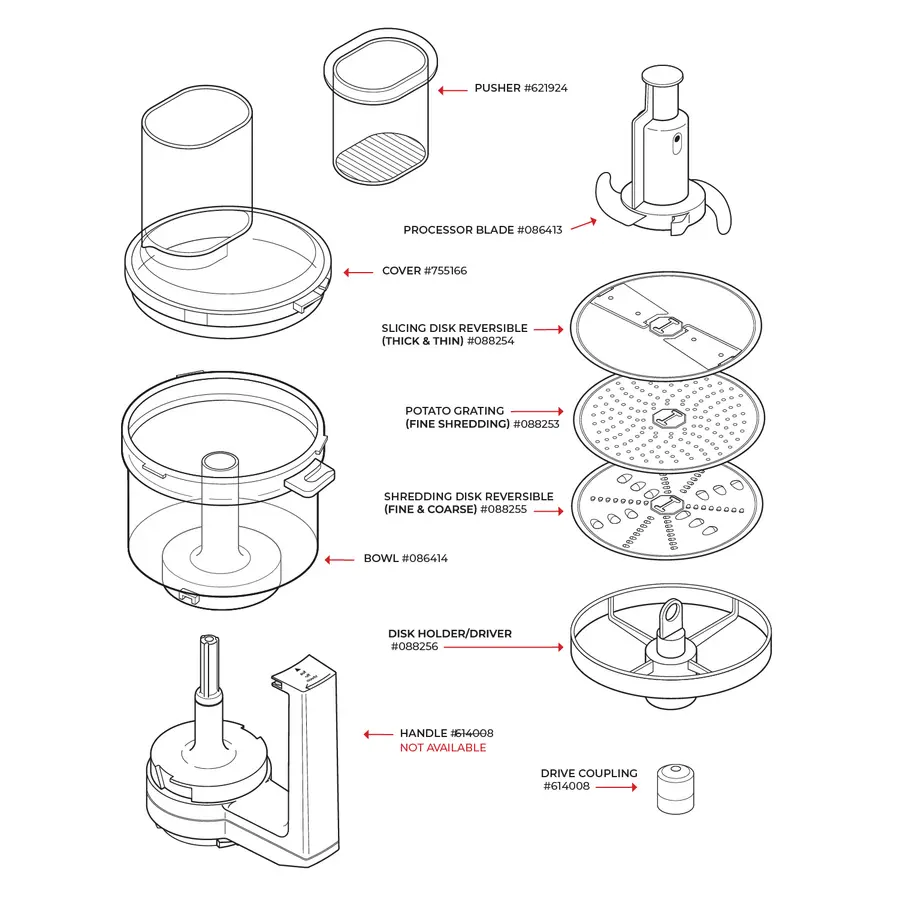
Source: nutrimill
Inspect the exposed coupling with the attachment removed. Depending on the machine, this may be a splined, forked, slotted, toothed, or shaped drive piece. Look for rounded drive faces, cracked plastic or elastomer elements, missing teeth, polished areas from slipping, deformation, and excessive looseness on its mounting.
A stripped food processor drive hub often has visibly rounded internal or external features. The motor-side component may rotate, but torque is no longer transferred positively to the attachment. In some designs, the coupling is intended to yield before a more expensive motor or gearbox component is damaged. That design intent does not mean every stripped coupling can be replaced without further checks: inspect the mating attachment hub as well.
If the coupling rotates but shows no obvious damage, check whether it has abnormal radial movement, axial play, or a loose retaining fastener. The acceptable amount of movement is model-dependent. Compare with manufacturer guidance rather than applying a generic clearance limit.
4. Inspect the attachment hub, spindle, and shaft
Turn attention to the removable tool. Examine the bore or socket that receives the drive. Rounded corners, widened slots, cracked hub material, and metal dust indicate repeated slip. A new coupling fitted against a damaged attachment hub may fail quickly because the load is carried on too little contact area.
For food processing machine shaft wear, inspect visible shaft flats, splines, keyways, threads, and shoulders. Wear may appear as bright polished surfaces, rounding, pitting, fretting debris, or a shaft that rocks in its mating component. Check that any key is present, correctly positioned, and undamaged. A sheared or loose key can allow a shaft or hub to spin without transmitting full torque.
Do not attempt to straighten a bent food-contact attachment shaft in service unless the manufacturer explicitly provides a repair method. A bent shaft can produce vibration, poor tool clearance, seal damage, and recurring hub wear. Replace or send it for approved service as appropriate.
5. Separate coupling failure from gearbox failure
Food processor gearbox coupling troubleshooting becomes necessary when the external coupling and attachment hub are intact but drive is still missing, erratic, or unusually noisy. Warning signs include grinding inside the base, oil or grease leakage where applicable, persistent vibration with known-good attachments, or a drive hub that does not turn despite an energized motor.
At this point, avoid continued test runs. Internal gearbox inspection can involve retained energy, electrical components, seals, gears, and alignment requirements. Refer the unit to trained maintenance personnel or the manufacturer’s authorized service route. Record the symptom, machine model, serial number, attachment used, product load, and photographs of worn parts; this speeds parts identification and root-cause review.
Repair decisions: replace one part or inspect the set?
Replace only the coupling when its mating shaft and attachment hub have crisp, undamaged drive surfaces; the coupling is securely mounted; and there is no indication of shaft play or gearbox noise. This is the usual response after a single overload event where the coupling has clearly failed as the sacrificial component.
Inspect and potentially replace the coupling and attachment hub together when both surfaces show rounding or polishing. Replacing only one worn half often concentrates load on the new part and leads to rapid repeat failure.
Escalate beyond external parts when there is shaft wobble, a damaged keyway, recurring coupling breakage, internal noise, leakage, or a hub that will not remain secure. These conditions can point to bearing wear, shaft damage, gearbox damage, or misalignment rather than a routine external coupling replacement.
Common diagnostic mistakes
- Ordering from appearance alone. A coupling may look similar across model families but have different dimensions, drive geometry, or fitment.
- Replacing the motor before inspecting the interface. A running motor with a non-driving tool frequently points to torque transfer, not motor output.
- Ignoring the attachment. A worn blade carrier or spindle hub can strip a replacement coupling.
- Testing repeatedly under heavy load. Continued slipping creates heat and debris and can worsen damage at the shaft or gearbox.
- Treating overload as the full root cause. Determine why the load rose: product condition, batch size, tool selection, dull cutting components, assembly error, or an existing mechanical fault.
- Bypassing an interlock. An interlock issue should be corrected through proper adjustment or replacement, not bypassed for production.
Preventing repeat coupling failures
Use only approved attachments and ensure they are fully seated before starting. Keep drive interfaces clean and dry unless the manufacturer specifies a lubricant. Remove product residues before they harden around the hub, bowl center, or attachment bore.
Train operators to stop the machine when a tool stalls, chatters, or slips rather than cycling the controls repeatedly. Review product loading practices after any overload-related failure, especially when processing dense or hard materials. During planned maintenance, include the coupling, attachment hub, shaft condition, retaining hardware, and unusual vibration in the inspection routine.
A practical maintenance record should capture the failed component, associated attachment, product being processed, observed wear pattern, and corrective action. Over time, this distinguishes isolated sacrificial-coupling failures from a pattern caused by loading, attachment wear, or a developing gearbox fault.
FAQ
Why is my food processor attachment not turning when the motor runs?
First check whether the attachment is fully seated and whether its hub engages the motor-side coupling. If engagement is correct, inspect both mating drive surfaces for stripping or rounding. If the external components are sound, an internal shaft or gearbox fault becomes more likely.
Can a stripped coupling damage the motor?
A coupling may be designed to fail before damage reaches more costly drive components, but the outcome depends on the machine design and the event. Inspect for excessive heat, shaft play, internal noise, and damage to the mating hub before returning the processor to service.
Should a worn coupling be replaced with a stronger part?
Use the manufacturer-specified part unless the manufacturer has issued an approved modification. Changing the intended weak point can shift overload damage to the attachment, shaft, gearbox, or motor.
When should the processor be removed from service?
Remove it from service when there is abnormal vibration, grinding from the base, a loose or wobbling shaft, repeated coupling failures, broken retaining features, or any uncertainty about attachment retention. These signs require a controlled inspection rather than continued production use.
References
- Drive coupling/coupling piece for food processor of Bosch - AltPart 00091027 – FixPart. (n.d.). https://fixpart.ie/product/drive-coupling-coupling-piece-for-food-processor-of-bosch-altpart-00091027-0005587168
- SEB Food Processor Drive Shaft MS-5A07205 User Manual. (n.d.). https://eu.manuals.plus/asin/B08P24413Y
- How Do I Troubleshoot My Food Processor?. (n.d.). https://www.youtube.com/watch?v=cHq963Uj2y0&xstg=CAMSBhUDze3xHw%3D%3D
- How to Fix a Food Processor Not Working? 4 Fixes Ranked by Likelihood (2026) | Spanr Guides. (n.d.). https://www.spanr.ai/guides/food-processor/food-processor-not-working
- Kenwood Food Processor Drive Coupling. Part Number 659631. | eSpares. (n.d.). https://www.espares.co.uk/food-processor-drive-coupling/product.pl?pid=592631
- Fast Robot Coupe Repairs & Spares UK | Fix Processors Fast. (n.d.). https://www.cattermoleelectrical.co.uk/robot-coupe-repairs-spares-uk-how-do-you-fix-food-processors-blixers-fast
- Kenwood Food Processor Drive Coupling. Part Number 659631. | eSpares. (n.d.). https://www.espares.co.uk/kitchen-small-appliances/blender/food-processor-drive-coupling/product.pl?pid=592631&%3Bpath=1021439%2C1021442
- Groupe SEB MS0672311 drive coupling/coupling piece food processor – FixPart. (n.d.). https://fixpart.co.uk/product/groupe-seb-ms0672311-drive-coupling-coupling-piece-food-processor