A gasketed plate heat exchanger CIP program works only when the cleaning circuit delivers adequate flow through every channel, uses chemistry compatible with the deposits and equipment materials, and is verified after the cycle. Cleaning solution alone is not a substitute for circulation, correct assembly, intact gaskets, or periodic inspection.
For routine soil loads, clean-in-place can avoid frequent opening of the plate pack. But a declining thermal result, rising pressure drop, unexplained leakage, repeated cleaning failures, or concern about trapped residue should trigger a closer review. In those cases, opening the exchanger for plate and gasket inspection may be the most reliable next step.
What CIP must accomplish in a gasketed plate heat exchanger
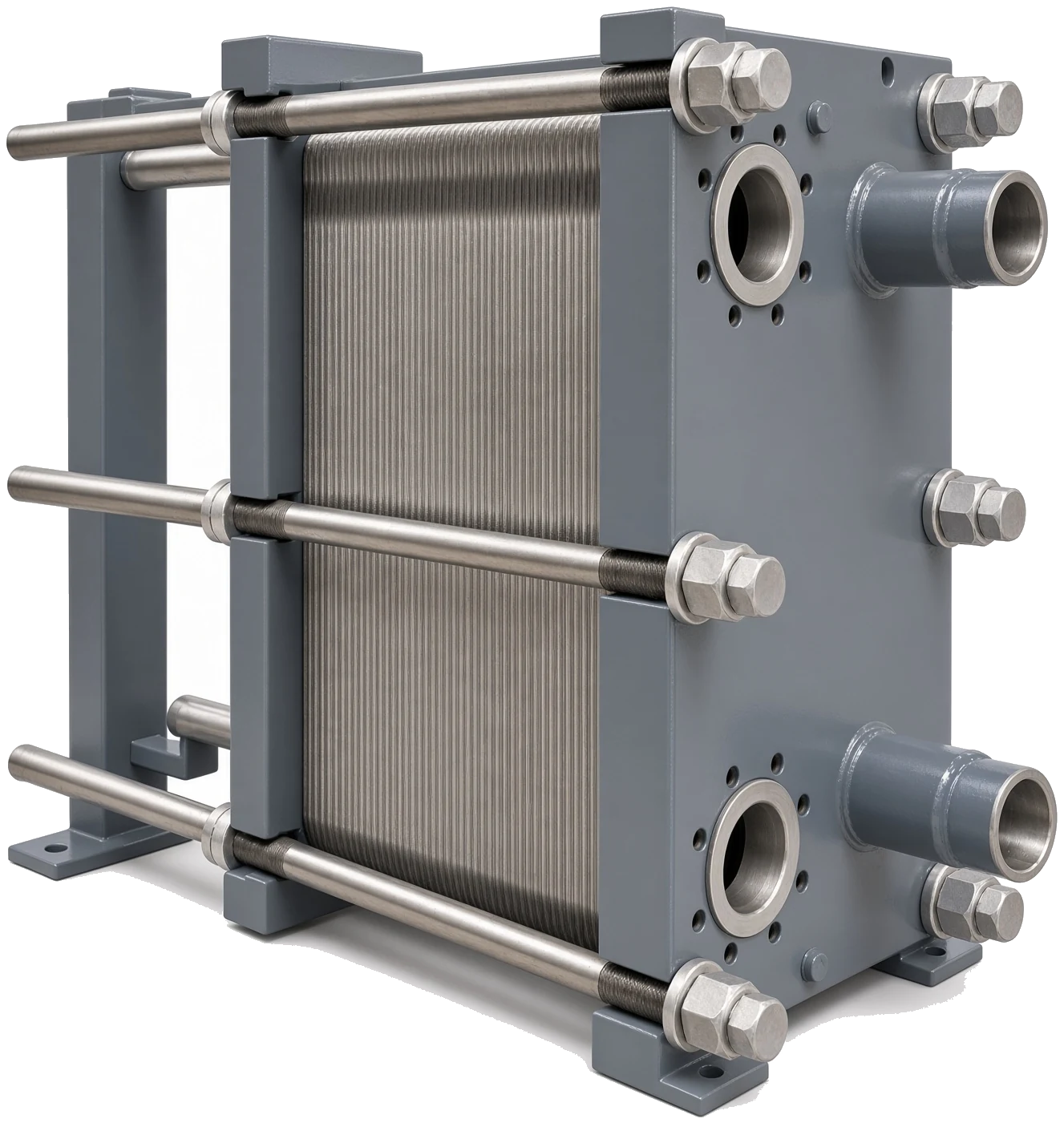
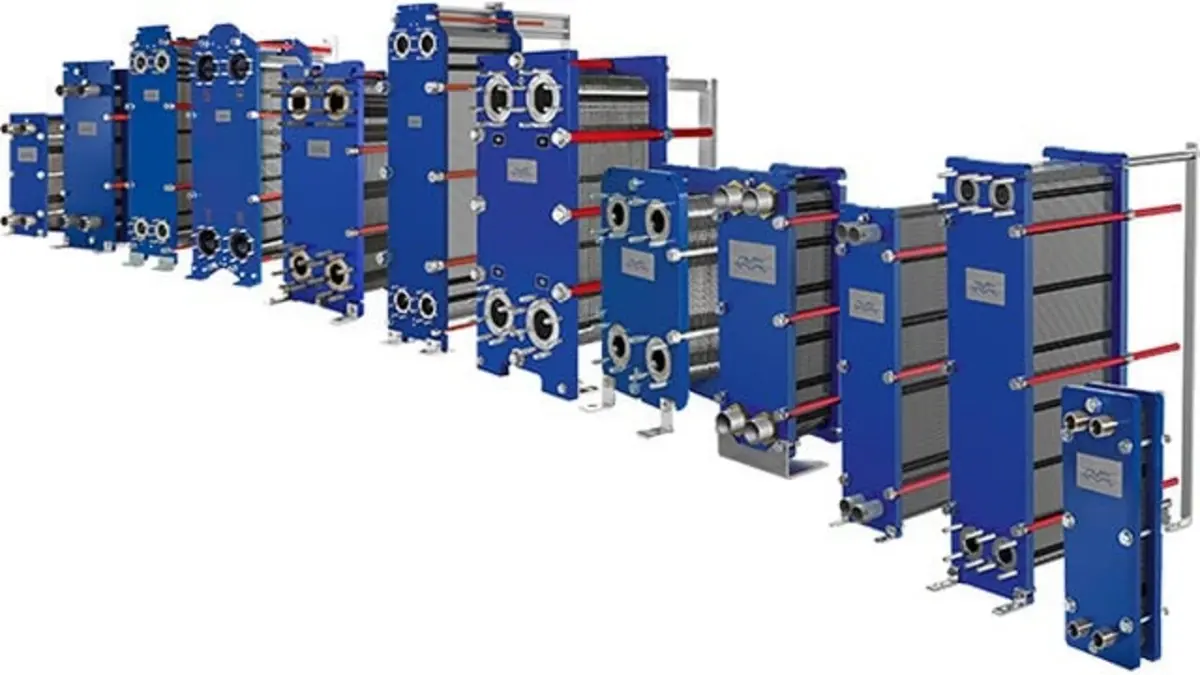
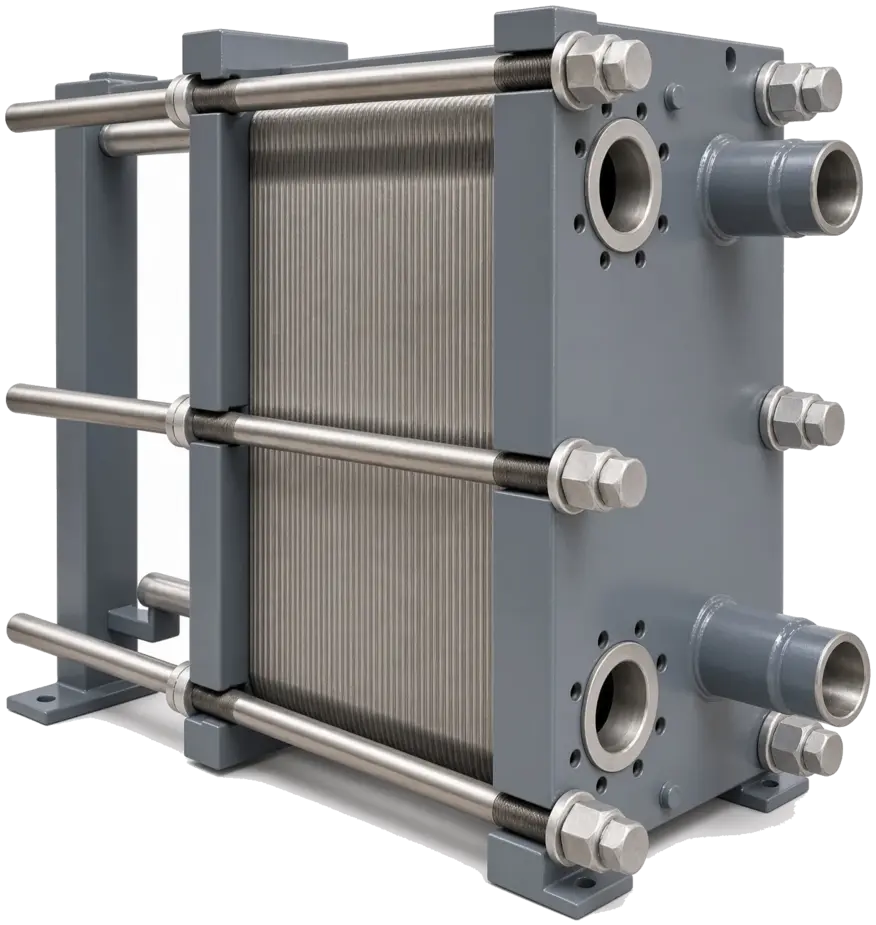
A hygienic gasketed plate heat exchanger consists of thin corrugated plates compressed between a fixed and movable frame. Gaskets seal the plates and direct product and service fluids into alternating channels. The corrugations create turbulence during normal operation, which supports efficient heat transfer but also creates a complex internal geometry that must be fully wetted and cleaned.
The objective of food processing heat exchanger CIP is to remove product residues and deposits from the product-contact circuit, rinse away cleaning chemicals, and leave the exchanger in a condition suitable for the plant’s validated sanitation and production requirements. The exact cleaning recipe depends on the product, fouling mechanism, plate material, gasket elastomer, water quality, and the site’s food-safety program.
A successful cycle therefore depends on five connected factors:
- Flow regime: Cleaning liquid must reach the required circulation rate and pass through all intended channels.
- Temperature: The cleaning temperature must support the selected chemistry while remaining within the plate, gasket, adhesive, and system limits.
- Chemistry: Detergents, acids, sanitizers, and rinse media must suit the deposit and be compatible with the equipment.
- Time: The circulation and any soak period must be sufficient for the approved procedure, not selected by guesswork.
- Mechanical condition: Correctly installed plates, sound gaskets, open ports, and clean distribution areas are necessary for repeatable results.
Start with the fouling pattern, not the chemical drum
Different deposits respond differently to cleaning. A cycle that works for a relatively soluble product film may be ineffective against mineral scale, protein deposits, fat, burned-on material, mixed soil, or corrosion products. Repeatedly increasing chemical strength without identifying the deposit can damage components and still fail to restore performance.
Before changing a CIP recipe, review operating history and symptoms:
| Observation | Possible meaning | Practical next action |
|---|---|---|
| Pressure drop increases at comparable production conditions | Channel restriction, deposit buildup, or flow distribution problem | Compare against baseline data and assess whether CIP flow is being achieved |
| Heat-transfer performance declines | Fouling on one or both circuits, changed utility conditions, or incorrect plate arrangement | Review process data and inspect if cleaning does not recover performance |
| Leakage around the plate pack | Incorrect tightening dimension, displaced gasket, damaged plate, or gasket deterioration | Isolate safely and inspect according to the manufacturer procedure |
| Cleaning results vary between cycles | Inconsistent flow, temperature, concentration, valve lineup, or water quality | Check CIP records, instrument condition, and sequence control |
| Deposits return quickly after cleaning | Upstream process issue, unsuitable cycle, product instability, or contamination source | Investigate the cause of fouling rather than shortening the maintenance interval alone |
The source of the deposit matters as much as the deposit itself. For example, scale formation may point to water chemistry or temperature conditions, while recurring organic deposits may indicate product hold-up, inadequate pre-rinsing, or conditions that promote product burn-on. A plate heat exchanger should be assessed as part of the wider process, including upstream filtration, pumps, product formulation, temperature control, and CIP return routing.
A practical gasketed plate heat exchanger CIP sequence
The approved plant procedure and exchanger manufacturer documentation should govern the actual sequence, chemical selection, temperature limits, and acceptance criteria. The following is a functional framework rather than a universal recipe.
1. Isolate, drain, and confirm the circuit lineup
Take the exchanger out of production using the site’s lockout, isolation, and depressurization procedures. Confirm that product is displaced from the relevant circuit and that the CIP supply and return are connected to the intended ports.
Incorrect valve alignment can leave channels uncleaned, expose the wrong circuit to chemistry, or send cleaning solution to an unintended part of the process. Where automated valves are used, verify that the programmed route matches the current piping configuration and any temporary hose connections.
2. Pre-rinse to remove loose product
A pre-rinse removes readily displaced product and reduces the soil load presented to the main wash. It also provides useful information: unexpected color, solids, foam, or poor return flow may indicate product retention, process upset, or a route problem.
Monitor the return in the manner defined by the site procedure. Do not treat a visually clear return as proof that internal surfaces are clean; deposits can remain attached to plates even after loose product is removed.
3. Circulate the main cleaning solution at the required flow
In a plate heat exchanger, circulation flow is a cleaning variable, not merely a transfer variable. The cleaning loop must provide enough hydraulic energy to move solution through narrow channels and across corrugated plate surfaces. Low flow can create partial wetting, weak turbulence, and inconsistent removal—especially where deposits have narrowed channels.
Use the exchanger manufacturer’s CIP guidance and the plant’s validated method to set flow direction, pump selection, flow target, temperature range, and recirculation duration. The required conditions can differ from normal product operation. A cleaning pump that is adequate for a tank circuit may not deliver the required performance through a fouled plate pack.
Record supply and return conditions that the site uses to demonstrate repeatability, such as flow, pressure, temperature, conductivity, chemical concentration, and cycle stage completion. Trends are often more valuable than a single reading.
4. Use intermediate rinses and additional stages when justified
Many cleaning programs use rinses between incompatible chemical stages and before final return to production. Depending on the soil and approved procedure, a separate stage may be needed for mineral deposits, followed by a rinse and any required sanitation step.
Chemical compatibility must be checked for all wetted materials, including plate alloy, gaskets, adhesive if fitted, valves, hoses, pumps, seals, and instruments. Temperature and concentration can materially affect compatibility. Do not assume that a chemical suitable for stainless steel is automatically suitable for the complete exchanger assembly.
5. Final rinse, drain, and return to service under control
The final rinse should continue until the plant’s defined endpoint is achieved. That endpoint may use conductivity, pH, another validated indicator, or a specified process verification method. The suitable approach depends on the cleaning chemistry and site program.
Drain the exchanger as designed and inspect externally for leakage before startup. During the next production run, compare pressure drop, flow behavior, utility demand, and thermal performance with the equipment’s normal baseline. A clean exchanger should not be assumed solely because the CIP sequence completed without an alarm.
Why flow distribution matters
The plate pattern and gasket arrangement divide liquid among multiple parallel channels. A blocked port, damaged gasket, incorrect plate orientation, or heavy localized deposit can change that distribution. Some channels may receive more flow while others receive less, leaving cleaning nonuniform.
This is why plate heat exchanger fouling inspection is sometimes necessary even when a CIP skid reports normal values. The skid can confirm conditions at the circuit boundary; it cannot directly prove that every internal surface received equivalent cleaning action.
Source: marineheatexchanger
When reviewing CIP performance, check whether the exchanger is being cleaned in the intended direction. Some installations use flow reversal as part of an approved cleaning method because deposits and channel geometry can make one direction more effective for certain duties. This should be based on equipment documentation and validated plant practice, not an ad hoc change during a cleaning failure.
Plate heat exchanger gasket maintenance essentials
Gaskets are both sealing elements and flow directors. A gasket that is hardened, swollen, cracked, loose, displaced, chemically attacked, or incorrectly seated can cause external leakage or internal cross-contamination between circuits. It can also alter how the cleaning liquid travels through the plate pack.
A practical gasket-care program includes:
- Keeping the manufacturer’s specified plate-pack tightening dimension available at the exchanger.
- Recording the tightening dimension before opening and after reassembly.
- Inspecting gaskets for deformation, loss of elasticity, damage at ports and corners, and poor attachment.
- Using only approved replacement gasket materials and installation methods.
- Avoiding unapproved solvents, excessive temperature, or cleaning conditions that can shorten gasket life.
- Checking that plates are hung in the correct order and orientation before closing the frame.
Do not compensate for leakage by simply tightening the frame beyond the manufacturer’s limit. Over-compression can damage plates and gaskets, reduce gasket service life, and make later opening difficult. Leakage requires diagnosis of the actual cause.
When CIP is not enough: opening and inspecting the plate pack
CIP is usually the least disruptive option for routine cleaning, but it has limits. Open the exchanger when operational evidence or risk assessment indicates that direct inspection is needed. Common triggers include persistent loss of thermal performance after cleaning, pressure drop that does not recover, repeated leaks, suspected gasket failure, visible contamination concern, extended service intervals, or heavy and mixed deposits.
Follow the manufacturer procedure for isolation, depressurization, cooling, opening, plate handling, cleaning, reassembly, and pressure testing. Thin plates can be bent or scratched, and gasket sealing surfaces can be damaged by aggressive tools. Avoid improvised scraping or high-force cleaning methods unless the equipment supplier has approved them.
During inspection, look for:
- Deposits concentrated near ports, distribution areas, or plate contact points.
- Evidence that some channels were cleaner than others.
- Plate cracks, pinholes, corrosion, distortion, or damaged contact points.
- Gasket movement, wear, swelling, cracks, adhesive failure, or missing sections.
- Incorrect plate sequence or orientation.
- Signs that deposits originate on the product side, service side, or both.
Document findings with photographs where the site’s procedures permit. The goal is not only to restore the exchanger but also to establish why the condition developed.
Cleaning verification: prove control with more than one signal
Verification should be proportionate to the process risk and integrated with the facility’s sanitation program. A completed recipe is useful evidence, but it is not the only evidence.
A practical verification approach can combine:
- CIP records: Confirm the approved stages, route, flow, temperature, chemical control, and rinse endpoint were achieved.
- Operational recovery: Compare post-cleaning pressure drop and heat-transfer behavior with known good operating data.
- Inspection findings: Use planned internal inspections to confirm that the CIP program matches actual fouling conditions.
- Food-safety verification: Apply the site’s approved methods for hygienic condition, allergen changeover where applicable, and sanitation release.
- Trend review: Investigate changes in cleaning time, chemical use, pressure drop, utility consumption, or cleaning failures before they become unplanned downtime.
The appropriate analytical tests and acceptance limits should be set by the processor’s food-safety, quality, engineering, and chemical-supplier teams. They must reflect the product, cleaning system, intended use, and applicable regulatory or customer requirements.
Common CIP mistakes to avoid
- Running a standard cycle after a significant process upset without checking whether the fouling type has changed.
- Assuming normal pump operation means adequate flow through the exchanger.
- Using chemical concentration or temperature outside the approved range to compensate for poor mechanical cleaning action.
- Ignoring gradual pressure-drop and thermal-performance trends.
- Opening the frame without recording plate order, orientation, and compression information.
- Reusing visibly degraded gaskets because the exchanger can still be closed.
- Treating a clear final rinse as the only cleaning verification.
A workable maintenance routine
The most effective gasketed plate heat exchanger CIP strategy is usually a controlled routine rather than a response to failure. Maintain a baseline for normal pressure drop, production flow, thermal duty, and utility conditions. Review CIP records alongside production data. Schedule internal inspection based on process risk, fouling history, equipment condition, and manufacturer recommendations rather than on a fixed calendar alone.
When cleaning performance declines, diagnose the interaction between deposit, flow, chemistry, and mechanical condition. That approach reduces unnecessary disassembly while recognizing when opening the plate pack is the only dependable way to confirm plate condition, gasket integrity, and cleaning effectiveness.
References
- Plate Heat Exchanger Impact on Food Safety Standards. (n.d.). https://eureka.patsnap.com/report-plate-heat-exchanger-impact-on-food-safety-standards
- Plate Heat Exchanger Cleaning Guide | CIP, Chemicals & Steps. (n.d.). https://tershion.com/how-to-clean-plate-heat-exchanger
- Hygienic gasketed plate heat exchangers | Danfoss. (n.d.). https://www.danfoss.com/en-us/products/dhs/heat-exchangers/gasketed-heat-exchangers/hygienic-gasketed-plate-heat-exchangers
- How to Clean a Plate Heat Exchanger: Step-by-Step Process. (n.d.). https://www.baronblakeslee.net/a-step-by-step-guide-plate-type-heat-exchanger-cleaning
- Heat exchangers for hygienic use. (n.d.). http://www.alfalaval.com/globalassets/images/microsites/sanitary-gphe-usa/literature/heat_exchangers__complete_line_brochure_01.13.pdf
- How to Clean a Gasketed Plate Heat Exchanger (GPHE). (n.d.). https://hexonic.com/en/news/cleaning-hexonic-gphe
- Hygienic Plate Heat Exchanger: Cleanliness Standard in …. (n.d.). https://maxwor.com/en/technical-library/hygienic-plate-heat-exchanger-cleanliness-standard-in-food-and-pharmaceuticals
- CIP Duties Blog | Thermaline. (n.d.). https://www.thermaline.com/content/more-info/recent-news/clean-place-duties-cleaning-your-heat-exchanger