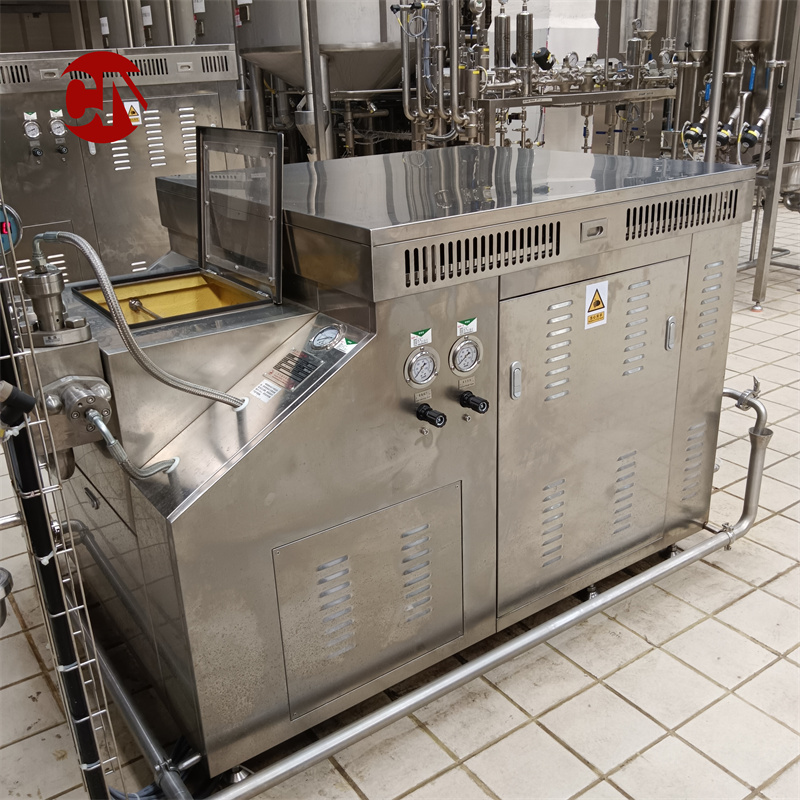
Industrial homogenization in food processing is an inline mechanical process used to make a liquid product more uniform. A high-pressure homogenizer pumps product through a precisely controlled valve restriction, creating a rapid pressure drop and intense fluid forces that reduce the size of dispersed droplets or particles.
The result is usually a more stable emulsion or dispersion: less visible separation, a more consistent appearance, and often a smoother texture. Homogenization is not simply vigorous mixing, however. A mixer distributes ingredients through a batch; a homogenizer changes the size and behavior of the dispersed phase. It is most useful when a formulation contains fat, oil, insoluble solids, or other material that must remain evenly distributed during processing and shelf life.
What an industrial food homogenizer does
Many liquid foods contain at least two phases that naturally tend to separate. In milk, fat globules can rise and form a cream layer. In an oil-containing beverage, droplets can merge and separate. In plant-based drinks, cocoa beverages, sauces, and nutritional liquids, suspended solids may settle or give an uneven mouthfeel.
A food homogenizer reduces the size of those droplets, particles, or agglomerates and distributes them more consistently through the continuous liquid phase. Smaller dispersed elements generally separate more slowly than large ones, although finished-product stability still depends on the formulation, processing conditions, packaging, and storage environment.
For milk and similar emulsions, the central effect is disruption of fat globules into much smaller globules. The newly created surface must then be adequately covered by proteins, emulsifiers, or other stabilizing components present in the system. This is why homogenization performance cannot be judged from pressure alone.
The food homogenizer working principle
A conventional high-pressure homogenizer combines two core functions: a positive-displacement pump that generates pressure and a homogenizing valve that creates a controlled restriction.
The basic sequence is as follows:
- Prepared product enters the machine. The liquid should already be sufficiently uniform for pumping and free of material that could damage or obstruct the valve.
- The pump pressurizes the product. Reciprocating plungers are commonly used to move liquid at high pressure in a continuous inline process.
- Product reaches the homogenization valve. The valve creates a narrow, adjustable flow passage between precision-machined surfaces.
- The product accelerates through the restriction. Pressure energy is converted into velocity as the liquid passes through the small gap.
- A rapid pressure drop creates disruptive forces. Turbulence, shear, elongational flow, impact, and cavitation-related effects can act together to break droplets, particles, and weak clusters apart.
- The treated product leaves for the next process step. Depending on the product and line design, it may proceed to thermal treatment, holding, cooling, deaeration, a buffer tank, or filling.
The valve is not a simple hole. Its geometry, material condition, adjustment, and wear state influence flow behavior and results. The product’s passage through the valve is extremely brief, but it is the main location where high-pressure homogenization produces its effect.
Why many systems use two stages
Food homogenizers may use a single stage or a two-stage valve arrangement. In a two-stage setup, the first stage performs most of the droplet or particle-size reduction. Its pressure drop is the primary driver of homogenization intensity.
The second stage applies controlled back-pressure after the first stage. It can help break up clusters that form immediately after the first pass and provide more stable operating conditions at the first valve. This is particularly relevant for emulsions in which newly formed small droplets can rapidly associate before stabilizing material is fully arranged at their surfaces.
A second stage is not automatically required for every formulation. Its value should be evaluated during product development or pilot trials rather than assumed from the equipment configuration alone.
Where homogenization fits in a food process
Homogenizers are typically installed after ingredient hydration, blending, and filtration or screening, but before one or more downstream finishing steps. Exact placement depends on product viscosity, temperature, ingredient function, and the purpose of the treatment.
A simplified liquid-food process may look like this:
Ingredient receiving → batching and mixing → hydration or blending → screening/filtration → homogenization → downstream thermal processing or cooling → holding/buffer → filling
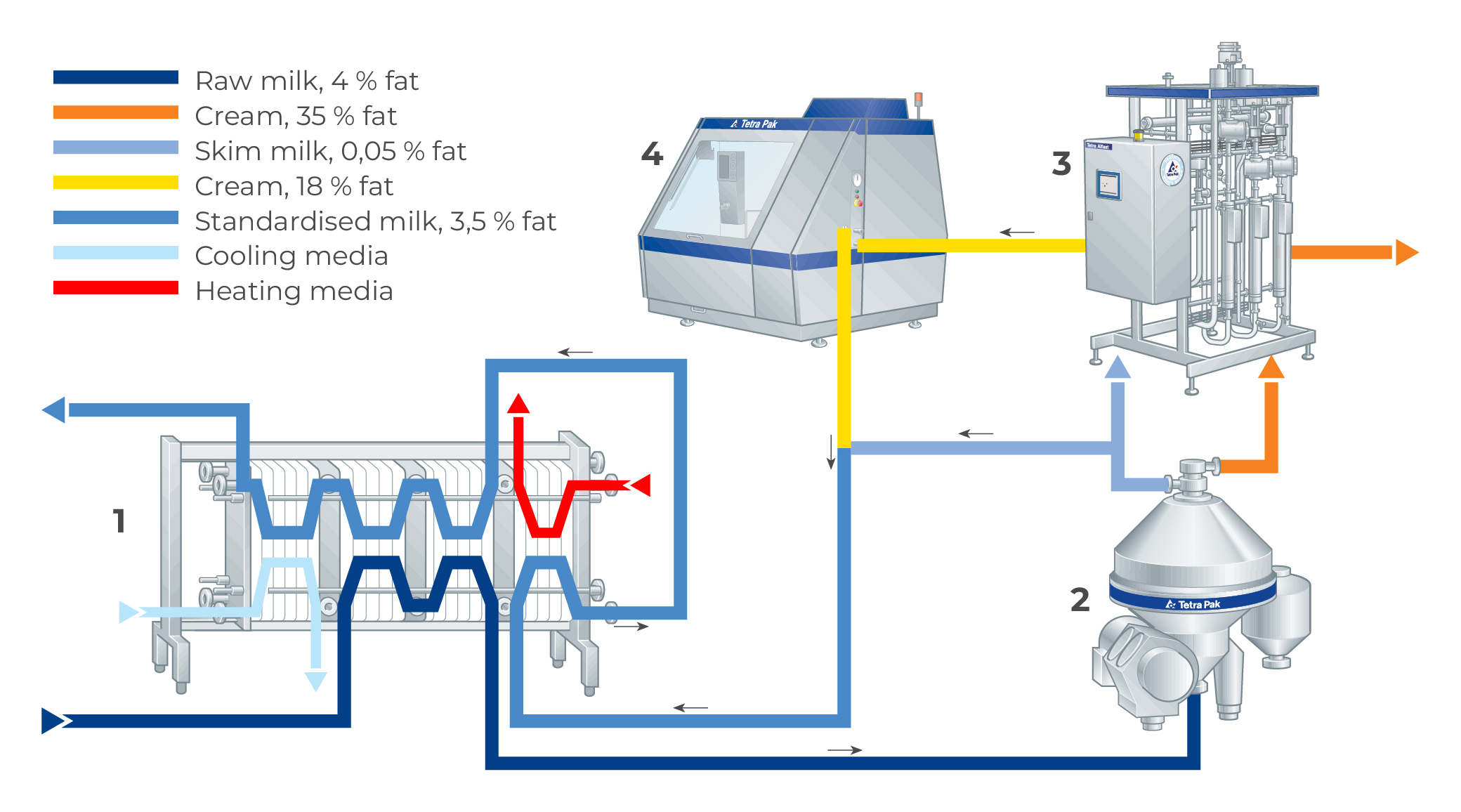
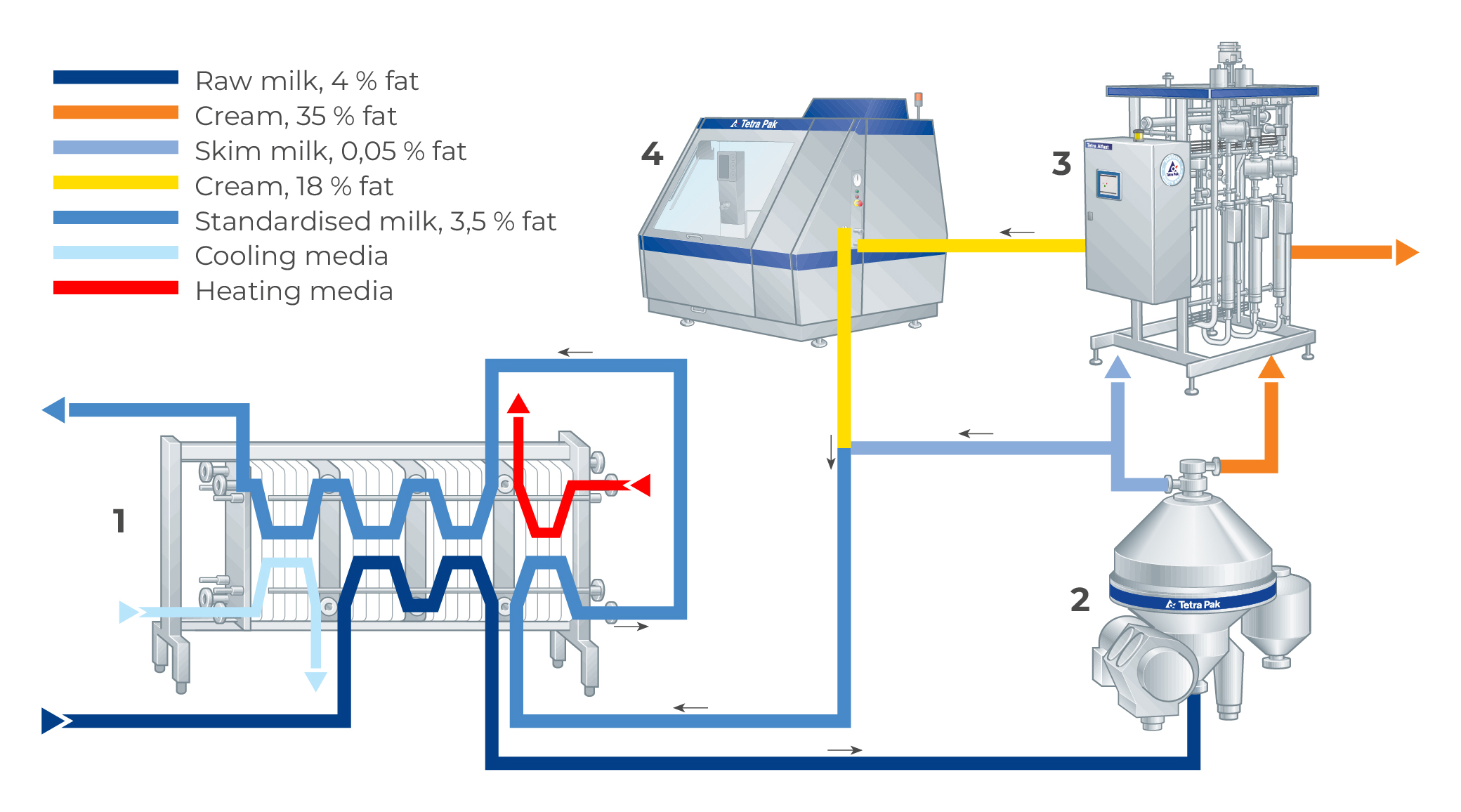
Source: dairyprocessinghandbook.tetrapak
In dairy processing, homogenization is commonly integrated with heat treatment because temperature affects product viscosity and the behavior of fat and proteins. In other products, processors may choose a different position to protect sensitive ingredients, manage viscosity, or match the operating window of upstream and downstream equipment.
The correct sequence must be validated for the specific product and plant. Homogenization itself should not be treated as a substitute for a validated thermal process, sanitation program, or other food-safety control.
Common food applications
High-pressure homogenization is widely used for products where physical stability and texture matter. Typical applications include:
- Fluid milk, cream-based products, and dairy beverages
- Ice cream mix and other frozen-dessert mixes
- Yogurt drinks and cultured dairy beverages
- Plant-based beverages made with soy, oat, nut, coconut, or blended ingredients
- Coffee whiteners and creamers
- Fruit beverages, smoothies, and juice drinks with pulp or added oils
- Sauces, dressings, soups, and culinary emulsions
- Nutritional beverages and liquid meal products
- Cocoa, protein, and fortified drinks
The desired outcome differs by application. A dairy processor may want to minimize creaming. A beverage producer may be trying to improve suspension of fine solids. A sauce producer may be seeking a smoother body and reduced oil separation. These are related but not identical objectives.
Homogenization versus mixing, blending, and high-shear processing
The terms are sometimes used loosely, but the equipment performs different jobs.
| Process | Main action | Best suited to | Important limitation |
|---|---|---|---|
| Batch mixing | Circulates and combines ingredients | Dissolving, hydration, bulk blending | May not create sufficiently small droplets or particles for long-term stability |
| High-shear mixing | Applies localized mechanical shear | Premixing, powder incorporation, some emulsification | Results can vary with tank geometry, recirculation, and batch time |
| High-pressure homogenization | Forces product through a valve under pressure | Fine emulsions and dispersions in continuous liquid processing | Requires a pumpable product and a suitable valve, pressure, and sanitation design |
A practical line may use more than one of these methods. For example, a high-shear mixer may hydrate stabilizers and create a preliminary emulsion, while the high-pressure homogenizer provides the final droplet-size reduction and consistency.
Operating variables that affect results
Pressure is important, but it is only one process variable. Increasing pressure can increase homogenization intensity, yet excessive treatment may not improve a product and can create unwanted changes in viscosity, texture, flavor perception, or ingredient functionality.
Key variables include:
- Product composition: Fat level, protein type, solids, sugar, salts, emulsifiers, and stabilizers all affect response.
- Temperature at the homogenizer: Temperature changes viscosity and flow behavior and can influence the ease of droplet disruption.
- Homogenization pressure: The main control for energy input at the valve.
- First- and second-stage settings: In two-stage machines, the balance between stages affects dispersion and cluster breakup.
- Viscosity and particle load: Thick products or products with large, hard particles may be difficult to process and can accelerate wear.
- Feed consistency: Variations in upstream blending, powder hydration, or solids content can appear as inconsistent homogenizer performance.
- Valve condition: Worn seats, impact rings, and valve components can alter results and reduce repeatability.
Processors should establish acceptable product specifications before selecting settings. Useful checks may include visual separation, particle or droplet-size measurement where available, viscosity, texture, color, and stability through the intended shelf-life evaluation. The appropriate test plan depends on the product and should be defined by qualified product-development and quality teams.
Practical limitations and operating considerations
A homogenizer cannot correct every stability problem. If an emulsion lacks enough suitable protein, emulsifier, or stabilizer to cover newly created droplet surface, reducing droplet size may not deliver the expected shelf stability. Likewise, insoluble particles that are too large, abrasive, or poorly hydrated can cause valve wear, plugging, or inconsistent results.
The machine also adds mechanical energy to the product. This can raise product temperature, so the broader line must account for thermal effects and the capacity of downstream equipment.
Hygienic design, cleanability, and maintenance access are essential selection and operating issues. Food-contact materials, seals, valve assemblies, piping, cleaning procedures, and any required process controls should be reviewed against the product, plant sanitation program, and applicable local requirements. Cleaning parameters, chemical compatibility, process temperatures, and food-safety controls must be established and verified for the actual installation rather than copied from a general equipment description.
When industrial homogenization is appropriate
Industrial homogenization is a strong fit when a pumpable liquid needs finer dispersion, reduced creaming or separation, a smoother texture, or more repeatable product appearance. It is especially valuable when simple agitation produces an emulsion that breaks during holding, thermal processing, or storage.
It may be unnecessary when ordinary mixing already achieves the required product stability, when the product contains particles unsuitable for a narrow valve, or when a formulation issue—not particle size—is the real cause of separation. The sound starting point is to define the product defect, confirm whether droplet or particle size is contributing to it, and trial the process at representative conditions.
In short, a high-pressure homogenizer is not just a powerful mixer. It is a controlled inline size-reduction device whose pump, valve design, operating conditions, formulation, and downstream process must work together to create a stable food product.
References
- Homogenizer: Working Principle, Pressure & Selection. (n.d.). https://viravix.com/blog/homogenizer-operating-principle-pressure-and-how-to-select-the-right-equipment
- High Pressure Homogenizer - ibc machine. (n.d.). https://fruitprocessingmachine.com/portfolio-items/high-pressure-homogenizer
- Fundamentals of High-Pressure Homogenization of Foods. (n.d.). https://www.researchgate.net/publication/340805441_Fundamentals_of_High-Pressure_Homogenization_of_Foods
- Homogenizers | Dairy Processing Handbook. (n.d.). https://dairyprocessinghandbook.tetrapak.com/chapter/homogenizers
- Shanghai High Pressure Homogenization Small Homogenizer for Dairy Juice Coconut Milk Homogenizing Machine 2000L Pasteurizer - GoldSupplier. (n.d.). https://www.goldsupplier.com/provide/p173399695.html
- Milk Homogenization - an overview. (n.d.). https://www.sciencedirect.com/topics/food-science/milk-homogenization
- Ice cream homogenization - Making.com. (n.d.). https://making.com/ice-cream/homogenization
- Shanghai Mixer Laboratory Homogenizer High Speed Homogenizer Laboratory High Shear Homogenizer - GoldSupplier. (n.d.). https://www.goldsupplier.com/provide/p173399677.html