A food equipment sanitation schedule should not be a generic list of daily, weekly, and monthly chores. It should be a risk-based operating document that states what must be cleaned, when it must happen, what event can trigger additional cleaning, who performs the work, and how the plant confirms the result.
The practical goal is simple: keep food-contact and surrounding equipment conditions under control without relying on vague instructions such as “clean as needed.” Build the schedule around the product, process, equipment design, soil load, allergen exposure, and evidence from inspections or environmental monitoring. Then connect each scheduled task to a usable SSOP and a verification record.
Start by separating cleaning from sanitizing
A workable food manufacturing SSOP schedule begins with a distinction that is often blurred in day-to-day language:
- Cleaning removes food residue, soils, oils, deposits, and other material from a surface.
- Sanitizing is a subsequent step intended to reduce microorganisms on a properly cleaned surface using an approved method.
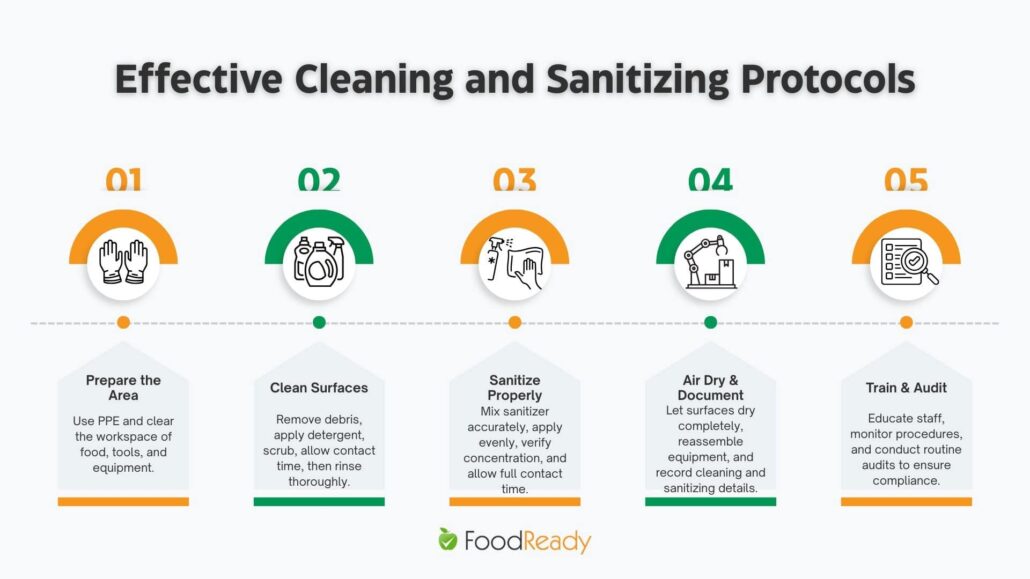
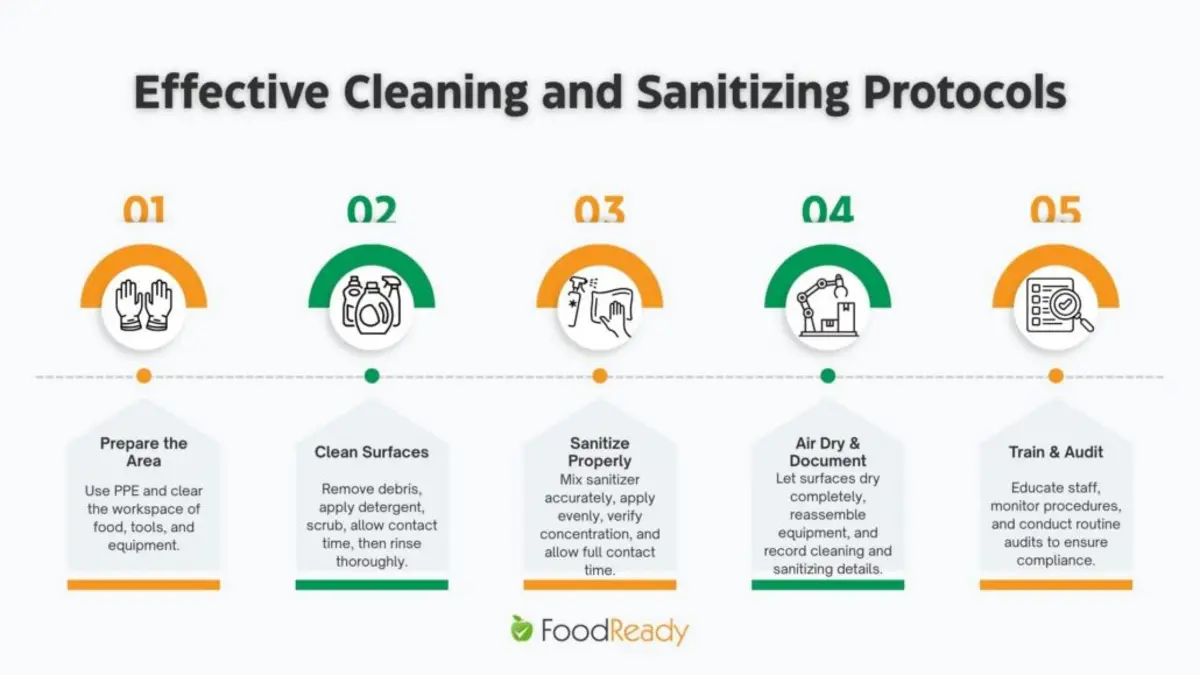
Sanitizing does not compensate for poor cleaning. Soil can shield surfaces, reduce chemical effectiveness, and make visual inspection unreliable. The SSOP for each equipment type should therefore define the full sequence, including safe shutdown and isolation, disassembly where necessary, soil removal, cleaning, rinsing if required by the chemical program, sanitizing, drying or reassembly, and pre-operational release.
The exact chemicals, concentrations, contact times, temperatures, and water quality requirements must come from the chemical supplier’s directions, the equipment manufacturer’s limits, and the facility’s validated procedures. Do not copy those parameters from another line or plant.
Map the process before assigning equipment sanitation frequency
List every product and map its path through the plant. Include receiving, staging, processing, transfer, filling, packaging, rework, waste handling, and storage. Then list the equipment and surfaces associated with each step.
The equipment list should cover more than the obvious product-contact machinery. Include:
- Mixers, conveyors, pumps, tanks, fillers, depositors, slicers, ovens, coolers, and packaging equipment
- Product-contact hoses, utensils, change parts, gaskets, seals, filters, and removable guards
- CIP circuits, return lines, spray devices, and components that may not be visible during routine inspections
- Framework, control panels, floors, drains, condensate-prone areas, and overhead structures near exposed product
- Cleaning tools, foamers, hoses, chemical stations, and tool-storage locations
For each item, identify whether it is a direct food-contact surface, an adjacent non-food-contact surface, or a more remote environmental surface. Also identify whether it handles raw ingredients, ready-to-eat product, allergen-containing product, high-moisture product, dry product, or rework.
This mapping step prevents a common failure: scheduling the main machine while overlooking attachments, transfer points, and inaccessible niches that accumulate residue or moisture.
Use a risk matrix to set the initial frequency
There is no single correct calendar interval for every food plant. A depositor handling exposed ready-to-eat food may need a substantially different sanitation routine than a dry ingredient conveyor, a closed transfer line, or the outside of a packaging machine.
Assess each equipment item against the following questions:
| Risk factor | Questions to ask | Likely scheduling effect |
|---|---|---|
| Product exposure | Does the surface directly contact exposed food? | Higher-risk contact surfaces generally need more frequent control. |
| Product type | Is the product raw, ready-to-eat, moist, dry, sticky, oily, or prone to microbial growth? | Soil behavior and food-safety risk affect the method and interval. |
| Allergen handling | Does the equipment run different allergen profiles? | Changeovers may require defined cleaning and verification before the next product. |
| Soil accumulation | How quickly do residues, oils, powders, or deposits build up? | Fast accumulation may require cleaning during a run, not only after production. |
| Equipment design | Are there hollow areas, seals, threads, dead ends, difficult-to-reach areas, or worn surfaces? | Poor access or hygienic-design concerns may require more frequent detailed cleaning. |
| Process conditions | Is there moisture, heat, condensation, pressure, or aerosol generation? | Conditions can increase residue buildup or transfer risk. |
| Historical evidence | Have inspections, swabs, complaints, breakdowns, or environmental results identified concerns? | Evidence may justify increased frequency or a revised method. |
Assign an initial frequency tier only after this review. Typical tiers may include per batch, at product changeover, at the end of a production run, daily, weekly, monthly, or another defined maximum interval. The label matters less than clarity: every task needs a specific maximum interval and a defined condition for earlier action.
Avoid using “as needed” as the only frequency. Teams can still initiate cleaning whenever conditions warrant it, but the schedule should establish the longest acceptable interval so that work is planned, monitored, and auditable.
Build event-driven triggers into the schedule
Calendar-based tasks alone do not control all sanitation risks. The schedule should tell operators and sanitation teams what events require additional cleaning, sanitizing, inspection, or a documented decision by food-safety personnel.
Common triggers include:
- A product or allergen changeover
- A line stoppage long enough to create a process-specific sanitation concern
- Product spill, leak, overflow, or contact with an unclean surface
- Equipment maintenance, repair, adjustment, or opening of product-contact areas
- Damaged seals, cracked belts, worn gaskets, loose fasteners, or other hygienic-design concerns
- Unusual buildup, visible residue, standing water, condensate, or pest evidence
- A failed pre-operational inspection, sanitation verification result, or environmental monitoring trend
- A deviation in CIP cycle conditions, chemical delivery, flow, return conditions, or other defined cycle parameters
- A raw-to-ready-to-eat transition or an unintended traffic pattern between hygiene zones
Each trigger should identify the immediate action, the person authorized to release the equipment afterward, and the record to complete. For example, a maintenance-triggered task may require cleaning of the affected area, inspection for foreign-material risks, sanitizing where applicable, and documented pre-operational approval before production resumes.
Source: foodready.ai
Write the master schedule and the SSOP as separate but linked documents
A master sanitation schedule is the control plan. It answers: what is cleaned, how often, by whom, and under what conditions?
An SSOP is the task instruction. It answers: how is this specific equipment safely and effectively cleaned and sanitized?
Link them with a procedure number or revision-controlled document reference. That keeps the master schedule concise while giving sanitation employees the detail they need at the point of use.
A useful master schedule row includes:
| Schedule field | What to include |
|---|---|
| Equipment or area | Specific asset name, line location, and component if needed |
| Surface classification | Food contact, adjacent non-food contact, or environmental |
| Product or process association | Relevant product family, allergen profile, and hygiene zone |
| Required task | Routine clean, full teardown, CIP cycle, external cleaning, inspection, or deep clean |
| Frequency | Defined calendar interval or maximum run time, where established by the plant |
| Event triggers | Conditions that require earlier cleaning or sanitation |
| SSOP reference | Current procedure, work instruction, or CIP recipe reference |
| Responsible role | Operator, sanitation crew, maintenance, quality, or contractor |
| Verification method | Visual inspection, records review, test method, or other plant-approved check |
| Corrective action | What happens when the task or verification fails |
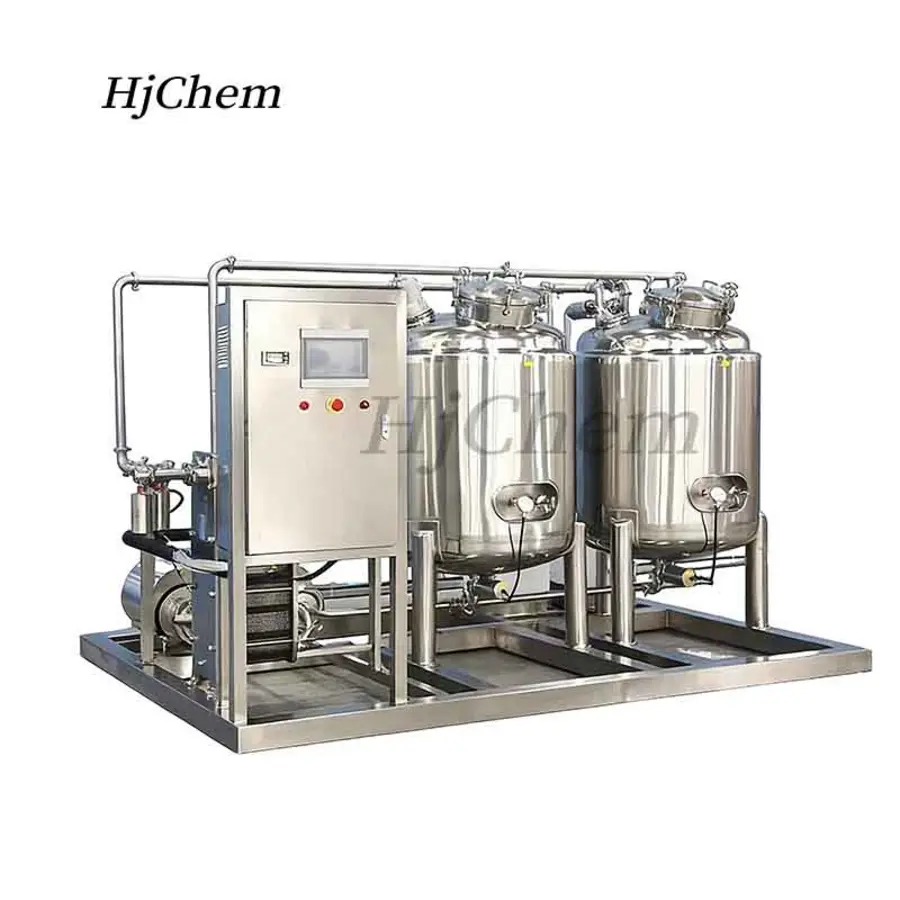
For CIP sanitation schedules, identify the circuit and the validated recipe or procedure rather than relying on an operator’s memory. The CIP record should capture the parameters and observations that the facility has determined are necessary to show the cycle ran as intended. If a deviation occurs, the response should be defined before the line is operating.
Match verification to the risk and the task
Completion of a sanitation task is not the same as verification that it was effective. Use more than one layer where appropriate.
1. Monitor execution
Monitoring confirms that the scheduled work occurred. Examples include sanitation checklists, CIP cycle records, chemical-use records, and sign-off by the assigned employee or supervisor.
Monitoring is important, but it generally shows that a task was performed—not necessarily that surfaces are acceptably clean.
2. Conduct pre-operational inspection
Before production, inspect equipment that has been cleaned and reassembled. The inspection should include the product-contact areas and the difficult points identified in the risk assessment, such as seals, guards, undersides, transfer interfaces, and inaccessible components opened during periodic deep cleaning.
Food-contact surfaces should be clean to sight and touch, but visual inspection alone may not identify every sanitation issue. Use it as a baseline check, not as the entire program.
3. Use plant-approved analytical verification where justified
Facilities may use methods such as protein or allergen checks, ATP-based hygiene checks, microbiological sampling, or environmental monitoring as part of verification. The right method, location, frequency, limits, and response plan depend on the product, process, hazard analysis, and regulatory obligations.
A result should never be interpreted in isolation. Consider the equipment condition, cleaning history, sampling technique, production status, product risk, and trend over time. Escalate recurring or unexplained results through the facility’s food-safety corrective-action process.
4. Review trends and adjust the schedule
Schedule review is where a sanitation program becomes risk-based rather than static. Review missed tasks, repeated pre-op failures, recurring residue points, excessive teardown findings, allergen verification issues, maintenance observations, and environmental-monitoring trends.
If evidence indicates that an interval is too long, reduce it or add an event trigger. If the plant wants to extend an interval, it should have documented technical justification, suitable verification, and approval through its food-safety system. A desire for more production time is not, by itself, a sanitation rationale.
Account for equipment design and maintainability
A sound food plant cleaning schedule cannot fully compensate for equipment that is difficult to clean. When a task repeatedly takes too long, requires improvised tools, produces inconsistent results, or exposes hidden buildup during teardown, investigate the equipment and process design.
Look for practical improvements such as:
- Easier access to product zones and transfer points
- Clearly identified removable parts and reassembly checks
- Better drainage and elimination of standing-water points
- Replacement of worn, cracked, or difficult-to-clean components
- Improved placement of guards, sensors, hoses, and utilities
- CIP coverage review for circuits with recurring issues
- Separate or clearly controlled tools for different hygiene zones and allergen applications
Document these findings in maintenance and food-safety review records. Some sanitation problems are fundamentally design, installation, or maintenance problems, not employee-performance problems.
A practical implementation checklist
Before approving a food equipment sanitation schedule, confirm that the plant can answer yes to these questions:
- Have all equipment, change parts, tools, and nearby surfaces been included?
- Does each item have a defined maximum cleaning interval?
- Are product changeovers, allergens, maintenance, spills, and verification failures addressed as triggers?
- Does every scheduled task link to a current, usable SSOP?
- Are cleaning and sanitizing described as separate steps where both are required?
- Are responsible roles, release authority, and records clearly assigned?
- Does the verification method match the level of product and process risk?
- Are failed inspections or test results tied to documented corrective actions?
- Is the schedule reviewed after product, equipment, chemical, process, or facility changes?
Common mistakes to avoid
The most common weakness is treating the schedule as a calendar rather than a control system. Daily cleaning may be necessary for some equipment, but it does not eliminate the need for changeover controls, deeper periodic cleaning, maintenance-triggered sanitation, or verification.
Other avoidable mistakes include copying frequencies from a different facility, omitting hard-to-access components, recording only that a task was completed, allowing undocumented changes to CIP procedures, and failing to revise the schedule after recurring findings.
A defensible sanitation schedule is specific enough for employees to execute consistently and flexible enough to respond to real operating conditions. When it links risk, frequency, triggers, SSOPs, verification, and corrective action, it becomes a working part of food-safety control rather than a spreadsheet used only before an audit.
References
- Developing An Effective Food Safety Cleaning Schedule. (n.d.). https://foodready.ai/blog/food-safety-cleaning-schedule
- Master Sanitation Schedules | Full Guide with Examples. (n.d.). https://www.alleratech.com/blog/master-sanitation-schedule
- Sanitation Performance Standards Compliance Guide | Food Safety and Inspection Service. (n.d.). http://www.fsis.usda.gov/inspection/compliance-guidance/sanitation-performance-standards-compliance-guide
- Cleaning and Sanitation Procedures for Your Food Business. (n.d.). https://farmersmarkettoolkit.org/food-safety/cleaning
- Master Sanitation Schedule: Daily to Monthly Plan. (n.d.). https://ifactoryapp.com/industries/food-manufacturing/master-sanitation-schedule-daily-weekly-monthly-food
- Food Safety & Equipment Sanitation. (n.d.). https://www.cater-event.com/food-beverage/food-safety-equipment-sanitation
- Sanitation Checklist for Food Manufacturing Equipment. (n.d.). https://www.ehsinsight.com/blog/sanitation-checklist-for-food-manufacturing-equipment
- The Importance of Master Sanitation Schedules | Food Processing. (n.d.). https://www.foodprocessing.com/food-safety/cleaning-sanitation-hygiene/article/11290845/the-importance-of-master-sanitation-schedules