Choosing a conveyor belt for food processing starts with the product and the process, not with a preferred belt material. Define what touches the belt, how the product behaves, where it transfers, how the line is cleaned, and what the existing conveyor can drive and support. Then select a belt construction that meets those conditions while allowing practical inspection, cleaning, tracking, and replacement.
For many direct-contact applications, the decision will narrow to a smooth monolithic or fabric-reinforced PU belt, a modular plastic belt, or wire mesh. PVC, silicone, PTFE-coated constructions, and specialty belts also have valid roles. The best food processing conveyor belt selection is usually the one that creates the fewest compromises across sanitation, product handling, uptime, and maintenance.
Start With the Product and Process Map
Before requesting quotes, follow the product through the full conveyor section. A belt that works at one point in a line may fail at the next because moisture, temperature, contamination risk, product orientation, or transfer conditions change.
Record the following for each conveyor:
- Product type, size range, weight, shape, and surface condition
- Whether product is loose, packaged, sticky, oily, wet, frozen, abrasive, fragile, or prone to rolling
- Direct food contact versus packaged-product handling
- Product accumulation, spacing, indexing, inclines, declines, and side transfers
- Conveyor speed and expected operating hours
- Ambient and process exposure, including heat, cold, steam, oils, fats, water, and cleaning chemicals
- Cleaning method, frequency, access requirements, and drying expectations
- Existing conveyor dimensions, pulley diameter, sprockets, slider bed or roller support, and drive arrangement
- Required metal detection, x-ray, vision, weighing, or other downstream inspection compatibility
A useful first question is: what failure would be most disruptive? On a produce line, it may be product damage or poor drainage. On a raw protein line, retained residue and difficult cleaning may be the larger concern. On a bakery cooling or cooking section, temperature exposure and transfer stability may control the choice.
Select the Belt Family Before Selecting the Exact Grade
The belt family determines much of the line’s hygiene, transfer, tracking, and maintenance behavior. Material compliance alone does not make a belt appropriate for food use.
Source: techbelt.com
| Belt type | Typical strengths | Main tradeoffs | Often considered for |
|---|---|---|---|
| Smooth PU or urethane belt | Smooth food-contact surface, good flexibility, compact transfers, suitable for many wet or oily product applications depending on construction | Can be vulnerable to cuts, edge damage, or unsuitable cleaning and temperature conditions; splice design matters | Meat, poultry, dairy, confectionery, bakery, prepared foods |
| PVC belt | Broad availability and practical performance in many light-duty applications | Verify food-contact suitability and resistance to the actual oils, cleaning regime, and temperature exposure | Dry foods, packaging, light handling, some bakery applications |
| Modular plastic belt | Positive drive, replaceable modules, open designs available for drainage and washdown, useful on curves and inclines | Hinges, rods, and underside geometry create more areas to inspect and clean; transfers may need careful design | Produce, containers, packaged foods, washdown lines, accumulators |
| Wire mesh or metal belt | Open surface, air flow, drainage, heat tolerance in suitable alloys and designs, robust construction | Product can mark, catch, or fall through openings; cleaning and transfer details remain important | Baking, frying, cooling, freezing, drying, high-temperature processes |
| Fabric or woven belt | Can provide a product-friendly surface and specific airflow or release characteristics | May retain debris or moisture depending on construction; cleaning validation is especially important | Bakery, produce, specialty handling and cooling |
| Silicone or specialty release belt | Useful where release properties or temperature performance are central | May have limits in abrasion resistance, tracking behavior, or mechanical durability | Sticky confectionery, bakery, specialized thermal processes |
PU and PVC Belts
Smooth belts are often chosen where close transfers, a continuous product-contact surface, and easy visual inspection matter. PU constructions are frequently used for direct product contact because they can offer resistance to oils and fats and can be supplied in food-contact formulations. PVC can be a practical option for dry or packaged-product applications and some food-contact duties, but it should not be treated as interchangeable with PU.
Ask suppliers about the complete belt construction: top cover, fabric layers, underside, edge sealing, splice method, and the recommended cleaning conditions. A belt’s food-contact declaration may apply to particular formulations and use conditions, not every belt sold under a broad material label.
For either belt type, examine the splice closely. Mechanical fasteners may be appropriate for certain maintenance needs, but they can affect cleanability and product transfer. Endless or finger-spliced belts can provide a smoother surface, yet replacement may require more conveyor disassembly. The right choice depends on sanitation requirements and how quickly the plant must recover from a belt failure.
Modular Plastic Belts
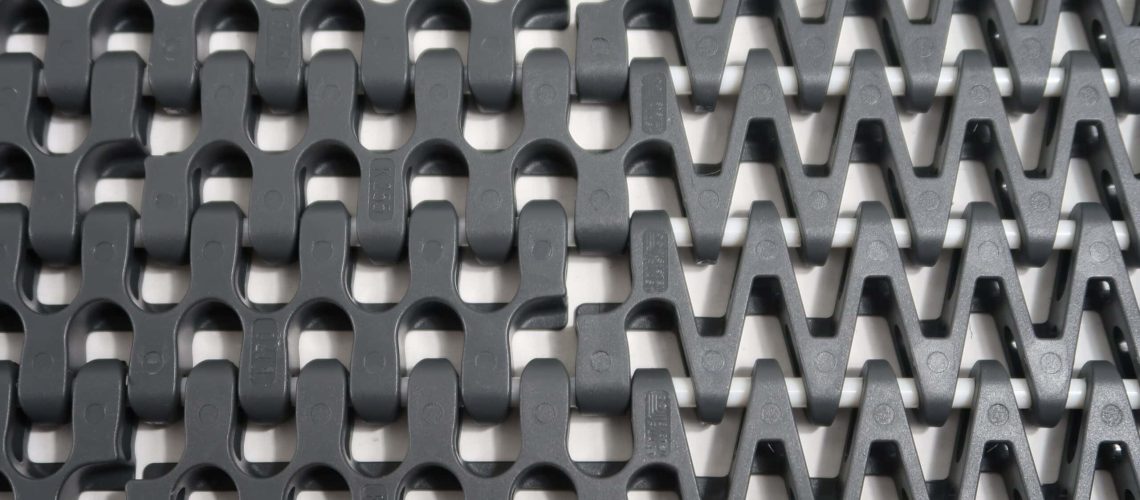
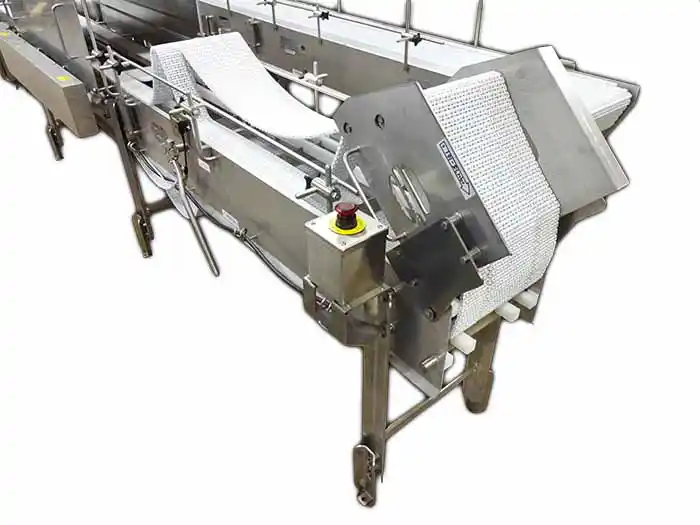
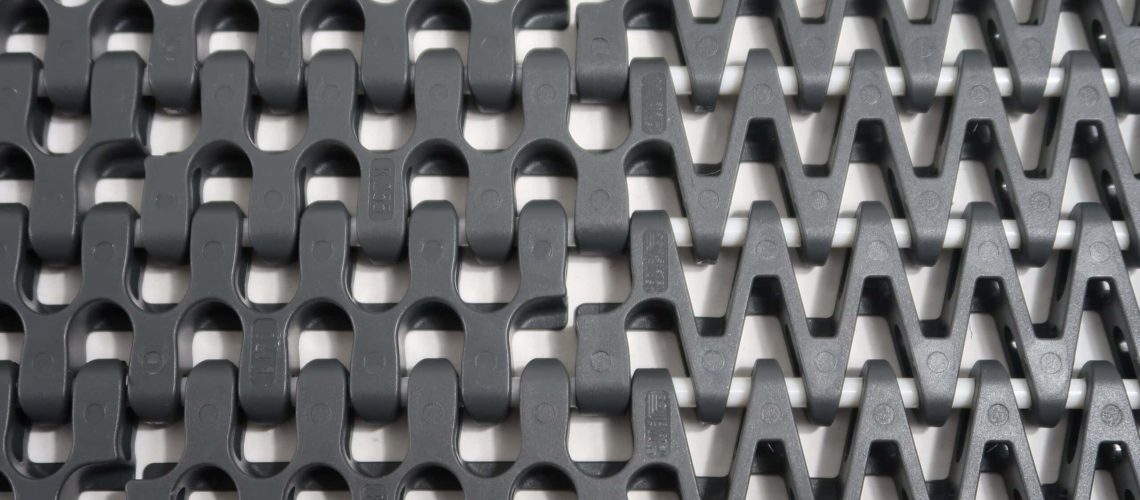
Modular plastic belts use interlocking modules connected by rods and driven by sprockets. This positive-drive arrangement can reduce the dependence on high belt tension and is useful for longer conveyors, wet environments, curves, and applications where a belt may otherwise slip on a drive pulley.
Their open construction can aid drainage and washdown access, especially compared with a solid surface that carries water. However, an open belt is not automatically easier to sanitize. Hinges, rod ends, return paths, wear strips, sprockets, and transfer devices all need access for inspection and cleaning. Product fragments can lodge in belt openings or under modules if the line is not designed for reachability.
Use modular belts when their mechanical advantages solve a genuine line problem. Do not select them only because individual modules can be replaced. Frequent module damage may point to poor transfers, excessive load, incompatible sprockets, or a cleaning method that is affecting the material.
Wire Mesh and Metal Belts
Wire mesh and metal belts are common where airflow, drainage, heat exposure, or a highly open conveying surface is needed. They are often considered for baking, frying, cooling, drying, and freezing systems. Mesh pattern, wire form, opening size, edge construction, and drive method all affect product support and cleanability.
A fragile product may vibrate or mark on a mesh belt. Small items can lodge in openings or be damaged at transfer points. A belt with large openings can improve airflow but may require special nosebar, dead-plate, or transfer arrangements. Specify the smallest product dimensions and the worst-case product orientation, not only the nominal product size.
Treat Hygiene as a Conveyor-System Requirement
A sanitary conveyor belt is not defined only by a food-grade material statement. It is the result of belt construction, conveyor frame design, access, drainage, cleaning method, and maintenance practices working together.
Evaluate these hygiene questions:
- Is every food-contact surface suitable for the intended product and use conditions?
- Can operators see and reach the belt’s top side, underside, edges, return run, drive area, and transfer points?
- Does the belt shed water, or can it retain liquid and residue in joints, fabric edges, hinges, or overlays?
- Are belt supports, wear strips, sprockets, rollers, and guards accessible for cleaning and inspection?
- Can the conveyor drain rather than hold water after cleaning?
- Does the proposed belt tolerate the plant’s approved cleaning chemicals, concentration, application method, and temperature?
- Can the belt be removed or lifted safely when deeper cleaning or inspection is required?
Food-contact compliance should be documented for the market and application where the equipment will operate. Ask the supplier for current declarations and confirm their relevance with the plant’s food-safety and regulatory teams. Also verify compatibility with the actual cleaning procedure; a compliant food-contact material can still have an unsuitable service life if cleaning exposure is outside the supplier’s recommendations.
Match the Belt to Transfers, Tracking, and Tensioning
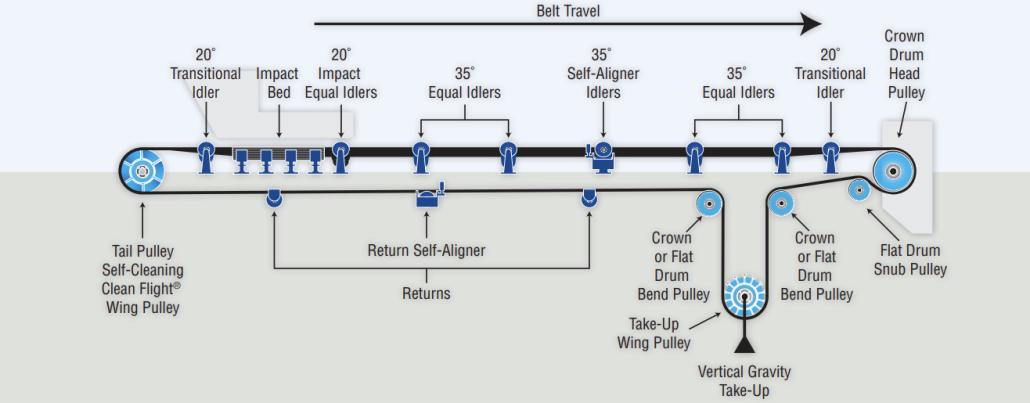
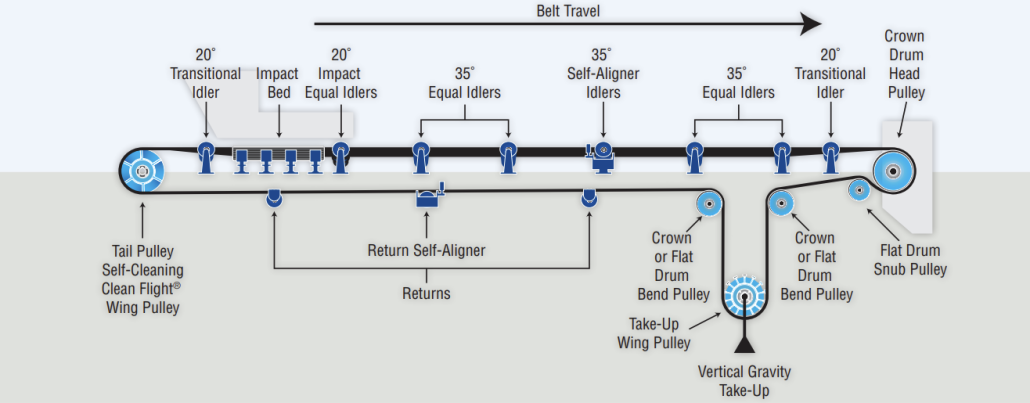
Many belt problems begin at transitions rather than in the belt itself. Product damage, belt edge wear, mistracking, and recurring splice failures often trace back to pulleys, support surfaces, or poorly controlled transfers.
Source: gramconveyor.com
Transfers and Product Support
Inspect the infeed and discharge points before choosing belt thickness or surface pattern. Small, delicate, or unstable products may need close-transfer geometry and a small-diameter nosebar or other engineered transfer solution. Larger products may need controlled guides, a dead plate, or matched conveyor speeds to avoid tipping and collisions.
For wet products, avoid creating ledges and gaps that trap material. For sticky products, consider whether the belt surface releases cleanly and whether scrapers or cleaning devices are compatible with the belt. For loose product, determine whether the belt surface needs flights, sidewalls, cleats, or a textured finish—and whether those features make cleaning more difficult.
Tracking
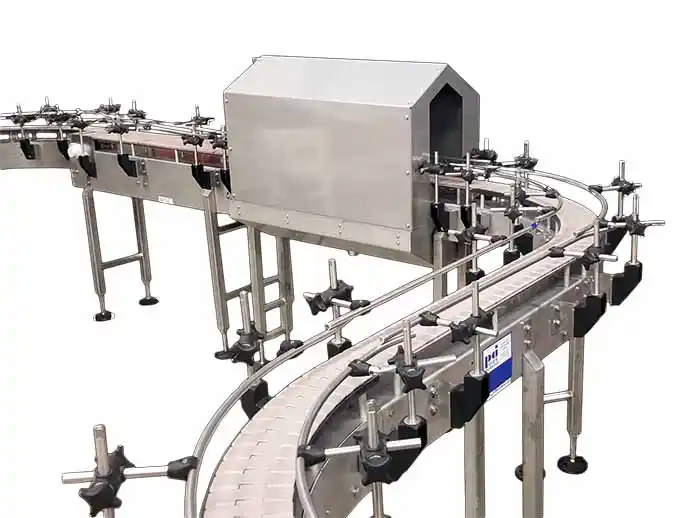
Conveyor belt tracking in a food plant depends on more than belt quality. Frame alignment, pulley condition, pulley crown or tracking design, belt tension, loading position, support wear, and contamination on rollers can all influence belt travel.
Conventional flat belts typically require properly aligned pulleys and controlled tension. Modular belts are positively driven by sprockets, but sprocket alignment, shaft condition, belt engagement, and thermal expansion still matter. Wire belts may use different tracking and drive arrangements that require their own alignment checks.
Do not use tracking adjustments to compensate for a bent frame, worn pulley, seized roller, damaged wear strip, or uneven product loading. Correct the mechanical cause first. A belt that repeatedly runs to one side can quickly damage edges, contaminate the return path, and create unplanned downtime.
Tension and Existing Hardware
Confirm that the existing conveyor can accommodate the belt’s required tension, minimum pulley diameter, drive method, support surface, and tracking system. Replacing a light fabric belt with a modular belt, for example, may require new sprockets, shafts, wear strips, take-up arrangements, and guards. A different belt thickness can also change product elevations at transfers.
Provide suppliers with conveyor drawings or measured dimensions whenever possible. Important details include center distance, pulley diameters, bed type, incline angle, shaft arrangement, drive location, and available take-up travel.
Consider Load, Speed, and Operating Environment Together
Belt selection should account for the combined effect of load, speed, accumulation, and exposure. A lightly loaded belt may still experience high stress if it starts and stops frequently, accumulates product, runs over small pulleys, or operates with side pressure.
Consider:
- Maximum product load at one time, including accumulation
- Start-stop cycles, indexing, and emergency stops
- Incline traction and the need for cleats or flights
- Abrasion from crusts, salt, bones, packaging, trays, or product debris
- Oil, fat, sugar, flour, moisture, and chemical exposure
- Freezer, oven, fryer, cooling, or ambient conditions
- Washdown intensity and the time available for drying before production resumes
Avoid relying on generic temperature or chemical-resistance ranges found in catalogs. Confirm the expected operating and cleaning exposures with the belt manufacturer, including whether the belt is continuously or intermittently exposed and whether it is under tension during cleaning.
Build Maintenance Access Into the Specification
A lower-cost belt can become expensive if routine inspection, cleaning, tracking, or replacement requires extensive disassembly. Ask who will service the belt, how often, and from where.
Good maintenance planning includes access to:
- Tensioning and tracking adjustments
- Drives, sprockets, pulleys, and return rollers
- Belt underside and return path
- Scrapers, guides, sidewalls, and transfer plates
- Belt removal points and lifting provisions
- Spare modules, rods, splice materials, or replacement belts
For critical lines, agree on what should be held in stock and how a failure will be handled. A modular belt may allow a localized repair, while an endless belt may require a planned replacement procedure. Neither approach is universally better; the operational consequence of failure decides the value of each option.
Common Food Processing Conveyor Belt Selection Mistakes
Choosing by material name alone
“PU,” “PVC,” and “food grade” are starting points, not complete specifications. Construction, surface finish, reinforcement, splice, cleaning exposure, and conveyor geometry can change suitability.
Ignoring the return side
The product-facing surface receives most attention, but the underside can carry water, residue, and debris through the conveyor. Evaluate the return run, supports, and cleaning access with the same care as the carry side.
Reusing old conveyor assumptions
A replacement belt may require different tension, pulley diameter, sprockets, or transfer elevations. Verify compatibility before ordering rather than discovering changes during installation.
Designing for normal product only
Specify the smallest, lightest, stickiest, wettest, and most fragile product conditions that the line will see. These edge cases often determine whether transfers and belt surfaces work reliably.
Treating cleaning as an afterthought
If operators cannot access a component, it cannot be reliably inspected or cleaned. Include sanitation and maintenance personnel in the selection review before finalizing the belt.
Food Conveyor Belt Specification Checklist
Send the following information to belt and conveyor suppliers to obtain a useful recommendation:
Application and product
- Product description, dimensions, unit weight, temperature, moisture, oil or fat content, stickiness, and fragility
- Direct food contact or packaged product
- Product flow, spacing, accumulation, and orientation requirements
Conveyor details
- Conveyor length, width, incline or decline, speed, and drive location
- Pulley diameters, center distance, bed or roller support, and take-up arrangement
- Existing belt type, belt width, thickness, splice style, and reason for replacement
- Transfer layout, including adjacent conveyor speeds and product gaps
Operating environment
- Ambient process conditions and expected exposure to heat, cold, water, oils, and debris
- Cleaning method and approved cleaning agents
- Required resistance to abrasion, cuts, chemicals, or static buildup where applicable
Hygiene and documentation
- Required food-contact documentation for the operating jurisdiction
- Cleanability expectations and access constraints
- Allergen, foreign-material, or inspection requirements identified by the plant’s food-safety program
Maintenance requirements
- Acceptable downtime for cleaning, tracking, and replacement
- Preferred repair method and available spare-parts strategy
- Access restrictions, guarding requirements, and safe belt-removal method
The final selection should be reviewed as a system: belt, conveyor frame, drive, supports, transfers, cleaning procedure, and maintenance access. That approach is more likely to prevent a replacement belt from becoming the next recurring production problem.
References
- meat conveyor belt for food processing. (n.d.). accio.com. https://www.accio.com/plp/meat-conveyor-belt
- Food-grade conveyor belts, food processing conveyor systems,FDA-compliant conveyor belts, heat-resistant food conveyor belt cost,California food plant conveyor suppliers, Texas meat processing conveyors - Xuanze Conveyor Belt,Coil Wrapper Belt,PU PVC PVK Novo sponge polyester Conveyor Belt,Drive Bel…. (n.d.). xzbelt.com. https://www.xzbelt.com/food-industry/how-to-choose-the-right-conveyor-belt-for-the-food-industry-7-key-factors-explained.html
- Food Conveyor Belt - Feeding Conveyor and Discharging Conveyor Belt for Food Processing. (n.d.). stainlesssteel-wiremesh.com. https://stainlesssteel-wiremesh.com/ssmesh/conveyor-mesh-belt/food-conveyor-belt.html
- Selecting the Right Conveyor Belting Material for Food Applications | Gough Econ, Inc.. (n.d.). goughecon.com. https://www.goughecon.com/selecting-the-right-conveyor-belting-material-for-food-applications
- Food Processing Conveyor Belts | Texas Belting and Supply. (n.d.). texasbelting.com. https://www.texasbelting.com/pages/food-processing-conveyor-belts
- Complete Metal Conveyor Belt Selection Guide. (n.d.). wirebelt.com. https://wirebelt.com/belt-blog/the-complete-guide-to-choosing-the-right-metal-conveyor-belt-for-your-application
- A Complete Guide to Conveyor Belt Materials. (n.d.). texasbelting.com. https://texasbelting.com/blogs/news/a-complete-guide-to-conveyor-belt-materials
- Food Processing Conveyor Belt: PU vs. PVC vs. Mesh | HOLO. (n.d.). holobelt.com. https://www.holobelt.com/blog/compare/food-grade-conveyor-belts-differences