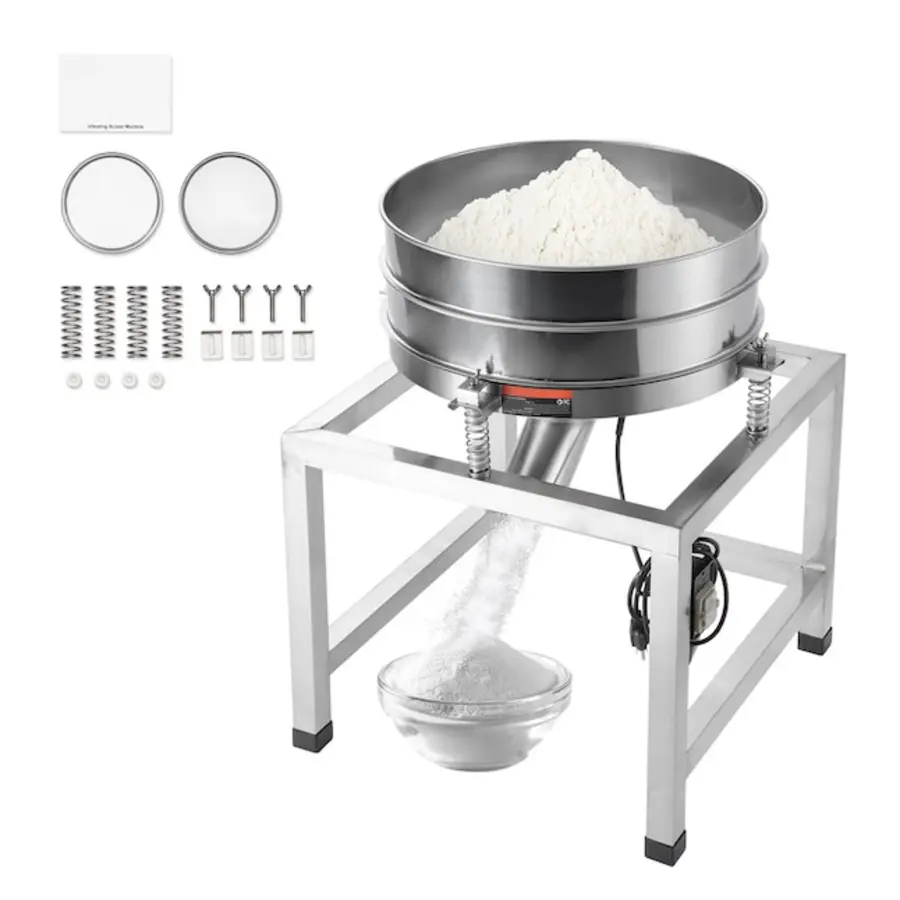
A vibratory sieve for food powders should be selected from the actual screening duty, not from a supplier’s nominal capacity figure. Start by defining whether the machine is a safety sieve that removes occasional oversize material and foreign matter, or a grading sieve that makes a controlled particle-size separation. Then match the screen opening, product behavior, required flow rate, number of decks, cleaning method, and installation layout to that duty.
For many dry-ingredient lines, the most practical choice is a single-deck, sanitary vibratory screener used ahead of blending, filling, or other sensitive equipment. But flour, spice blends, dairy powders, sugar, starches, inclusions, and free-flowing granules behave very differently on a screen. A machine that handles one ingredient well may blind, flood, segregate, or restrict flow with another.
Start with the screening objective
The first specification question is simple: what must pass through the screen, and what must be retained?
Safety screening
Safety screening, also called check screening, removes material that should not enter the next process step. This may include product lumps, bag or liner fragments, accidental foreign material, or oversize particles that could disrupt a mixer, filler, depositor, or packaging system.
The accepted product passes through the screen, while the retained material is discharged for inspection or disposal. The goal is generally to protect product quality and downstream equipment with minimal restriction to normal production flow.
A safety screen is often appropriate:
- After bag dumping or bulk-bag discharge
- Before a blender or mixer
- Before filling equipment
- Ahead of pneumatic conveying or sensitive process equipment
- As a final check before packaging, where the process design supports it
Grading or classification
Grading separates a material into defined size fractions. It may use multiple screen decks and has a more demanding relationship between feed rate, particle distribution, screen area, and required separation accuracy.
Do not specify a grading machine when the true requirement is only occasional reject removal. Conversely, a basic safety screener may not provide reliable classification when product must be separated into consistent size bands.
Build the specification from the ingredient
The ingredient usually determines whether a screening application is easy or difficult. Provide suppliers with a representative product description and, where practical, arrange trials with material that reflects normal and worst-case conditions.
Particle size and required cut size
The mesh opening is determined by the size separation required, not simply by the smallest particle in the product. Define:
- The maximum particle size permitted in the passing product
- The expected size and quantity of oversize material
- Whether the objective is a broad safety check or a tight size classification
- Whether fragile granules must remain intact
Mesh descriptions can be confusing because nominal mesh numbers, wire dimensions, and actual apertures are related but not interchangeable. Specify the required opening or cut point clearly, and ask the equipment supplier to confirm the screen construction proposed for that opening.
Fine screens can improve removal of small oversize particles, but they also have less open area and are more prone to loading. A finer mesh may therefore reduce real throughput or demand more frequent intervention. The best choice is usually the coarsest opening that reliably achieves the process requirement.
Flowability, moisture, and agglomeration
A dry ingredient is not necessarily free-flowing. Powders may bridge at the inlet, smear on the screen, form soft agglomerates, or retain moisture during seasonal changes. Fat-containing powders and certain spice or sugar products can also behave differently as plant conditions change.
Ask whether the material is likely to:
- Form lumps during storage or conveying
- Become cohesive under humidity or temperature changes
- Carry static charge
- Produce large amounts of fine dust
- Segregate by particle size during handling
- Degrade when exposed to prolonged vibration
If the ingredient regularly blinds the screen, increasing machine diameter alone may not solve the problem. The screen opening, feed distribution, vibration characteristics, screen-cleaning arrangement, and upstream powder conditioning may all need review.
Bulk density and feed consistency
Volumetric feed rate does not tell the whole story. A low-density powder and a dense granule may occupy the same volume but load the screen differently. Short, high-rate surges from bag dumping, rotary valves, or conveying systems can also overwhelm a sieve that handles the same average rate in steady flow.
Provide both expected average flow and peak flow. Include the intended operating pattern: continuous feed, batch discharge, manual bag dumping, or intermittent transfers. The machine and its upstream hopper should be selected to tolerate realistic surges rather than idealized average conditions.
Size the sieve for usable capacity, not brochure capacity
Screening capacity depends on product and process conditions. It is affected by screen area, mesh opening, feed depth, product flowability, vibration settings, percentage of oversize, and the time material remains on the screen.
For this reason, nominal capacity figures are useful only as an initial comparison. A supplier should evaluate the actual product, required screen, reject rate, and feed arrangement before confirming performance expectations.
A larger diameter sieve offers more usable screen area and can reduce bed depth, which may improve separation. It also takes more floor space and may complicate access in a tight installation. A smaller machine may be adequate for low-throughput safety screening but can become a bottleneck if it receives periodic surges.
One deck or multiple decks?
A single-deck unit is normally enough when the purpose is to pass acceptable product and remove one oversize reject stream.
Choose multiple decks only when the process requires more than one particle-size fraction, or when separate oversize and undersize streams are necessary. Each additional deck increases screening complexity, inspection requirements, changeover work, and potential sources of hold-up. More decks are not automatically better.
Specify hygienic construction and access early
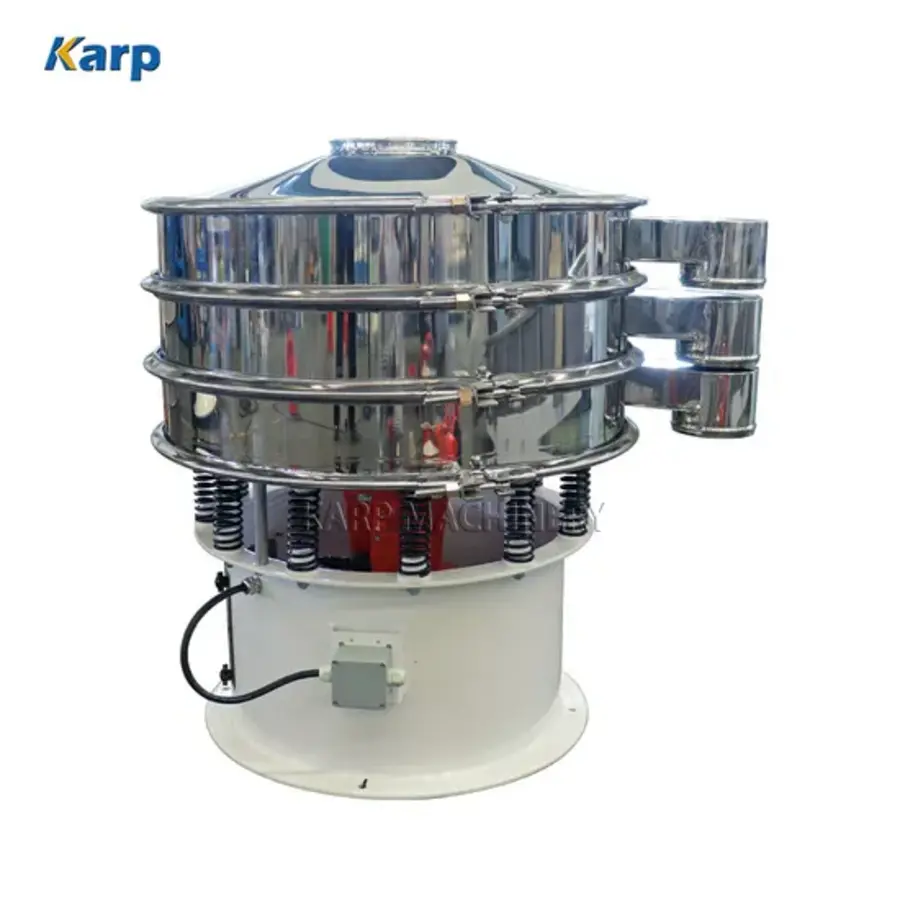
For food applications, the practical details of construction often matter as much as screening performance. A food-grade vibratory screener should be compatible with the plant’s hygienic design requirements, cleaning method, product-contact material requirements, and inspection procedures.
Source: image.made-in-china
Review the following features during selection:
| Selection point | Why it matters |
|---|---|
| Product-contact construction | Must suit the ingredient, cleaning approach, and site material standards. |
| Smooth, accessible surfaces | Simplify inspection and reduce locations where product can collect. |
| Tool-free or controlled-release clamps | Affect speed and consistency of screen changes and cleaning. |
| Gaskets and seals | Must fit securely and be suitable for the product and sanitation program. |
| Screen-frame design | Influences durability, cleanability, and ease of replacement. |
| Inspection access | Allows operators to check retained material and internal condition without excessive disassembly. |
| External finish and frame design | Affects cleanability around the equipment and integration with the surrounding area. |
Do not assume that “stainless steel” alone makes a machine suitable for a particular food application. Confirm the product-contact materials, surface finish expectations, sealing arrangement, documentation, and any site-specific standards with the supplier and the plant’s quality, sanitation, and engineering teams.
Cleaning and allergen changeover
Screening equipment can retain powder in screen frames, gaskets, covers, discharge spouts, and interfaces with upstream and downstream equipment. If the line handles multiple products or allergens, evaluate the whole changeover task rather than the sieve alone.
Ask operators or suppliers to walk through a screen change and cleaning sequence. Useful questions include:
- Can the screen be removed without difficult lifting or awkward access?
- Are contact surfaces visible and reachable for inspection?
- How are gaskets identified, removed, and reinstalled?
- Can product collect in dead spaces around the inlet, outlet, or frame?
- Does the planned cleaning method match the equipment design and site procedure?
- How will the facility verify cleaning effectiveness under its own food-safety program?
Cleaning validation, allergen controls, sanitation chemicals, and regulatory obligations should be established by the processor using its applicable requirements and qualified internal or external expertise. Equipment suppliers can provide design and material information, but they cannot replace site-specific verification.
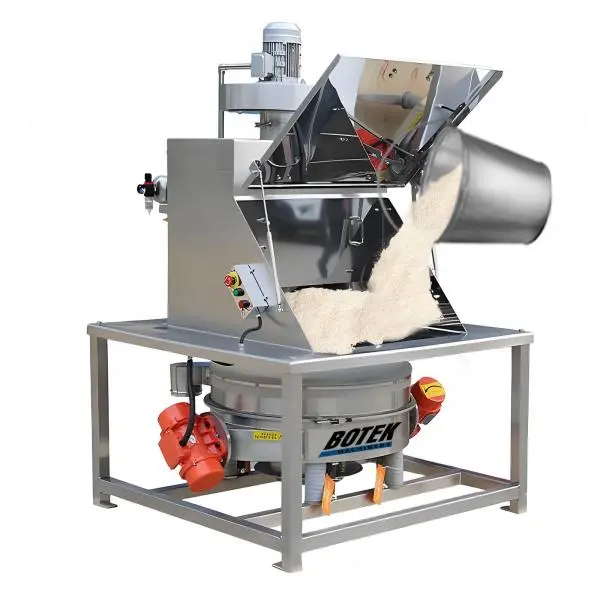
Control dust and integrate the sieve into the line
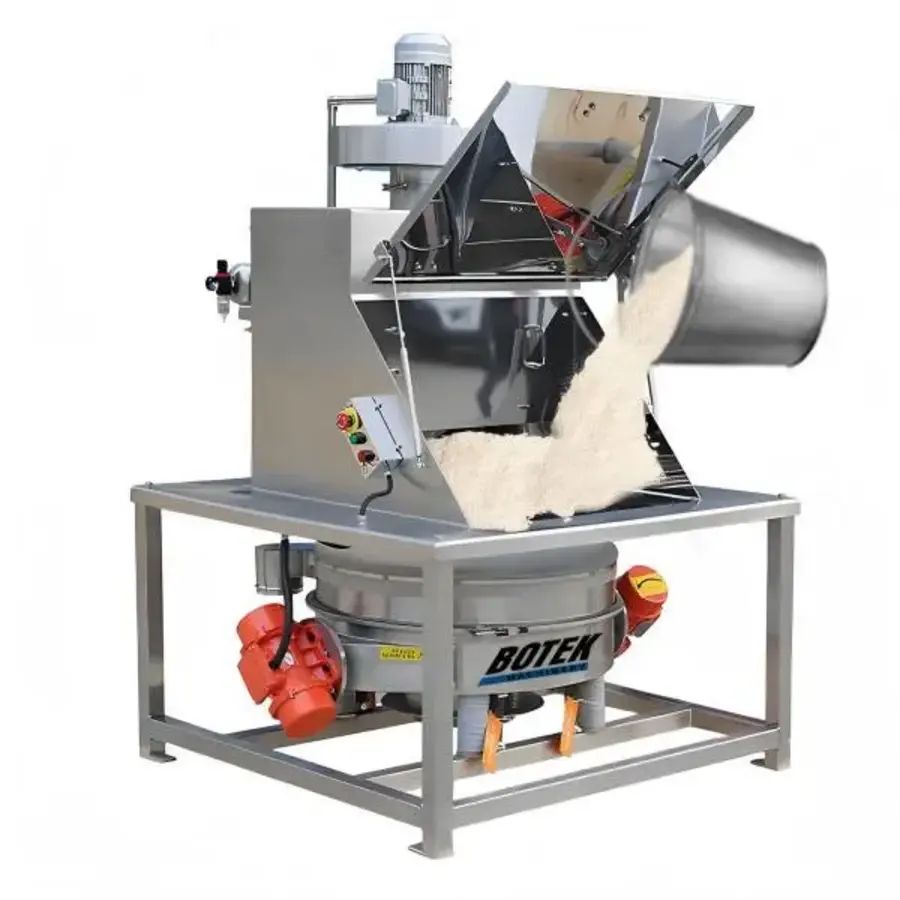
A sieve can become a dust source when it is poorly connected to the feed system, discharge hopper, or dust collection arrangement. Fine powders may escape at covers, clamps, flexible connectors, bag-dump stations, and transfer points if the system is not designed as a whole.
The screening unit should be considered together with:
- The feed hopper or bag-dump station
- Venting and dust collection connections
- Flexible connections that isolate vibration without creating product traps
- Downstream hopper capacity and level control
- Access for reject removal and inspection
- Structural support and available headroom
Source: botekmachinery
Avoid placing a sieve where downstream equipment cannot accept its discharge rate. Similarly, avoid an inlet arrangement that dumps product onto one small area of the screen. A properly designed feed transition helps distribute material across the screen and supports more stable operation.
If combustible dust may be present, the processor should conduct the applicable dust-hazard assessment and determine the required equipment and facility safeguards. Do not treat a standard machine configuration or a dust-collection connection as proof of suitability for a specific dust hazard.
Check maintenance and operating practicality
A screen is a consumable process component. It can wear, tear, loosen, or be damaged during cleaning and handling. The selection should include a plan for inspection, spares, and controlled replacement.
Before purchase, clarify:
- How screen condition will be inspected and documented
- Whether spare screens can be held on site
- How quickly screens can be changed
- Whether screen frames are interchangeable across similar machines
- How the vibration drive and mounts are accessed for routine maintenance
- What alarms, interlocks, or controls are needed for the intended operating sequence
Also consider ergonomics. Frequent screen removal from an elevated machine, a confined platform, or a bag-dump enclosure can turn a theoretically quick changeover into a difficult routine task.
Common vibratory sieve selection mistakes
The most frequent errors are specification errors rather than mechanical failures.
- Choosing by nominal throughput alone: Actual capacity depends on product, mesh, feed consistency, and reject loading.
- Using an unnecessarily fine mesh: This can cause blinding and reduce output without adding useful protection.
- Treating a grading duty as safety screening: Multi-fraction separation needs a more detailed process specification.
- Ignoring peak feed surges: A sieve may be adequate at average flow but overload during bag dumping or batch transfer.
- Overlooking cleaning access: Difficult-to-reach product contact areas create longer changeovers and inconsistent inspection.
- Selecting the machine before defining installation constraints: Headroom, discharge elevation, dust extraction, access, and support structure can determine the workable design.
- Assuming all dry powders behave alike: Moisture, fat content, static, particle shape, and agglomeration can change screen performance significantly.
A practical purchase checklist
Before requesting quotations for powder screening equipment in food processing, prepare the following information:
- Ingredient name, bulk density, particle-size range, and flow behavior.
- Screening purpose: safety removal, de-lumping, grading, or multiple separations.
- Required screen opening and acceptable oversize level.
- Average and peak feed rates, plus batch or continuous operating pattern.
- Likely contaminants, lumps, or packaging fragments to be retained.
- Moisture, cohesion, static, dust, and agglomeration concerns.
- Required number of product and reject streams.
- Product-contact material and hygienic design requirements.
- Cleaning method, product-change frequency, and allergen-management requirements.
- Available floor area, elevation, access space, power, venting, and downstream connection details.
- Required documentation, inspection practices, and site standards.
- A representative product sample for screening trials where the duty is uncertain.
The selection decision
The right vibratory sieve is the one that achieves the required separation with stable flow, practical cleaning, manageable mesh changes, and a layout that fits the real production line. For simple safety screening, prioritize a robust single-deck design, suitable mesh opening, good access, and dust-conscious integration. For classification, fine powders, or inconsistent materials, spend more time on product trials and process details before committing to size, deck arrangement, and screen configuration.
A well-written specification should describe the material and the duty clearly enough that suppliers can propose comparable solutions—and clearly identify what still needs to be verified on the actual ingredient.
References
- Vibratory Sieves and Sifters for Food Powder Screening. (n.d.). https://vibratingsieves.co.uk/vibratory-sieves-and-sifters-for-food-powder-screening
- Vibrating Sieve, Industrial Vibrating Sieves. (n.d.). https://elcanindustries.com/vibrating-sieve
- Industrial Vibratory Sieves & Screening Machines | Sieve Machine Manufacturer | Vibrating Sifters & Equipment. (n.d.). https://vibrascreener.com
- How to choose industrial sieves for food powders and ingredients. (n.d.). https://www.farleygreene.com/blog/how-to-choose-industrial-sieves-for-food-powders-and-ingredients
- Top Benefits of Industrial Vibrating Sifters in Food Powder Processing. (n.d.). https://vibrascreener.com/top-benefits-of-industrial-vibrating-sifters-in-food-powder-processing
- How Vibrating Sieve Technology Transforms Food Industry Filtration. (n.d.). https://www.topspacking.com/news/how-vibrating-sieve-technology-transforms-food-industry-filtration
- Vibratory Screening for Food & Beverage Processing. (n.d.). https://www.screenerking.com/pages/vibratory-screening-food-beverage
- Industrial screening - Powder sieving | Palamatic Process. (n.d.). https://www.palamaticprocess.com/en-us/bulk-handling-equipment/sieve