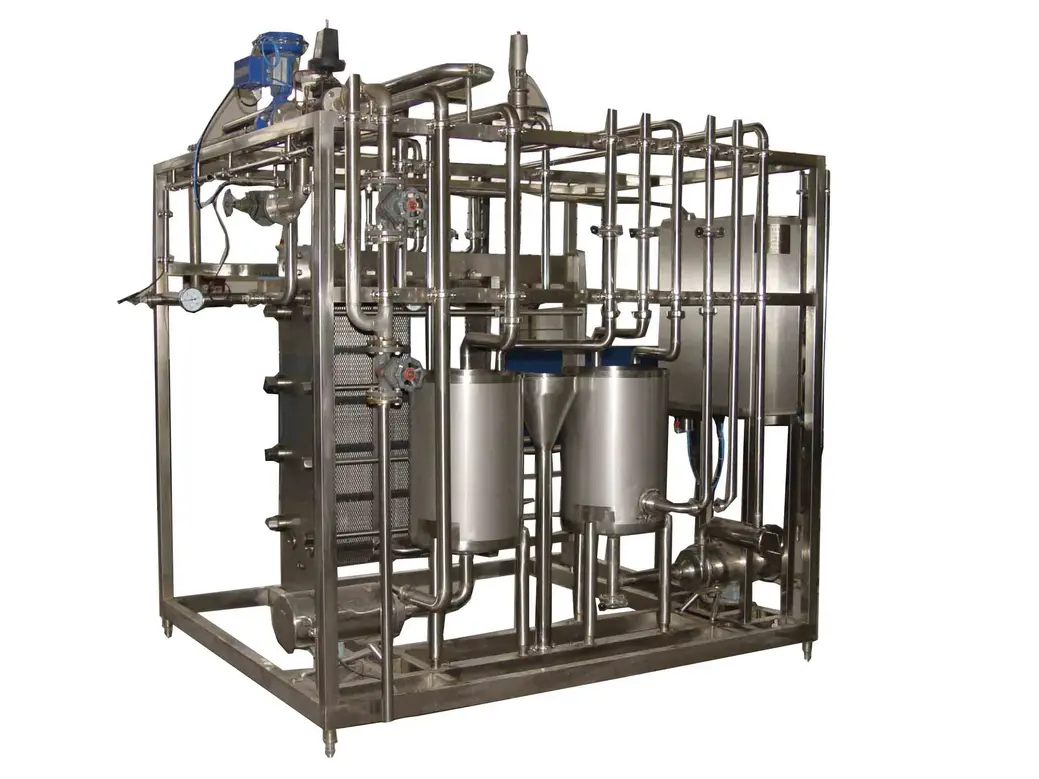
HTST vs batch pasteurization is mainly a choice between continuous throughput and batch flexibility. An HTST system moves product through a controlled heating, holding, and cooling path at a steady flow rate. A batch pasteurizer heats one defined tank volume, holds that lot under controlled conditions, then cools and empties it before the next cycle.
Neither format is automatically safer or better for every product. The right choice depends on production volume, product behavior, packaging-line demand, cleaning and changeover needs, available utilities, and the validated thermal process required for the product. Equipment suppliers can help define machine capability, but the required time-temperature schedule and critical limits must be established or approved by the appropriate process authority and regulator.
The core process difference
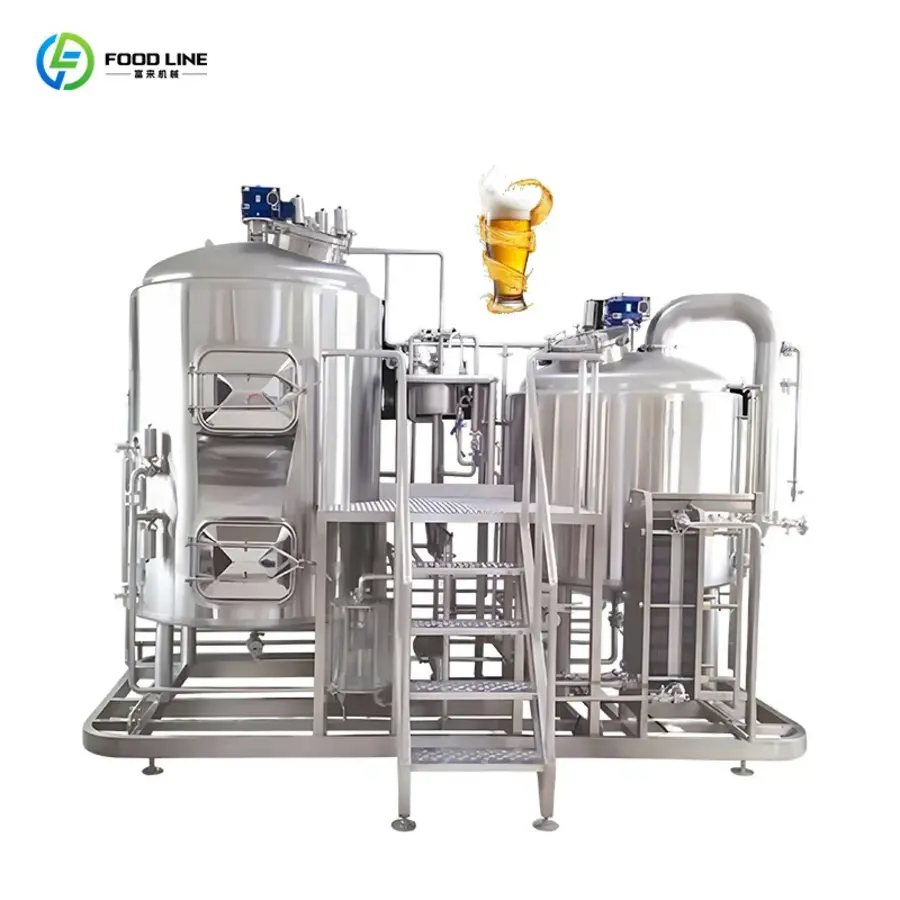
Batch pasteurization is a tank operation. Product enters a jacketed, agitated vessel or similar insulated vat. The system heats the full volume, mixes it to reduce temperature variation, holds it according to the validated process, cools it, and transfers it downstream. The plant works in discrete lots.
High-temperature short-time pasteurization, usually called HTST, is a continuous operation. Product is pumped through heat-exchange sections, reaches the required process temperature, passes through a holding section sized for the validated residence time, and is then cooled for filling, further processing, or storage. Product enters and exits continuously once the system is in stable operation.
The distinction affects far more than hourly output. It changes how the plant schedules production, manages product losses, documents controls, connects to packaging, and responds to deviations.
HTST vs batch pasteurization at a glance
| Selection factor | Batch pasteurization | HTST pasteurization |
|---|---|---|
| Product movement | One tank volume at a time | Continuous, controlled flow |
| Main equipment form | Jacketed vat or tank, agitator, heating/cooling system | Integrated processing skid with pumps, heat exchanger, holding section, controls, and valves |
| Throughput profile | Cyclical, with fill, heat, hold, cool, discharge, and cleaning stages | Steady output after startup and stabilization |
| Best operational strength | Small lots and frequent product changes | Repeated production of larger, more consistent runs |
| Changeover | Usually simpler to isolate individual lots, but still requires validated cleaning and line clearance | Can involve more piping, valves, heat-exchange circuits, and product recovery considerations |
| Automation need | Can be relatively simple, though automated batch control is available | Typically depends more heavily on instrumentation, flow control, interlocks, and automated records |
| Product handling | Longer tank residence and agitation exposure | Shorter continuous residence, but product passes through narrow channels and pumps |
| Packaging integration | Often feeds fillers intermittently or through a surge tank | Can directly support a continuously operating filler when capacities are matched |
How a batch pasteurizer works
A batch pasteurizer combines heating, mixing, holding, and cooling in one vessel. The vessel may use a jacket, internal coils, or another indirect heat-transfer arrangement. Agitation is important because the process must achieve uniform conditions throughout the tank, including around the vessel wall and within the product mass.
A typical pasteurization process flow is:
- Fill the vat with a measured product lot.
- Heat the product while agitating according to the approved operating procedure.
- Confirm that the full batch reaches the validated process condition.
- Hold the batch for the required validated period.
- Cool the product to the specified downstream temperature.
- Transfer to a filler, fermentation tank, storage tank, or other next process step.
- Clean and prepare the system for the next lot.
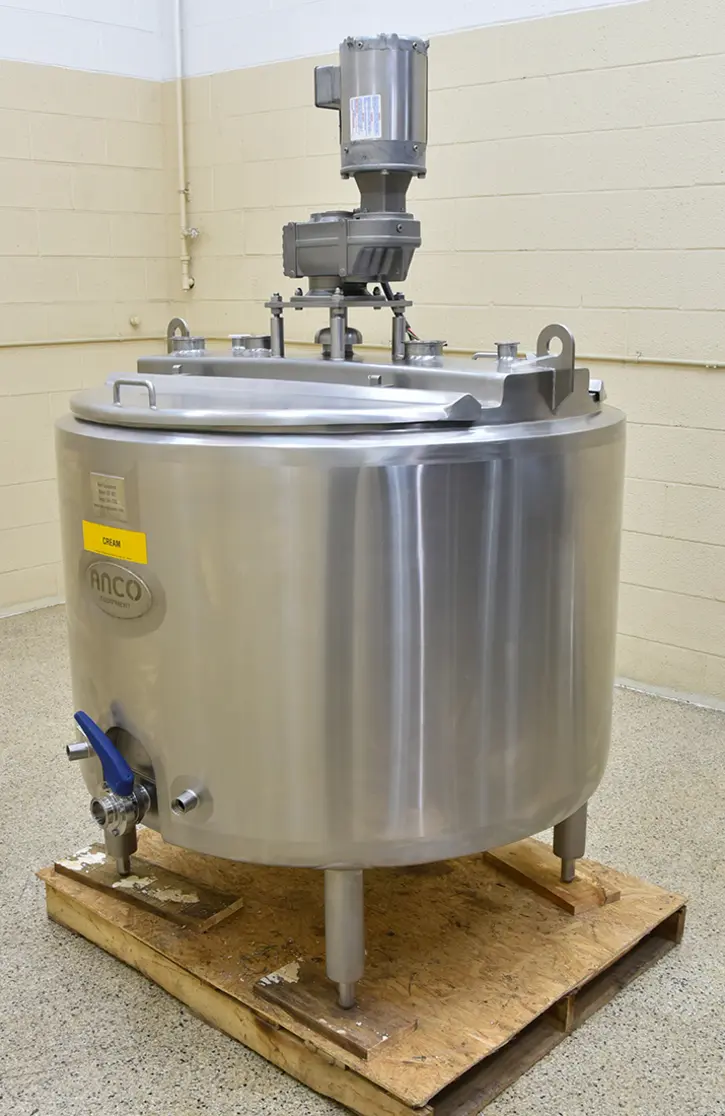
Source: alard-equipment
This format is useful when a processor needs to make multiple recipes, smaller production lots, seasonal products, pilot runs, or products that also need mixing, culturing, blending, or ingredient addition in the same vessel. In some operations, the vat performs several production functions, reducing the need for separate tanks.
Its main limitation is that the cycle includes nonproductive periods. Filling, heating, cooling, discharge, and cleaning all consume time. Output is therefore determined by usable tank volume and total cycle time, not simply by heating capacity.
Batch equipment considerations
When evaluating a batch pasteurizer, look beyond nominal vessel size. Useful questions include:
- Is the working volume appropriate after allowing for headspace, foaming, and agitation?
- Can the agitator handle the product viscosity and particulates without damaging the product or creating poor circulation?
- Is the heating and cooling surface sufficient for the intended cycle time?
- Can the vessel cool quickly enough to support the intended production schedule?
- Are temperature sensing locations, controls, and recording functions suitable for the validated process?
- Does the tank design drain fully and support the plant’s cleaning program?
- Will the tank also be needed for blending, fermentation, holding, or ingredient addition?
A batch system can be mechanically straightforward, but process control should not be treated casually. Temperature uniformity, agitation performance, sensor accuracy, timing, records, and operator procedures all affect whether every part of the lot receives the intended treatment.
How an HTST pasteurization system works
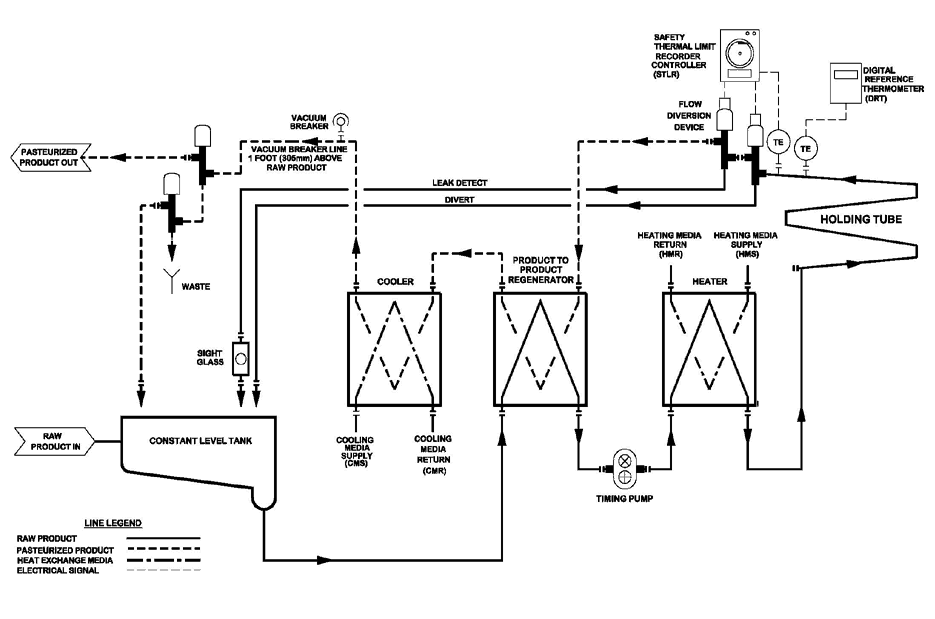
An HTST line separates the thermal process into controlled stages. While layouts vary by product and regulatory requirements, a typical system includes a product balance tank, feed pump, regenerative heat exchanger, heating section, holding section, temperature instruments, flow controls, a diversion arrangement, cooling sections, and sanitary valves and piping.
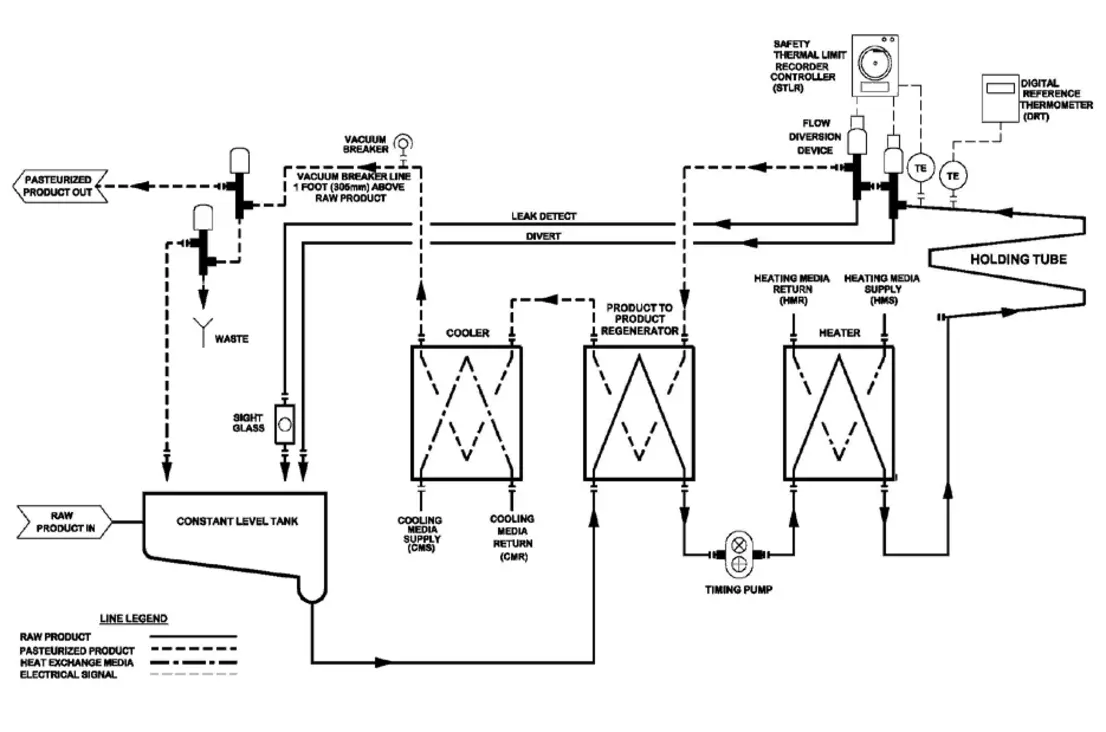
Source: zwirnerequipment
In a common plate heat exchanger pasteurization arrangement, product flows through thin channels between stainless steel plates. Heating or cooling media flow through adjacent channels without directly contacting the product. This gives a large heat-transfer area in a compact footprint.
Many HTST systems use regeneration. In regeneration, incoming cold product is preheated by outgoing hot product across separate heat-exchanger channels. The outgoing product is simultaneously cooled before it reaches the final cooling stage. This can reduce utility demand, but it also makes system design, pressure relationships, inspection, and maintenance more important.
The holding section is central to the process. Its dimensions and the actual product flow rate together determine residence time. A change in flow rate, product properties, pump behavior, or piping configuration can affect that relationship. For this reason, continuous systems rely on coordinated controls rather than a temperature display alone.
A properly designed system may include a flow diversion function that routes product away from the accepted-product path when a critical process condition is not met. The exact configuration, required instruments, records, and testing expectations depend on the product, process, jurisdiction, and applicable standard. These requirements should be confirmed before equipment is specified or installed.
HTST equipment considerations
A high temperature short time pasteurization equipment package should be reviewed as a complete process system. Important evaluation points include:
- Required production rate at the actual product viscosity and inlet temperature.
- Heat-exchanger channel geometry and suitability for particulates, pulp, fat, protein, fiber, or viscous products.
- Holding-tube design, flow measurement approach, and validated minimum residence time.
- Heating and cooling utility availability, including chilled water, glycol, cooling water, steam, or hot-water supply as applicable.
- Regeneration capability and whether it is appropriate for the product and operating profile.
- Pump selection, pressure control, and sensitivity to shear.
- Instrumentation, data recording, alarms, diversion logic, and user access controls.
- Clean-in-place coverage, drainability, gasket maintenance, and inspection access.
- Coordination between pasteurizer capacity, buffer capacity, and filler demand.
Throughput and line integration
HTST usually fits facilities that need a predictable, steady supply of pasteurized product. It can be a strong match for a packaging line that runs for extended periods and has relatively stable demand. The pasteurizer, downstream surge capacity, and filler should be sized as a system. A fast pasteurizer feeding a slower filler can create unnecessary recirculation or holding; a slow pasteurizer can starve the filler.
Batch pasteurization suits plants where output is naturally intermittent. A processor might produce one recipe in the morning, perform a changeover, then run another product later in the day. It also works well where the filling operation is scheduled around completed batches rather than requiring a continuous product supply.
Do not compare systems only by their stated hourly capacity. Compare usable daily output after startup, product recovery, changeovers, cleaning, scheduled breaks, maintenance, and packaging constraints. The equipment with the highest nominal rate is not always the system with the highest practical output for a particular plant.
Product suitability: flow behavior matters
HTST systems generally favor products that can be pumped consistently and transferred through heat-exchanger channels without excessive fouling, blockage, separation, or product damage. Low- to moderate-viscosity liquids are common candidates, but each formulation needs review.
Products with larger particulates, high viscosity, unstable emulsions, fibers, sticky solids, or strong fouling tendencies may require specialized heat exchangers, modified flow paths, different pumping arrangements, or a batch process. A plate heat exchanger is compact and efficient for many liquids, but it is not the only continuous thermal-processing design.
Batch systems may be more forgiving when the product needs substantial mixing, gradual heating, recipe adjustments, or handling that would be difficult in a narrow-channel continuous system. That does not mean every thick or particulate product belongs in a vat; it means product trials and engineering review are needed before selecting a thermal platform.
Changeovers, cleaning, and maintenance
Batch systems can simplify lot separation because each run is physically contained in a vessel. However, the tank, valves, transfer piping, and any filler connection still need validated cleaning and line-clearance procedures. Product changeovers may be easier operationally, but allergen management, residue control, and cleaning verification remain plant-specific responsibilities.
HTST systems have more wetted components: heat-exchanger channels, gaskets, pumps, holding tubes, valves, instruments, and product piping. They can be designed for automated cleaning, but cleaning success depends on a verified CIP program, suitable flow conditions, chemistry, time, temperature, drainage, and inspection practices. Those parameters must be established for the actual equipment and product soils; they should not be copied from a generic equipment brochure.
Maintenance planning is also different. Batch systems require attention to agitator seals, jackets, controls, valves, and vessel condition. HTST systems add heat-exchanger gasket condition, plate integrity, pump performance, valve seats, sensors, timing controls, and potential fouling in product channels. A plant choosing HTST should have staff or service support able to maintain and verify these components.
Automation and validation responsibilities
HTST depends heavily on automation because the system must coordinate temperature, flow, holding time, routing, and records while product is moving. This can improve repeatability, but it also means controls, software settings, sensor calibration, and interlocks must be managed under a disciplined preventive-maintenance and verification program.
Batch systems may use manual or semi-automated controls, but manual operation increases reliance on written procedures and operator execution. Automated batch recipes, recorded temperature histories, controlled hold timers, and access-managed setpoints can make batch documentation more consistent.
In either format, equipment selection does not establish the process. The manufacturer is responsible for ensuring that the process is appropriate for its product and intended distribution conditions. Confirm applicable legal requirements, approved process conditions, monitoring methods, recordkeeping, instrument calibration, diversion or corrective-action requirements, and validation expectations with qualified process and regulatory resources.
When a batch pasteurizer is usually the better fit
A batch pasteurizer is often the more practical option when:
- Production consists of small or variable lots.
- Product recipes change frequently.
- The same vessel can support pasteurization and another needed operation, such as blending or fermentation.
- Available capital, floor space, utilities, or technical staffing do not support a more complex continuous line.
- The packaging schedule does not require uninterrupted product flow.
- The product is difficult to move through a plate heat exchanger or requires gentle tank-based handling.
When HTST is usually the better fit
An HTST system is often the better fit when:
- Demand is high enough to justify continuous operation.
- Product runs are long and relatively consistent.
- A filler or downstream process benefits from steady product supply.
- The product is suitable for continuous pumping and indirect heat exchange.
- The plant can support the required utilities, controls, maintenance, sanitation, and verification activities.
- Energy recovery through regeneration is a meaningful operating consideration.
A practical selection checklist
Before requesting equipment proposals, define the operating case rather than asking only for a capacity quote:
- List every product, viscosity range, particulate size, and likely seasonal variation.
- Estimate production by product and by run length, not only total annual volume.
- Map the full pasteurization process flow from raw receiving through filling or storage.
- Identify required changeovers, allergen segregation needs, and cleaning windows.
- Document available utilities and realistic cooling capacity.
- Match pasteurizer output with buffer tanks, fillers, and downstream equipment.
- Specify required records, controls, data access, and validation support.
- Ask how the supplier will demonstrate cleanability, drainability, service access, and performance with the intended product.
- Have the proposed process reviewed by qualified food-safety, process, and regulatory personnel before purchase.
The basic decision is straightforward: choose batch pasteurization for flexibility and lot-based processing, and choose HTST for sustained, controlled continuous production. The harder work is confirming that the selected system can deliver the validated process while fitting the actual product, staffing, cleaning program, utilities, and packaging operation.
References
- HTST Pasteurizer vs. Batch Pasteurizer | Tessa Dairy Machinery. (n.d.). https://www.tessadm.com/post/htst-pasteurizer-vs-batch-pasteurizer-which-is-right-for-your-dairy-operation
- Pasteurization. (n.d.). https://tractian.com/en/glossary/pasteurization
- Pasteurization - an overview | ScienceDirect Topics. (n.d.). https://www.sciencedirect.com/topics/agricultural-and-biological-sciences/pasteurization
- Methods of Pasteurization | Zwirner Equipment. (n.d.). https://www.zwirnerequipment.com/blog/methods-of-pasteurization
- How HTST Pasteurization Systems Support the Juice and Beverage Industr. (n.d.). https://www.genemco.com/blogs/news/how-htst-pasteurization-systems-support-the-juice-and-beverage-industry
- Batch vs Continuous Pasteurization: Which Is Best in 2026?. (n.d.). https://maheshengworks.com/batch-vs-continuous-pasteurization-the-complete-guide-for-food-producers-2026
- What is HTST Pasteurization? | Zwirner Equipment. (n.d.). https://www.zwirnerequipment.com/blog/what-is-htst-pasteurization
- How Batch Pasteurizers Work in Milk Processing. (n.d.). https://agriculture.institute/milk-processing-packaging/how-batch-pasteurizers-work-milk-processing