Importing food processing equipment is not simply a purchasing and freight task. The machine must arrive with the right technical records, suit the plant’s utilities and food-safety program, clear customs correctly, and be installed and tested before it enters production. The lowest quoted machine price can become expensive if drawings, spare parts, controls support, or commissioning responsibilities are unclear.
A practical approach is to treat the project as a controlled handoff from supplier design through site acceptance. Define the machine and compliance requirements before ordering, verify the completed equipment before shipment, inspect it at receipt, then commission it against written acceptance criteria. Local import, workplace safety, electrical, food-contact, and food-processing requirements vary by jurisdiction, so confirm applicable obligations with customs authorities, electrical inspectors, food regulators, insurers, and qualified local professionals before committing to a purchase.
The import workflow at a glance
A workable sequence for foreign food processing machinery is:
- Define the process, site, and regulatory requirements.
- Qualify the supplier and lock the technical specification into the purchase order.
- Review hygienic design, food-contact, electrical, and controls documentation.
- Conduct a factory acceptance test, where appropriate.
- Prepare shipping, customs, insurance, and receiving plans.
- Inspect the shipment before installation.
- Install utilities, guarding, drainage, and controls according to approved drawings.
- Complete site acceptance, training, cleaning validation activities, and production startup.
Each stage should create records that support the next one. Missing information is easier and cheaper to resolve before shipment than after a machine is inside a production room.
1. Start with a plant-ready equipment specification
Do not request a quote based only on a product name, capacity target, and photograph. A useful specification describes what the machine must do in your process and what it must connect to at your facility.
Include the following points:
- Product type, ingredient characteristics, and expected operating range.
- Required throughput and acceptable variation in output.
- Product-contact materials, seals, belts, lubricants, and coatings.
- Cleaning method: dry cleaning, manual wet cleaning, clean-in-place, or another approved plant procedure.
- Hygienic design expectations, including access for inspection and cleaning, drainage, avoidance of product traps, and disassembly requirements.
- Available electrical supply, frequency, grounding arrangement, and preferred control voltage.
- Compressed air, water, steam, chilled water, vacuum, drainage, ventilation, and other utilities where applicable.
- Footprint, access routes, ceiling height, floor loading, drainage locations, and maintenance clearance.
- Required guards, interlocks, emergency-stop arrangement, lockout provisions, and operator access.
- Preferred automation platform, communication protocols, language of the human-machine interface, and data requirements.
- Required documents, training, spare parts, remote support, and site services.
The specification should distinguish between mandatory requirements and preferences. If a requirement is critical to food safety, site permitting, worker safety, or line integration, state it plainly and require the supplier to acknowledge it in writing.
2. Verify the supplier and define responsibility boundaries
A supplier may be a machine builder, a trading company, an integrator, or a reseller. That distinction matters when engineering questions arise after delivery. Ask who designs the machine, who controls the software, who holds drawings, and who will support replacement parts and troubleshooting.
Before placing an order, request evidence relevant to the equipment being offered, such as recent manufacturing information, reference installations where appropriate, quality procedures, service contacts, and sample manuals or drawings. A video call or third-party inspection can help confirm that the supplier has the stated manufacturing capability, but it does not replace technical review of the specific machine.
The contract should identify who is responsible for:
- Engineering approval and design changes.
- Export packing, shipping marks, and loading.
- Freight, cargo insurance, customs brokerage, duties, and taxes.
- Offloading, rigging, positioning, and assembly at the site.
- Utility connections and electrical work.
- Software setup, startup support, and operator training.
- Factory and site acceptance testing.
- Warranty response, remote access, travel costs, and replacement parts.
Use the agreed commercial delivery terms carefully. They allocate responsibilities, but they do not eliminate the buyer’s need to confirm local compliance and site readiness.
3. Build a documentation package before the machine ships
Food processing equipment documentation is often treated as a paperwork issue. In practice, it is needed for installation, safe operation, maintenance, sanitation review, troubleshooting, and future modifications.
Require a document register that lists each deliverable, revision level, language, and due date. The final package should match the as-built machine, not an earlier quotation.
Typical documents include:
| Document | Why it matters |
|---|---|
| General arrangement drawing | Confirms footprint, elevations, service connections, access, and shipping sections. |
| Utility schedule | Allows the plant to verify electrical, pneumatic, water, drainage, and other site provisions. |
| Electrical schematics and panel drawings | Supports installation, inspection, fault finding, and future service. |
| Pneumatic, hydraulic, and process diagrams | Clarifies connections, valves, instruments, and operating functions. |
| Operation and maintenance manuals | Provides operating limits, inspections, lubrication, cleaning guidance, and troubleshooting. |
| Parts list and recommended spares list | Supports purchasing and reduces downtime after startup. |
| Software, parameter, and recipe backups | Helps restore controls after a hardware failure or authorized update. |
| Calibration and instrument records, when applicable | Supports the plant’s quality and maintenance program. |
| Material and food-contact declarations, when required | Supports assessment of product-contact suitability under the rules that apply to the plant. |
| Safety and conformity records required for the destination | Supports local review, but should be checked against destination-specific obligations. |
Ask for editable native-format electrical drawings and a controlled backup of programmable controller, drive, and human-machine-interface files when contractually feasible. A PDF alone may be insufficient for long-term maintenance.
4. Review hygienic design before fabrication is complete
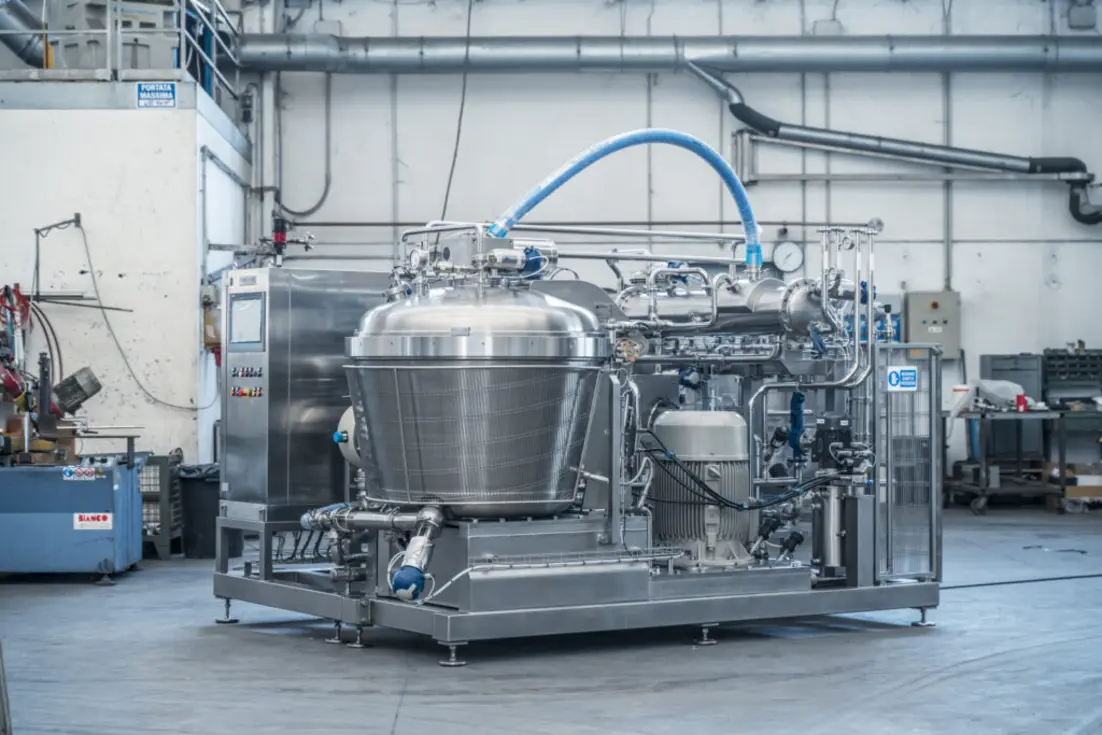
Hygienic design is not established by stainless steel alone. The plant needs to assess whether the equipment can be cleaned, inspected, drained, maintained, and operated without creating avoidable contamination risks.
Review product zones and splash zones separately from non-product areas. Look for inaccessible ledges, hollow sections that cannot be properly sealed, threads or fasteners in difficult-to-clean locations, poor drainage, unprotected cable routes, damaged surface finishes, and joints that can retain product or cleaning residues.
Ask the supplier to show cleaning access in drawings, photographs, or a live inspection. Confirm how belts, guards, tools, covers, blades, pumps, filters, and other routine-cleaning components are removed and reinstalled. If the equipment will handle allergen-containing products, raw materials, or sensitive ready-to-eat products, involve the plant’s food-safety and sanitation team early. They should determine whether the proposed design and cleaning method fit the site’s hazard analysis and sanitation program.
No generic equipment certificate substitutes for a plant-specific assessment of intended product, cleaning method, and production environment.
5. Resolve electrical and controls compatibility early
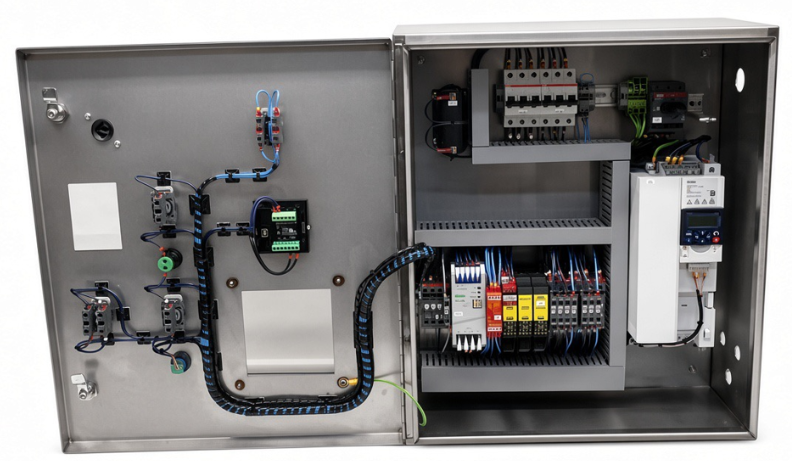
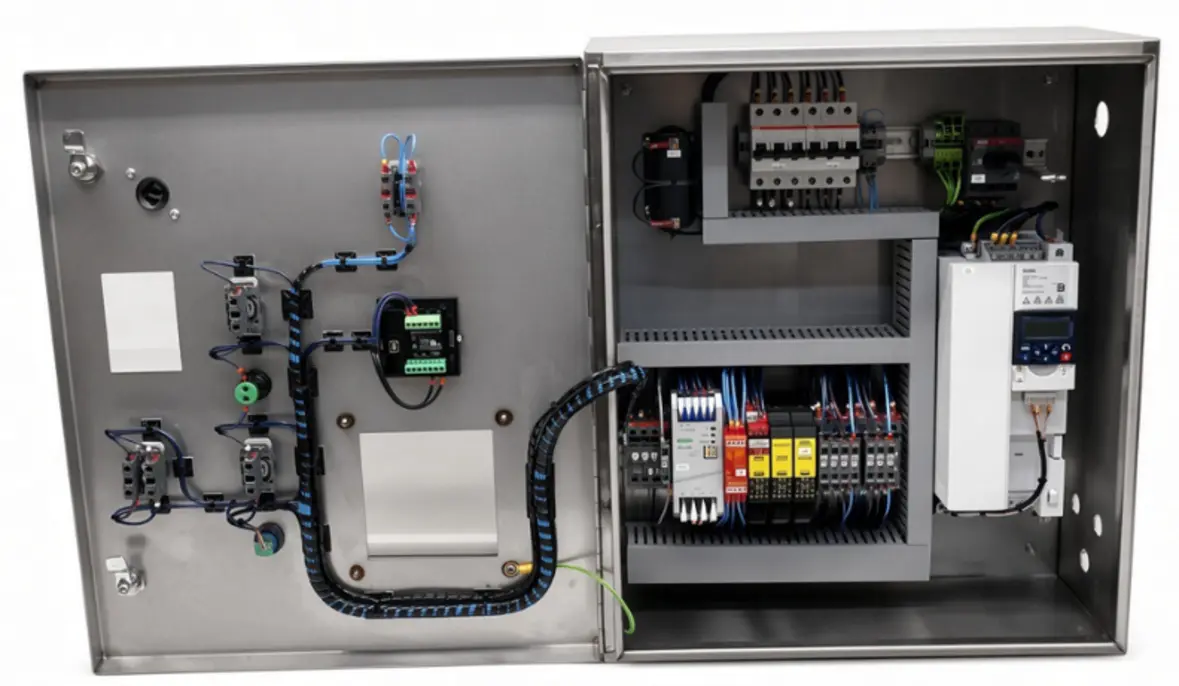
Food machine electrical compliance problems frequently appear only when installation begins. The delivered panel may be functional in the supplier’s factory but unsuitable for the destination supply system, local installation rules, or the plant’s maintenance standards.
Source: moderndrives.co
Provide the supplier with the confirmed site electrical data and ask for a documented response. Verify voltage, frequency, phase arrangement, short-circuit considerations, grounding method, disconnect requirements, enclosure suitability, cable entry approach, and control-component availability in your region. Have qualified local electrical personnel review the proposed design before shipment where required.
Also address controls integration:
- Interface signals to upstream and downstream equipment.
- Line start, stop, fault, and emergency-stop philosophy.
- Product tracking and reject verification where applicable.
- Network requirements, remote support rules, and cybersecurity restrictions.
- Data ownership, user access levels, alarm history, and audit-trail needs where applicable.
- Language, units of measure, and alarm descriptions on the operator interface.
Do not accept an undocumented controls package on the assumption that a local electrician can reconstruct it later. Rework may affect warranty, safety review, schedule, and machine performance.
6. Use a factory acceptance test to reduce pre-shipment risk
A factory acceptance test (FAT) is a structured pre-shipment check of the completed machine against the purchase order and agreed test plan. It is especially useful for custom equipment, integrated lines, machines with controls complexity, or equipment that would be costly to return or modify after arrival.
The FAT plan should state what will be inspected, demonstrated, recorded, and signed off. Depending on the machine, it may cover construction, dimensions, guards, controls functions, alarms, interlocks, utility connections, dry running, product trials, changeover features, cleaning access, documentation, and spare parts.
A failed FAT does not necessarily mean canceling the order. It creates a controlled punch list. The important point is to classify open issues, assign owners, set closure evidence, and decide whether each issue must be resolved before shipment or can be completed safely at site.
7. Plan customs, freight, and receiving as part of the equipment project
Import paperwork and tariff treatment depend on the destination, the goods, origin, valuation, and transaction structure. Work with a qualified customs broker or trade adviser early enough to confirm classification, required declarations, possible permits, and the documents needed for entry. Do not rely on a supplier’s informal classification alone.
Typical shipping records may include a commercial invoice, packing list, transport document, insurance records, origin-related documents where applicable, and any documents required by the importing jurisdiction. Confirm that serial numbers, package counts, machine descriptions, and values are consistent across documents.
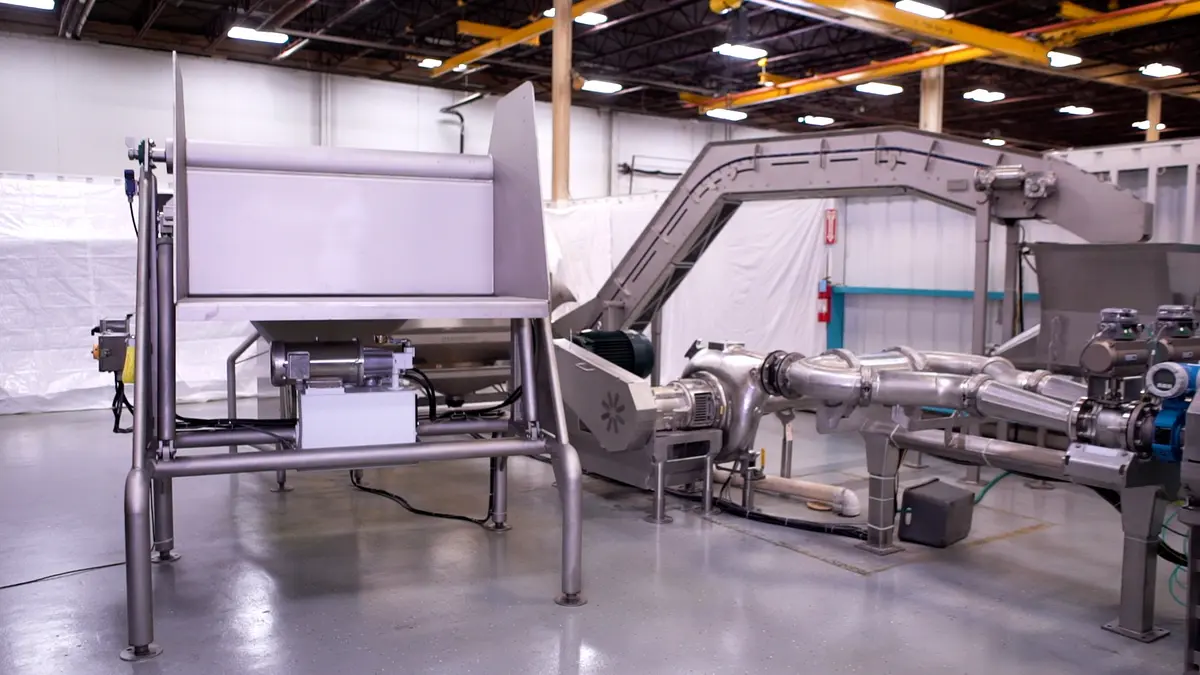
Before the shipment arrives, prepare a receiving plan covering offloading equipment, rigging capacity, doorway clearance, temporary storage, weather protection, security, and who has authority to record transit damage.
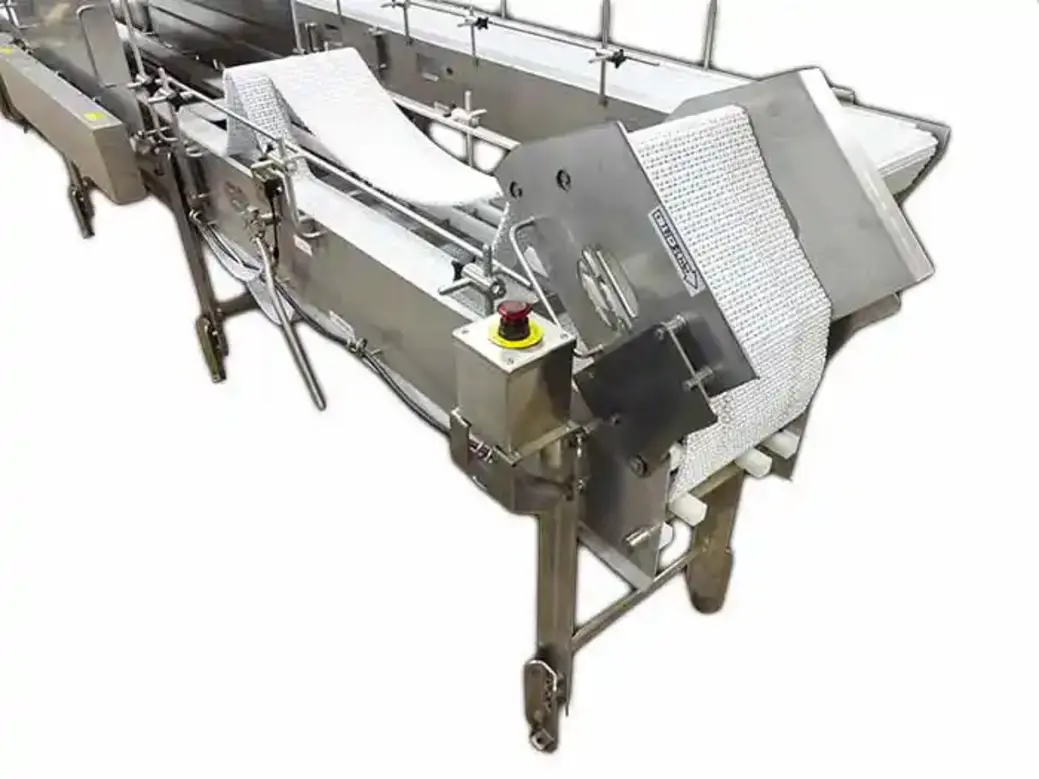
Source: vanmark
At receipt, inspect packages before signing final delivery paperwork where possible. Photograph all sides of crates, shock or tilt indicators if fitted, visible damage, package labels, and serial-number plates. Compare received items against the packing list. Record shortages and damage immediately according to the carrier and insurer process, then preserve packaging until the claim position is clear.
8. Stock practical spares before startup
The first spare-parts order should be based on likely downtime risk, not only the supplier’s catalog. Ask which parts have long lead times, which are proprietary, which wear in normal operation, and which components are locally available.
Common planning categories include product-contact seals, belts, bearings, sensors, fuses, pneumatic components, cutting tools, filters, drives, and critical electronic modules. The correct list depends on the machine and production schedule. Coordinate spare selection with maintenance, sanitation, quality, and purchasing teams.
Store software backups, manuals, drawings, and serial-number records with the parts information. A spare component is less useful if the plant cannot identify its configuration or install it correctly.
9. Install against an approved site plan
Installation should not begin as an improvised mechanical task. Review the approved layout, foundation or support requirements, utility routing, drainage, access, guarding, and service clearances before positioning the equipment.
Use qualified personnel for lifting, rigging, electrical work, piping, and any modifications. Do not bypass guards, interlocks, or protective devices to accelerate installation or testing. Any field changes should be documented, reviewed for safety and hygiene effects, and reflected in the as-built record.
Before energizing, verify that the machine is mechanically complete, anchored or supported as specified, connected to the correct utilities, and free of shipping restraints. Confirm that electrical inspections and permits have been completed when applicable.
10. Commission with site acceptance criteria, not assumptions
Imported machinery commissioning should prove that the installed equipment meets the agreed function in its actual plant environment. A site acceptance test (SAT) usually follows installation and includes checks that could not be fully demonstrated at the supplier’s factory.
A practical SAT may include:
- Verification of serial numbers, documentation, and installed configuration.
- Inspection of guards, emergency stops, interlocks, labels, and access points.
- Confirmation of utilities under operating conditions.
- Functional checks of controls, alarms, sensors, and line interfaces.
- Product trials using agreed materials and defined acceptance criteria.
- Verification of cleaning access and sanitation procedures with the plant team.
- Operator, sanitation, quality, and maintenance training.
- Completion of punch-list items and handover of backups and spare parts.
Define in advance what counts as acceptance, what evidence is required, and what happens if performance is not achieved. Separate machine capability from issues caused by unavailable product, unstable upstream supply, uncompleted building work, or other site conditions.
Final pre-production checklist
Before routine production begins, confirm that the plant has:
- Complete as-built mechanical, electrical, and controls records.
- Approved utility connections and required inspections.
- Documented safety review and operator procedures.
- A sanitation assessment appropriate to the product and process.
- Trained operators, maintenance personnel, and sanitation staff.
- Critical spare parts and supplier support contacts.
- Controlled backups of machine software, recipes, and parameters.
- Closed or formally managed acceptance-test punch-list items.
- A preventive-maintenance plan and initial inspection schedule.
- Clear responsibility for warranty claims and technical escalation.
The most reliable importing process is front-loaded: specify carefully, obtain documentation before shipment, inspect methodically, and treat commissioning as a formal acceptance stage. That approach does not remove every risk, but it makes problems visible while they are still manageable.
References
- Food Processing Equipment Factory Acceptance Test Guide. (n.d.). https://www.teemyeah.com/industry-news/food-processing-equipment-factory-acceptance-test
- Industrial Equipment Sourcing & Importing | Part Distribution. (n.d.). https://partdistribution.com/equipment
- Hygienic Design of Equipment in Food Processing | Food Safety Magazine. (n.d.). https://www.food-safety.com/articles/4350-hygienic-design-of-equipment-in-food-processing
- Import - Wikipedia. (n.d.). https://en.wikipedia.org/wiki/Import
- How Can Buyers Reduce Risk When Importing Machines? – Practical Buyer…. (n.d.). https://machinematcher.com/knowledge/how-can-buyers-reduce-risk-when-importing-machines-practical-buyer-guide
- Food safety, hygienic design and regulation support. (n.d.). https://forcetechnology.com/en/expertise/comply/food-safety--hygienic-design-and-regulation
- Hygienic Design of Equipment in Food Processing | Food Safety Magazine. (n.d.). https://www.food-safety.com/articles/4350-hygienic-design-of-equipment-in-food-processing?v=preview
- Importing Goods Into the USA: Documents, Duties, and More | USA Customs Clearance. (n.d.). https://usacustomsclearance.com/process/importing-goods-into-the-usa