An industrial blender and a cutter mixer solve different process problems. Choose an industrial blender when the main objective is to distribute ingredients, dissolve powders, blend liquids, suspend solids, or mix a product while retaining much of its particle structure. Choose a cutter mixer when the process must actively chop, reduce particles, break down fibers, disperse ingredients into a paste, or move toward a finer and more uniform texture.
The practical decision is not simply “blender versus food processor.” It depends on the finished product specification: particle size, acceptable texture, solids level, viscosity, batch weight, required mixing intensity, and whether ingredients must remain recognizable. A machine that produces a smooth sauce can be the wrong choice for a chunky salad, and a gentle mixer can be inadequate for a dense filling that needs both mixing and particle reduction.
The core difference: circulation versus cutting
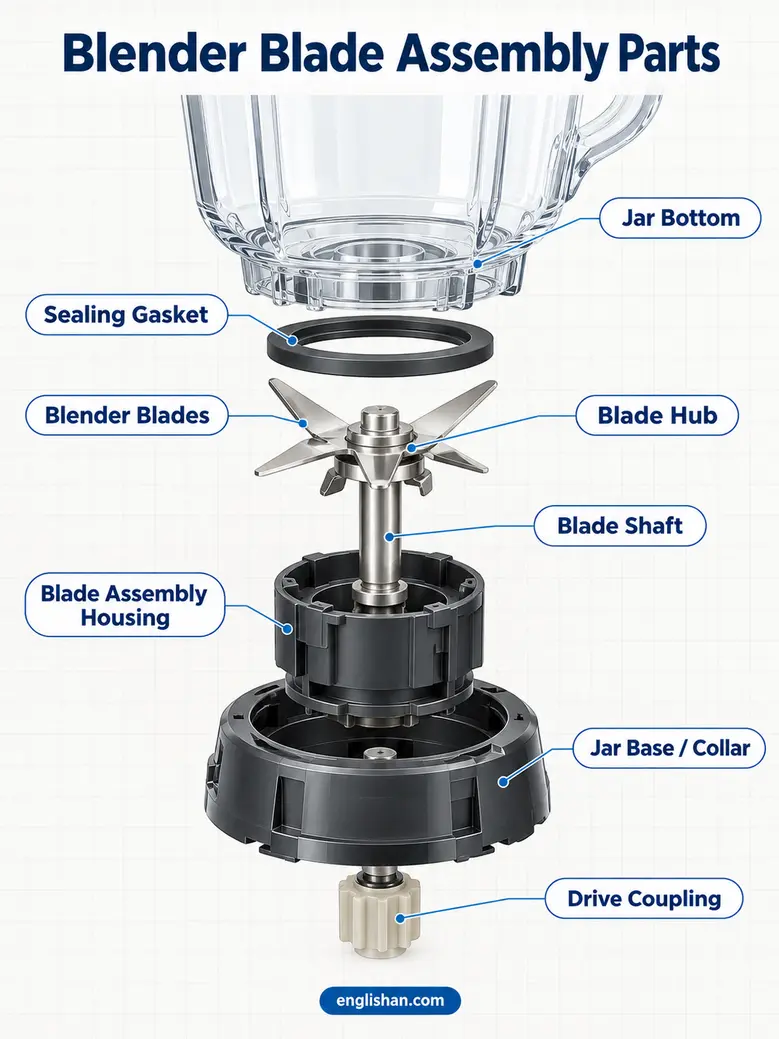
Industrial blender is a broad term. It may describe a vessel with an agitator, a high-speed liquid blender, a paddle or ribbon blender, or another system designed to move product and distribute ingredients. Its working principle is product circulation: the impeller, paddles, ribbons, or similar agitator create movement through the batch so components become evenly distributed.
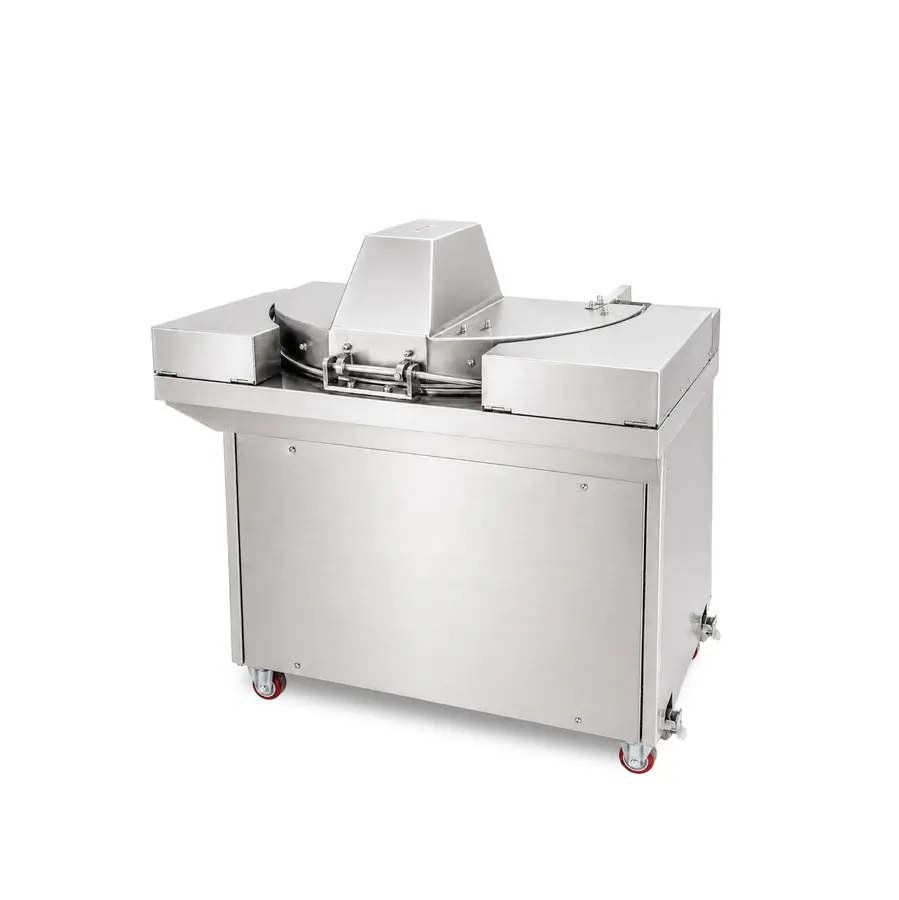
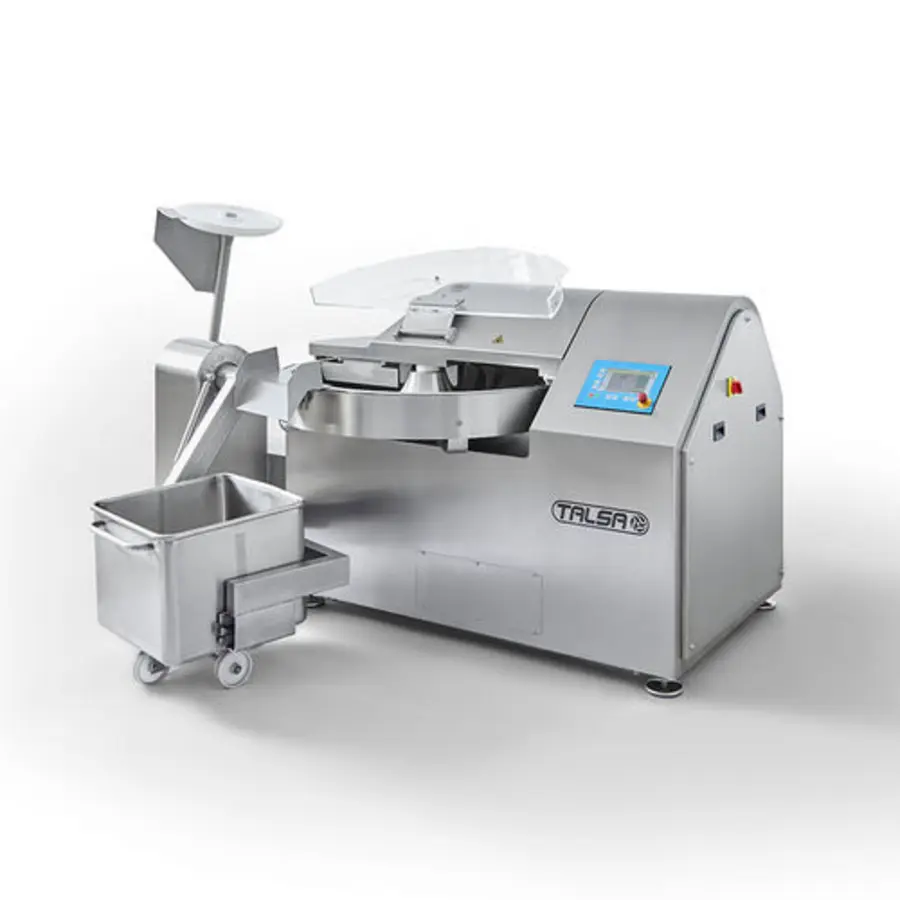
A cutter mixer, often called a bowl cutter in some applications, combines a rotating bowl with rapidly moving knives. The bowl presents material to the knife set repeatedly while the knives cut and fold the product. The result is a much more aggressive mechanical action than ordinary batch mixing. It can combine ingredients and reduce their size in the same operation.
Source: img.directindustry
Industrial blender vs cutter mixer at a glance
| Selection factor | Industrial blender or mixer | Cutter mixer |
|---|---|---|
| Primary action | Circulates, folds, disperses, or homogenizes ingredients | Cuts, chops, smears, and mixes ingredients |
| Particle definition | Usually preserves it when properly selected | Reduces it, sometimes substantially |
| Best starting point | Liquids, powders, sauces, inclusions, bulk ingredients, and general batch mixing | Chopped vegetables, meat mixtures, fillings, pastes, spreads, and products needing particle reduction |
| Liquid requirement | Depends on mixer design; liquid systems generally need enough flowable phase for circulation | Can process wet or relatively dry ingredients, but product behavior changes greatly with formulation |
| Viscosity range | Varies widely by agitator and drive; high-viscosity work needs a suitable high-torque design | Can handle many dense batches, but knife action is not a substitute for a purpose-built heavy-duty kneader |
| Texture outcome | Uniform distribution without necessarily making a puree | Finer, more integrated, or paste-like texture as cutting continues |
| Main risk if misapplied | Poor circulation, dead zones, floating powders, or incomplete incorporation | Overprocessing, excess particle breakdown, heating, or loss of desired texture |
When an industrial blender is the better fit
Select a blender or batch mixer when the product needs uniformity more than size reduction. Examples include dry seasoning distribution, a sauce with controlled vegetable pieces, a liquid blend requiring powder incorporation, a marinade, or a particulate product where inclusions must remain intact.
The exact blender type matters. “Blender” alone does not establish whether a machine can manage your formulation.
Liquid blending and powder incorporation
For a flowable liquid, an agitator or high-speed blending system may provide enough circulation to distribute ingredients, dissolve soluble components, and maintain a consistent batch. The design must account for powder addition. Fine powders can float, form lumps, or enter as poorly wetted clumps if they are added too quickly or into a weak circulation zone.
A system designed for powder induction or strong surface turnover can simplify this step. For products that require a very fine emulsion or a narrowly controlled particle size, however, a conventional tank agitator may not be enough. An inline high-shear device, colloid mill, or dedicated emulsifier may be more appropriate.
Particulate products that must keep their identity
Paddle and ribbon-style batch systems are commonly considered where pieces, granules, and dry ingredients need distribution without deliberate cutting. They are useful only when the agitator geometry, speed, fill level, and discharge arrangement suit the product.
If the product contains fragile inclusions—vegetable pieces, grains, nuts, fruit pieces, or formed components—evaluate the likelihood of breakage during the entire cycle, including discharge. A blender can be gentler than a cutter mixer, but it is not automatically gentle. High speed, tight clearances, and long cycle times can still damage particles.
High-viscosity mixing
Dense products require torque, not just motor power. A high-torque food mixer must overcome the resistance of the batch as it moves through a thick mass. The drive, gearbox, shaft, agitator shape, vessel geometry, and wall clearance all affect whether material actually turns over.
For moderate viscosity, a suitable anchor, paddle, or other vessel agitator may work. For very dense doughs, confectionery masses, heavy pastes, or products that cling to the vessel wall, a twin-shaft or Z-arm style mixer may be a better fit than either a standard liquid blender or a cutter mixer. Do not assume that a fast knife machine can solve a torque-limited mixing problem.
When a cutter mixer is the better fit
A cutter mixer is appropriate when the recipe requires chopping and mixing as one batch operation. It is particularly useful when operators would otherwise need to pre-chop ingredients, transfer them to a separate mixer, and then continue processing.
Typical applications include vegetable-based fillings, chopped meat mixtures, spreads, dips, sauces with intentionally reduced solids, and blended fillings. The machine can shorten handling steps, but the final result depends heavily on ingredient order, knife speed, bowl speed, fill level, and processing time.
Chopping is not the same as blending
A cutter mixer can make an ingredient mix appear uniform while changing the product structure. Repeated knife passes reduce particle size, release moisture from plant material, alter the appearance of the batch, and may turn a coarse product into a paste. This is desirable for some products and unacceptable for others.
Before choosing a cutter mixer, define the target texture in practical terms:
- Maximum acceptable piece size
- Minimum amount of visible particulates
- Whether fibers, skins, or seeds should remain evident
- Whether ingredients should be chopped before or after liquids are added
- Whether a smooth paste, coarse chop, or mixed texture is required
- Whether the process must avoid excessive batch warming or smear
A sample batch trial with the actual formula is usually more informative than selecting from a general machine category. Raw material variability matters: a dry vegetable, a wet vegetable, a chilled protein mixture, and a cooked product can respond very differently to the same knife action.
Food processor-style machines: where they fit
A food processor-style machine generally occupies the same functional territory as a cutter mixer, especially when it uses a wide bowl and interchangeable chopping, slicing, grating, or mixing tools. At industrial scale, the key question is whether its construction, drive, guarding, sanitation features, and batch capacity are adequate for the planned production environment.
The familiar rule that blenders suit wetter products while food processors suit chopping is directionally useful, but it is too simple for equipment selection. A cutter mixer can process wet products, and an industrial blender can handle some solids. The deciding factor is the required action on those solids: circulate them, suspend them, coat them, fold them, or cut them.
Batch size, fill level, and throughput
Nameplate vessel volume should not be treated as usable batch capacity. A mixer needs enough product for its working elements to engage the batch, while a cutter mixer needs enough bowl loading for material to pass consistently through the knife zone. Overfilling can prevent proper circulation and create uneven results. Underfilling can reduce control, increase air incorporation, or leave product outside the effective mixing path.
Assess throughput as a complete process, not only a mixing cycle. Include:
- Ingredient loading and verification
- Pre-chopping or pre-hydration steps
- Mixing or cutting time
- Sampling and adjustment
- Discharge time and residual product loss
- Cleaning and product changeover
- Transfers to the next process step
A machine with a shorter active cycle may still limit output if loading, discharge, or cleaning takes too long.
Cleanability and changeover should influence the choice
The machine that produces the right texture must also fit the sanitation program. Cutter mixers have knives, covers, bowl surfaces, seals, and product-contact areas that need clear access or a validated cleaning approach. Blenders and mixers may have shafts, agitators, valves, ports, and vessel interiors that also require attention.
For either equipment family, confirm the practical details before purchase:
- Product-contact materials and surface finish requirements
- Access for inspection and manual cleaning where needed
- Whether cleaning-in-place is suitable for the product and machine design
- Ability to fully drain product and cleaning solution
- Removal or safe servicing of blades, seals, and other wear components
- Allergen changeover requirements and verification method
- Availability of replacement knives, seals, scrapers, and drive components
Cleaning requirements should be reviewed with the equipment supplier and the processor’s sanitation team using the actual product range. Sticky pastes, allergen-containing formulas, powders, and products with seeds or fibers can create different cleaning challenges.
A practical equipment-selection checklist
Use these questions to narrow the choice before comparing models:
- Must the machine reduce particle size? If yes, begin with a cutter mixer, mill, emulsifier, or another size-reduction process rather than a standard blender.
- Must pieces remain intact? If yes, prioritize a gentle particulate food mixing equipment design and test the inclusion breakage rate.
- What is the thickest product the machine will process? Specify viscosity or, for non-Newtonian products, describe the actual formulation and temperature condition. Select for torque and turnover, not nominal motor power alone.
- How much free liquid is available? Low-liquid products may not circulate in a vessel designed for liquid blending.
- Is the batch a mix, a chop, a puree, an emulsion, or several of these? One machine may not be the best tool for every stage.
- What texture is acceptable at the end of the longest normal cycle? This identifies the risk of overprocessing.
- How often will formulas change? Frequent changes increase the importance of access, cleanability, recipe controls, and short changeover time.
- What happens after discharge? Consider pumpability, downstream filling, cooking, cooling, and whether the process will further change particle size.
When dedicated equipment is preferable
Neither an industrial blender nor a cutter mixer is universally appropriate. Dedicated equipment is often preferable when one processing demand dominates.
Use a mill, emulsifier, or high-shear system when a fine emulsion or controlled reduction is central to product quality. Use a heavy-duty kneader or Z-arm mixer when dense, low-flow material requires strong folding and high torque. Use a ribbon or paddle system for many dry blends and particulate products where particle integrity matters. Use an inline continuous system when the required throughput or integration with upstream and downstream equipment makes batch processing inefficient.
The most reliable selection approach is to begin with the product specification, then map each operation—loading, wetting, mixing, cutting, discharge, and cleaning—to the equipment action required. In an industrial blender vs cutter mixer decision, the decisive question is simple: do you need to move ingredients together, or do you need to mechanically change them while mixing? The answer defines the equipment category; trials with the real formulation determine the final machine design.
References
- Food Processors vs Blenders vs Choppers. (n.d.). https://www.webstaurantstore.com/blog/5572/food-processor-vs-chopper-vs-blender.html
- Industrial Blenders and its mixing technology — Kiron Food Processing Technologies. (n.d.). https://www.fptindia.com/blog/industrial-blenders
- Blender vs Food Processor: Which Do You Need? (2026). (n.d.). https://nutritionrefined.com/blender-vs-food-processor
- Mixing vs Blending: Understanding the Difference in Food Processing. (n.d.). https://www.bakfoodequipment.com/blending-vs-mixing-process
- Types, Uses, Features and Benefits of Blenders. (n.d.). https://www.iqsdirectory.com/articles/mixer/industrial-blenders.html
- Food Processor vs Blender: Which One is Best? | Dito Sama. (n.d.). https://www.ditosama.com/en/news-events/food-processor-vs-blender-which-one-best
- Food processor vs blender: what’s the difference? | KitchenAid US. (n.d.). https://www.kitchenaid.com/countertop-appliances/pinch-of-help/difference-between-food-processor-and-blender
- Different Types of Mixers. (n.d.). https://www.blikai.com/blog/projects/different-types-of-mixers