Selecting an industrial slicer starts with the product, not the advertised speed. Define the product’s temperature, firmness, shape, dimensions, surface condition, and required slice presentation; then match those requirements to a blade, feed method, portioning system, and sanitation design. A machine that runs quickly but distorts slices, creates trim, or takes too long to clean is rarely the right production choice.
For most processors, the practical decision sequence is: establish acceptable slice quality, stabilize the incoming product condition, calculate required output at realistic operating efficiency, and assess how the slicer will load, discharge, change over, and clean within the line. This industrial food slicer selection framework applies to meat, cheese, bacon, cooked proteins, plant-based products, and many formed or portioned foods.
Start with the product condition and cut specification
A slicer cuts consistently only when product condition is reasonably consistent. The same machine may handle a firm, chilled cooked ham well and perform poorly on a soft cheese or an irregularly shaped product with a warm surface. Before requesting quotations or trials, document the full operating range rather than providing only the ideal product.
Key product questions include:
- Is the product raw, cooked, cured, frozen, tempered, chilled, or ambient?
- How much does firmness vary between batches, suppliers, and shift conditions?
- Is the cross-section round, rectangular, oval, irregular, or naturally variable?
- Are there hard inclusions, fat seams, rind, crust, skin, bone, or surface seasoning?
- What are the shortest and longest product lengths the machine must accept?
- Is the objective a single slice, a shingled arrangement, a stack, a folded presentation, or a fixed-weight portion?
- What thickness range, thickness tolerance, and appearance standard are acceptable?
Product temperature deserves particular attention because it affects cutting force, slice separation, surface smearing, and product control. Softer products can compress ahead of the blade, while insufficiently firm meat can tear or show uneven faces. Very cold or partially frozen products may cut cleanly but can place different demands on the blade, gripper, feed components, and downstream handling.
Do not treat a recommended temperature as a universal process target. Product formulation, fat content, salt, moisture, shape, and the desired slice thickness all affect the workable range. Validate the proposed slicer using representative product from normal production, including expected variation, and verify applicable product-quality and food-safety controls separately.
Define slice quality before comparing capacity
“Uniform slices” can mean different things. A sandwich-meat line may prioritize reliable thickness and stack height. A bacon operation may focus on clean separation and visual consistency. A cheese slicer machine may need to minimize sticking, edge deformation, and shingling faults. High-value products may justify a more complex portioning system if it reduces giveaway.
Set measurable acceptance criteria for the finished output. These may include:
- Slice thickness and slice-to-slice consistency
- Face quality, including tearing, feathered edges, cracking, and compression marks
- Slice separation and placement accuracy
- Stack, shingle, or fold presentation
- Portion count or target weight consistency
- Tail-end yield and recoverable trim
- Product debris on the blade, conveyors, and guards
- Ability to meet the requirement across the full product range
A thin slice that looks good during a brief demonstration may behave differently after an extended run, especially as blade condition changes or the product temperature drifts. Ask to evaluate start-up, steady operation, product changeovers, and end-of-log behavior.
Choose the cutting principle and blade configuration
Industrial slicers generally use circular or involute blade systems. A research review of industrial food slicing identifies these as the two principal machine approaches. The best choice depends on the product and presentation requirement, not on a simple claim that one blade type is always superior.
Circular-blade machines are widely used and can suit a broad range of products and slicing patterns. Their selection should consider blade diameter, blade speed, available cutting stroke or orbit, product feed control, and the practical access needed for cleaning and blade service.
Involute blade systems are common in high-output applications, including sliced meat, bacon, sausage, and cheese. Their blade geometry and cutting motion can be advantageous for products requiring fast, repeatable slicing. In either design, performance depends on the complete cutting system: blade edge, product support, feed, gripper action, and discharge transfer must work together.
Blade edge, material, and coating
Blade selection should be based on the food being cut and the operating environment.
| Blade consideration | Why it matters | Typical selection question |
|---|---|---|
| Straight or smooth edge | Often supports clean cuts in firm, uniform products | Does it produce the required face quality without pulling the product? |
| Serrated edge | Can help engage certain crusted, tough-skinned, or difficult surfaces | Does it improve entry without creating a rough slice face? |
| Edge geometry and grind | Influences cutting force, sharpness retention, and slice appearance | What geometry is recommended for the actual product and thickness range? |
| Stainless or tool-steel construction | Balances corrosion resistance, edge life, and maintenance practice | Which material fits the cleaning regime and blade-management program? |
| Non-stick coating | May help reduce adhesion with certain cheese and sticky products | Is the coating appropriate for the product, cleaning method, and planned blade life? |
Blade life is not just a purchasing detail. Dull or damaged blades can increase tearing, smearing, slice variation, and product loss. Include blade inspection, sharpening or replacement, safe handling, inventory, and supplier lead time in the operating plan. Blade requirements should be agreed with the equipment and blade suppliers for the actual product, sanitation chemistry, and duty cycle.
Match the feed system to product geometry
The feed system determines how reliably the slicer presents product to the blade. It is often the difference between strong performance on uniform logs and poor results on short, tapered, soft, or irregular pieces.
For consistent cylindrical or rectangular logs, an automated feed and end-grip arrangement may provide stable, repeatable control. For products with variable geometry, assess whether the machine can center, support, and advance them without excessive compression. A gripper that is too aggressive may damage the tail end; one that is too light may allow product movement and thickness variation.
Ask specifically about:
- Minimum usable product length before the gripper engages
- Tail-end loss and whether end pieces are recoverable
- Handling of tapered, curved, or nonuniform products
- Change parts for different cross-sections
- Feed pressure adjustment and recipe control
- Product orientation at loading
- Whether multiple logs can be sliced in parallel
A commercial food slicing machine intended for intermittent deli use should not be assumed to have the same feed precision, loading method, or duty cycle as an industrial meat slicer integrated into continuous packaging. Compare the intended operating model, not only the apparent blade size.
Calculate throughput using the whole line
Required throughput should be expressed in finished packs or finished kilograms per hour, then converted into slicing demand using the actual portion format. A slicer’s theoretical slices-per-minute figure does not show what the line will deliver after loading interruptions, product gaps, portion handling, package-machine limits, quality checks, and changeovers.
Use a simple line calculation:
- Define the required finished output per shift or hour.
- Determine slices per portion, or expected portion weight and average slice weight.
- Add realistic allowances for normal stops, product loading, blade service, and changeover.
- Identify the slowest downstream station, often portion handling or packaging.
- Size the slicer so normal production does not require it to run continuously at its limit.
A high-speed food slicer may be necessary when demand is high, but speed can make weaknesses elsewhere more visible. Slices must separate, land predictably, and transfer without folding errors or jams. Product accumulation between the slicer and packaging machine can protect against brief interruptions, but it may also complicate presentation control and cleaning.
For variable-weight portions, assess how the system corrects for natural slice-weight variation. Some applications use count-based portions; others need checkweighing, feedback controls, or optimized portioning logic. Ask what data the slicer can receive and provide, how recipes are managed, and whether portion corrections are made before or after discharge.
Plan loading, discharge, and packaging integration
The slicer should be selected as part of a material-flow system. Manual loading may be appropriate for modest volumes or frequent product changes, but it can constrain output and create inconsistent product orientation. Automated infeed can raise throughput and reduce repetitive handling, provided the upstream product spacing and orientation are controlled.
At discharge, determine whether the product goes directly to thermoforming, tray sealing, vacuum packaging, weighing, cartoning, freezing, or a manual packing station. The discharge conveyor and portion-placement method must preserve the intended presentation. A clean slice is of little value if it shifts, overlaps incorrectly, or sticks during transfer.
Confirm the physical and control interfaces early:
- Available footprint, service clearance, and access for blade changes
- Infeed and outfeed elevations
- Conveyor width and package pitch
- Product buffering requirements
- Electrical, pneumatic, vacuum, and utility requirements
- Recipe and line-control communication
- Fault handling when packaging stops
Make hygienic design a selection criterion, not an afterthought
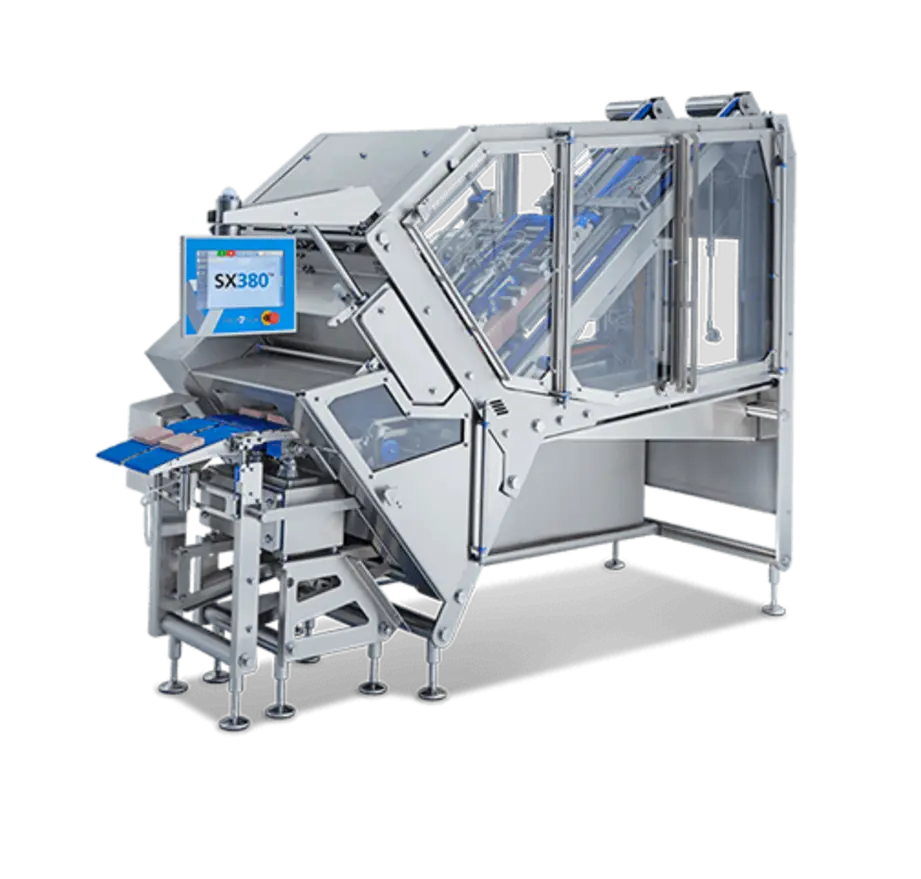
Food slicer hygienic design affects sanitation time, inspection confidence, allergen changeover, and the likelihood that product residues remain in hard-to-reach areas. The appropriate design depends on the product risk, cleaning regime, and facility procedures, but all processors should evaluate cleanability with the same seriousness as slice quality.
Look for practical features such as open access around product-contact areas, smooth and drainable surfaces where applicable, minimal residue traps, accessible guards, cleanable conveyors, and components that can be removed or opened without excessive tools. Examine the underside of belts, blade surrounds, grippers, product guides, transfer points, and the interface between the slicer and adjacent conveyors.
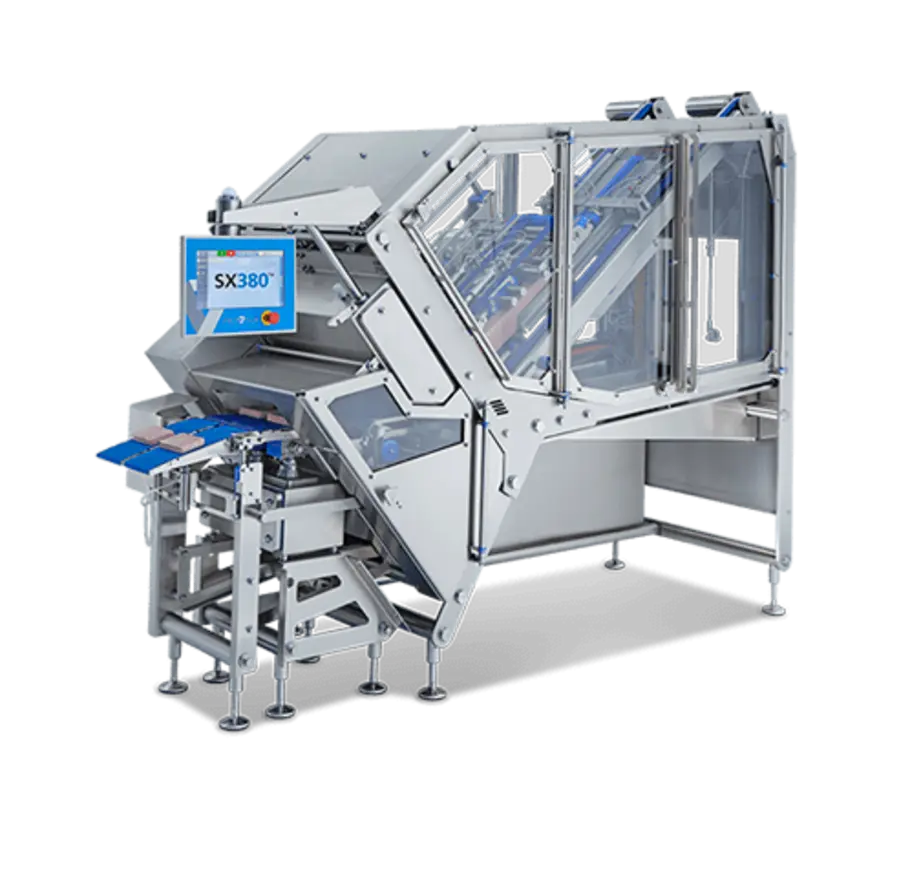
Source: provisur
Ask the supplier to explain the full cleaning sequence, including what must be removed, what tools are needed, how long reassembly normally takes, and which parts require inspection. Do not rely solely on an external appearance of stainless construction. Verify that the proposed design fits the facility’s validated sanitation procedures, cleaning chemicals, water-management practices, allergen program, and local requirements.
Run a representative acceptance trial
The most useful final step is a structured trial using normal product and the intended packaging format. Include variation: warmest and firmest expected product condition, shortest logs, different suppliers where relevant, and a realistic production run rather than only a short demonstration.
Use a trial checklist:
- Confirm target slice thickness, appearance, and portion format.
- Record product condition and dimensions at loading.
- Observe first slices, steady-state output, and tail-end performance.
- Check for sticking, tearing, compression, skipped slices, and placement faults.
- Measure actual finished output, not only blade-cycle speed.
- Review operator access, loading ergonomics, blade-service tasks, and cleaning access.
- Confirm changeover steps for the next product or allergen category.
- Verify that the slicer and packaging system recover predictably after normal line stops.
Common industrial slicer selection mistakes
The most frequent mistake is choosing around a headline capacity rather than a defined product-and-portion requirement. Other avoidable errors include specifying a slicer based on one ideal product sample, overlooking tail-end loss, assuming a blade coating solves all sticking problems, and leaving packaging integration until after the slicer is ordered.
Another common error is underestimating sanitation access. If blade areas, transfer points, and product guides are difficult to inspect and clean, the apparent savings of a simpler machine can be offset by longer downtime and more difficult changeovers.
The right industrial food slicer is therefore the one that repeatedly produces the desired portion from normal incoming product, at a sustainable line rate, while fitting the plant’s loading, packaging, maintenance, and sanitation practices. Put those operating conditions into the specification before comparing machine models, and use a representative trial to confirm them.
References
- A review of research relating to food slicing in industrial applications. (n.d.). https://www.sciencedirect.com/science/article/abs/pii/S0260877419303796
- The Ultimate Guide to a Commercial Food Slicer. (n.d.). https://therestaurantwarehouse.com/blogs/restaurant-equipment/commercial-food-slicers-that-make-the-cut-literally
- Hygienic Design of Equipment in Food Processing | Food Safety Magazine. (n.d.). https://www.food-safety.com/articles/4350-hygienic-design-of-equipment-in-food-processing
- Involute Slicing Blades for Food Processing Machines | Kassa Cutters USA. (n.d.). https://www.kassacuttersusa.com
- Commercial Kitchen Slicing Equipment Guide | Types & Selection. (n.d.). https://www.gofoodservice.com/guides/kitchen-slicing-equipment-buying-guide
- Involute vs Orbital Blades - Earthworm Express. (n.d.). https://earthwormexpress.com/the-meat-factory/involute-vs-orbital-blades
- High-Performance Industrial Slicers for Efficient Food Processing - Bizerba. (n.d.). https://www.bizerba.com/us/en/solutions/slicers/industrial-slicer
- Blade expertise from the market leader for slicers | Weber. (n.d.). https://www.weberweb.com/company/news/blade-expertise