An industrial immersion blender and a batch food processor overlap in a few tasks, but they use different processing actions. Choose an immersion blender when the main job is smoothing, pureeing, emulsifying, or finishing a pumpable product directly in a pot, tank, or batch vessel. Choose a bowl-type food processor when the work involves chopping, slicing, shredding, grating, or mixing relatively thick ingredients before they become a smooth liquid.
For many processors, the practical answer is not one machine replacing the other. A commercial immersion blender can reduce transfers during soup, sauce, and puree production, while a food processor gives better control over particulate preparation and thicker chopped mixtures. The right choice depends on the product’s starting texture, required finished texture, batch routine, and sanitation workflow—not simply motor power.
Core difference: blending in the vessel versus processing in a work bowl
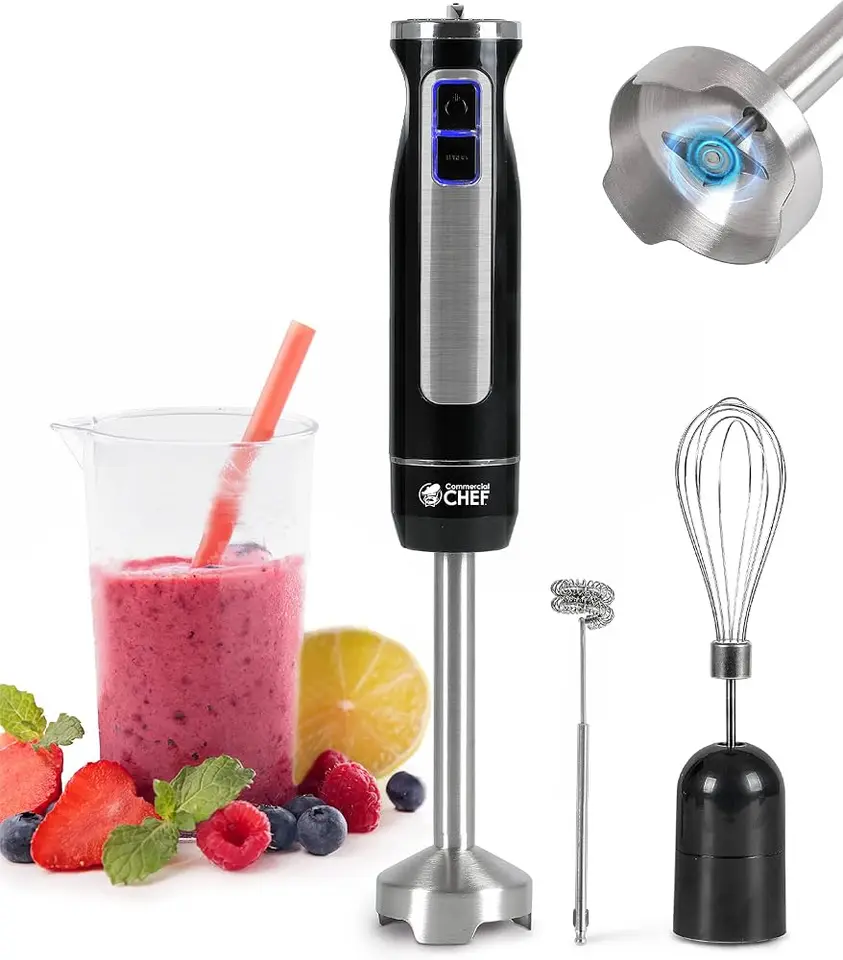
An immersion blender has a motor above a long blending shaft. Its rotating blade works below the surface of the product, creating circulation that draws material through the blade area. Handheld units are common for light intermittent work; larger commercial units may be supported by a clamp, stand, or mobile frame to reduce operator effort during repeated batches.
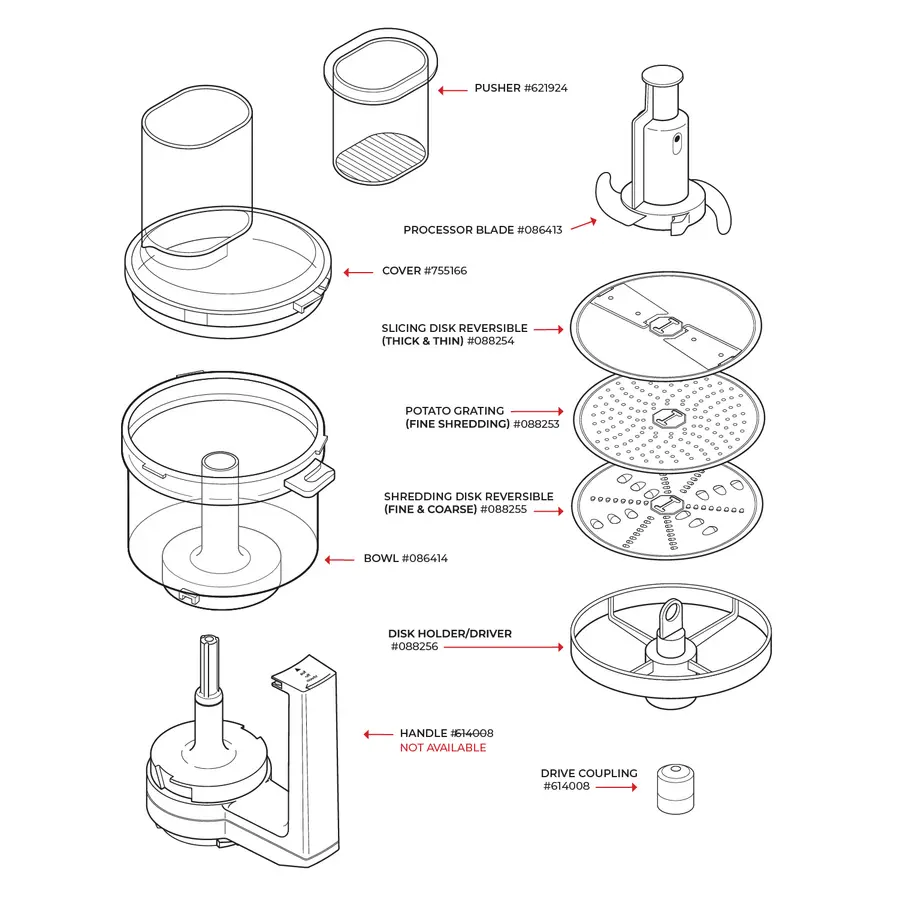
A food processor contains product in a fixed work bowl. A blade at the bottom commonly chops and mixes, while interchangeable discs may slice, shred, grate, or perform other preparation tasks. The enclosed bowl gives the operator more control over a defined load of solids, but it also imposes a practical limit on batch size and requires loading and unloading between cycles.
| Selection factor | Industrial immersion blender | Batch food processor |
|---|---|---|
| Primary processing action | Purees, disperses, blends, and emulsifies | Chops, slices, shreds, grates, mixes, and can puree |
| Best product state | Flowable or becoming flowable | Solid, semi-solid, or thick ingredients in a defined batch |
| Typical vessel | Existing pot, kettle, pail, tote, or tank | Dedicated work bowl |
| Handling advantage | Can avoid transferring a hot or liquid product | Contains the ingredient load during cutting and mixing |
| Texture strength | Smooth sauces, soups, dressings, and purees | Controlled chopped pieces and prepared vegetable, cheese, or dough-like mixtures |
| Main limitation | Poor choice for uniform slices, shreds, and dry chopping | Limited by bowl volume and less convenient for large hot liquid batches |
When an immersion blender is the better fit
Commercial immersion blender applications center on products that already contain enough moisture to circulate around the blade. Common examples include soups, gravies, sauces, fruit preparations, vegetable purees, salad dressings, dairy-based blends, and reworkable liquid or semi-liquid mixes.
The main operational advantage is processing in the same vessel used for cooking or holding. A processor can blend a sauce in a kettle rather than ladling it into a separate bowl, then returning it to the process vessel. This can simplify small-batch handling and reduce the number of containers that need cleaning.
Source: m.media-amazon
Immersion blenders are particularly useful when a batch must be smoothed late in the process. For example, cooked vegetables may be softened in a kettle and then pureed in place. A blender can also help disperse powders or stabilize an emulsion, provided the product formulation, viscosity, and process method are suitable for that equipment.
However, an immersion blender does not create the same result as a chopping blade or slicing disc. It may break down soft vegetables, herbs, or cooked ingredients, but it is not the right tool where the specification calls for consistent diced pieces, shreds, slices, or a deliberately coarse chop. It can also struggle with products that are too dry, too stiff, poorly circulated, or loaded with hard particulate matter beyond the machine’s intended duty.
Immersion blender questions to ask
- Will the product flow around the blending head during processing?
- Is the objective a smooth puree, a dispersed mixture, or an emulsion?
- Can the blender reach the bottom and full working depth of the intended vessel?
- Will the operator need to hold the unit for long periods, or is a support stand needed?
- Is the product made hot, and can it be blended safely in its process vessel under the facility’s procedures?
- Can the shaft, blade guard, seals, and any removable parts be cleaned and inspected adequately?
When a batch food processor is the better fit
A batch food processor is generally the stronger option for ingredient preparation before cooking or blending. It can reduce onions, herbs, cooked vegetables, cheese, nuts, breadcrumbs, and similar ingredients into repeatable chopped or processed forms. With suitable attachments, it can also slice, shred, or grate ingredients that an immersion blender cannot process in a controlled way.
This makes food processors useful for prep rooms producing fillings, dips, vegetable bases, garnishes, chopped toppings, and other formulations where particle size matters. They can also mix thicker products that may not circulate effectively around an immersion blending shaft.
The processor’s bowl is both its advantage and its constraint. It contains the ingredients during processing and supports repeatable small loads, but every batch must fit the bowl without overloading. The operator must also open the machine, load ingredients, close and secure the lid, process the batch, remove the product, and clean the bowl and cutting components. This can be efficient for varied prep tasks but inefficient for large quantities of liquid product.
Food processor questions to ask
- Does the product need chopped pieces, slices, shreds, or grating rather than a smooth puree?
- Is the batch small enough to be handled efficiently in the work bowl?
- Can operators load ingredients in a consistent order and quantity?
- Are the necessary blade and disc options available for the required cuts?
- Does the product cling to the bowl or lid, creating yield loss or slower changeover?
- Can staff safely handle, store, clean, and inspect sharp blades and discs?
Product texture should drive industrial food processor selection
The most common selection mistake is treating both machines as generic “food chopping and blending equipment.” They are not interchangeable when texture is part of the product specification.
Use an immersion blender for a product that should become smooth or substantially homogeneous. It is usually the more direct choice for pureed soups, smooth sauces, dressings, and other fluid products. The final particle size and smoothness will still depend on the ingredient condition, product viscosity, processing time, blade design, and machine configuration.
Use a food processor when the product needs a cut rather than a puree. A chopped salsa base, shredded cheese component, sliced vegetable ingredient, or coarse herb mixture benefits from the food processor’s blade or disc options. A processor can produce a puree as well, but it may be less practical than in-vessel blending when the batch is mostly liquid or is produced in a larger cooking vessel.
If both textures are required, separate stages are often more reliable. A food processor can prepare solids first, after which an immersion blender can finish the cooked or hydrated product. This sequence is common in operations where a vegetable base must begin as a controlled chop but finish as a smooth soup or sauce.
Batch size, labor, and ergonomics
Do not evaluate capacity only by the nominal size of a processor bowl or the length of a blender shaft. Consider the amount of usable product handled per labor cycle.
A food processor may be efficient for many small, repeatable ingredient batches, especially when several cuts are needed in the same prep area. But repeated loading, scraping, emptying, and washing can become labor-intensive. A larger bowl does not always solve this problem if it creates inconsistent cutting, difficult unloading, or excessive manual handling.
An immersion blender can process a larger quantity in an existing vessel, but handheld operation can create fatigue if blending is frequent or prolonged. For recurring production, assess mounted or supported blender arrangements, vessel access, cable or power routing, and the operator’s ability to control the blending head without awkward reaching.
The product level also matters. A shaft that is too short may not reach the active product zone; one that is poorly matched to the vessel can be difficult to position. Request a demonstration using representative product characteristics whenever possible, particularly for viscous formulas, products with particulates, and batches with a defined texture target.
Cleaning, sanitation, and changeover
Both equipment types require a cleaning approach that fits the product and production schedule. Selection should account for more than visible food-contact surfaces.
For immersion blenders, inspect the blending shaft, blade area, guard openings, shaft-to-motor connection, seals, and any removable components. Determine whether the shaft can be removed, how it is cleaned, where it is stored between uses, and whether the design allows effective visual inspection after cleaning.
For food processors, assess the bowl, lid, feed components, blades, discs, drive interface, seals, and areas where product can collect. Multiple accessories expand processing options but can also increase parts handling and changeover complexity.
Cleaning procedures, chemical compatibility, allergen controls, validation methods, and sanitation frequency should be established by the facility’s food-safety program and verified against the machine supplier’s instructions. Where products contain allergens or have different formulation risks, determine whether the equipment can be fully cleaned and inspected within the planned changeover window. Do not assume that a removable blade, a smooth exterior, or a rinse step alone is adequate.
Safety and controls to verify before purchase
Both machines use rapidly rotating cutting tools. Equipment selection should include a review of guarding, start controls, shutdown behavior, interlocks, blade handling methods, electrical requirements, and service access.
A bowl-type processor should prevent ordinary operation when required guarding or lid components are not correctly positioned, consistent with its design and applicable requirements. An immersion blender should have controls that reduce unintended activation and a practical method for securing a mounted unit before use. Operators should never bypass guards, lid systems, switches, or interlocks to speed production.
Verify the supplier’s operating instructions, local electrical requirements, facility safety procedures, and any applicable regulatory or third-party requirements before installation. Training should cover correct assembly, product loading, blade and disc handling, cleaning, lockout or isolation procedures where applicable, and the conditions that require maintenance support.
When neither machine is an adequate substitute
An immersion blender or batch food processor may be the wrong choice when production requires a specific particle-size distribution, continuous throughput, high-volume emulsification, vacuum processing, tightly controlled aeration, or a pumpable finished product with repeatable industrial-scale results.
Depending on the application, more suitable equipment may include a high-shear mixer, rotor-stator mixer, colloid mill, cutter mixer, bowl chopper, industrial mixer, depositor-fed preparation system, or a dedicated vegetable cutter. The correct alternative depends on product rheology, batch volume, particulate requirements, upstream cooking, downstream filling, and cleaning design.
For example, a processor making a smooth, high-volume sauce may outgrow handheld blending even if an immersion blender worked during development. Conversely, a facility producing a chopped vegetable inclusion should not expect a puree-oriented blender to replace a proper cutting system.
A practical selection checklist
Choose an industrial immersion blender when most answers are yes:
- The product is liquid, semi-liquid, or easily made flowable.
- The finished texture should be smooth, blended, or emulsified.
- Product can be processed directly in a suitable vessel.
- Avoiding transfers is valuable for the workflow.
- The expected production schedule is compatible with handheld or supported operation.
Choose a batch food processor when most answers are yes:
- The process begins with solid or thick ingredients.
- The finished product needs chopping, slicing, shredding, grating, or controlled coarse processing.
- Batches fit the work bowl and can be loaded consistently.
- The prep area can support accessory storage, blade handling, and bowl cleaning.
- Multiple ingredient-preparation tasks justify interchangeable tools.
Choose separate equipment when the process needs both controlled cutting and smooth final blending, or when either machine would become a labor bottleneck. In small-batch production, the best equipment decision is often the one that preserves the required texture while reducing unnecessary transfers, manual handling, and difficult cleanup.
References
- Food Processors vs Blenders vs Choppers - WebstaurantStore. (n.d.). https://www.webstaurantstore.com/blog/5572/food-processor-vs-chopper-vs-blender.html
- Best Immersion Blender Food Processor You Can’t Miss! - Pacific St Pizza Co | Italian Restaurant in Greenvale, NY. (n.d.). https://pacificstreetpizza.com/best-immersion-blender-food-processor
- Immersion blender vs food processor? I do have a small …. (n.d.). https://www.facebook.com/groups/843116839778797/posts/1378492476241228
- Immersion blender vs. food processor. (n.d.). https://www.breville.com/en-us/blog/cooking/immersion-blender-vs-food-processor
- Food Processing Facility Requirements for Modern Manufacturing. (n.d.). https://www.bakfoodequipment.com/food-processing-facility-requirements
- Immersion blender vs. food processor. (n.d.). https://www.breville.com/us/en/blog/cooking/immersion-blender-vs-food-processor.html
- Immersion blender vs. food processor: what’s the difference?. (n.d.). https://www.kitchenaid.com/countertop-appliances/pinch-of-help/immersion-blender-vs-food-processor-whats-the-difference
- Immersion Blender vs Food Processor. (n.d.). https://www.youtube.com/watch?v=CLMozUXTq4k