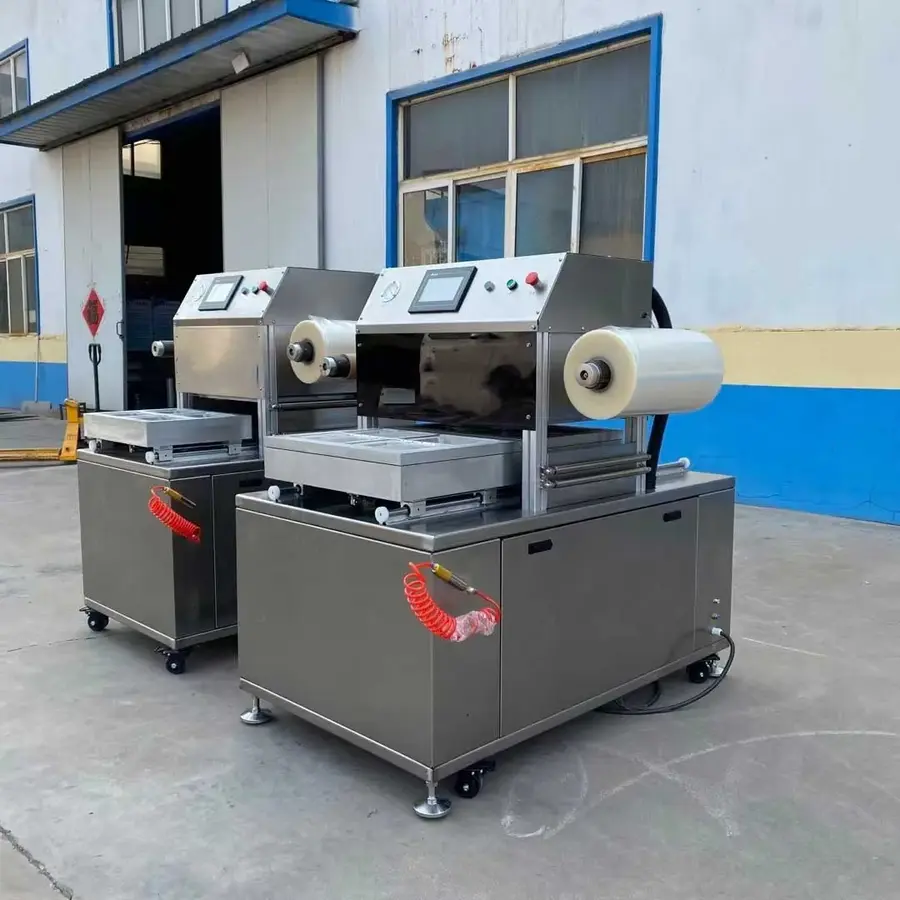
Modified atmosphere packaging for fresh foods changes the gas inside a sealed package to help preserve the product’s intended quality during distribution and sale. The equipment does not create shelf life by gas flushing alone. It must consistently remove or displace enough ambient air, deliver the validated gas mixture, make an intact seal, and maintain that package integrity through handling and refrigerated distribution.
For manufacturers, MAP is best understood as a controlled packaging system rather than a universal preservation method. Product condition, package design, film barrier, headspace, sealing performance, gas measurement, and cold-chain management all affect the final result. A pack can leave the machine with the expected gas reading and still fail in the market if it leaks, if the product was unsuitable at packing, or if distribution conditions do not match the product’s validated process.
What MAP does inside a fresh-food package
A conventional pack starts with air in its headspace. MAP replaces or modifies that atmosphere before the pack is closed. Depending on the product and validated packaging specification, the atmosphere may use nitrogen, carbon dioxide, oxygen, or a blend of these gases.
Each gas has a different role:
- Nitrogen is generally used as an inert displacement gas and can help maintain package shape where a product or pack format needs support.
- Carbon dioxide is used in many applications because it can contribute to spoilage control, but it can also be absorbed by product and influence pack appearance or internal pressure.
- Oxygen may be reduced where oxidation, browning, or aerobic spoilage is a concern. In other product applications, a controlled oxygen level may be part of the packaging specification.
There is no single correct MAP recipe for “fresh food.” Produce continues to respire, meats and seafood have different quality and handling requirements, and prepared foods bring their own formulation and process variables. The gas blend, residual oxygen target, film structure, headspace, storage conditions, and declared shelf life should therefore be developed and validated for the actual product, pack size, process, and distribution route.
MAP also does not replace good manufacturing practices, hygienic handling, or temperature control. It should not be treated as a corrective measure for a product that has already lost quality or for an uncontrolled process. Food-safety controls and shelf-life validation should be established with qualified food-safety and technical personnel and verified against applicable regulatory requirements.
The MAP packaging process, from product to sealed pack
The exact sequence differs by machine type, but most MAP systems follow the same basic logic.
Prepare and portion the product. Product temperature, surface moisture, portion consistency, and fill level affect package performance. Product or liquid on the sealing flange is a common source of weak or inconsistent seals.
Load the package. The product enters a preformed tray, a thermoformed pocket, or a film tube or pouch, depending on the machine format.
Evacuate air or flush with gas. The machine uses vacuum, gas flushing, or a combination of both to reduce the original atmosphere and introduce the selected gas mixture.
Create the seal. The lidding film, top web, or tube seal is applied while the product is held in the intended package position.
Discharge and inspect. Packs move to downstream labeling, coding, checkweighing, inspection, case packing, or refrigeration. Quality checks confirm that the machine is delivering stable results.
The key point is that the flush is only one stage. A package with the right gas composition at the sealing station is not necessarily a stable MAP pack after transport.
How vacuum-gas and gas-flushing cycles differ
A MAP packaging machine may use one of several atmosphere-replacement methods.
Vacuum-gas cycles
In a vacuum-gas cycle, the machine chamber first draws down the atmosphere around the pack, then introduces the gas mixture before sealing. Some applications use repeated evacuation and gas-fill steps to improve air displacement. The method can provide strong control over residual air, but the settings must suit the product and package. Excessive vacuum can damage delicate items, pull moisture or product juices toward the seal area, or distort the pack.
Gas flushing
In gas flushing packaging, the machine introduces protective gas to displace air from the package. Flow, timing, nozzle position, package geometry, and product volume influence how effectively this happens. A pack with a deep tray, irregular product shape, or restricted pathways for air to escape may retain more air than expected even when gas supply pressure appears normal.
Some formats use continuous or near-continuous flushing before the final seal. This is common in form-fill-seal and flow-wrapping arrangements, where film is formed around the product and the atmosphere is modified before individual packs are separated.
MAP machine types and where they fit
The best MAP packaging machine depends on the product, desired presentation, throughput, film format, and available operating controls.
| Machine type | Typical package format | MAP strengths | Important considerations |
|---|---|---|---|
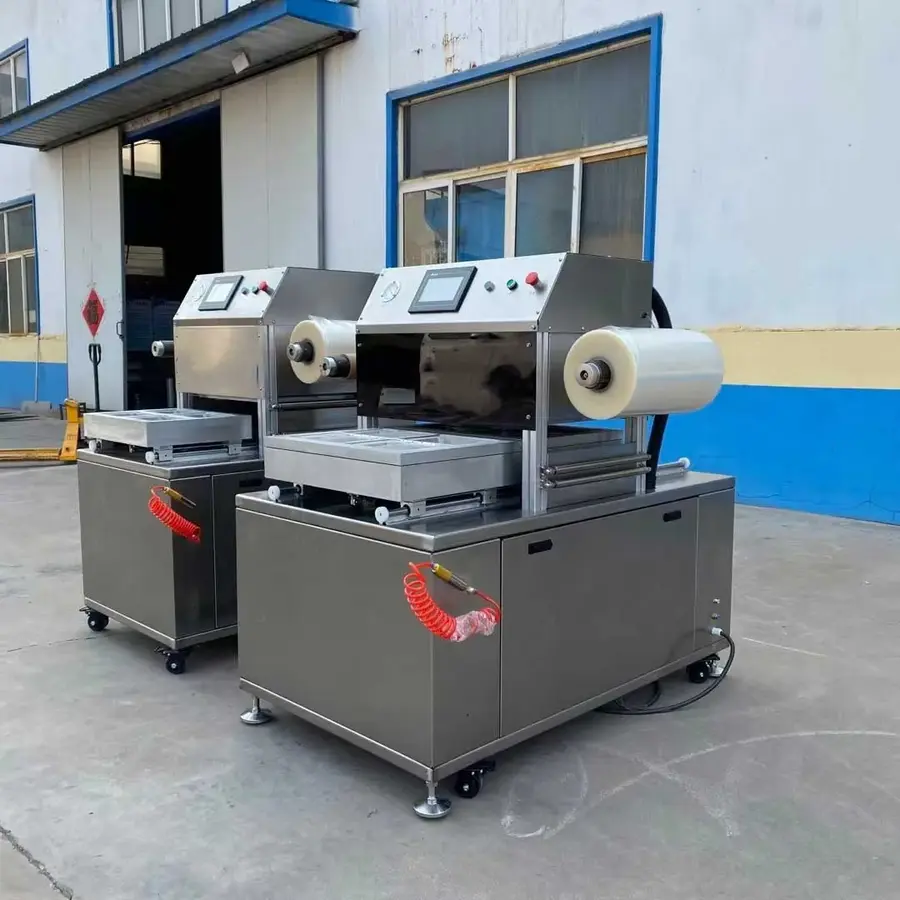
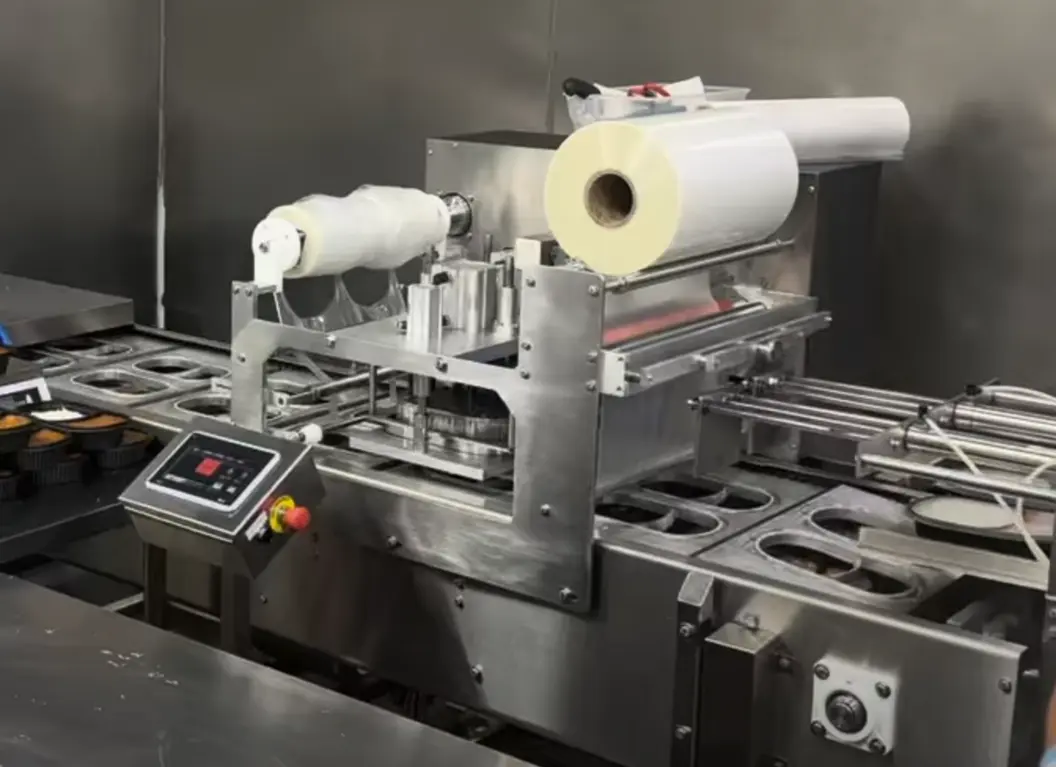
| Tray sealer | Preformed trays with lidding film | Strong retail presentation; suitable for many fresh and prepared products; flexible tray options | Tray flange cleanliness, lid registration, seal consistency, and tooling changeovers require control |
| Thermoformer | Packs formed from bottom web with top web applied | Integrated high-volume form-fill-seal operation; efficient for repeatable pack geometries | Film forming, web tracking, product loading, and format changes can affect output and pack quality |
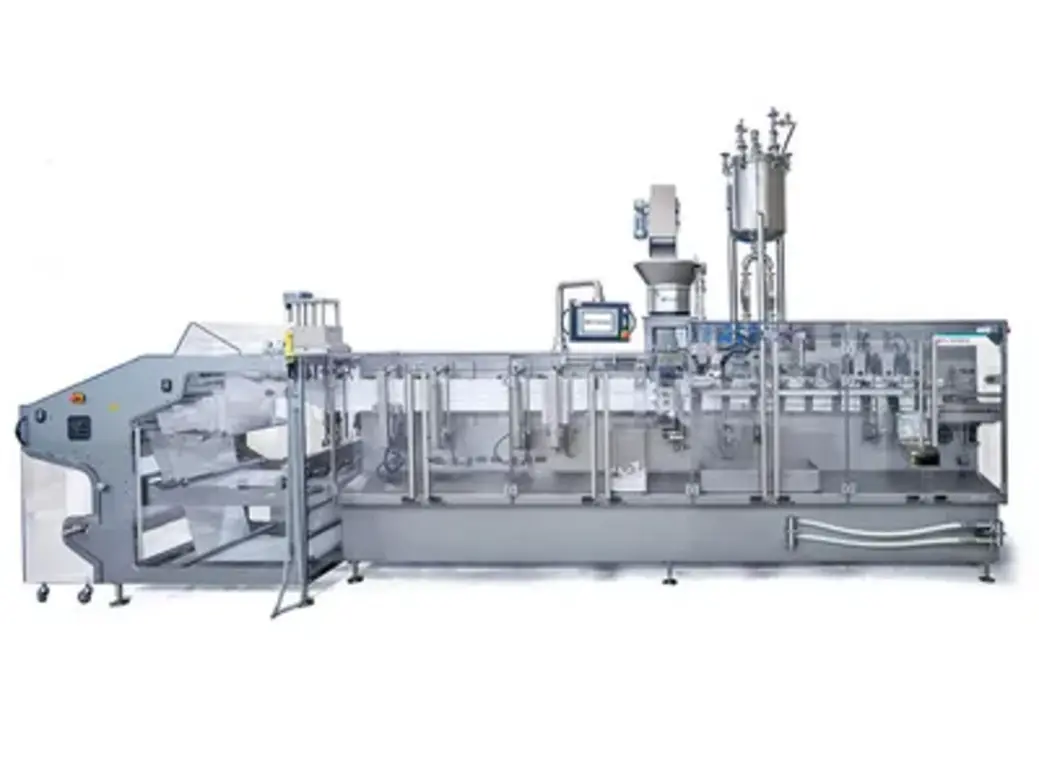
| Flow wrapper or horizontal form-fill-seal system | Film-wrapped trays, products, pouches, or pillow packs | Continuous operation and efficient wrapping for suitable product shapes | Gas retention, end seals, package geometry, and film selection must be matched carefully |
| Chamber vacuum sealer with gas option | Pouches and some specialty formats | Useful for lower-volume operations or varied products | Cycle time, product sensitivity to vacuum, and repeatability should be evaluated |
Tray sealing MAP is often selected where a rigid or semi-rigid tray supports the product and provides a retail-ready presentation. The tray is placed into a tooling cavity, the machine closes, the headspace is modified, and lidding film is heat-sealed to the tray flange. Thermoformers instead form the package cavity from a roll of bottom web before loading, flushing, and sealing with top web. Both can deliver MAP packs, but their operating disciplines differ.
The seal is the real boundary of the system
MAP works only while the intended atmosphere remains inside the package. That makes sealing and leak prevention central process controls, not finishing details.
A reliable seal depends on compatible tray and film materials, correct sealing temperature and dwell settings, adequate pressure, clean sealing surfaces, and stable tooling. Wrinkles, product contamination, damage to a tray flange, poor web tension, incomplete sealing pressure, or a poorly matched material structure can all create leak paths.
Seal appearance is useful but not sufficient. Some defects are obvious, while others only become apparent through testing or after pack handling. Manufacturers commonly combine visual inspection with defined checks for seal integrity, package leaks, and headspace gas composition. The right frequency and acceptance criteria should come from the validated product and packaging program rather than an assumed industry default.
Why gas composition alone does not guarantee shelf life
A headspace gas test confirms a condition at one point in time. It does not independently prove that every package is sealed, that gas levels will remain stable, or that the product has been held under the required conditions.
Several variables can change the atmosphere after packing:
- Gas can enter or leave through a leak or a damaged seal.
- Gas can move through packaging materials over time, depending on the film’s barrier properties.
- Carbon dioxide may be absorbed by some foods, changing pack pressure and the headspace composition.
- Fresh produce can consume oxygen and release carbon dioxide through respiration.
- Product volume and pack headspace can affect how quickly the atmosphere changes.
- Temperature changes can affect product behavior, gas behavior, and package appearance.
For this reason, the package should be evaluated as a system. A suitable MAP specification includes the product, gas blend, residual oxygen or headspace criteria where relevant, pack format, film and tray structure, seal parameters, expected distribution conditions, and verification plan.
Quality checks that matter on a MAP line
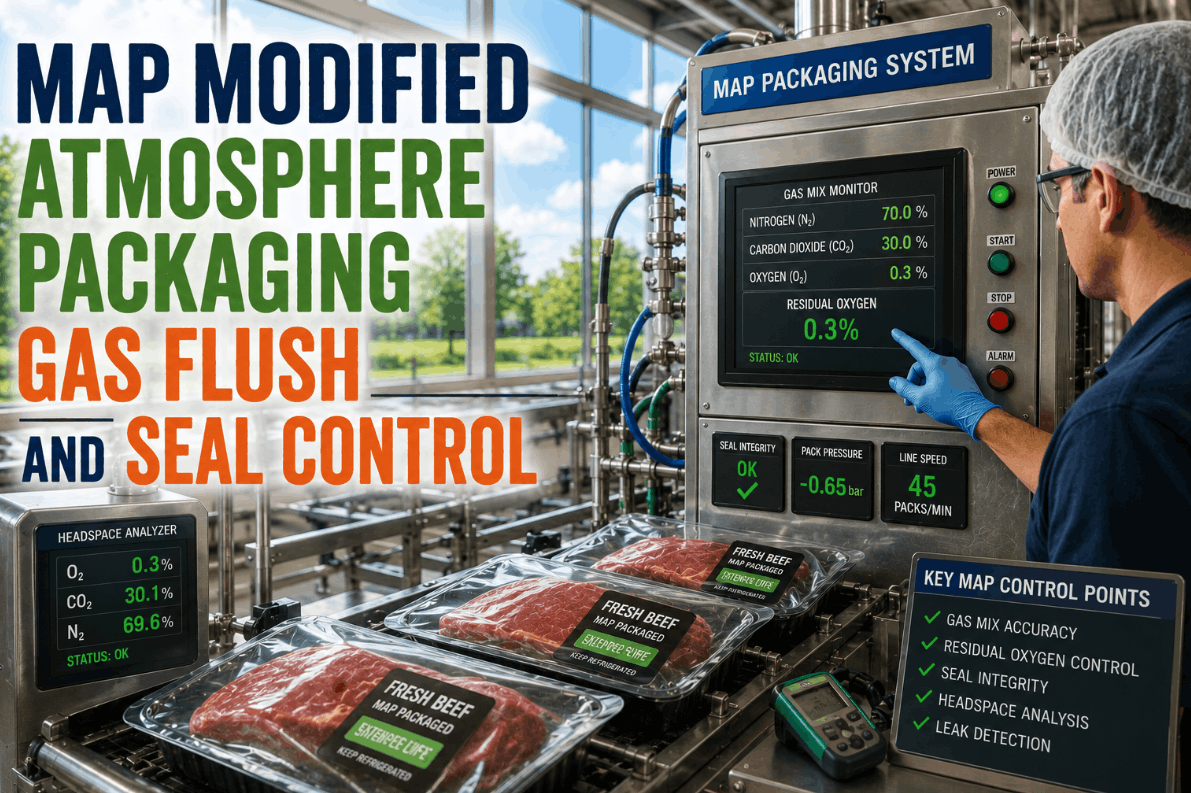
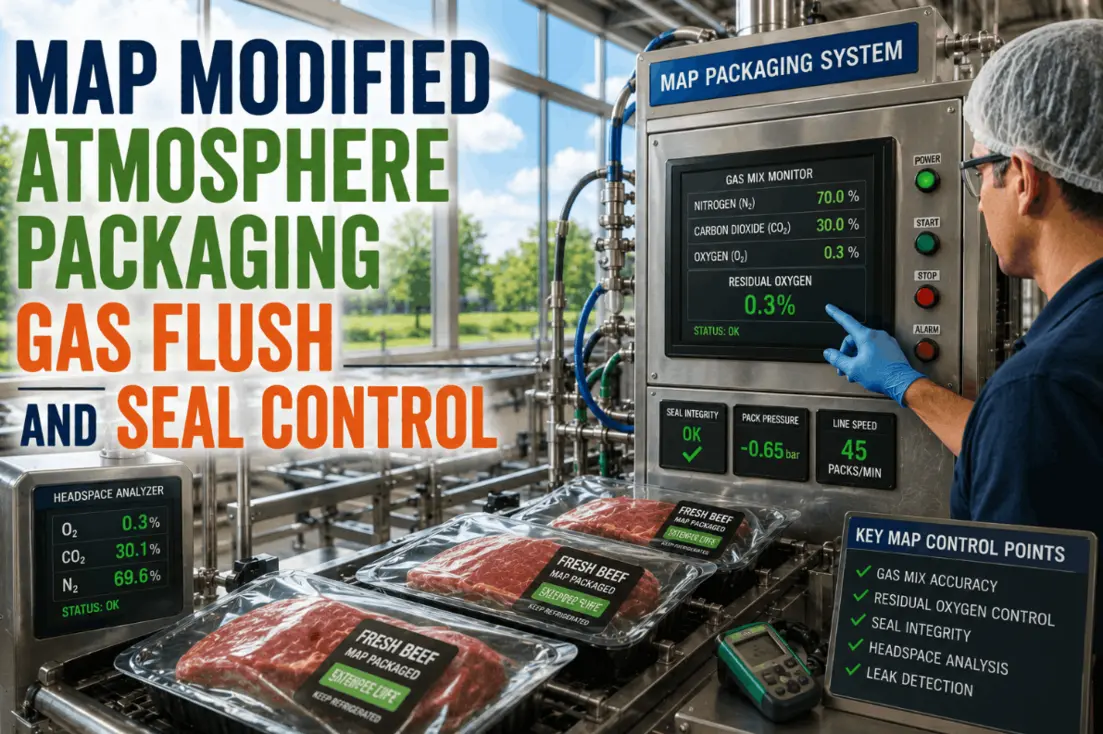
A practical MAP control plan normally looks beyond the gas cylinder or mixer. Key checks may include:
- Verification that the supplied gas or mixed gas matches the approved specification.
- Machine settings for vacuum level, gas flow, flush time, sealing time, and sealing conditions, maintained through documented setup procedures.
- Headspace gas analysis on finished packs, using a suitable sampling plan.
- Seal inspection and leak testing appropriate to the package type and risk assessment.
- Checks for product contamination in the seal area and for damaged trays or film.
- Monitoring of gas supply, line pressure, filters, valves, and tubing for drift or restriction.
- Calibration and maintenance of gas analyzers, sensors, and machine controls according to the equipment supplier’s procedures.
- Documentation that links quality checks to production lots and corrective actions.
Source: ifactoryapp
When gas readings drift, operators should avoid treating the analyzer reading as the only fault indicator. Check the gas source and mixer first, then examine the packaging cycle, pack loading, gas delivery path, tooling condition, film and tray compatibility, and seal cleanliness. A stable reading on a sampled pack does not rule out intermittent seal faults elsewhere on the line.
Cold-chain dependence and product validation
MAP can help maintain quality within a validated storage and distribution system, but it does not make temperature abuse acceptable. Refrigerated products still need the storage conditions specified by the food manufacturer and supported by its safety and shelf-life program. If those conditions are not maintained, the intended MAP performance may not hold.
Before launching or extending a MAP-packed fresh-food line, manufacturers should validate the finished package under realistic production and distribution conditions. That work should include the actual product, expected product variability, packaging materials, machine settings, handling, and storage profile. Shelf-life and food-safety decisions should be reviewed by qualified specialists using applicable official guidance and the manufacturer’s hazard-control program.
A practical MAP startup checklist
Before treating a MAP line as production-ready, confirm that the following are defined and controlled:
- Product preparation and loading conditions
- Approved gas specification and supply arrangement
- Machine cycle settings and changeover procedures
- Tray, film, or web material compatibility
- Seal-area cleanliness controls
- Headspace gas testing method and analyzer maintenance
- Seal-integrity and leak-testing method
- Criteria for pack rejection, hold, investigation, and release
- Refrigerated storage and distribution requirements
- Product-specific shelf-life and food-safety validation
Modified atmosphere packaging is valuable because it combines packaging equipment, gases, and materials into one controlled system. The machinery must do more than flush gas: it must repeat the atmosphere cycle, protect the sealing area, form a dependable closure, and provide a process that can be checked. When that system is matched to the product and maintained through the cold chain, MAP becomes a practical packaging method rather than a promise based on a gas blend alone.
References
- What Elements Do You Need For Modified Atmosphere Packaging?. (n.d.). https://www.industrialpackaging.com/blog/-modified-atmosphere-packaging
- Modified Atmosphere Packaging (MAP). (n.d.). https://www.youtube.com/watch?v=hKMCMmrMrVc
- What is Modified Atmosphere Packaging (MAP)?. (n.d.). https://www.ametekmocon.com/knowledge/learnaboutmodifiedatmospherepackagingmap/whatismodifiedatmospherepackagingmap
- Modified Atmosphere Packaging. (n.d.). https://www.wittgas.com/us/consulting-service/white-papers/modified-atmosphere-packaging
- 7 Key Advantages of Modified Atmosphere Packaging (MAP). (n.d.). https://blog.icpg.co/7-key-advantages-of-modified-atmosphere-packaging-map
- Towards Impact of Modified Atmosphere Packaging (MAP) on Shelf-Life of Polymer-Film-Packed Food Products: Challenges and Sustainable Developments. (n.d.). https://www.mdpi.com/2079-6412/11/12/1504
- How Nitrogen Is Used in Modified Atmosphere Packaging - MESA Specialty Gases & Equipment. (n.d.). https://mesagas.com/blog/how-nitrogen-is-used-in-modified-atmosphere-packaging
- What is Modified Atmosphere Packaging & Can It Extend Shelf Life? - Inline Plastics. (n.d.). https://www.inlineplastics.com/blog/what-is-modified-atmosphere-packaging-can-it-extend-shelf-life