A packaging line downtime response workflow gives operators, maintenance personnel, and production leaders one repeatable way to handle an unplanned stop. The objective is not simply to get equipment moving again. It is to restore safe, stable, saleable production quickly while preserving enough information to prevent the same stop from recurring.
The most effective workflow is simple at the point of use: make the line safe, classify the stop, perform approved first-response checks, escalate at defined thresholds, assign repair ownership, verify the restart, and record the event. Without these steps, a short jam can become a long outage because people troubleshoot in parallel, wait too long to call for support, or restart before the actual cause has been addressed.
The operating flow: contain, classify, respond, escalate, verify, learn
A practical packaging line downtime response workflow should answer five questions immediately:
- Is there a personnel, product-quality, food-safety, or equipment-damage concern?
- What machine or line zone initiated the stop?
- Is this an operator-recoverable interruption or a maintenance fault?
- Who owns the next action, and when does ownership transfer?
- What must be checked before the line returns to normal production?
The workflow should be available at the line, not buried in a maintenance manual. A short decision tree, stop-code guide, and contact path are generally more useful during an event than a lengthy procedure.
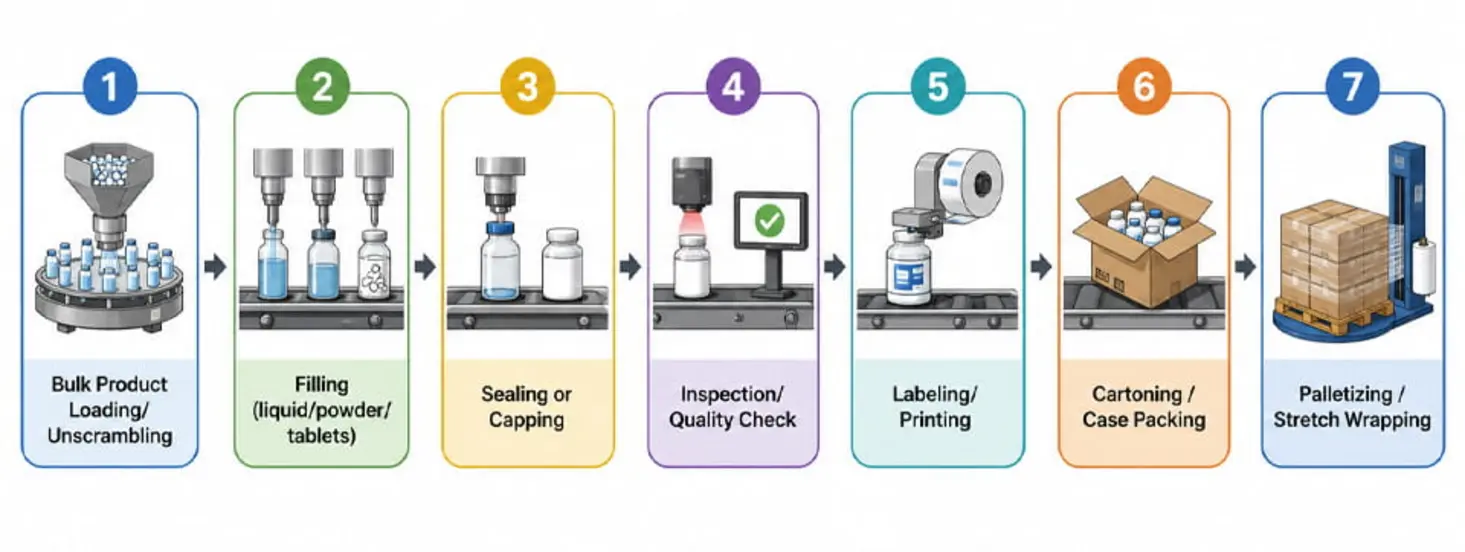
Source: jinlupacking
1. Make the stop safe and protect the product
The first response is containment. Operators should follow the site-approved stop, isolation, and access procedures before reaching into a machine, removing a jam, or inspecting moving components. Guards, interlocks, and other protective devices should not be bypassed to save time.
At the same time, protect product and packaging materials. Depending on the line and product, this may include:
- Stopping upstream feed or placing product on hold.
- Identifying product affected by a seal, coding, label, closure, or package-integrity issue.
- Preventing mixed materials from entering the line after a changeover-related stop.
- Separating damaged packages, unverified labels, or questionable coded product according to the plant’s quality procedures.
- Notifying quality personnel when the stop may affect product disposition or traceability.
A machine stop and a quality stop are not always the same event. A cartoner jam may be mechanically straightforward, while a missed code, wrong label, or poor seal may require quality review before production can restart.
2. Classify the stop before troubleshooting expands
Stop classification prevents every interruption from being treated as either a major breakdown or an informal operator fix. Use categories that fit the plant’s equipment and reporting system, but keep them clear enough for consistent use across shifts.
| Stop category | Typical examples | Normal first owner | Escalate when |
|---|---|---|---|
| Minor operational stop | Simple accessible jam, misplaced carton, material refill, routine film or label roll transition | Operator | It cannot be cleared using the approved standard procedure, repeats, or affects quality |
| Material or supply interruption | Empty packaging-material feed, damaged blanks, poor film tracking, label-stock issue, low air or utility indication | Operator or line lead | Material condition is uncertain, a utility problem persists, or the issue repeats |
| Equipment fault | Sensor fault, drive alarm, actuator problem, repeated misfeed, sealer or labeler malfunction | Maintenance | The fault creates a safety concern, risk of damage, or extended production loss |
| Quality or compliance hold | Code failure, label mismatch, poor seal, damaged package, foreign-material concern | Quality and production | Product disposition, cleaning, or a formal investigation is required |
| System or line-balance stop | Downstream accumulation full, conveyor backup, palletizer fault, upstream starvation, speed mismatch | Production lead with maintenance as needed | The constraint cannot be corrected through normal line coordination |
The categories should reflect the point of failure rather than only the place where the line stopped. A filler may stop because a downstream case packer is blocked. If the event is coded only as “filler down,” the plant loses visibility of the real constraint.
Use a separate code for repeat stops
Brief stops can be easy to dismiss, especially on high-speed equipment. Yet repeated sensor trips, minor jams, intermittent film tracking problems, or product-handling disruptions can consume substantial time across a shift. A useful rule is to flag an event as recurring when the same condition happens repeatedly within a defined production window, even if each recovery is short.
The exact repeat threshold should be set locally. It should reflect line speed, product risk, staffing, and the known behavior of the asset. The important point is that recurrence triggers a different response: investigate the cause instead of repeatedly resetting the machine.
3. Define the operator’s first-response boundary
Operators often restore production fastest when they can handle routine, low-risk conditions without waiting for maintenance. But this requires a documented boundary, training, and access to the right information.
An operator first-response checklist can include only approved actions such as:
- Read and record the alarm message or fault code before resetting it.
- Check material presentation, product orientation, and visible obstructions.
- Confirm that the correct packaging material, recipe, or change parts are in use.
- Inspect accessible guides, sensors, and feeds for obvious contamination, misalignment, or loose material.
- Clear a jam only through the approved procedure.
- Restart once after a verified minor cause has been corrected.
The checklist should explicitly state what operators do not own. Examples can include electrical-panel work, pneumatic or hydraulic repairs, adjustments inside guarded areas, changes to safety settings, machine-program changes, and repairs requiring isolation or specialized tools. Those tasks belong with qualified personnel under site procedures.
4. Escalate based on condition, not frustration
Packaging line fault escalation works best when it is automatic and visible. “Call maintenance if needed” is too subjective during a busy shift. Define conditions that require a call, a line-lead notification, or a quality hold.
Typical maintenance escalation triggers include:
- An alarm that remains after the approved first-response check.
- A repeated fault, even if an earlier reset restored operation.
- Abnormal noise, heat, vibration, odor, leaking fluid, damaged components, or a suspected mechanical failure.
- A machine that cannot hold normal operating conditions after restart.
- A problem involving drives, controls, sensors, air supply, vacuum, heating, sealing, or motion components.
- Any condition that could damage equipment or create an unsafe situation.
Production or quality escalation may be appropriate when the event affects code verification, label control, seal integrity, package appearance, traceability, product accumulation, or material identity. The workflow should identify who can release held product and who can authorize a restart after a quality-related stop.
Send a useful escalation message
A maintenance call should contain enough information for the technician to arrive prepared. At minimum, communicate:
- Line, machine, and station.
- Time the stop began and whether the line is fully down or operating at reduced speed.
- Alarm text or code, if shown.
- Product, pack format, and material in use.
- What happened immediately before the stop, such as a roll change, changeover, cleaning, speed adjustment, or material lot change.
- Actions already taken and whether the fault has repeated.
- Any quality or safety concern.
This information reduces duplicate troubleshooting and helps distinguish a machine defect from a material, setup, or line-flow problem.
5. Assign one repair owner and manage the line around the repair
Once a fault crosses the escalation threshold, one person should own technical diagnosis and repair coordination. That does not mean maintenance works alone. Operators provide event context, production leaders manage staffing and schedule decisions, and quality personnel address product-control questions.
For longer stops, the line lead should also decide what happens around the failed point. This can include stopping upstream equipment to avoid excess buildup, using available accumulation, protecting open product, redirecting labor, or preparing materials for a controlled restart. These decisions should follow the plant’s process and quality requirements rather than improvised workarounds.
Maintenance documentation should distinguish between the immediate corrective action and the suspected root cause. Replacing a sensor, tightening a guide, or clearing a damaged carton may restore operation, but it does not necessarily explain why the failure occurred.
6. Verify the restart instead of treating motion as recovery
A running machine is not automatically a recovered line. The restart phase should confirm that the equipment is operating safely, the packaging is acceptable, and the line is stable at the intended rate.
A restart verification should cover:
- Guards and access panels restored, with no tools, parts, or debris left in the equipment.
- Required machine settings, recipe, and change parts confirmed.
- Packaging materials and product correctly positioned.
- First packages checked through the relevant quality controls, including coding, labels, closure, seals, fill condition, or case configuration as applicable.
- Downstream handling, accumulation, and palletizing observed for a short stability check.
- The original alarm or symptom absent at the planned operating condition.
If the stop involved a quality hold, the restart process must include the site-defined release decision. Do not assume that an equipment repair alone resolves product disposition.
7. Capture downtime data that can drive action
A downtime response checklist is also a data-collection tool. Records should be quick enough to complete under production pressure but specific enough to support trend analysis.
Useful fields include the asset, stop category, initiating condition, fault code, start and end time, lost-production estimate if used by the plant, corrective action, parts used, and whether the event was a repeat. A free-text note is valuable when it explains the context that a standard code cannot capture.
Avoid an overgrown list of vague codes. If a large share of events is recorded as “other,” “jam,” or “mechanical,” the data will not reveal what to improve. Refine codes around meaningful failure modes, such as film feed, label application, carton feed, product transfer, seal station, conveyor backup, or utility interruption.
8. Review repeated events and convert them into prevention work
Production line downtime management should not end when the shift does. Review recurring stops across operations, maintenance, and quality. The purpose is to identify patterns that call for a permanent countermeasure: a guide adjustment standard, improved cleaning access, a material specification discussion, a replacement part, better changeover setup, an operator job aid, or a preventive-maintenance task.
A short regular review can focus on:
- The most frequent stop categories and the longest recovery events.
- Stops that returned soon after a repair.
- Differences by SKU, package format, material supplier, shift, or line speed.
- Events concentrated around changeovers, roll changes, cleaning, or startup.
- Parts or utilities that repeatedly delay repair.
- Open corrective actions and whether they reduced recurrence.
Changeovers deserve particular attention. Case packers, labelers, film-handling equipment, and other format-sensitive machines can generate recurring downtime when setup steps, saved recipes, adjustments, and preventive checks are not managed as one controlled process.
A practical downtime response checklist
Use this compact checklist as a starting point for a line-specific standard:
- Stop safely and protect product, materials, and equipment.
- Identify the stopping station and capture the alarm or visible symptom.
- Classify the event: minor operational, material, equipment, quality, or system-flow stop.
- Complete only approved operator first-response checks.
- Escalate immediately when the fault is persistent, recurring, safety-related, quality-related, or outside the operator boundary.
- Give the responder the machine, alarm, format, event history, and actions already taken.
- Assign technical repair ownership and coordinate the surrounding line.
- Verify guards, settings, package quality, and line stability before returning to normal operation.
- Record the cause category, action taken, duration, and repeat status.
- Review recurring events and assign a preventive action with an owner and due date.
A well-designed workflow does not eliminate every packaging-line stop. It reduces uncertainty when stops occur, shortens the path to the right responder, and makes each event more useful for improving the next shift.
References
- Packaging Line Maintenance in Food Manufacturing: Reducing Changeover Time and Failures. (n.d.). https://oxmaint.com/industries/food-manufacturing/packaging-line-maintenance-food-manufacturing-changeover
- Packaging Industry: Recognizing and Resolving Line Speed and Downtime Issues to Maximize Productivity - Lean 6 Sigma Hub. (n.d.). https://lean6sigmahub.com/packaging-industry-recognizing-and-resolving-line-speed-and-downtime-issues-to-maximize-productivity
- How to minimize unplanned downtime in your food packaging line. (n.d.). https://info.interroll.com/blog/how-to-minimize-unplanned-downtime-in-your-food-packaging-line
- Packaging Machine Maintenance on the Production Line. (n.d.). https://oxmaint.com/industries/manufacturing-plant/packaging-machine-maintenance-production-line
- Reducing Downtime in Food Packaging and Manufacturing Plants. (n.d.). https://www.advancedtech.com/blog/reducing-downtime-for-food-and-beverage-manufacturing
- How To Reduce Downtime in Beverage Line Packaging. (n.d.). https://robopacusa.com/how-to-reduce-downtime-in-beverage-line-packaging
- Why Preventative Maintenance is Important for Packaging Line Machinery. (n.d.). https://www.industrialpackaging.com/blog/why-preventative-maintenance-is-important-for-packaging-line-machinery
- Common Packaging Line Problems & Fixes Guide 2026. (n.d.). https://www.pallasmt.com/common-packaging-line-problems