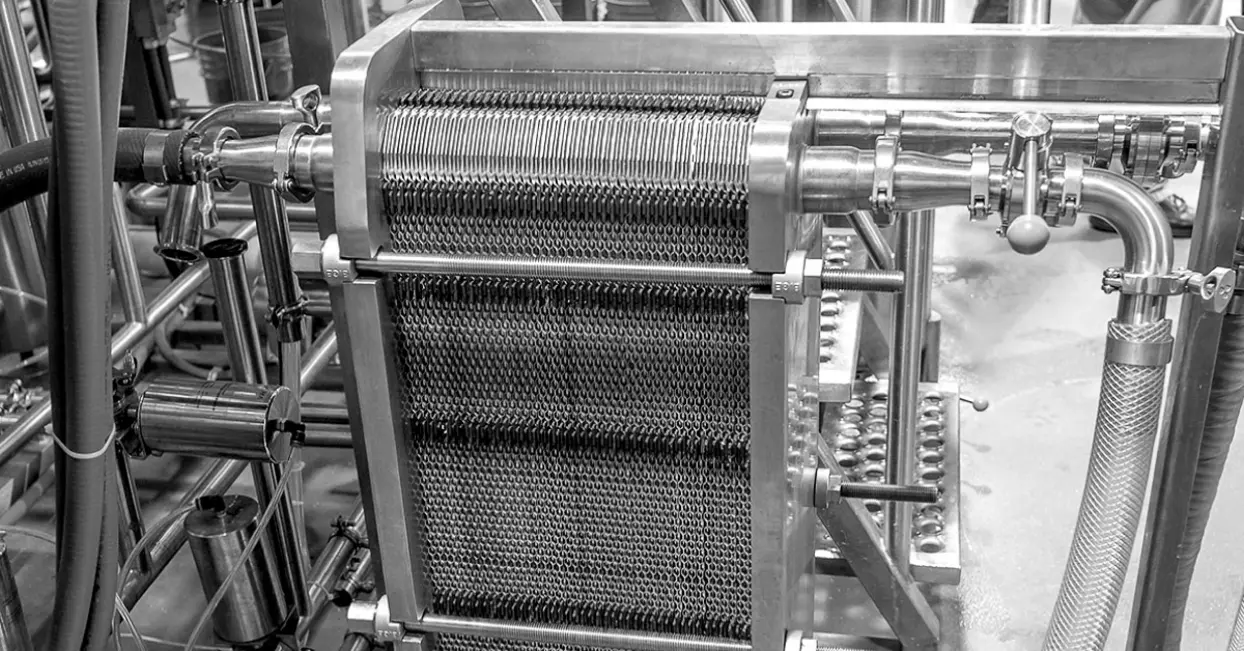
For most clean, low-viscosity liquids, a plate heat exchanger is usually the practical first choice. It provides high heat-transfer efficiency in a compact footprint and is widely used for products such as milk, beverage bases, clarified juices, water, and similar pumpable liquids. A tubular heat exchanger is usually the safer starting point when the product is viscous, contains particles, forms deposits readily, or needs a larger, less restrictive product path.
The best choice in plate vs tubular heat exchanger food processing is not simply the unit with the highest thermal efficiency. A heat exchanger that transfers heat efficiently but plugs, causes excessive pressure drop, damages inclusions, or requires frequent shutdowns can be the more expensive option in daily operation. Product behavior, run length, cleaning method, and maintenance access should be evaluated together.
The core design difference
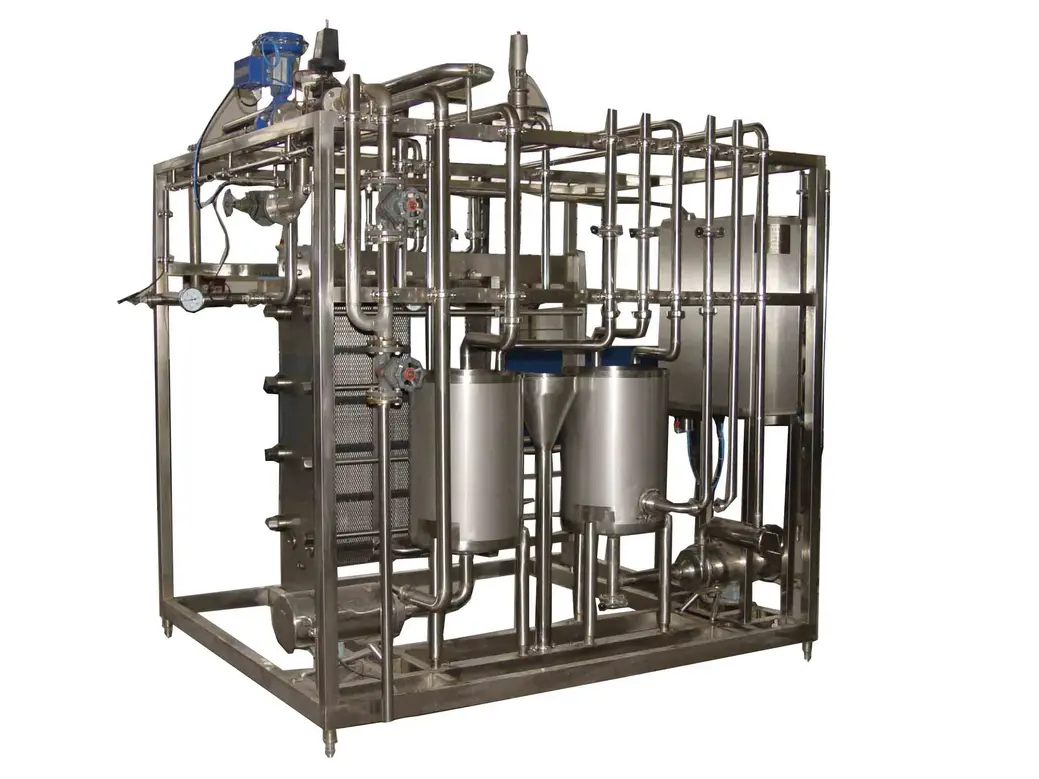
A plate heat exchanger uses a stack of thin corrugated metal plates. Product and heating or cooling media flow through alternating narrow channels. The corrugation promotes turbulence, which improves heat transfer and can help reduce deposits when the product is suitable for the channel geometry.
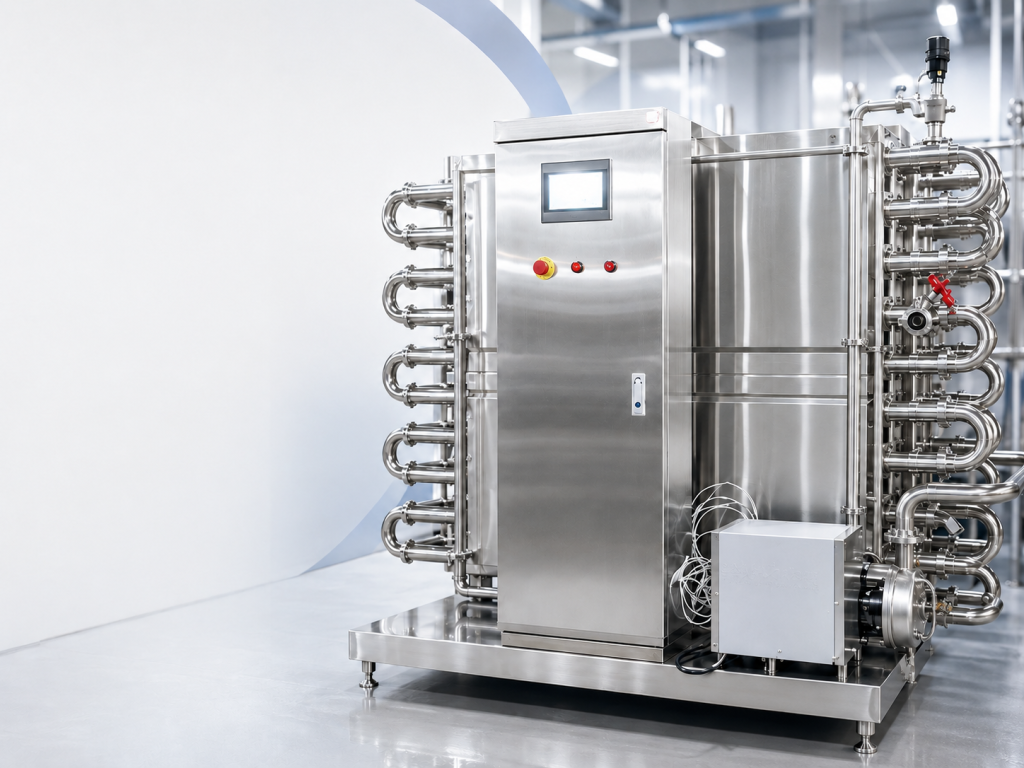
A tubular heat exchanger routes product through tubes, often within a larger shell or jacket carrying the service medium. Sanitary tubular designs may use straight tubes, concentric tubes, or multiple tube arrangements. Their product passages are generally more open than those of plate units, which makes them more tolerant of thicker fluids and some particulate products.
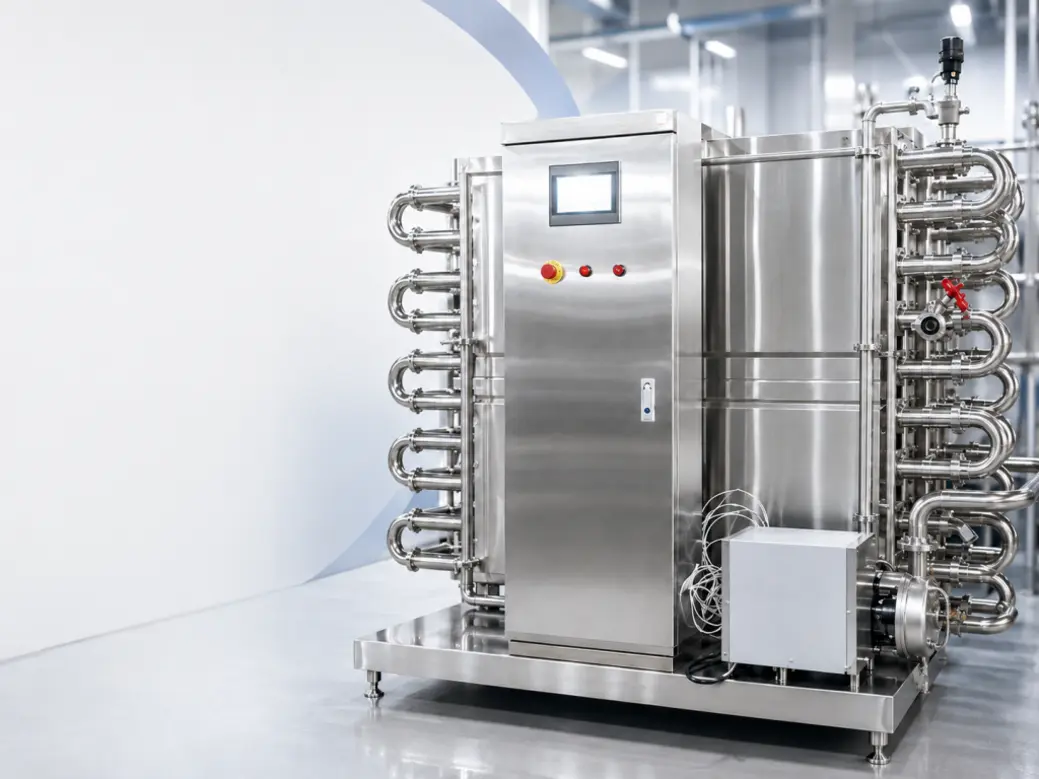
Source: zjzhongbo
Plate vs tubular heat exchanger comparison
| Selection factor | Plate heat exchanger | Tubular heat exchanger |
|---|---|---|
| Best general product fit | Clean, low-viscosity liquids | Viscous, particulate, pulpy, or deposit-forming products |
| Heat-transfer efficiency | Usually high because of thin plates and turbulent flow | Often lower for a similar footprint, but depends on design and duty |
| Footprint | Typically compact | Often longer or larger for the same duty |
| Product channels | Narrower, more restrictive | Larger and more forgiving |
| Pressure drop | Can be relatively high | Often easier to manage for difficult products, though not always low |
| Fouling tolerance | Sensitive to product solids, buildup, and poor flow distribution | Generally better suited to fouling-prone and viscous products |
| Cleaning approach | Often CIP-capable; gasketed models can be opened for inspection | Often CIP-capable; access depends on tube bundle and sanitary design |
| Capacity changes | Gasketed plate units can often be expanded or reconfigured | Changes may require more substantial modification or a separate unit |
| Typical applications | Dairy, beverages, water-like liquids, product regeneration duties | Soups, sauces, fruit preparations, purees, products with particulates |
These are broad tendencies, not absolute rules. Plate spacing, plate pattern, tube diameter, flow velocity, product rheology, and the selected duty can shift the outcome substantially.
Product viscosity and particulates: the first screening step
Viscosity is often the fastest way to narrow the field. As a product becomes thicker, pumping it through narrow plate channels requires more pressure. Higher resistance can increase pump energy, limit production rate, and produce uneven flow if the exchanger is poorly matched to the product.
Plate units can handle more than water-thin liquids, particularly when configured with appropriate plate geometry. But processors should not assume that a plate heat exchanger rated for a given flow rate will suit a product merely because the product is pumpable. Viscosity can change sharply with temperature, solids level, shear history, and batch variation. The design basis should include the product’s expected viscosity across the full operating range, not only a room-temperature sample or nominal recipe value.
A tubular heat exchanger for viscous products generally offers a more open route and can be designed around a larger allowable particle size. This is important for soups with vegetable pieces, fruit preparations, sauces with herbs or seeds, and products where preserving inclusions matters. Product passages must still be sized for the actual largest inclusion, including occasional oversized pieces and process variation upstream.
Do not rely on a generic claim that a design is “particle capable.” Ask the supplier to define the permitted particle dimensions, product path restrictions, pump requirements, and any conditions that could cause bridging or blockage.
Heat-transfer efficiency versus usable production time
Plate heat exchangers are valued for close temperature approach and compact surface area. Their thin metal plates and turbulent channels create favorable heat transfer, often enabling efficient regeneration in processes where a hot outgoing product stream can preheat a cold incoming stream.
That advantage can be decisive for clean liquid systems. It may be less decisive for products that foul rapidly. Deposit buildup adds thermal resistance, increases pressure drop, and eventually shortens the usable run. A unit that begins with excellent heat transfer but needs frequent cleaning may deliver less productive time than a larger tubular system with lower initial thermal performance.
For food processing heat exchanger selection, compare expected operation over a complete campaign rather than at clean-start conditions alone. Useful questions include:
- How will heat-transfer performance change as the run progresses?
- What pressure-drop rise is expected before cleaning is required?
- Will product quality change if residence time, local wall temperature, or shear increases?
- Can the existing pumps maintain required flow as deposits build?
- What is the actual production loss from a cleaning stop, cooldown, startup, and product recovery?
A sensible design balances utility use, pumping power, floor space, cleaning frequency, and recovered production time.
Fouling: why product behavior matters more than exchanger labels
Heat exchanger fouling in food production can result from proteins, sugars, minerals, fibers, starches, fat, burned-on product, or solids that settle in low-velocity areas. The mechanism depends on both product formulation and operating conditions.
Plate channels can be vulnerable when fibers, curd fragments, pulp, or unstable product deposits collect in narrow flow paths. A well-designed plate unit promotes even distribution and avoids stagnant areas, but it cannot make an unsuitable product behave like a clean liquid.
Tubular exchangers are not immune to fouling. Thick products can still build deposits on tube walls, particularly where velocity is too low or heating conditions are poorly controlled. However, the larger flow passages and simpler product route can make them more tolerant where plate channels would be restrictive.
The correct response to fouling is not automatically to select a tubular model. First identify the likely mechanism. Review ingredient additions, homogenization or mixing changes, upstream filtration, product temperature, flow stability, and whether the issue occurs at heating, cooling, or regeneration sections. A process issue can appear as an equipment limitation.
Pressure drop and pumping requirements
Pressure drop is a central tradeoff in this comparison. Plate heat exchangers commonly use narrow passages and turbulence to achieve strong heat transfer. The result can be a higher pressure requirement than a tubular design handling the same product duty.
Higher pressure drop is not necessarily a problem. It may be worthwhile if the product remains stable, the available pump can maintain flow, and the operating savings from better regeneration outweigh pumping costs. But it should be calculated at expected product viscosity and at the anticipated end-of-run fouling condition, not just for water during a vendor demonstration.
Check the full system, including balance tanks, valves, filters, holding equipment where applicable, piping, and downstream fillers or processors. The heat exchanger is only one restriction in the product path. Confirm that the selected pump has adequate margin without creating unacceptable product shear or control instability.
Cleanability and hygienic operation
Both plate and tubular units can be designed for clean-in-place operation, but cleanability depends on more than the exchanger type. Product contact surfaces, drainage, gasket condition, flow distribution, tube geometry, dead-leg control, instrumentation placement, and the cleaning program all matter.
Gasketed plate exchangers can be opened for visual inspection and mechanical attention, which is useful when deposits or gasket condition need direct review. This accessibility comes with labor and downtime: opening, cleaning, inspecting, regasketing when necessary, and correctly retightening a large plate pack can be a significant maintenance task.
Tubular units may offer a simpler product passage and can be robust for demanding applications. Yet inspection access varies by construction. Some designs allow bundle or tube access more readily than others. Before purchase, ask how the unit is opened, which components are wear items, what lifting or clearance is needed, and whether maintenance can be completed within the available shutdown window.
Cleaning procedures, chemical compatibility, sanitation requirements, and process validation must be set by the processor’s qualified food-safety and engineering teams. Verify the equipment’s hygienic design, cleaning capability, materials of construction, seals, and documentation against the applicable local regulations, customer requirements, and plant sanitation program.
Hold-up volume and changeover
Hold-up volume is the amount of product retained in the exchanger and connected circuit during operation and shutdown. It affects startup losses, product recovery, changeover waste, and the amount of product exposed to processing conditions outside steady state.
Plate heat exchangers are often compact and can offer relatively low product hold-up for their duty, although configuration matters. Tubular systems may have greater hold-up because of their tube length and diameter, especially when designed for difficult products. That is not automatically a disadvantage: a larger passage may be necessary for product integrity and reliable flow.
For short runs, expensive products, frequent flavor changes, or allergen-sensitive scheduling, calculate recoverable and unrecoverable product volume for the entire circuit. Include transfer lines, valves, separators, holding sections, and fillers where relevant. The exchanger alone does not determine changeover losses.
Typical food applications
Plate heat exchanger food applications
Plate designs are commonly well suited to:
- Milk and many dairy liquids
- Beverage bases and ready-to-drink products without significant solids
- Clarified juices and liquid sweeteners
- Water, process water, and utility-side cooling or heating
- Regeneration duties in continuous liquid processing
These applications benefit from compact construction, efficient heat transfer, and the ability to adapt some gasketed units by adding or changing plates.
Tubular heat exchanger applications
Tubular designs are often a stronger candidate for:
- Fruit purees and pulpy products
- Sauces, dressings, and thicker condiments
- Soups and products containing discrete particles
- Products with fibers, seeds, herbs, or other inclusions
- Viscous products with a higher fouling risk
The final fit depends on the specific formulation, particle size distribution, required texture, pumpability, and process conditions.
A practical selection checklist
Before requesting final quotations, provide each equipment supplier with the same operating data:
- Product description: Include ingredients, solids, particulates, viscosity behavior, sensitivity to shear, and likely batch variation.
- Required duty: State inlet and target outlet conditions, production rate, utility availability, and whether regeneration is required.
- Pressure limits: Identify pump capability, upstream and downstream restrictions, and maximum allowable pressure constraints for the product path.
- Run expectations: Define planned campaign duration, cleaning frequency, expected foulant behavior, and acceptable performance decline.
- Cleaning requirements: Describe the plant’s CIP philosophy, chemical compatibility constraints, inspection needs, and validation expectations.
- Changeover needs: Include product recovery, flavor or allergen scheduling, and desired hold-up volume.
- Installation limits: Confirm floor space, headroom, access for service, drain routing, and utility connections.
The practical decision
Choose a plate heat exchanger when the product is clean and low in viscosity, compactness matters, and high thermal efficiency or regeneration is valuable. It is often the most efficient answer for continuous liquid food processing, provided the pressure drop and fouling risk are acceptable.
Choose a tubular heat exchanger when product passage size, fouling tolerance, particle handling, or robust operation matters more than achieving the smallest possible footprint. For viscous, pulpy, particulate, or deposit-forming foods, the lower-risk choice is frequently the design that stays open, cleanable, and controllable through the required production run.
The final specification should be based on tested product data and a documented process duty. Ask suppliers to state their assumptions clearly, including end-of-run pressure drop, cleaning method, product hold-up, service access, and the limits of the proposed design. That comparison is more useful than selecting on heat-transfer area or initial thermal efficiency alone.
References
- Plate vs. Shell & Tube Heat Exchangers: Which is Best for Hygienic…. (n.d.). https://www.csidesigns.com/blog/articles/plate-vs-shell-and-tube-beyond-basics
- Shell Tube or Plate Exchangers for Food Processing. (n.d.). https://www.alliedheattransfer.com.au/post/shell-tube-vs-plate-heat-exchangers-selecting-the-right-solution-for-food-processing
- Tetra Pak® Plate Heat Exchanger | Tetra Pak Canada. (n.d.). https://www.tetrapak.com/en-ca/solutions/integrated-solutions-equipment/processing-equipment/heat-transfer/tetra-pak-plate-heat-exchanger
- Tetra Pak® Plate Heat Exchanger | Tetra Pak Greece. (n.d.). https://www.tetrapak.com/en-gr/solutions/integrated-solutions-equipment/processing-equipment/heat-transfer/tetra-pak-plate-heat-exchanger
- Tetra Pak® Plate Heat Exchanger | Tetra Pak Netherlands. (n.d.). https://www.tetrapak.com/en-nl/solutions/integrated-solutions-equipment/processing-equipment/heat-transfer/tetra-pak-plate-heat-exchanger
- Tetra Pak® Plate Heat Exchanger | Tetra Pak Philippines. (n.d.). https://www.tetrapak.com/en-ph/solutions/integrated-solutions-equipment/processing-equipment/heat-transfer/tetra-pak-plate-heat-exchanger
- Tetra Pak® Plate Heat Exchanger | Tetra Pak Singapore. (n.d.). https://www.tetrapak.com/en-sg/solutions/integrated-solutions-equipment/processing-equipment/heat-transfer/tetra-pak-plate-heat-exchanger
- Tetra Pak® Plate Heat Exchanger | Tetra Pak Egypt. (n.d.). https://www.tetrapak.com/en-eg/solutions/integrated-solutions-equipment/processing-equipment/heat-transfer/tetra-pak-plate-heat-exchanger