PLC change management food manufacturing is a disciplined method for changing control code, PLC hardware, I/O, networks, drives, or operator interfaces without turning a short maintenance task into a long production outage. The practical objective is simple: know exactly what will change, preserve a recoverable baseline, test as much as possible before the outage, define when to stop, and prove the line is ready before product is released.
A food line adds consequences that are easy to overlook in a generic controls project. A program edit can affect recipes, interlocks, alarm behavior, batch records, cleaning sequences, traceability signals, or a process step that needs formal verification. Treat controls work as a coordinated operational change, not as a programmer connecting to a cabinet during a quiet shift.
The change-control flow
A reliable workflow has seven connected stages:
- Define the change and its production impact.
- Review technical, safety, food-safety, and quality risks.
- Capture verified backups and a known-good baseline.
- Build and test the change offline where possible.
- Plan the cutover, including clear rollback criteria.
- Commission the change in a controlled sequence.
- Hand the line back to production with complete records.
The stages may be lightweight for a low-risk display correction and more formal for a processor replacement, safety-related logic modification, recipe-system integration, or network migration. What should not change is the discipline of authorization, backup, verification, and documentation.
1. Define the change before anyone edits code
Start with a change request that a production supervisor, maintenance lead, controls engineer, and relevant quality or food-safety personnel can understand. Avoid descriptions such as “fix filler issue” or “update PLC.” State the problem, the intended correction, and the limits of the work.
A useful request identifies:
- Line, machine, panel, PLC, rack, HMI, drive, switch, and software versions affected.
- Current operating issue and observable symptom.
- Proposed hardware, wiring, firmware, configuration, or logic change.
- Expected effect on sequences, recipes, alarms, reporting, and connected equipment.
- Required outage window and required support roles.
- Whether the work affects validated process controls, cleaning programs, lot records, product segregation, or any safety function.
- Acceptance criteria and the person authorized to release production.
Separate the requested outcome from the proposed solution. For example, “prevent conveyor accumulation from stopping the upstream depositor unnecessarily” is an outcome. “Add a timer to rung 42” is a proposed solution that may not address the actual cause.
Classify the risk
A simple risk classification helps the plant decide how much preparation is needed. Low-risk work may include an HMI label correction that does not affect commands, setpoints, permissions, or records. Medium-risk work might include adding a noncritical sensor or revising a standard machine sequence. High-risk work includes a processor migration, remote I/O replacement, firmware change, managed-switch reconfiguration, drive-control change, recipe logic revision, or any modification that could affect personnel protection, product disposition, or a critical process step.
High-risk changes need a formal review and a realistic rollback plan. They should not be approved solely because a vendor believes the edit is routine.
2. Review dependencies, not just the PLC program
Many failed cutovers occur because the PLC file was correct while something around it was not. The review should map the control path from field device to operator action.
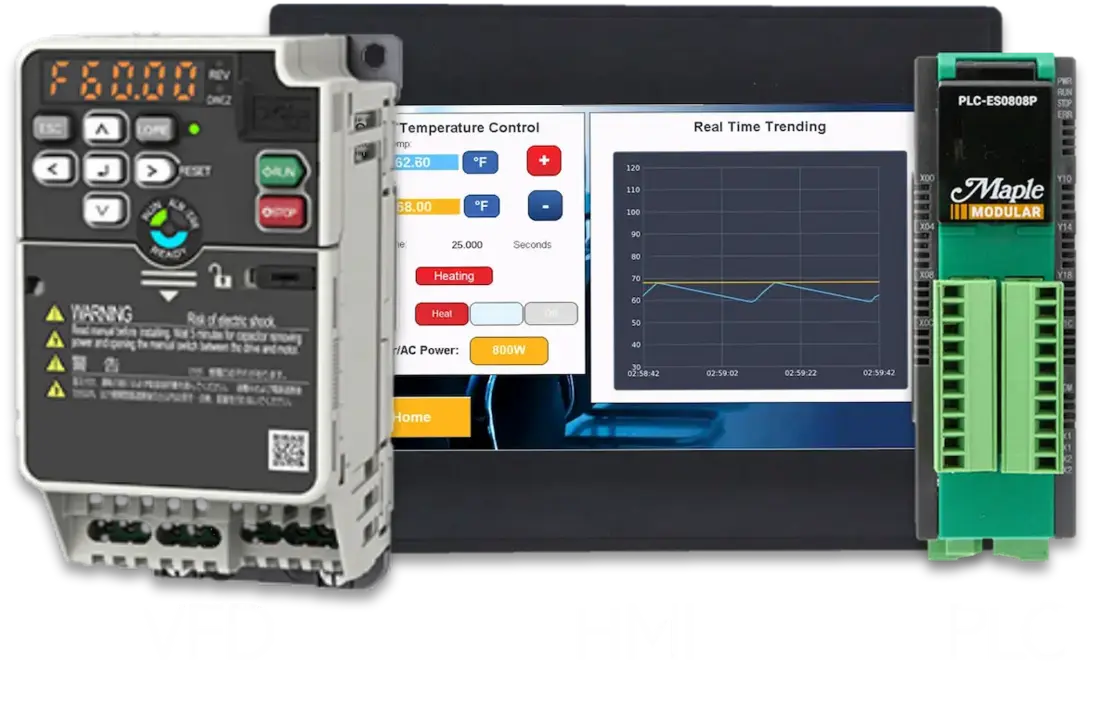
Source: media.maplesystems
Check dependencies such as:
- PLC processor, power supply, rack layout, remote I/O, and spare capacity.
- HMI and SCADA tags, alarm screens, user roles, and recipe interfaces.
- Variable-frequency drives, servo controllers, motor starters, and their parameter sets.
- Industrial network topology, IP addresses, device names, managed switches, and remote-access paths.
- Sensors, actuators, valve manifolds, safety devices, instrument ranges, and wiring terminations.
- Upstream and downstream equipment handshakes.
- Data links to historians, batch systems, printers, labelers, vision systems, or enterprise systems.
For every affected signal, ask what happens if it is missing, inverted, stale, scaled incorrectly, or received late. That question is especially important after I/O replacements, network changes, and analog-signal work.
Do not assume that a normal production sequence proves all conditions. Include abnormal states: an empty supply, blocked discharge, failed device, loss of communications, emergency stop condition, controlled stop, restart, and power recovery. Safety functions must be reviewed and verified using the plant’s approved safety process by qualified personnel; they must not be bypassed to accelerate commissioning.
3. Create a verified backup and rollback baseline
A backup is useful only if it is identifiable, complete, accessible, and capable of being restored. Before work starts, collect the current baseline rather than relying on an old project folder.
The baseline package should normally include the running PLC project and program, processor and I/O configuration, HMI application, drive and motion-controller parameters where applicable, network-device configurations, electrical drawings, current software and firmware versions, and a change log. Exported reports, screenshots of key settings, and photos of panel wiring can be valuable supplements, but they do not replace source files and device configurations.
Use a controlled storage location with a naming convention that distinguishes the approved production baseline from working copies. Record the date, machine identity, controller identity, software revision, and person who captured it.
Verify restore capability before the outage
The strongest PLC backup and rollback practice is to confirm that the recovery package is usable before it is needed. This does not mean casually downloading files into a live machine. It means confirming the correct engineering software is available, access credentials are controlled and accessible to authorized personnel, files open without missing dependencies, and the team knows the approved recovery method.
For a major migration, keep the old processor, known-good program, removable media if used, configuration records, and any required communication hardware available until commissioning is complete. If rollback would require rewiring, address changes, or a long configuration rebuild, it is not a practical rollback plan.
4. Test offline and keep versions under control
Use version control appropriate to the plant’s tools and skills. At minimum, preserve an immutable pre-change version, a documented working version, and an approved release version. Record what changed, why it changed, who made it, and what testing occurred.
When software supports comparison tools, compare the proposed project against the baseline. Review changed routines, tags, controller properties, I/O mappings, communications settings, alarm configuration, and recipe data. A code comparison is helpful, but it does not reveal every configuration or field issue, so it should be paired with an I/O and commissioning plan.
Offline simulation, emulation, factory testing, or a spare test rack can reduce risk. Test the logic sequences that can be modeled, including permissives, faults, manual controls, alarms, and restart behavior. Clearly label simulated results as simulated results. Field commissioning is still needed to confirm wiring, timing, mechanics, instruments, and equipment interactions.
Avoid untracked “night-shift fixes.” An urgent correction may be necessary, but it should still receive a temporary change record, a backup before and after the edit, a named owner, and a scheduled review. Otherwise, the next team may troubleshoot a line using drawings and source files that no longer match the running system.
5. Plan the cutover and set rollback criteria
A cutover plan should read like an operating procedure, not a broad project summary. Assign one person to direct the work and specify who can authorize a download, energization, test run, production release, and rollback.
Include these elements:
- Planned outage start, stop point, and communications plan.
- Equipment isolation and safe-work requirements under site procedures.
- Hardware installation, wiring inspection, and configuration sequence.
- Exact files and revisions to load.
- Defined I/O checkout order and test materials, if needed.
- Responsible person for each task and independent witness for critical checks.
- Required production, maintenance, quality, sanitation, and IT/OT support.
- Decision points, including the latest practical point to return to the old system.
Set rollback criteria in advance. Examples include inability to establish stable communications, failed I/O verification, loss of required machine interlocks, incorrect equipment direction or response, unexpected alarms that cannot be resolved within the approved window, or failure to meet agreed commissioning acceptance criteria. The right response to a failed criterion is to stop, return the equipment to a safe condition, and follow the approved rollback plan—not to make increasingly broad live edits under schedule pressure.
6. Commission in layers, then prove the production sequence
Commissioning should move from basic infrastructure to controlled operation. A common order is power and hardware inspection, communication checks, configuration verification, point-to-point I/O checks, manual device tests, automatic sequence tests, and integrated line trials.
Confirm that field devices match drawings and tag names. Verify actuator motion and equipment direction carefully. Check that displayed values and status indications agree with field conditions. Then test permissives, alarms, interlocks, fault recovery, manual modes, automatic modes, and controlled restart behavior.
Do not use a production run as the first test of every condition. Start with the lowest-risk available method and progress deliberately. Where product safety, quality, sanitation, or regulatory controls may be affected, the plant should use its documented verification and release requirements. Process setpoints, time controls, cleaning sequences, and product-disposition rules should be verified against the facility’s approved process documentation and applicable official requirements, not improvised during controls commissioning.
7. Hand the line back with an operational record
A line is not fully released when it starts moving. The handoff should confirm that operators understand any changed screens, alarms, modes, recipe behavior, startup steps, and escalation points. Maintenance should receive updated drawings, device details, spare-part implications, and the approved backup location.
Close the change with:
- Final released PLC, HMI, drive, and network configuration files.
- Updated electrical drawings, I/O lists, software revision records, and network documentation.
- Test results, exceptions, corrective actions, and unresolved follow-up items.
- Training or briefing records for affected personnel.
- A post-change review after the line has operated under normal conditions.
The post-change review is where recurring nuisance alarms, operator workarounds, intermittent communications faults, and overlooked production impacts are often found. Document those findings before the details disappear into shift turnover.
A practical night-shift rule
Night-shift changes deserve the same controls as daytime work, with additional attention to staffing and escalation. Before allowing a change, confirm that an authorized decision-maker, competent controls support, and the required production and maintenance contacts are available or reachable. Confirm that the current backup is captured and that the shift knows the rollback boundary.
If a change cannot be tested, supported, and reversed within the available window, defer it to a planned outage. This is usually faster than recovering from an uncontrolled fault after the people and resources needed to resolve it are unavailable.
Common failure patterns to avoid
- Editing the live program without first capturing the running version. The plant loses its dependable recovery point.
- Treating a processor swap as a like-for-like replacement. Firmware, communication behavior, I/O addressing, HMI drivers, and drive interfaces may differ.
- Using one person as programmer, checker, and release authority. Independent review helps catch incorrect assumptions.
- Testing only normal automatic operation. Faults, restarts, manual modes, and equipment handshakes often expose the real problems.
- Leaving redlines and temporary settings undocumented. The next outage begins with uncertainty.
- Using informal remote access or shared credentials. Controlled access and documented pathways support both recoverability and industrial cybersecurity.
Final operating principle
Effective automation change control is not paperwork for its own sake. It is a repeatable way to preserve production knowledge while making necessary improvements. When the plant can identify the baseline, test the proposed state, define the stop point, restore the prior state if needed, and document the released state, PLC changes become planned maintenance work rather than a source of avoidable downtime.
References
- Change Management Process in Food Industry Explained. (n.d.). https://www.fldata.com/blog/food-industry-change-management
- Legacy PLC Upgrade for Food Plants - Disruptive Process Solutions丨DPS. (n.d.). https://dpsfoodeng.com/blog/legacy-plc-upgrade-for-food-plants
- Change Management. (n.d.). https://www.sqfi.com/docs/sqfilibraries/code-documents/guidance-documents/2026-updates/change-management-guidance-document_032026.pdf?sfvrsn=ee1bcd1d_9
- Change Management: A Practical Approach in Manufacturing | Food Safety Magazine. (n.d.). https://www.food-safety.com/articles/9450-change-management-a-practical-approach-in-manufacturing
- PLC Programming for Food Processing - Disruptive Process Solutions丨DPS. (n.d.). https://dpsfoodeng.com/blog/plc-programming-for-food-processing
- Quick Guide to Using PLC in Food and Beverage Industry. (n.d.). https://plc-direct.com/blogs/news/quick-guide-to-using-plc-in-food-and-beverage-industry
- What Is Change Management in the Food & Beverage …. (n.d.). https://www.linkedin.com/pulse/what-change-management-food-beverage-industry-smartfoodsafe-2vv7c
- F&B Industrial Automation and Control Systems Guide. (n.d.). https://pacificblueengineering.com/guide-industrial-automation-control-food-beverage