A reliable pre-production QA checklist food manufacturing program prevents avoidable startup errors: the wrong ingredient at the line, obsolete packaging, an incorrect date code, incomplete sanitation, or an unchecked critical control point. The objective is simple: do not release the line until the product, materials, equipment condition, process controls, and records all agree with the approved production plan.
The most effective system is not one long inspection performed by one person. It is a sequenced line-release process with clear ownership. Warehouse, sanitation, production, maintenance, and QA may each complete part of the work, but QA or another designated qualified person should have defined authority to place the line on hold or authorize startup.
What a pre-production line release should confirm
A food production line release is a documented decision that a specific line can begin a specified product and batch. It should be completed after sanitation and line clearance, but before ingredients or packaging are introduced into the production area.
The release should reconcile five things:
- The scheduled product, formula, revision, and customer specification.
- The ingredients and processing aids staged for that run.
- The packaging, labels, coding information, and printed materials.
- The physical and sanitary condition of the line and surrounding production area.
- The process controls, instruments, documents, and trained personnel needed for safe operation.
A checklist is useful only when each question has a clear acceptance criterion. “Materials okay” is vague. “Ingredient lot, status, identity, allergen designation, and use-by status match the released batch record” is auditable.
Build the checklist around a fixed release sequence
Use the same order for every startup. This reduces skipped checks during busy shifts and makes deviations easier to investigate later.
1. Review the production plan and approved documents
Begin away from the equipment. Verify the exact run planned for the line, including product name, item code, formula or bill of materials revision, packaging format, target quantity, and applicable customer requirements.
Confirm that the documents available at the line are the current approved versions. This can include:
- Master manufacturing instructions or batch record.
- Formula, ingredient statement, and allergen profile.
- Packaging specification and approved artwork reference.
- Process monitoring instructions and CCP or preventive-control records, where applicable.
- Startup, changeover, and in-process inspection forms.
- Approved date-code format and coding instruction.
If the schedule changed after materials were staged, stop and repeat the reconciliation. A correct checklist attached to the wrong product plan is not a valid release.
2. Verify ingredient identity, status, and condition
Ingredient expiry verification is more than checking a printed date. QA should confirm that every staged ingredient is the approved item and lot for the batch, has an acceptable release status, and has been held under its required storage conditions.
Check the following before opening or charging materials:
- Ingredient name, internal item number, supplier lot, and plant lot against the batch record.
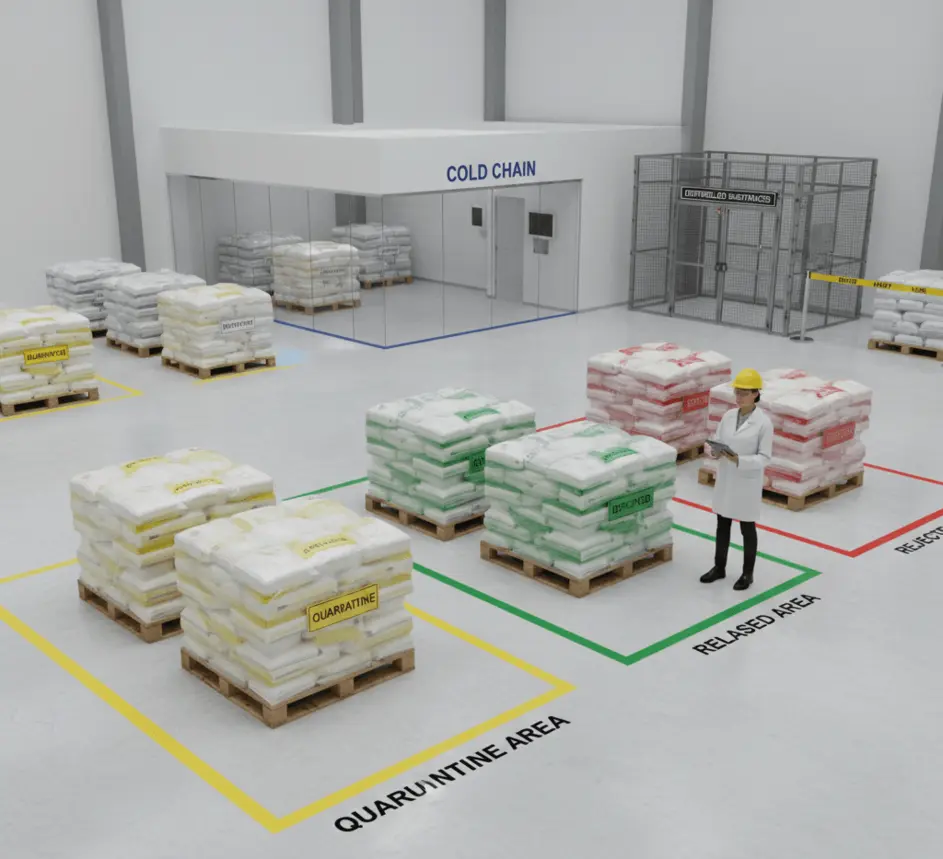
- QA disposition: released, on hold, rejected, or pending review.
- Use-by, best-before, retest, or internal shelf-life status according to the site’s inventory-control procedure.
- Packaging integrity, including damaged liners, broken seals, wet cartons, leakage, or evidence of contamination.
- Required storage condition and any available temperature or handling record for temperature-controlled materials.
- Allergen identity and segregation requirements.
- Certificate, test result, or other receiving documentation when the product program requires it.
Do not treat a material as acceptable merely because it is physically present at the line. Inventory systems, hold tags, pallet labels, and the batch record must agree. Any discrepancy should place the affected material on hold until it is resolved through the facility’s documented process.
3. Complete line clearance before materials are loaded
Line clearance confirms that remnants from the previous run cannot enter the next product. It is especially important at product changes, label changes, allergen changes, and after downtime.
Walk the full product and packaging path, not just the filler or wrapper. Include hoppers, conveyors, transfer points, rework containers, accumulation tables, printers, labelers, coding stations, case packers, and nearby staging areas.
A practical line-clearance check includes:
- Removal or controlled disposition of prior product, ingredients, rework, labels, cartons, inserts, film, and code information.
- Removal of old batch paperwork, sample containers, and temporary identification labels.
- Verification that bins, utensils, scoops, and hoses are correctly identified and suitable for the scheduled product.
- Confirmation that approved materials are the only materials at the active point of use.
- A second-person check where the food safety plan or site procedure requires independent verification.
Wrong-label incidents often begin with incomplete clearance rather than a printer malfunction. Treat changeovers as a controlled reset, not a quick cleanup between runs.
Source: oxmaint.ai
4. Reconcile packaging, labels, and printed materials
Packaging verification should use the approved specification or controlled sample, not memory. Compare the actual material at the line with the approved item number, revision, artwork, and product configuration.
Review primary and secondary packaging as applicable. For example, a pouch line may require verification of film, zipper configuration, label, shipping case, and pallet label; a tray-seal line may require tray, lidding film, label, carton, and case code checks.
Confirm:
- Correct packaging item and approved artwork revision.
- Correct ingredient statement, nutrition information, claims, and allergen declaration for the scheduled product.
- Correct package size, count, orientation, and pack configuration.
- Correct barcode or customer identification where required by specification.
- Reasonable material condition: no obvious damage, contamination, or mixed stock.
- Controlled quantity issuance, especially for labels and other printed packaging.
The line should not run if packaging information conflicts with the scheduled formula. For example, a product formula containing an allergen must not be packed in material that lacks the required declaration. Escalate such conflicts through the site’s label-control and food-safety procedures.
5. Perform packaging date code verification
Packaging date code verification should happen before routine production, using the site-approved code format and product-specific instruction. Check the setup at the printer, coder, laser marker, or thermal transfer unit, then inspect the code on actual production packaging at startup.
The startup check should verify, as applicable:
- Correct production date, best-before date, use-by date, lot code, shift identifier, and plant identifier.
- Correct code format, including order and punctuation where defined.
- Legibility, location, contrast, and permanence appropriate to the package and process.
- Correct coding on each package level that requires a code.
- Code information matches the batch and traceability record.
Date and lot codes are part of traceability, not just package appearance. A code that is readable but assigned to the wrong product or date is still a release failure.
6. Confirm pre-operational sanitation readiness
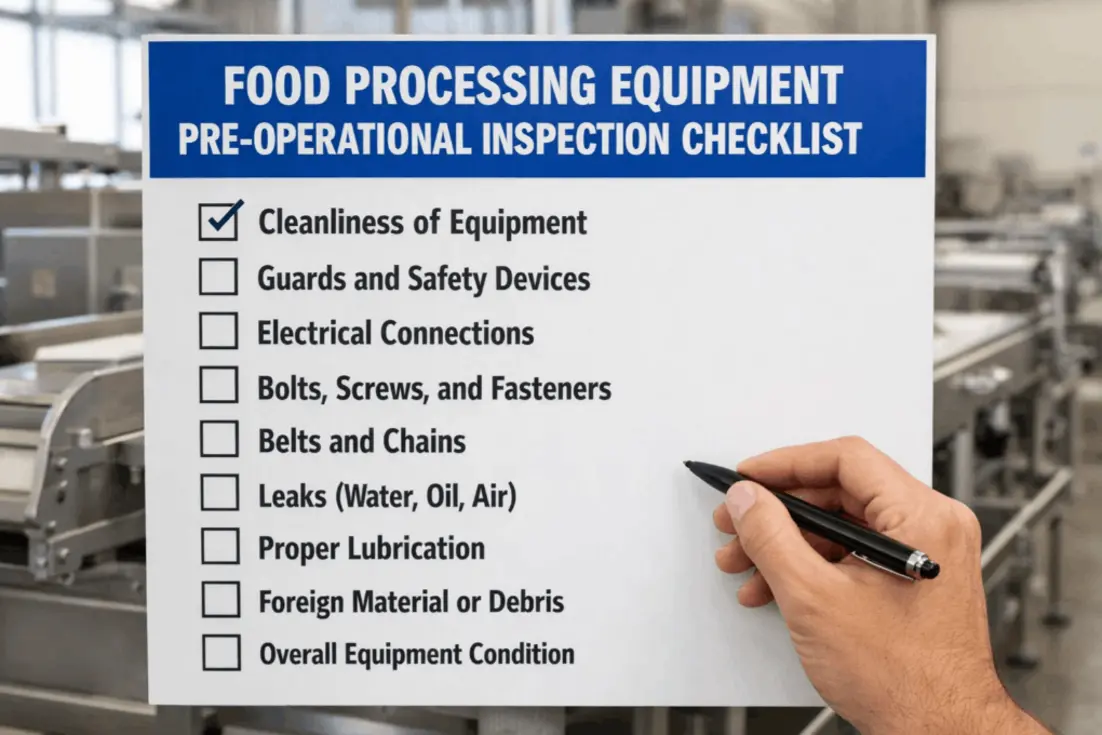
Pre-operational food safety checks begin with completed sanitation records. Verify that the sanitation team has completed its assigned work and that required sign-off is present before QA begins the line inspection.
SQF’s Food Manufacturing Code states that pre-operational inspections are to be conducted after cleaning and sanitation to confirm that processing areas, product-contact surfaces, equipment, amenities, sanitary facilities, and essential areas are clean before production begins. The inspection method, responsibility, and records should be defined in the facility program.
During the physical inspection, examine relevant areas for visible residues, standing water, chemical residue, damaged surfaces, improper reassembly, foreign-material risks, and evidence that the equipment is not ready for use. Focus on product-contact areas and difficult-to-clean points, such as belts, guides, hoppers, fillers, chutes, guards, seals, utensils, and drains near exposed product.
Where the facility uses ATP, allergen, microbiological, chemical, or other verification methods, follow the approved sampling plan and acceptance criteria. Do not substitute generic limits or frequencies for the facility’s validated sanitation and food-safety program.
7. Verify equipment, CCP, and process-control readiness
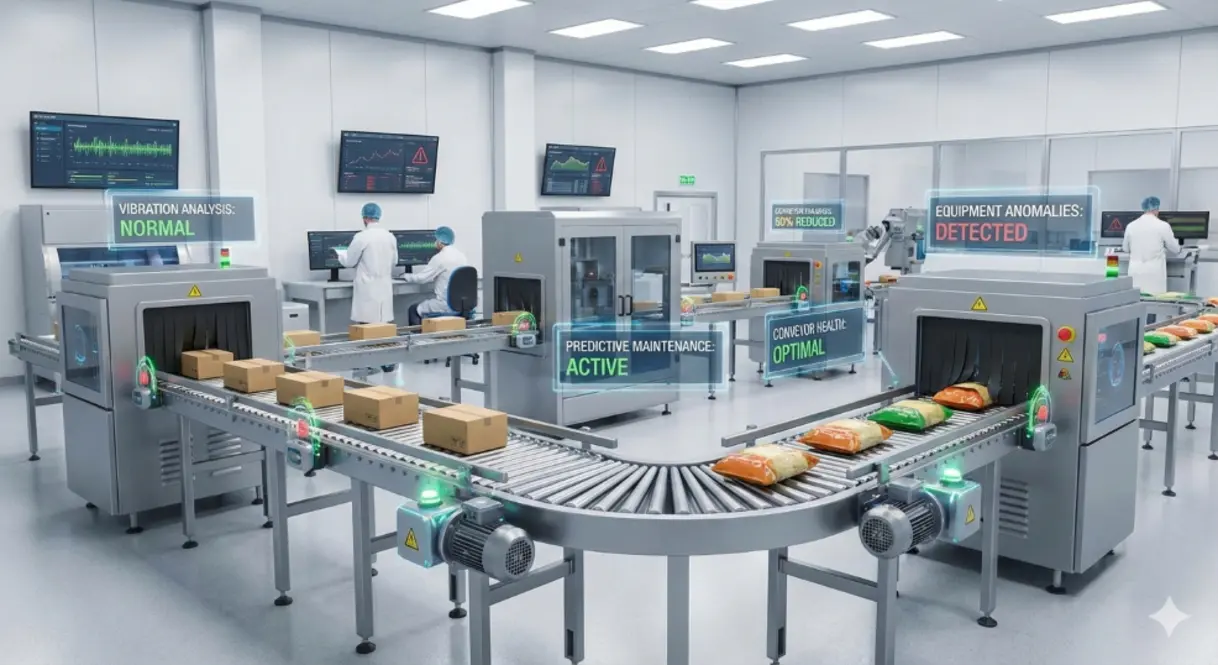
A clean line is not necessarily a ready line. Before release, confirm that the controls needed to make safe, conforming product are available and functional.
The exact checks depend on the process, but may include:
- Equipment assembled correctly, guards in place, and food-contact parts installed.
- Required preventive maintenance work completed or formally assessed for impact on the run.
- Instruments within their required calibration or verification status.
- Monitoring devices, checkweighers, metal detectors, vision systems, thermometers, or other controls ready for the scheduled product.
- Correct process settings loaded or available for authorized setup.
- CCP monitoring materials and deviation instructions available at the point of use.
- Rework status, identification, and permitted use confirmed before rework enters the line.
Only qualified personnel should adjust critical process settings or make decisions on control-system readiness. The checklist should point users to the applicable work instruction rather than attempting to replace it.
8. Document exceptions and make a clear release decision
The final section of the checklist should not allow ambiguous outcomes. Use a defined status such as:
| Release status | Meaning | Required action |
|---|---|---|
| Released | All required checks meet the approved criteria. | QA or authorized designee signs and production may start. |
| Released with documented condition | A non-food-safety condition is controlled under an approved procedure. | Record the condition, owner, deadline, and approval. |
| Hold / not released | One or more required checks fail or cannot be verified. | Prevent startup or isolate affected materials until disposition. |
Record the product, line, date, shift, batch or work order, names of people completing checks, observations, corrective actions, and final authorization. Electronic forms can improve visibility, but the control point is the release decision itself: an incomplete form must not become an informal approval to run.
Assign stop-start authority before the shift begins
The production startup QA inspection works only when operators understand who can stop the line and who can restart it. Define this in the procedure and train each shift accordingly.
As a practical rule, any person finding a potential food-safety, allergen, packaging, date-code, or traceability problem should be able to stop material from entering the process or prevent affected product from being released. Restart should require the responsible function to correct the issue and the designated authority to verify closure.
Avoid the common shortcut of correcting an issue verbally and starting production while paperwork is completed later. The record should show what failed, what was corrected, and who verified the correction before release.
Common pre-start failures and better controls
Checklist completed from a desk: Require a physical line walk and identify the inspected zones on the form.
Materials checked by description only: Use item numbers, lot numbers, status labels, and controlled batch documentation.
Date code approved from the machine screen: Verify the actual printed code on the actual package.
Prior packaging left “just in case”: Remove it from the line or place it under documented, segregated control.
Sanitation sign-off mistaken for QA verification: Treat sanitation completion and pre-op inspection as separate steps with defined responsibilities.
No defined restart after a hold: Include corrective-action verification and re-release requirements in the form.
A practical final release question
Before signing, ask one concise question: If this line starts now, can the facility demonstrate that it will make the intended product in the intended package, with correct identification and required controls in place?
If the answer is not clearly yes, the appropriate decision is hold, investigate, correct, and verify. That discipline makes the pre-production QA checklist a functioning operating control rather than a shift-start formality.
References
- Food Processing Equipment Pre-Operational Inspection Checklist. (n.d.). https://oxmaint.com/industries/food-manufacturing/food-processing-equipment-pre-operational-inspection-checklist
- Best Practices for Consistent Food Quality Assurance in Manufacturing. (n.d.). https://www.linkedin.com/pulse/best-practices-consistent-food-quality-assurance-manufacturing-ymyyc
- 11 Food Safety Forms Every Food Plant Must Have. (n.d.). https://safetychain.com/blog/11-food-safety-forms-every-food-plant-must-have
- The Ultimate 2026 Guide To Food Quality Assurance. (n.d.). https://foodtech.folio3.com/blog/ultimate-guide-to-food-quality-assurance
- How to Conduct a Pre-Op Inspection in Food Manufacturing?. (n.d.). https://sfpmfoodconsulting.com/how-to-conduct-a-pre-op-inspection-in-food-manufacturing
- Edition 9 - Food Safety Code: Food Manufacturing. (n.d.). https://www.sqfi.com/docs/sqfilibraries/code-documents/edition-9/code-pdfs/20227fmin_foodmanufacturing_v3-2-final-w-links.pdf
- 6 Steps to Ensure Correct Food Labeling & Prevent Recalls. (n.d.). https://fsns.com/6-steps-to-ensure-correct-product-labeling-and-prevent-recalls
- Performing The Pre-Operational Sanitation Standard Operating Procedures Verification Task - Revision 3 | Food Safety and Inspection Service. (n.d.). http://www.fsis.usda.gov/policy/fsis-directives/5000.4