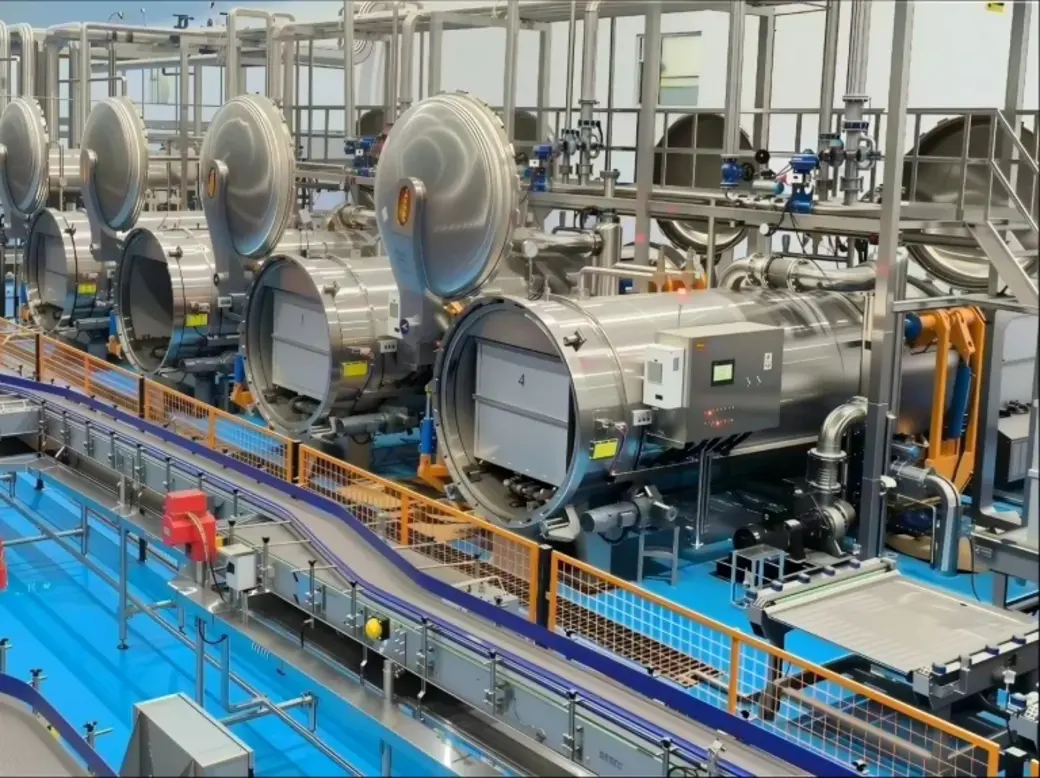
Retort pouch inflation during processing is often expected to some degree. As the sealed package heats, residual air, water vapor, and gases in the food expand, while the flexible pouch walls soften and move. The concern is not simply whether a pouch becomes fuller or rounded in the retort. The concern is whether pressure differential, filling conditions, pouch construction, seal performance, or loading practice allows that movement to damage the package or change the conditions on which the thermal process was validated.
A pouch that expands temporarily and remains intact may be behaving normally. A pouch that balloons excessively, shifts into an abnormal shape, leaks, develops seal channels, delaminates, or remains swollen after cooling needs investigation. Do not treat visibly abnormal post-process pouches as a cosmetic issue: container closure integrity and the scheduled thermal process are linked parts of shelf-stable product control.
Why retort pouches expand
A flexible pouch has little inherent rigidity. During heating, its internal pressure can rise because of several overlapping effects:
- Residual air expands. Air left in the headspace or trapped in product particulates increases in volume as it heats.
- Moisture produces vapor pressure. Product water and liquid in the headspace contribute to internal pressure at elevated process conditions.
- Dissolved or entrained gases may be released. Some products release gas as they warm, especially where mixing, pumping, filling, or ingredient structure has introduced air.
- The product itself expands. Sauces, particulates, fats, and liquids can change volume and redistribute within the pouch.
- The pouch laminate becomes more compliant. Heat can make the package more flexible, allowing internal pressure to reshape it.
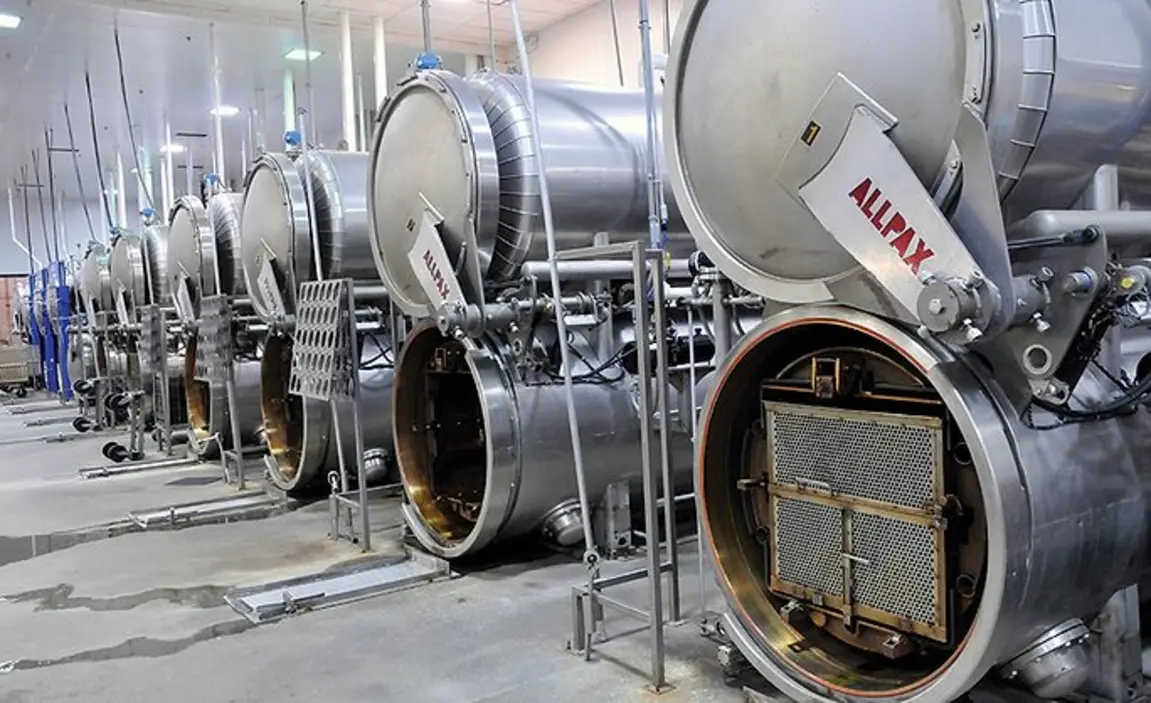
Commercial retort systems for flexible packages use a controlled external pressure environment to counter the pouch’s internal pressure. Depending on the retort design, this may involve steam-air, water spray, water immersion, or another overpressure method. The external pressure must be controlled as part of the validated process, not adjusted casually to correct a production symptom.
Normal pouch movement versus abnormal swelling
Pouch expansion during the heating portion of a cycle is not, by itself, proof of a faulty pouch. The more useful question is whether the pouch stays within the expected geometry and whether it returns to an acceptable condition after the complete heating, pressure, and cooling cycle.
| Observation | Likely interpretation | What to check |
|---|---|---|
| Moderate, consistent expansion across a properly restrained load | Often normal thermal response | Compare with established process observations and package specifications |
| A few pouches visibly larger than the rest | Potential fill, headspace, residual-air, or seal variation | Review fill weights, deaeration, sealing records, and pouch location in the load |
| Pouches crowding, folding sharply, or pressing against rack surfaces | Loading or restraint issue that can add mechanical stress | Inspect tray pattern, divider condition, rack compression, and product spacing |
| Wet pouches, product residue, or obvious loss of contents | Probable package or seal failure | Segregate affected product and investigate closure integrity and retort records |
| Persistent post-cooling swelling | May indicate gas generation, retained gas, or package failure; requires technical review | Hold product and involve qualified food safety and packaging personnel |
| Wrinkled seals, corner distortion, delamination, or channel-like defects | Potential loss of package integrity | Evaluate seal construction, contamination, thermal cycling, and handling damage |
A uniform change in pouch shape during processing can be acceptable when it is anticipated in package and process development. Isolated, severe, or repeatable abnormalities deserve a structured investigation.
The main causes of excessive retort pouch swelling
Too much residual air or unsuitable headspace
Residual air is a common driver of excessive pouch expansion. Air can remain because the pouch was not adequately evacuated, the filling system entrained air, the product foamed, or the seal was made before product and headspace stabilized. Headspace also needs to be controlled within the product’s approved packaging specification. Excessive headspace can increase package movement, while too little space can create different filling, sealing, and product-distribution problems.
Review the full filling sequence rather than focusing only on the vacuum setting. Check product temperature at filling, pump behavior, nozzle position, foaming, pouch presentation, settling time, and seal-jaw timing. A vacuum sealer can remove air effectively only when the pouch is presented consistently and the product does not interfere with evacuation or sealing.
Product in the seal area
Sauce, oil, particulates, fibers, starch residue, or moisture in the seal area can weaken or interrupt the closure. The pouch may appear sealed at ambient conditions but open or form a micro-channel under the combined effects of internal pressure, high temperature, and flexing.
Inspect seal contamination patterns closely. If failures cluster at the same side, corner, or fill level, examine pouch handling and filling alignment before assuming the laminate is defective. Seals near corners and transitions deserve particular attention because stress concentrates in these areas as the pouch expands.
Incorrect sealing conditions or worn sealing equipment
Sealing temperature, dwell, pressure, jaw alignment, cooling, and surface condition must suit the specific pouch structure. A setting that makes an acceptable-looking seal may not provide a robust closure through retort exposure. Worn covers, uneven jaws, poor pressure distribution, damaged cutters, and contamination on contact surfaces can create local weak points.
Verify settings against the pouch supplier’s approved operating window and the plant’s established sealing procedure. Any seal-setting change should be evaluated through the company’s package-quality and process-control system; it is not a simple production-line adjustment where retorted shelf-stable products are concerned.
Pouch structure not matched to the process
A retort pouch is a laminate system, not merely a bag. Its barrier layers, structural films, adhesives, sealant layer, gussets or fitments, and printing or overvarnish system all need to tolerate the defined process and distribution environment. A pouch designed for hot fill or pasteurization may not be suitable for a retort schedule.
Confirm that the exact pouch specification—including dimensions, seal geometry, laminate construction, and closure features—is approved for the intended process. Substituting a visually similar material, changing pouch width, or altering seal width can affect both mechanical behavior and heat penetration.
Insufficient external pressure or poor pressure control
Overpressure is used to balance pressure inside flexible packages during heating and cooling. If external pressure does not follow the established profile, pouches can over-expand, seals can be stressed, and the load can shift. Excessive external pressure can also damage pouches, restrict desired package geometry, or create handling issues.
Investigate retort pressure records, control response, air supply or water-system performance, valves, sensors, and the relationship between temperature and pressure during the full cycle. Only trained personnel working under the approved process should make changes to retort control parameters.
Rack loading, restraint, and product movement
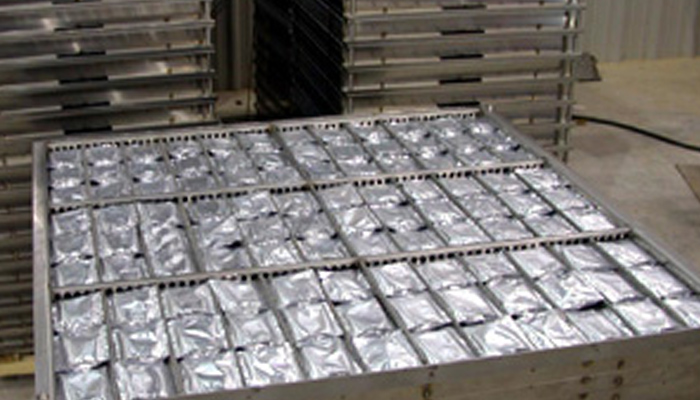
Flexible packages need a loading pattern that supports product circulation and limits damaging movement. Overfilled trays, inadequate dividers, poor rack compression, protruding hardware, sharp edges, and inconsistent pouch orientation can all create localized stress. A pouch that folds around a tray edge or rubs repeatedly against an adjacent pouch may emerge with damaged seals or abrasion.
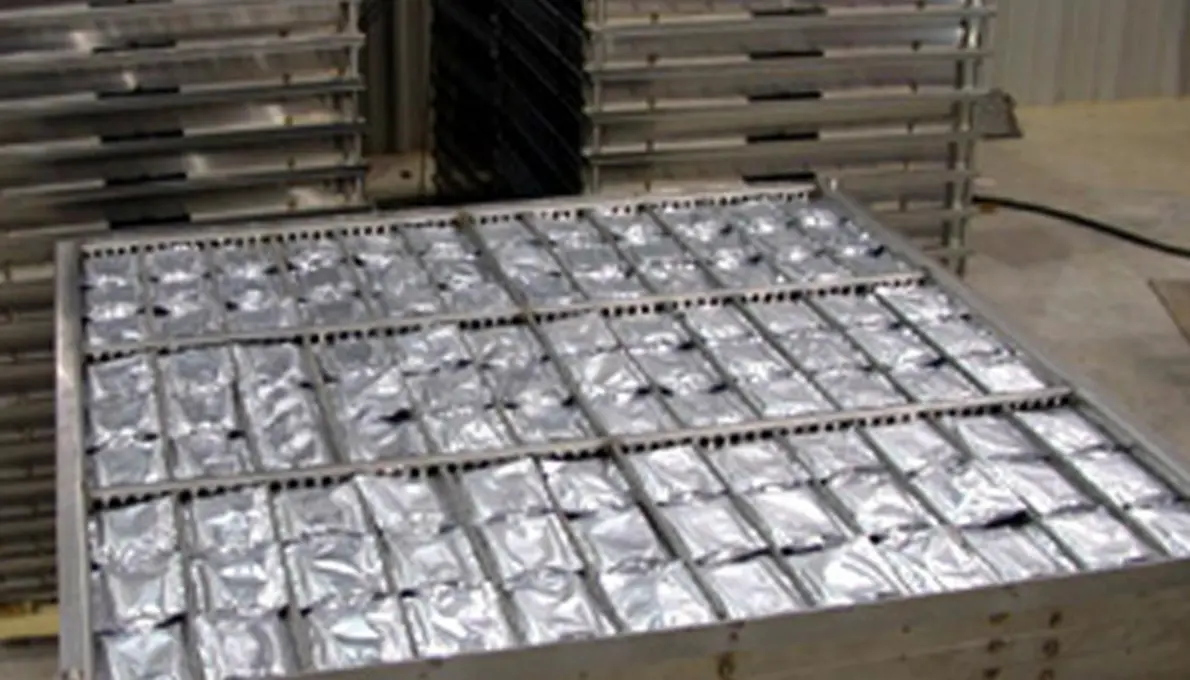
Source: retorts
Loading is also a thermal-process variable. A different tray count, pouch orientation, fill weight, rack arrangement, or restraint method can alter heating and cooling behavior. Do not assume that a mechanically convenient loading change is automatically equivalent to the validated load configuration.
A practical investigation sequence
When abnormal retort pouch swelling occurs, work from containment and evidence toward root cause.
- Hold and identify affected production. Follow the plant’s established deviation and product-disposition procedure. Do not release questionable shelf-stable product based on visual inspection alone.
- Document the pattern. Record pouch format, lot, line, retort, basket or rack position, tray level, product code, fill condition, and defect location. Determine whether the problem is random or concentrated.
- Separate pre-retort from post-retort evidence. Review retained pre-process samples where available. Determine whether pouches were already overfilled, poorly evacuated, contaminated in the seal area, or visibly distorted before processing.
- Review filling and sealing controls. Examine fill-weight trends, product temperature, foam, residual-air controls, seal-jaw condition, and seal checks.
- Review retort records and loading practice. Compare actual cycle records, pressure behavior, cooling conditions, and rack configuration with the scheduled process and approved operating instructions.
- Evaluate package integrity with appropriate methods. Use the plant’s approved seal-strength, leak, burst, visual, dye-penetration, vacuum-decay, or other validated test methods as applicable. A qualified packaging specialist should interpret results in context.
- Escalate process deviations. If pouch behavior could affect commercial sterility, closure integrity, or heat penetration, involve the process authority, quality leadership, and relevant technical personnel before restarting or releasing product.
Cooling can create a second package-integrity challenge
The package does not stop being vulnerable when heating ends. During cooling, internal pressure falls as the product and headspace cool. External pressure must be reduced in a controlled manner consistent with the scheduled process and equipment design. An unsuitable pressure transition can stress seals and laminate bonds in the opposite direction from heating.
Cooling water quality and post-process handling also matter. Pouches with compromised seals can be vulnerable to contamination pathways during or after cooling. Plants should verify their cooling-water controls, container-handling practices, and closure-integrity program against applicable regulatory requirements and the recommendations of their process authority.
Why inflation matters to thermal process validation
The validated process is tied to a specific product, package, fill condition, retort system, and loading arrangement. Heat penetration can differ with pouch thickness, fill weight, product consistency, orientation, headspace, and how pouches are compressed or spaced in a rack.
For example, a high-viscosity product may heat differently from a free-flowing broth, and a pouch with changed fill depth may have a different cold spot. If swelling causes packages to change shape or stack differently, it can also affect heat transfer through the load. That is why package behavior should be considered during temperature-distribution and heat-penetration work, rather than addressed solely as a packaging-line defect.
For low-acid canned foods in the United States, processors are generally expected to operate according to a scheduled process with identified critical factors. The applicable regulatory obligations, filing requirements, records, and deviation handling should be confirmed with qualified regulatory and process-authority resources for the product and market involved.
Prevention checklist
- Use only the approved retortable pouch specification and closure configuration.
- Control fill weight, product temperature, foam, and residual air within established limits.
- Keep product and contamination out of the seal area.
- Maintain seal jaws, pressure surfaces, cutters, and pouch-guiding components.
- Confirm pouch orientation, tray pattern, dividers, and rack restraint at every relevant changeover.
- Inspect trays, racks, and handling systems for sharp edges, abrasion points, and damaged components.
- Trend post-retort package defects by line, pouch lot, retort, and load location.
- Treat changes in pouch dimensions, laminate, fill profile, product formulation, or loading arrangement as potential validation questions.
- Review abnormal swelling with packaging, quality, and thermal-process personnel before making retort-control changes.
Retort pouch swelling is best managed as an interaction between product, package, filling, sealing, retort pressure, rack loading, cooling, and process validation. A stable operation does not require pouches to remain perfectly flat throughout the cycle. It requires their movement to stay within the behavior anticipated by the approved package system and validated process.
References
- Overview of Retort Pouch Technology | PDF | Pressure Cooking | Sterilization (Microbiology). (n.d.). https://www.scribd.com/document/123271720/Introduction-to-Retort-Pouch-Technology
- Food Lab Autoclave Sterilization: Retort Process Validation for Shelf-Stable and Canned Products | Lab Manager. (n.d.). https://www.labmanager.com/food-lab-autoclave-sterilization-retort-process-validation-for-shelf-stable-and-canned-products-35567
- Retort Pouch Leak Testing: Post-Process Seal Verification. (n.d.). https://flexpakinc.com/retort-pouch-leak-testing
- Retort Packaging: Pouches Vs. Cans, Materials, Seal Integrity, And Real-World Failures | 2026. (n.d.). https://agristuff.com/food-industry/retort-packaging-pouches-vs-cans-materials-seal-integrity-and-real-world-failures
- Retort Processing: Thermal Sterilization For Shelf-Stable Meals (U.S. Standards) | 2026. (n.d.). https://agristuff.com/food-industry/retort-processing-thermal-sterilization-for-shelf-stable-meals-u-s-standards
- Commercial Sterilization Thermal Processing for Retorts. (n.d.). https://www.retorts.com/white-papers/retort-temperature-distribution-and-container-heat-penetration-testing
- Retort Pouch Principles and Applications: A Practical Guide for Shelf-Stable Food Brands. (n.d.). https://www.ldpack.com/article/principles-and-applications-of-retort-pouch.html
- L-10-Retort-pouch-processing-Autosaved.pdf. (n.d.). https://www.slideshare.net/slideshow/l-10-retort-pouch-processing-autosaved-pdf/277277488