A reusable no-rinse sanitizer solution can be used again only when the specific product label permits reuse and the solution continues to meet its labeled use conditions. In beverage production, that means more than keeping a bucket or tank from looking dirty: staff must verify the correct concentration with the appropriate test method, prevent soil and chemical contamination, achieve the labeled contact time on a pre-cleaned surface, and follow the product’s storage and discard instructions.
The practical rule is simple: do not reuse sanitizer based on age, appearance, or habit alone. Reuse is a controlled process. If the label does not authorize holding or reuse, if the solution cannot be tested correctly, or if the solution has been contaminated or is outside its specified conditions, replace it.
Start with the distinction: cleaning is not sanitizing
Cleaning removes product residue, soil, sugars, proteins, oils, yeast, mineral scale, and other material from equipment surfaces. Sanitizing is a separate step intended to reduce microorganisms on an already clean food-contact surface.
A no-rinse claim does not mean a sanitizer can be applied over beverage residue, foam, biofilm, or an incomplete cleaning cycle. It means that, when the product is used exactly as its food-contact directions specify, a potable-water rinse after sanitizing is not required. The label remains the controlling document for dilution, permitted surfaces, application method, contact time, water conditions, temperature limits, and any draining or air-drying instruction.
For beverage lines, this distinction is especially important around fillers, transfer hoses, valves, gaskets, carbonation equipment, tanks, sample ports, and removable small parts. Sanitizer cannot reliably compensate for a failed cleaning step.
Define whether the solution is actually reusable
Before building a sanitation SOP around reuse, review the current product label and technical documentation with the chemical supplier or sanitation provider. Confirm these points:
- The product is authorized for food-contact surface sanitizing without a rinse at the intended dilution.
- The label allows prepared solution to be held or reused for the intended application.
- The solution has a stated use concentration or acceptable concentration range.
- A suitable test strip, titration kit, meter, or other verification method is available for that sanitizer chemistry.
- The label identifies required contact time and any temperature, pH, water-hardness, or soil-load limitations.
- The intended application method is covered, such as immersion, circulation, spray, foam, or wiping.
- The product has clear storage, disposal, and incompatibility instructions.
Do not transfer rules from one sanitizer type to another. Chlorine-based products, iodine sanitizers, quaternary ammonium compounds, acid sanitizers, and alcohol-based ready-to-use products can have different verification methods, material-compatibility concerns, and use directions. A reading method designed for one chemistry may be unsuitable for another.
A workable process for reusable sanitizer management
A beverage plant can manage reusable solutions through six controlled stages: mix, identify, hold, verify, use, document, and discard.
1. Mix from a defined recipe
Prepare the sanitizer only from the product’s current directions for use. Use clean measuring tools, an appropriate container, and the water quality specified by the supplier. If an automated chemical dispenser is used, include the dispenser’s setup and calibration in the sanitation program rather than assuming it always delivers the intended dilution.
Use a dedicated, clean vessel. A container that previously held detergent, caustic, acid, lubricant, or another sanitizer may create a chemical incompatibility or invalidate the prepared solution. Never mix products unless the manufacturer explicitly instructs it.
Mix enough solution for the planned task, not simply enough to fill the largest available vessel. Smaller, controlled batches can reduce waste and make replacement easier when a solution fails verification.
2. Label the working solution immediately
Every prepared container should be identifiable without relying on operator memory. At minimum, the label or attached tag should include:
- Product name and sanitizer chemistry
- Intended concentration or label dilution reference
- Date and time prepared
- Initials or name of the person who prepared it
- Assigned use area or equipment group
- Required test method
- Required contact time reference
- Expiry, change-out, or discard instruction from the label or site SOP
Use closed or covered containers where practical and compatible with the task. This helps prevent dilution from accidental water addition, contamination from dust or debris, and confusion with other chemicals.
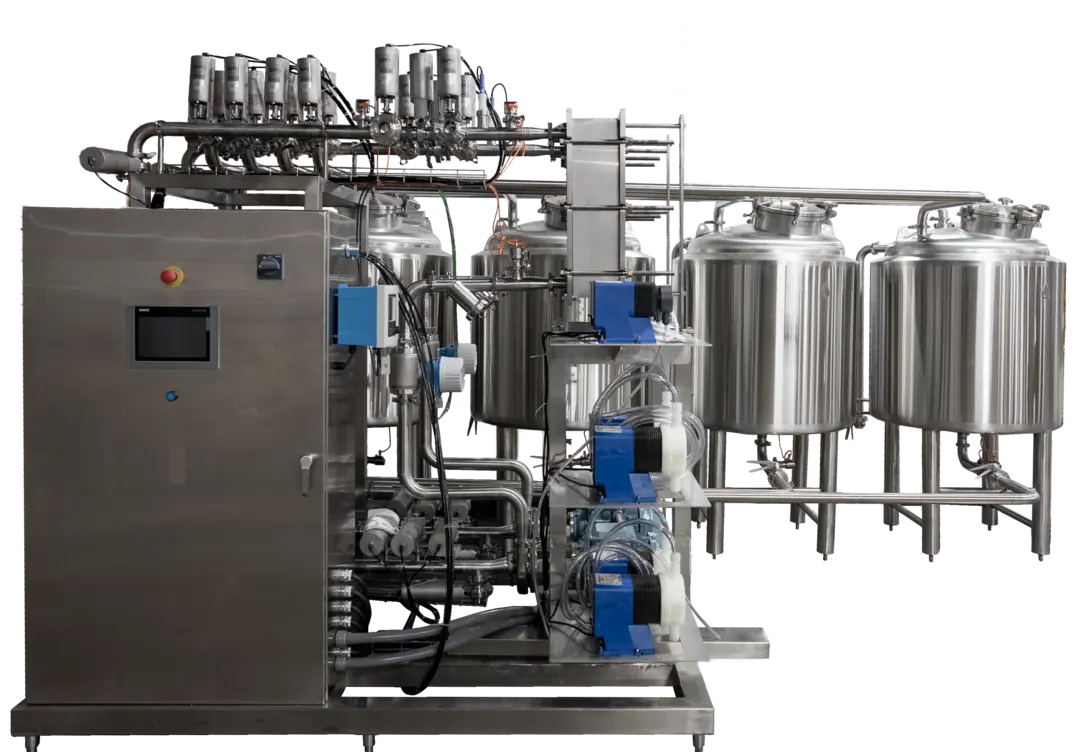
Source: onfocussolutions
3. Store it so its condition can be controlled
Sanitizer solution storage is not merely a housekeeping issue. Storage conditions can affect concentration, contamination risk, employee safety, and traceability.
Keep working solutions in compatible containers, away from food, ingredients, packaging, and open product. Store them separately from incompatible chemicals and out of direct conditions that the manufacturer identifies as unsuitable. Do not use unlabeled spray bottles, open pails left on the floor, or containers that are difficult to clean.
For recirculated or soak solutions, consider the whole system: return lines, tank lids, pumps, screens, fittings, and dead legs can introduce residue into the sanitizer. If the equipment cannot be kept clean between uses, the solution’s reuse window may be too difficult to control operationally.
4. Verify concentration before use—and as the SOP requires
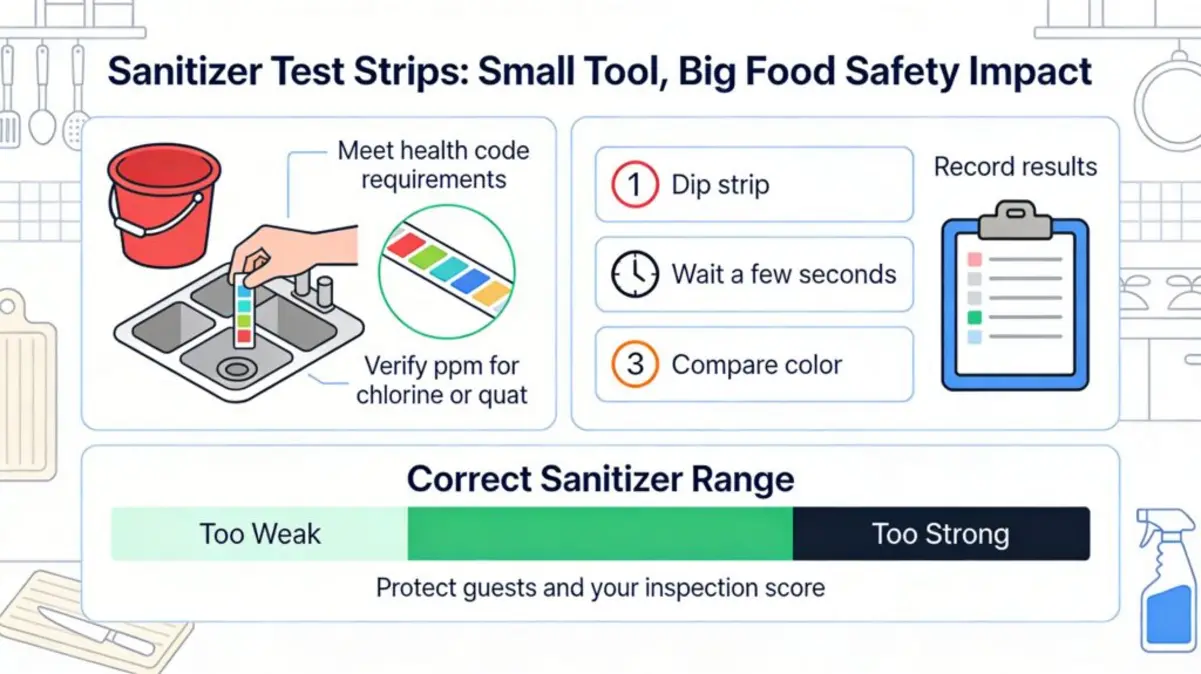
Sanitizer concentration verification is the central control for reuse. A prepared solution may lose effectiveness through dilution, carryover of rinse water, soil loading, evaporation, chemical breakdown, or repeated exposure to equipment surfaces.
Use the test device specified or approved for the sanitizer chemistry. Follow its directions carefully, including sample collection, immersion time, color comparison, lighting, shelf life, and storage of the test materials. Expired, wet, contaminated, or improperly stored test strips may produce unreliable results.
A sound verification routine typically includes:
- Test a freshly mixed batch before it enters service.
- Test before each later use of a held or reused solution.
- Test at defined intervals during extended use, circulation, or shift work.
- Test after any event likely to change the solution, such as substantial water carryover, visible soil entry, top-up, accidental dilution, or a long idle period.
- Record the result and the action taken if it is outside the acceptable labeled range.
If a reading is outside the approved range, do not guess by adding more chemical or water unless the product directions and site procedure specifically allow correction and subsequent retesting. In many operations, the safer and clearer response is to discard the batch, clean the vessel if needed, prepare a new solution, and verify it before use.
5. Apply it to clean surfaces for the full required contact time
The sanitizer must reach all intended food-contact surfaces and remain there for the stated contact time. For spray applications, that usually means the surface stays visibly wet for the full period. For immersion or circulation, the relevant surfaces must remain fully exposed for the specified time.
Draining and air-drying procedures matter. Do not wipe a sanitizer off early unless the label specifically allows that technique. Likewise, do not rinse a no-rinse sanitizer after use unless the product directions or a validated site requirement calls for it; an unnecessary rinse can reintroduce contamination or undermine the intended process.
Pay particular attention to difficult-to-reach areas: filler bowls, nozzles, valve seats, hose ends, pump housings, couplings, gaskets, spray balls, and removable fittings. Equipment design, disassembly practices, and cleaning access determine whether sanitation is repeatable.
6. Discard based on verification and condition, not just the clock
A defined maximum hold time may be part of the product label or plant SOP, but elapsed time is not the only discard trigger. Replace a reusable no-rinse sanitizer solution when:
- Testing shows concentration outside the approved range.
- The solution is visibly dirty, cloudy, or contains product residue or foreign material.
- It has been used on inadequately cleaned equipment.
- It has been cross-contaminated by another chemical or by unknown material.
- Its identity, preparation time, or test history cannot be confirmed.
- The maximum permitted storage or use period has been reached.
- The container, recirculation loop, or application equipment cannot be adequately cleaned.
Dispose of spent solution according to the product label, safety documentation, local wastewater requirements, and facility procedures. Never discharge chemicals simply because they are food-contact sanitizers; use approval for food-contact surfaces does not replace disposal requirements.
A concise sanitation log that supports control
The record should be easy enough to complete consistently. A useful log may include the date, area or equipment, sanitizer product, batch or lot reference where applicable, preparation time, target concentration, actual test result, test method, contact-time reference, operator initials, and corrective action.
For recirculated sanitizer, add the start and end time of use, any additions or adjustments, and each verification point. Review logs routinely for recurring failures. Frequent low readings may indicate excessive rinse-water carryover, a dosing problem, a leaking connection, poor container control, or an unrealistic reuse practice.
Common mistakes to avoid
Treating no-rinse as no-clean. Sanitizer is applied after effective cleaning, not instead of cleaning.
Using the wrong test strip. Verification tools must match the sanitizer chemistry and intended concentration range.
Topping up without control. Adding chemical or water to an old solution can create an unknown concentration unless the approved procedure specifies how to adjust and retest it.
Relying on smell, color, or clear appearance. These observations may reveal obvious contamination, but they do not establish active concentration.
Using one bucket across unrelated zones. A shared solution can transfer soil, allergens, or microorganisms between tasks. Assign solutions and tools to defined areas where the sanitation plan requires separation.
Assuming a supplier’s general recommendation overrides the label. The EPA-registered label and the facility’s approved procedures govern use. Obtain written clarification when instructions are unclear.
Practical decision rule for small beverage operations
Reuse is most defensible when the solution is made in a clean, labeled vessel; used only on properly cleaned equipment; protected from contamination; tested with the correct method before use; kept within all labeled limits; and documented by trained staff.
If any one of those controls is missing, a fresh batch is usually the more reliable operating choice. The cost of replacing sanitizer is typically easier to manage than the uncertainty created by an unverified or contaminated solution.
References
- Food Safe Sanitizer: Cleaning Food-Safe Bottles. (n.d.). https://www.restaurantware.com/blogs/kitchen-and-cooking-tips/choosing_the_right_cleaning_solutions_for_food-safe_bottles
- Food Processing Sanitizers. (n.d.). https://d2sanitizers.com/industries/food-processing
- No-Rinse Sanitizing Products, EPA Registered - Sani Professional. (n.d.). https://saniprofessional.com/category/products/no-rinse-sanitizing-products
- Commercial Sanitizers | EPA Registered | Southland. (n.d.). https://southlandorganics.com/products/sanitizers
- PRIA Label and CSF Amendment. (n.d.). https://www3.epa.gov/pesticides/chem_search/ppls/001677-00259-20260513.pdf
- Requirements for Surface Sanitizers to be FDA Food Code …. (n.d.). https://www.gojo.com/-/media/GOJO-Site/Industries/Foodservice/Files-1/Food-Code-Technical-Bulletin-FDA-Food-Code.pdf
- Sanitizers and Disinfectants: A Retail …. (n.d.). https://www.foodprotection.org/members/fpt-archive-articles/2021-05-sanitizers-and-disinfectants-a-retail-food-and-foodservice-perspective
- Content and Format of Premarket Notification [510(k)] Submissions for Liquid Chemical Sterilants/High Level Disinfectants - Guidance for Industry and FDA Reviewers | FDA. (n.d.). https://www.fda.gov/regulatory-information/search-fda-guidance-documents/content-and-format-premarket-notification-510k-submissions-liquid-chemical-sterilantshigh-level