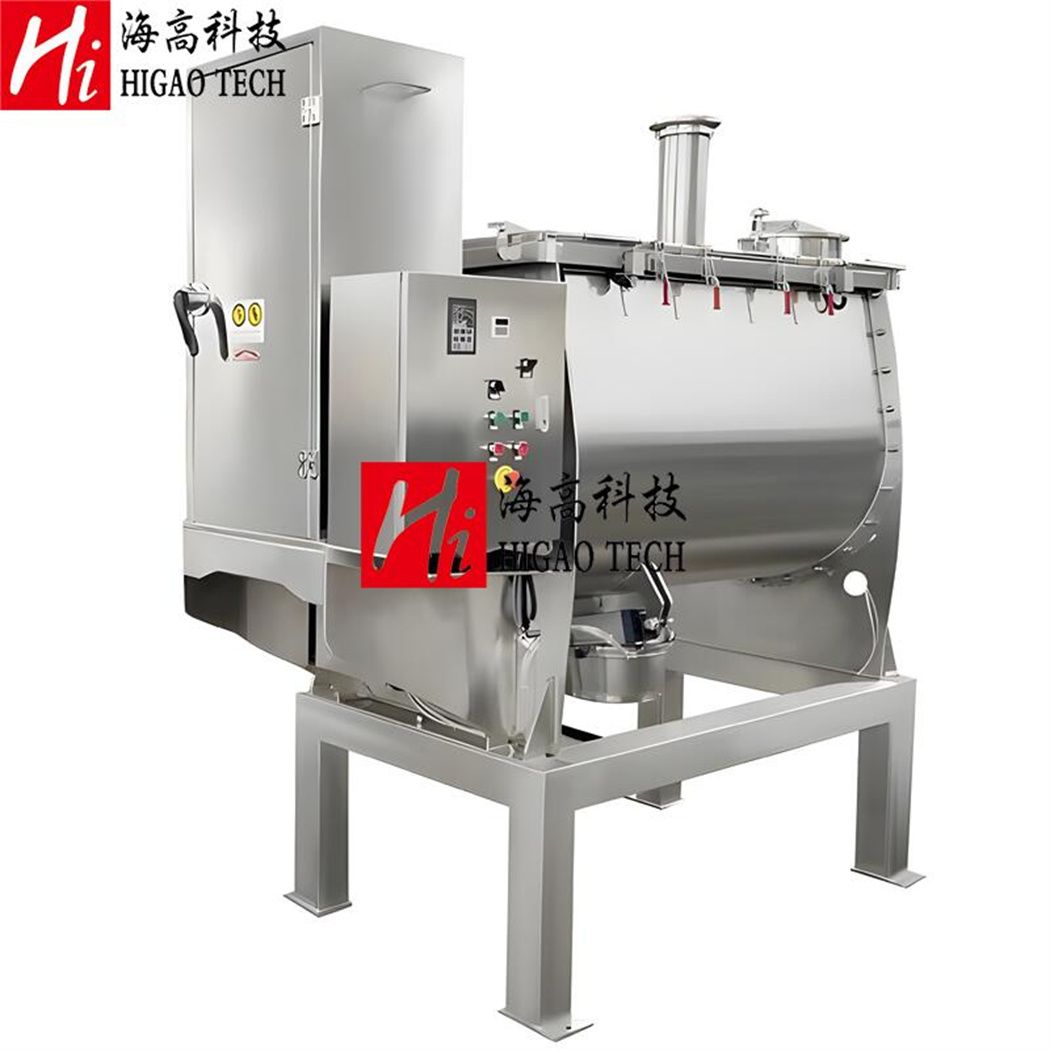
A ribbon blender is usually the practical starting point for large, free-flowing food powder batches that need fast, economical blending. A paddle mixer is often the better choice when the recipe contains fragile inclusions, uneven particle sizes or densities, light agglomerates, or ingredients that must be mixed with less compression and shear.
The right answer in a ribbon blender vs paddle mixer decision depends less on the product name than on how the individual ingredients behave. Flour, seasoning, sugar, starch, protein powder, cereal pieces, dried vegetables, nuts, and minor ingredients can all create different mixing and discharge problems. A trial using the actual formula remains the most reliable way to confirm blend uniformity, particle damage, cleanout, and cycle time before purchase.
The core difference: how each mixer moves product
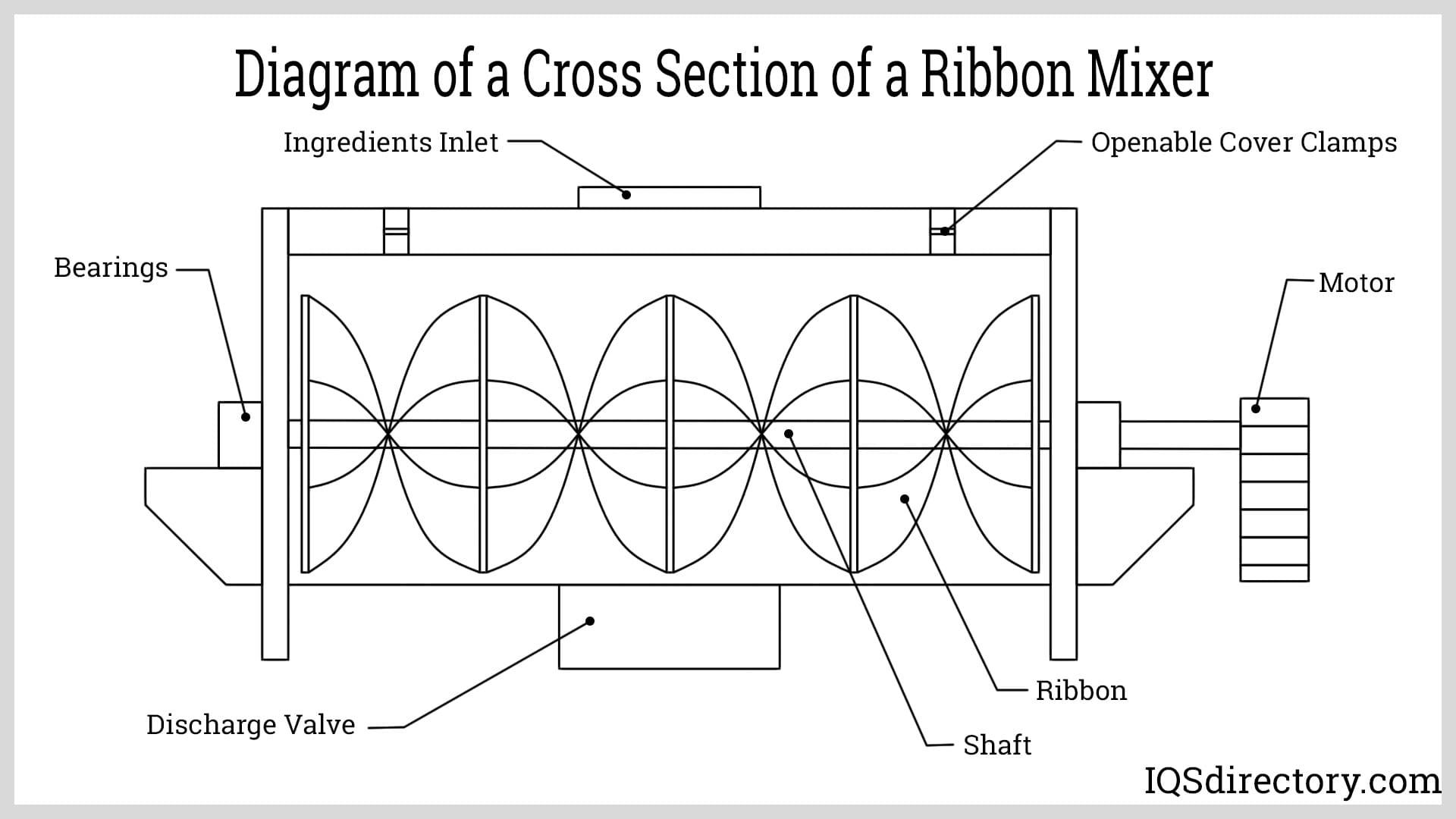
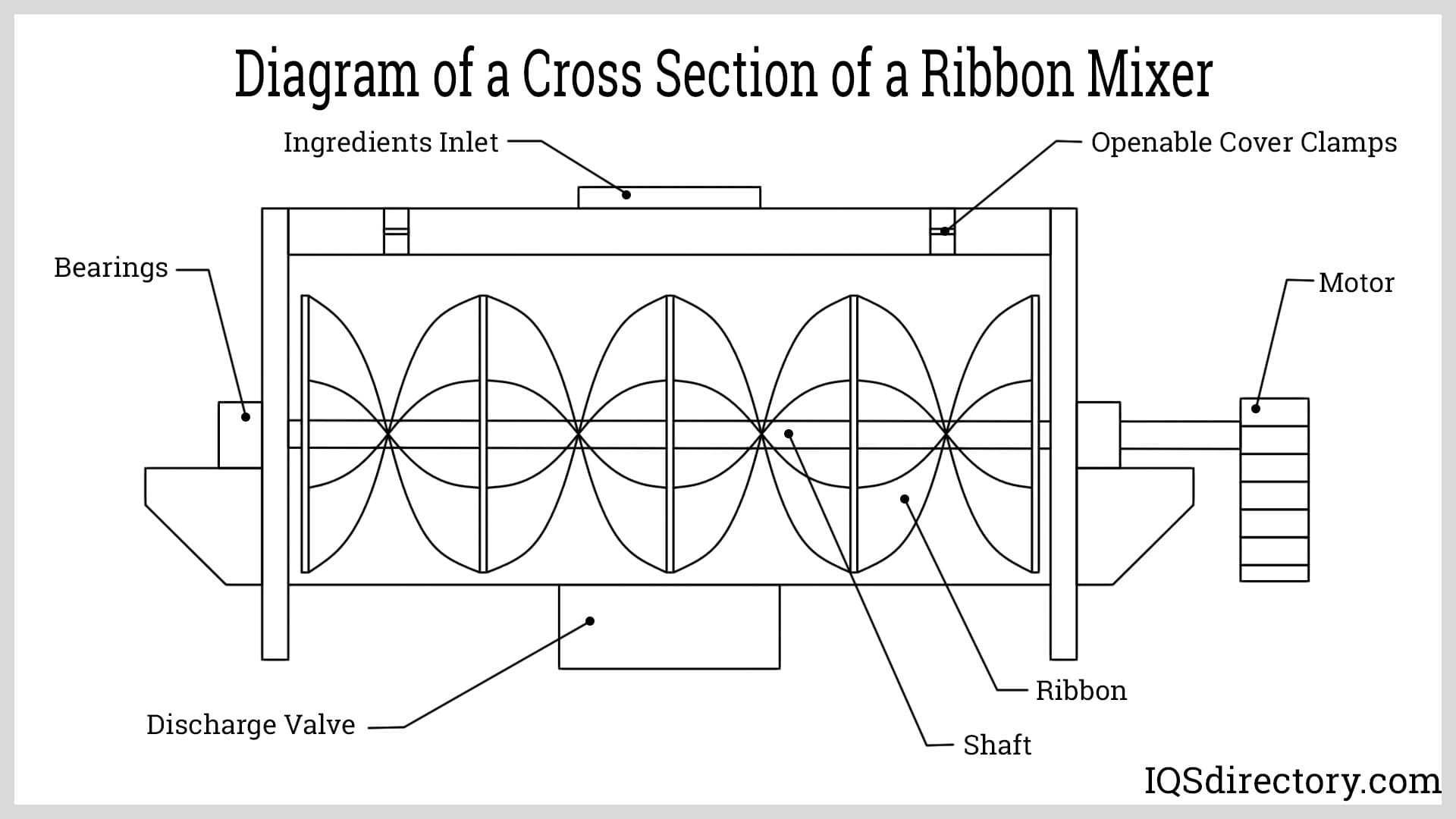
Both machines are generally horizontal batch mixers with a U-shaped or similar trough, a central shaft, a drive, end seals, a cover, and one or more bottom discharge outlets. Their agitators create different product movement.
A ribbon blender uses one or more helical ribbons. Inner and outer ribbons typically move material in opposing axial directions while also lifting and folding it through the batch. This produces strong convective mixing and rapid turnover in conventional dry powder blends.
A paddle mixer uses spaced paddles on a shaft. The paddles lift, toss, and tumble the ingredients through a more open mixing zone. The action can create a fluidized, three-dimensional movement that is often gentler on friable pieces and more accommodating of recipes with differing particle properties.
Source: iqsdirectory
Ribbon blender vs paddle mixer at a glance
| Selection factor | Ribbon blender | Paddle mixer |
|---|---|---|
| Primary mixing action | Folding, conveying, and convective turnover | Lifting, tumbling, and fluidizing movement |
| Typical strength | Fast blending of many standard free-flowing powders | Gentle treatment of sensitive, irregular, or mixed-density ingredients |
| Shear and compression | Can be higher, especially in tighter product zones | Usually lower and more open in its product movement |
| Fragile inclusions | May cause attrition or breakage depending on the product | Often preferred when pieces must retain shape |
| Standard high-volume powder batches | Common choice | Possible, but must be assessed against required cycle time and fill range |
| Sticky or lightly moist components | Can become difficult if material adheres to ribbons or trough surfaces | Often more forgiving, though product testing is still needed |
| Cleanout | Depends heavily on trough geometry, seals, discharge design, and access | Depends heavily on paddle geometry, seals, discharge design, and access |
| Recipe flexibility | Best when products have similar, predictable behavior | Often useful across a wider range of ingredient shapes and fill conditions |
The table describes general tendencies, not guaranteed outcomes. Agitator geometry, shaft speed, clearance, vessel shape, discharge valve design, and the specific formula can change performance substantially.
When a ribbon blender is the better fit
A ribbon blender is often well suited to dry, relatively free-flowing materials with compatible particle sizes and densities. Typical examples can include flour-based blends, dry soup or sauce bases, bakery premixes, beverage powders, seasoning carriers, starch blends, and similar formulations where ingredient integrity is not easily affected by the mixing action.
Its main operational advantage is efficient bulk turnover. For a processor making repeated batches of a stable formula, this can support short blend cycles and straightforward production scheduling. Ribbon blenders are also widely available in large working volumes, which can make them attractive where batch size is a primary requirement.
Choose a ribbon blender carefully, however, when the recipe includes components that can smear, compress, fracture, or segregate. Delicate flakes, puffed products, coated pieces, dried herbs, inclusions with weak structure, and ingredients with substantially different bulk densities may not respond well to an aggressive mixing pattern. The concern is not simply visible breakage: fines generated during blending can alter appearance, dust behavior, downstream filling, and final texture.
A ribbon design can also be less forgiving when a formula has cohesive material or small additions of oil, syrup, or other liquids that form localized lumps. Some such applications can work well with a suitable design and process sequence, but they should be validated rather than assumed.
When a paddle mixer is the better fit
A paddle mixer is commonly considered when protecting the product is as important as reaching a uniform blend quickly. Its lifting and tumbling action can be useful for formulas containing fragile ingredients, irregular particles, or components that differ in size and density.
Examples may include grain blends, granola-style mixtures, spice blends containing leafy herbs, dry mixes with dehydrated vegetable pieces, cereal inclusions, nuts, coated particles, and dry products receiving a modest liquid addition. Paddle mixers are also often considered for recipes that change frequently, because the open mixing action may accommodate a broader range of product behaviors.
That does not mean a paddle mixer is automatically the gentlest solution in every case. Paddle tip speed, paddle angle, shaft arrangement, fill level, and residence time still affect attrition. A long cycle can damage a delicate inclusion even in a low-shear mixer. Conversely, a properly configured ribbon blender may perform acceptably for a product that initially appears sensitive.
For processors adding a liquid binder, flavor, oil, or color, the key question is whether the system distributes liquid evenly without making persistent wet clumps or leaving coated buildup in difficult-to-clean locations. The liquid addition method, spray coverage, and loading sequence can matter as much as the agitator style.
Blend consistency: look beyond mixing time
It is tempting to compare mixers only by stated blend time. That can lead to an expensive mistake. A short cycle is valuable only if it produces a consistent batch without damage, segregation, or carryover.
Assess consistency at three points:
- After mixing: Take representative samples from multiple parts of the batch, using a sampling plan that fits the product and operation.
- During discharge: Check whether the composition remains consistent from the beginning to the end of the discharge. Some products can segregate after appearing uniform in the mixer.
- After downstream handling: Conveying, screening, storage hoppers, and filling can undo a satisfactory mixer result, particularly with broad particle-size distributions.
Minor ingredients deserve special attention. Vitamins, colors, flavors, salt, spices, sweeteners, and other low-inclusion components may need preblending with a carrier before the main batch. Neither a ribbon blender nor a paddle mixer eliminates the need for a sound addition strategy.
Fill level and batch range matter
Every horizontal mixer has a practical operating range. Underfilling can reduce the interaction between product and agitator. Overfilling can limit the free movement needed for efficient blending, increase load on the drive, and make discharge less predictable.
A processor should define more than its nominal batch size. Document the smallest likely batch, the routine batch, and the largest planned batch. This is especially important for co-manufacturers and plants with many stock-keeping units. A mixer that performs well at one fill level may not deliver the same result at another.
Ask suppliers to explain the usable working-volume range for the proposed configuration and to demonstrate performance at realistic batch sizes. Also consider whether future formulas will be materially lighter, denser, more cohesive, or more fragile than the initial product.
Discharge and cleanability can decide the purchase
Mixing performance is only part of food mixer selection. A blender that leaves a heel of retained product, traps material around seals, or takes too long to clean can create avoidable yield loss and changeover delays.
Review these details in the machine design:
- Bottom outlet size, location, and valve geometry
- Residual product left after normal discharge
- Accessibility of the trough, agitator, cover, and outlet for inspection and cleaning
- Shaft seal arrangement and ability to inspect seal areas
- Internal ledges, fasteners, gaps, and other potential product-retention points
- Suitability for the plant’s dry-cleaning or wet-cleaning method
- Whether dismantling is required for the intended sanitation procedure
- Controls and interlocks needed to prevent operation during access or cleaning
For allergen changeovers, sanitation expectations should be established with the plant’s food-safety team before equipment selection. Verify that the proposed design, cleaning method, validation approach, and production schedule are compatible. Do not rely on a general claim that a mixer is “easy to clean” without examining the actual product-contact geometry and access points.
A practical selection checklist
Before choosing between a ribbon blender and a paddle mixer, prepare a product and process brief covering:
- Ingredient list, including particle size, shape, bulk density, moisture behavior, and any fragile components.
- Target batch sizes and expected operating fill range.
- Required blend consistency and the method used to verify it.
- Maximum acceptable particle breakage, fines generation, or agglomerate formation.
- Minor-ingredient addition points and any required preblend step.
- Liquid addition requirements, if applicable, including application method and cleanup implications.
- Discharge destination, such as a tote, conveyor, hopper, or packaging system.
- Changeover frequency, allergen segregation requirements, and available cleaning method.
- Available floor space, loading arrangement, dust collection, and maintenance access.
- A representative production trial that includes mixing, discharge, and cleaning assessment.
Common selection mistakes
The first mistake is selecting on capacity alone. A large ribbon blender may meet a throughput target but be unsuitable for a formula with brittle inclusions. A paddle mixer may protect those inclusions but not provide the desired cycle time for a simple, high-volume powder blend.
The second is evaluating only the finished blend in the trough. Product behavior during discharge and packaging can reveal segregation that was not obvious during mixing.
The third is treating cleanability as a secondary feature. In food production, retained material, difficult access, and lengthy changeovers can affect usable uptime more than a modest difference in mixing speed.
The fourth is skipping a representative trial. Use the intended formulation where possible, include the real loading sequence, run the expected fill level, and inspect the product after discharge. If liquid addition or delicate inclusions are part of the process, they should be included in the evaluation.
Bottom line
For conventional, free-flowing food powders produced in stable, relatively large batches, a ribbon blender is often the efficient and economical choice. For formulas with fragile pieces, broad differences in ingredient shape or density, light agglomerates, or a stronger need to limit shear, a paddle mixer is often the safer starting point.
The best food mixer selection comes from matching the mixer to the formula, batch range, discharge behavior, and cleaning reality—not from assuming one horizontal mixer design is universally better than the other.
References
- Ribbon Blender vs Paddle Mixer: Design, Working Principle & Performance. (n.d.). https://www.jmindustrial.com/blog/ribbon-blender-vs-paddle-mixer-dry-powder-blending
- What is the difference between a paddle blender and a ribbon …. (n.d.). https://www.topspacking.com/news/what-is-the-difference-between-a-paddle-blender-and-a-ribbon-blender
- Ribbon Blender vs Paddle Blender - Industrial Mixers. (n.d.). https://www.permixmixers.com/ribbon-blender-vs-paddle-blender
- Ribbon Blender vs. Other Mixers: Which is Best for Your …. (n.d.). https://tipcoengineer.wordpress.com/2025/01/23/ribbon-blender-vs-other-mixers-which-is-best-for-your-process
- Ribbon Blender vs Paddle Mixer: Design, Working Principle & Performance. (n.d.). https://www.jmindustrial.com/blog?p=2107
- Ribbon Blender vs Paddle Mixer: Choosing the Ideal Mixer for Dry Powder Blending. (n.d.). https://www.mfgrobots.com/Article/equipment/industry/51692.html
- What is the difference between a ribbon blender and a paddle …. (n.d.). https://www.topspacking.com/news/what-is-the-difference-between-a-ribbon-blender-and-a-paddle-blender
- Ribbon vs. Paddle Blenders: Food Processing Efficiency - Orbis Machinery. (n.d.). https://www.orbismachinery.com/ribbon-vs-paddle-blenders-food-processing-efficiency