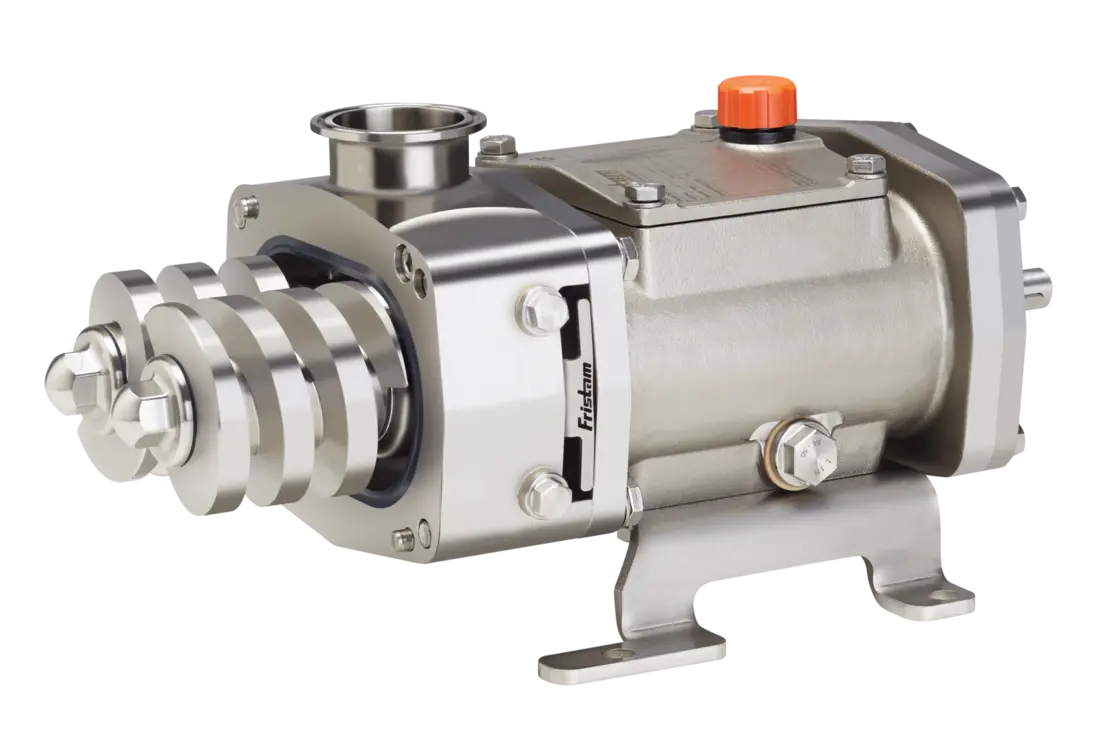
A rotary lobe pump is usually the practical choice when a food processor needs dependable, gentle positive-displacement transfer for a relatively stable product and duty. A twin screw pump is often the stronger option when one pump must cover a much wider viscosity range, provide better suction performance, handle more difficult product changes, and also circulate cleaning fluid during CIP.
In a rotary lobe pump vs twin screw pump food processing decision, neither design is automatically better. The correct choice depends on the actual product, particle size and fragility, suction conditions, pressure requirement, cleaning strategy, and the degree of operating flexibility the line needs. The decision should be based on tested product data and the pump supplier’s duty calculations rather than viscosity alone.
The core difference
Both rotary lobe and twin screw pumps are sanitary positive-displacement pump types. Their flow is broadly related to pump speed, making them useful for viscous products and applications where a predictable transfer rate matters.
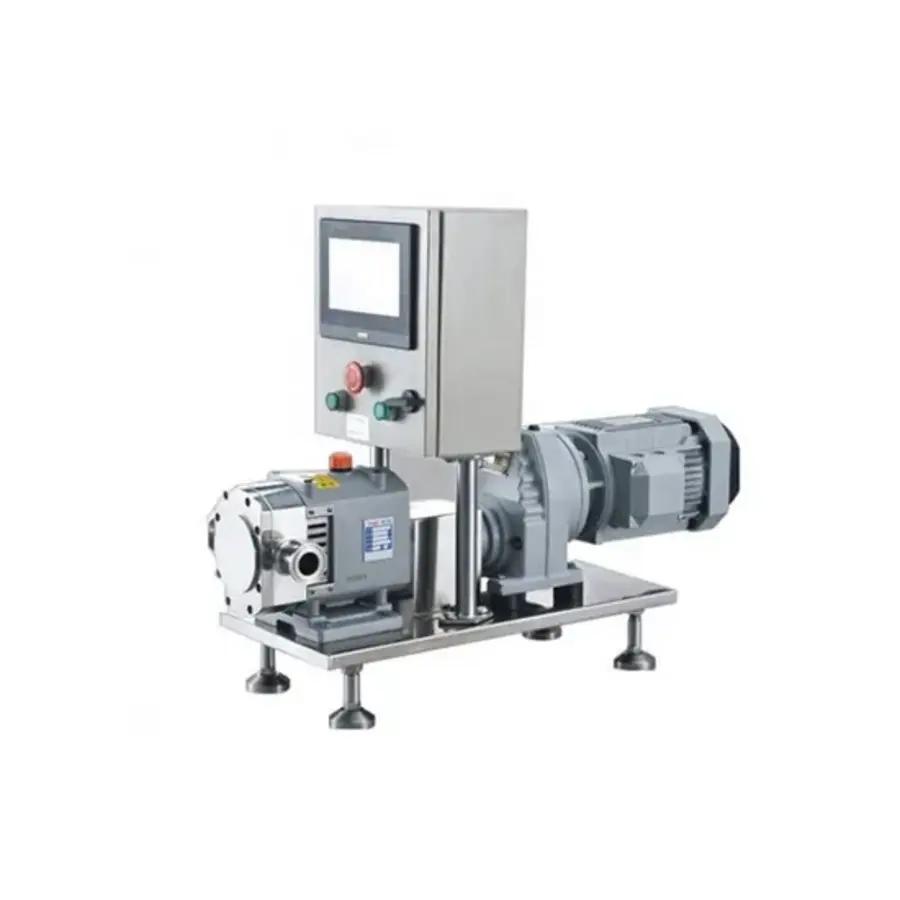
A rotary lobe pump uses timed lobed rotors that turn without contacting each other. As the lobes rotate, they form cavities that carry product from inlet to discharge. The design is familiar across dairy, beverage, bakery, prepared foods, and other hygienic applications.
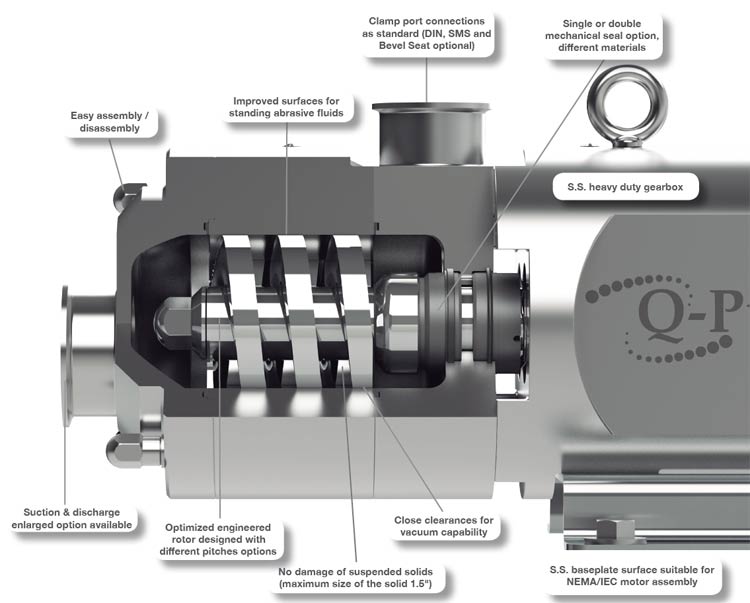
A twin screw pump uses two intermeshing screws, also synchronized through timing gears. The screws create enclosed chambers that move product axially through the pump. This geometry commonly gives the pump a broad operating envelope, including difficult suction conditions and both low- and high-viscosity media.
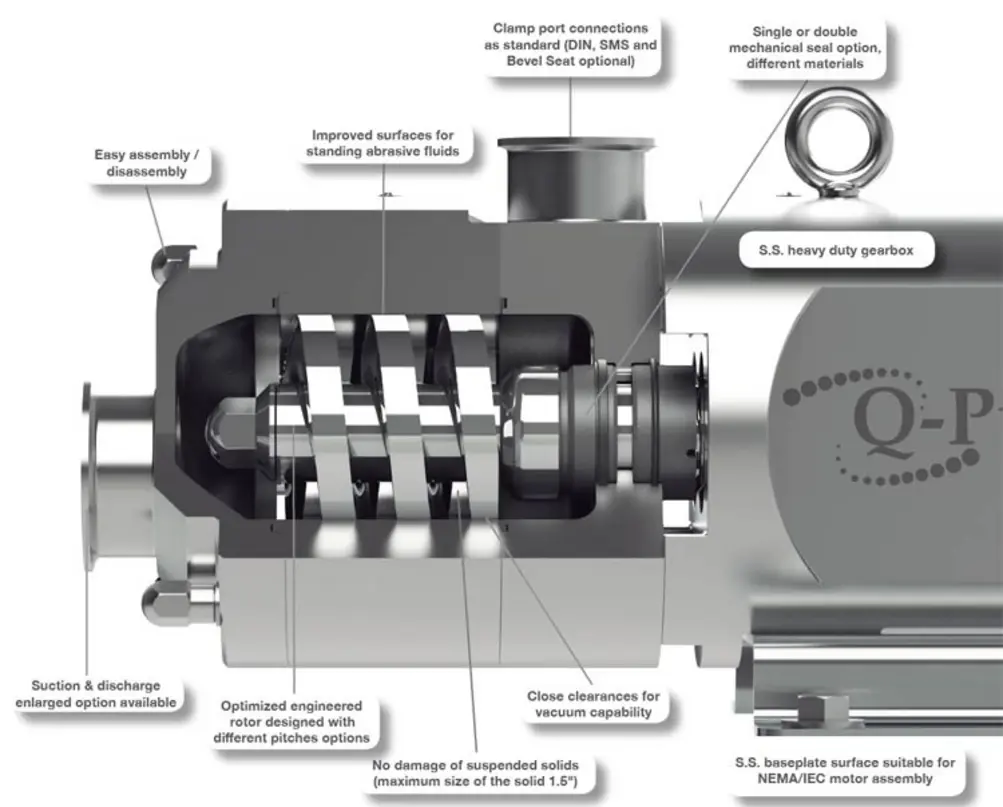
Source: catalog.springerpumps
Rotary lobe pump vs twin screw pump: comparison at a glance
| Selection factor | Rotary lobe pump | Twin screw pump |
|---|---|---|
| Typical product fit | Stable, viscous, shear-sensitive products and products with manageable particulates | Variable-viscosity products, difficult suction duties, sensitive products, and applications needing broad flexibility |
| Flow behavior | Positive-displacement flow; pulsation depends on rotor design and system conditions | Generally low-pulsation, smooth flow characteristics |
| Viscosity range | Well suited to many viscous food products, but must be selected for the actual range | Often selected where the product viscosity changes substantially between products, batches, or temperatures |
| Suction performance | Can perform well with proper inlet design, but may be more sensitive to poor suction conditions | Commonly offers strong suction and lift capability, subject to the specific model and installation |
| Solids handling | Can handle soft particulates when clearances, rotor profile, and speed are suitable | Often well suited to suspended solids and products that require gentler chamber movement |
| CIP role | Sanitary designs may support CIP, but cleaning performance must be verified for the installed system | Often used for both product transfer and CIP circulation, potentially reducing the need for a separate CIP pump duty |
| Maintenance emphasis | Rotor condition, front cover access, seals, clearances, and timing components | Seals, screw timing, gearbox condition, and correct assembly after service |
| Initial complexity | Generally simpler and widely understood | Usually more complex, with a higher value case where flexibility replaces separate equipment or operating compromises |
Product fit: start with the product, not the pump name
The most useful first question is not, “Which pump is more sanitary?” Both can be built for hygienic service. Ask instead: “What happens to this product as its viscosity, temperature, solids content, and air content change during normal production?”
When a rotary lobe pump is a good fit
A rotary lobe pump food processing installation can be a sound choice for products with a repeatable transfer duty. Examples may include cultured dairy products, sauces, dressings, cream-based products, syrups, fillings, and fruit preparations, provided the pump is sized around the real product condition.
Rotary lobe pumps are often favored where operators value straightforward service access and a familiar sanitary pump design. They can also be suitable for products containing soft pieces or inclusions, but “solids handling” should not be treated as a blanket approval. Particle dimensions, concentration, fragility, line bends, valve restrictions, and pump speed all affect whether pieces remain intact.
A lobe pump becomes less attractive when the same line must routinely transfer thin liquids, thick concentrates, aerated products, and CIP fluid with one fixed arrangement. It may still work, but the process team should confirm that the pump and controls remain within acceptable limits at every duty point.
When a twin screw pump is a good fit
A twin screw pump food processing application is particularly compelling when operating conditions vary widely. This may include lines that run both thin and thick products, products that change viscosity during a campaign, or systems where product transfer and cleaning circulation are expected from the same pump.
Twin screw designs are also commonly considered for products that need gentle movement with low pulsation, for challenging inlet conditions, and for difficult recovery duties. Their enclosed chambers and axial product movement can support smooth handling, but no pump should be described as universally “no-shear.” Product damage can still occur through speed, pressure differential, tight restrictions, recirculation, valves, downstream equipment, and product formulation.
The added flexibility of a twin screw pump can simplify a process layout in some cases. For example, using one pump for product transfer and CIP may reduce equipment count and piping complexity. That benefit should be weighed against the pump’s purchase cost, control requirements, and maintenance capability on site.
Suction conditions and pressure: where selections often fail
Positive-displacement pumps can create strong inlet demand. A pump that performs well on a vendor test stand can be unreliable when installed under a shallow product head, with undersized suction piping, restrictive fittings, cold viscous product, or entrained air.
Twin screw pumps are often selected for stronger suction performance and lower required inlet head than many alternatives. That does not remove the need for proper inlet design. The processor should provide the pump supplier with suction pipe diameter and length, elevation, product temperature range, vessel level, line restrictions, and any expected air or gas entrainment.
Rotary lobe pumps also require careful inlet design, especially on thick products. A common mistake is to size the suction side as though it were a water service line. High-viscosity products can create substantial pressure loss before reaching the pump, which may lead to unstable flow, noise, product damage, or reduced capacity.
Pressure capability should be evaluated as a complete system issue. Include friction losses, filters, heat exchangers, valves, filling equipment, elevation changes, and the pressure rise that can occur if a downstream path is closed. Because positive-displacement pumps continue displacing volume, the system needs an appropriately engineered overpressure protection approach. The type, location, settings, and validation requirements must be determined by qualified personnel for the actual installation.
CIP behavior: verify the whole cleaning circuit
“CIP-compatible” does not mean every pump will clean equally well in every line. The pump, piping, valves, seals, spray devices, return paths, cleaning program, and control sequence work together.
Twin screw pumps are widely used where the pump must handle both product and CIP fluid. This can be useful on lines that would otherwise need a separate centrifugal CIP circulation pump or a more complex bypass arrangement. Their ability to move lower-viscosity cleaning fluids can improve operational flexibility.
Sanitary rotary lobe pumps can also be designed for clean-in-place operation. However, the process team should confirm the manufacturer’s approved cleaning method for the exact pump model, rotor configuration, seal arrangement, elastomers, and installed orientation. Some applications may require particular flow directions, speeds, pressure limits, or disassembly practices.
For either pump type, verify these points during selection and commissioning:
- The wetted materials, elastomers, seals, and surface finish are suitable for the product and cleaning chemistry.
- The pump’s CIP duty is supported by the manufacturer, not assumed from its product-transfer rating.
- Cleaning flow, return conditions, and the pump’s ability to clear residual product are evaluated in the complete circuit.
- The system’s sanitation program is validated under the facility’s food-safety procedures.
- Product changeovers and allergen controls are assessed with the site’s qualified food-safety team.
Do not rely on generic CIP times, temperatures, chemical concentrations, or sanitation claims from unrelated systems. Those conditions must be established and verified for the specific product, equipment, cleaning chemicals, and facility program.
Maintenance and uptime considerations
Rotary lobe pumps are often valued for accessible front-end service and a relatively familiar maintenance routine. Rotor wear, seal condition, rotor timing, clearances, and cover sealing deserve routine attention. Wear can affect capacity, pressure performance, cleaning behavior, and particle handling.
Twin screw pumps add flexibility but demand disciplined maintenance. Correct screw timing, seal replacement, gearbox condition, and assembly procedures are important. Some hygienic twin screw designs offer cartridge-style or front-loading seal arrangements that can make in-place service easier, but this depends on the model.
For either design, a maintenance plan should include spare parts strategy, seal failure response, inspection intervals based on actual duty, and technician training. The lowest-cost pump is rarely the lowest-cost choice if it causes frequent product loss, extended changeovers, or unplanned cleaning work.
A practical selection checklist
Use this checklist before requesting quotations or comparing pump curves:
- Define the full product range. Include viscosity variation, temperature range, density, abrasiveness, particle characteristics, air content, and sensitivity to shear or pulsation.
- Map every operating duty. Product transfer, tank unloading, recirculation, filling feed, recovery, CIP supply, and CIP return may have different needs.
- Document the suction side. Provide vessel level, pipe routing, pipe size, restrictions, and whether the product may be cold, foamy, or intermittently unavailable.
- Set flow and pressure requirements by duty. Do not use only a maximum flow target.
- Review the cleaning philosophy. Decide whether the process genuinely benefits from a single pump for product and CIP, or whether separate duties are simpler and more robust.
- Check product integrity at line conditions. Consider not only the pump but also downstream valves, fillers, heat exchangers, and restrictions.
- Plan for service. Compare seal access, required tools, spare components, cleaning access, and the local ability to maintain timing components.
Common selection mistakes
The first mistake is selecting on viscosity alone. A product’s behavior at the pump inlet, its solids, air content, temperature changes, and cleaning requirements may matter just as much.
The second is treating low pulsation as a complete product-protection strategy. A gentle pump can still be installed in a damaging system. High speeds, restrictive piping, excessive differential pressure, and poor valve sequencing can undermine the benefit.
The third is assuming that a sanitary construction standard or a CIP claim proves sanitation performance for the complete process. Hygienic design is essential, but the final cleaning outcome depends on installation, operating conditions, cleaning validation, inspection, and site procedures.
Which pump should you choose?
Choose a rotary lobe pump when the product duty is reasonably consistent, the process needs a proven sanitary positive-displacement transfer pump, and straightforward serviceability is a priority. It is often the sensible fit for established recipes and stable process conditions.
Choose a twin screw pump when flexibility is central to the business case: broad viscosity changes, demanding suction conditions, sensitive or particulate products, low-pulsation transfer, or a desire to use one pump for product handling and CIP circulation. Its advantages are strongest when they remove a real process constraint rather than simply adding capability that the line will not use.
Before finalizing either option, ask the supplier to evaluate the actual process data and confirm performance for each operating mode. For food applications, include the facility’s engineering, operations, maintenance, and food-safety functions in that review. The best pump selection is the one that meets product quality, cleanability, protection, and uptime requirements across the full operating range—not only during its easiest transfer duty.
References
- Explained: Food Twin Screw Pump Standards, Composition, and Industrial Use. (n.d.). https://www.alibaba.com/product-insights/food-twin-screw-pump.html
- Twin Screw vs. Lobe Pumps: Which Fits Your Process?. (n.d.). https://www.linkedin.com/pulse/twin-screw-vs-lobe-pumps-which-fits-your-process-5j6fe
- Twin Screw vs. Lobe Pump? Which Pump is the Better Choice for Suspended Solids?. (n.d.). https://blog.unibloctech.com/twin-screw-vs.-lobe-pump-which-pump-is-the-better-choice-for-suspended-solids
- Twin Screw Sanitary Pump for Fermentation Transfer. (n.d.). https://www.accio.com/plp/twin-screw-sanitary-pump-fermentation-industry-transfer-applications
- Guide to Pump Selection for Food & Beverage Processing. (n.d.). https://blog.craneengineering.net/guide-to-pump-selection-for-food-and-beverage-processing
- Twin Screw pump for hygienic applications | Alfa Laval. (n.d.). https://www.alfalaval.us/products/fluid-handling/pumps/twin-screw-pump/twin-screw
- Twin Screw pump for hygienic applications | Alfa Laval. (n.d.). https://www.alfalaval.co.nz/products/fluid-handling/pumps/twin-screw-pump/twin-screw
- Twin Screw pump for hygienic applications | Alfa Laval. (n.d.). https://www.alfalaval.com.au/products/fluid-handling/pumps/twin-screw-pump/twin-screw