A screw feeder and a rotary valve can both discharge food powders, but they should not be treated as interchangeable. In the simplest terms, choose a food powder screw feeder when controlled withdrawal, dosing range, or short positive conveying is the main requirement. Choose a rotary valve when the process must discharge powder while limiting gas movement across a pressure or vacuum boundary, such as at the inlet to a pneumatic conveying line.
The practical challenge in a screw feeder vs rotary valve for food powders decision is separating three jobs that are often bundled together: getting material out of a hopper, metering its rate, and maintaining an airlock. Flour, sugar, starch, dairy powder, seasoning blends, and similar materials may need all three functions—but one machine rarely performs each equally well.
The core difference: screw conveys; a rotary valve pockets and airlocks
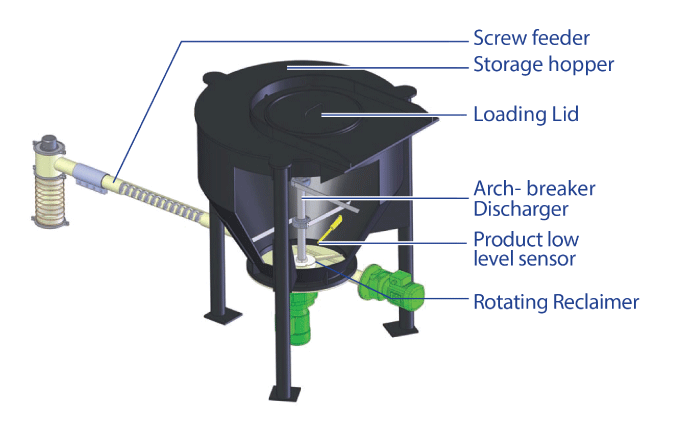
A screw feeder uses a rotating helical screw in a trough or tube. As the screw turns, it withdraws powder from the hopper and moves it toward the outlet. Its output is commonly adjusted through screw speed. Screw designs can be configured to draw material across a longer hopper opening and can provide positive movement to the next process step.
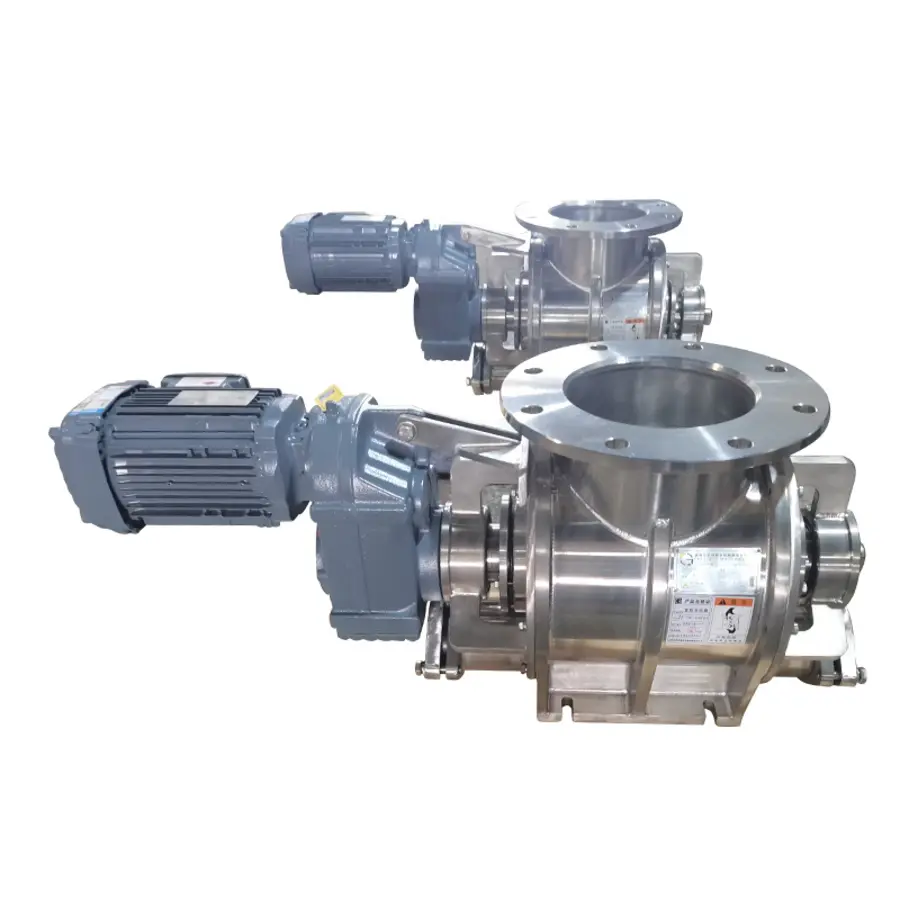
A rotary valve has a rotor with pockets that fill with powder at the inlet and discharge as the rotor turns. It is often called a rotary airlock because the rotating pockets help reduce gas leakage between two connected process zones. This makes it a common choice below dust collectors, pneumatic receivers, cyclones, and hoppers feeding pneumatic conveyors.
A rotary valve can meter material by rotor speed, but metering precision depends on consistent pocket filling and stable powder bulk density. A screw feeder can also provide rate control, but it is not normally selected as an airlock where a meaningful pressure differential must be contained.
Quick comparison
| Selection factor | Screw feeder | Rotary valve |
|---|---|---|
| Primary strength | Controlled extraction and short-distance transport | Powder discharge with airlock duty |
| Best hopper interface | Long or rectangular outlet; applications needing controlled withdrawal | Compact outlet with reliable gravity flow into rotor inlet |
| Airlock capability | Not a dependable airlock | Designed to limit gas leakage, subject to clearances and wear |
| Dosing behavior | Often better for broad turndown and controlled feeding | Can provide volumetric feed, but depends on pocket fill consistency |
| Pneumatic conveying feed | Possible only with suitable system design; not an airlock substitute | Common choice for feeding or discharging from pneumatic systems |
| Powder compaction risk | Can compact some powders, especially in restrictive designs | Can shear or damage particles at inlet and rotor clearances |
| Cleanout considerations | Trough, screw, bearings, seals, and dead areas need access | Rotor pockets, end clearances, housing, and seals need access |
| Common failure mode | Uneven withdrawal, bridging, buildup, or rate variation | Air leakage, pocket carryover, rotor wear, or inlet blockage |
Start with the actual duty
Before comparing models, define which function governs the application.
1. Hopper discharge
If the main problem is getting powder reliably out of a hopper, the hopper and outlet design deserve as much attention as the feeder. A feeder cannot consistently correct for an unsuitable hopper geometry, bridging powder, ratholing, segregation, or an unstable head of material above the outlet.
Screw feeders are often useful where the hopper has an elongated outlet. A properly designed screw can withdraw powder along that opening rather than drawing only from a central point. This can support more uniform flow from the hopper when the powder and vessel design are compatible.
A rotary valve generally needs powder to flow consistently into the rotor inlet. If the powder bridges above the valve, compacts at the inlet, or arrives in slugs, the rotor pockets will not fill consistently. The result may be unstable downstream feed even though the valve speed remains constant.
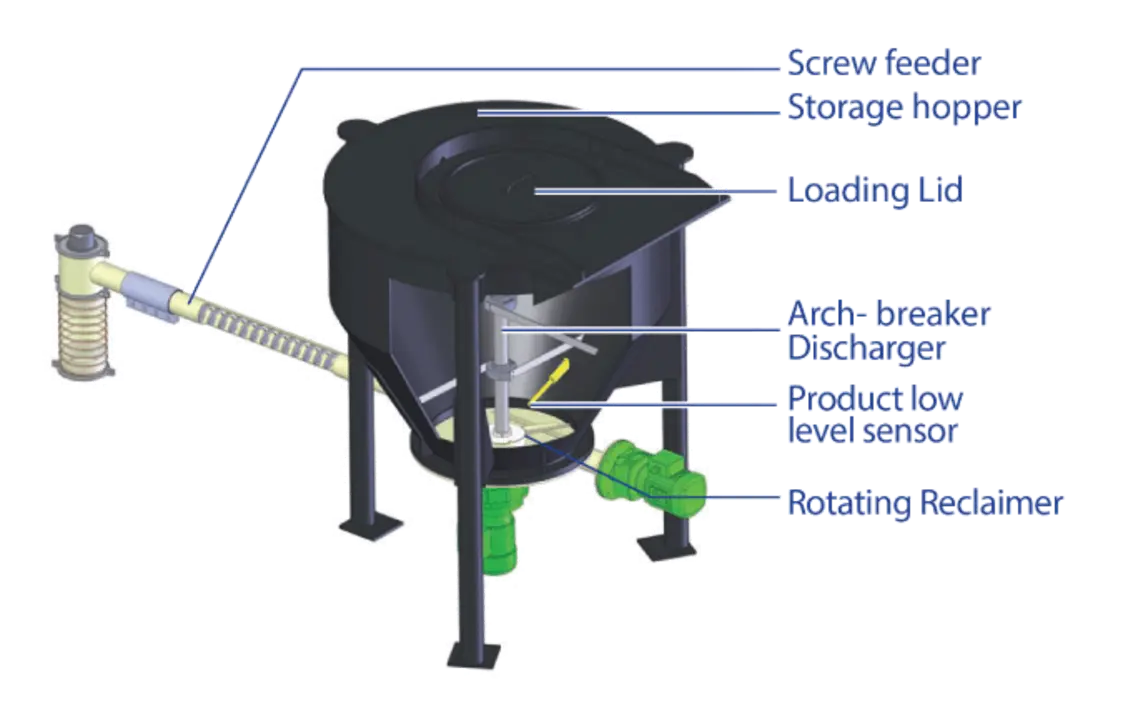
Source: sodimate-inc
2. Ingredient dosing
For powder ingredient dosing, determine whether the system needs approximate volumetric control or a verified mass-based feed rate.
Both feeder types are commonly operated at a set speed, producing volumetric rather than direct gravimetric control. With food powders, the mass delivered per revolution can change as bulk density changes. Aerated flour, compacted sugar, hygroscopic starch, or a seasoning blend with changing particle distribution may not fill a screw or rotor pocket consistently from one production period to the next.
When formula accuracy is important, a loss-in-weight arrangement or another mass-measurement method may be needed. The feeder then becomes one part of the dosing system rather than the sole source of accuracy. The equipment supplier and process team should evaluate rate stability at the expected minimum and maximum feed rates, as well as after starts, stops, refill events, and product changeovers.
A screw feeder is often the stronger starting point for a wide operating range or where controlled extraction is necessary. A rotary valve may be suitable for relatively steady volumetric discharge, but it should not be assumed to provide tight recipe control merely because rotor speed is controlled.
3. Short-distance transfer
A screw feeder can move powder horizontally or on a modest incline over a short distance, depending on its design and the ingredient. It may feed a mixer, sifter, mill, packaging machine, or another process inlet directly.
A rotary valve is not a conventional conveyor. It transfers material through its rotor from inlet to outlet, usually over a very short vertical or horizontal path. Its broader value is at the boundary between process zones, especially where airflow control matters.
4. Airlock duty
If a hopper, receiver, or collector operates under vacuum or pressure relative to the receiving side, airlock performance becomes the leading issue. A screw feeder has clear pathways around and through its mechanical arrangement and should not be considered a substitute for a purpose-selected airlock.
A rotary airlock can reduce air leakage, but it is not a perfect seal. Leakage is influenced by pressure differential, rotor-to-housing clearance, end clearance, powder characteristics, rotor design, wear, and the condition of seals and bearings. Abrasive ingredients or foreign material can accelerate wear and increase leakage. Fine powders can also behave differently from coarse, free-flowing granules.
For pneumatic conveying, establish whether the valve is feeding into a pressure line, discharging from a vacuum receiver, or operating under another pressure condition. The direction and magnitude of the pressure differential affect the required valve configuration. Do not select a standard drop-through valve without confirming how it will connect to the conveying line and how the product will enter the air stream.
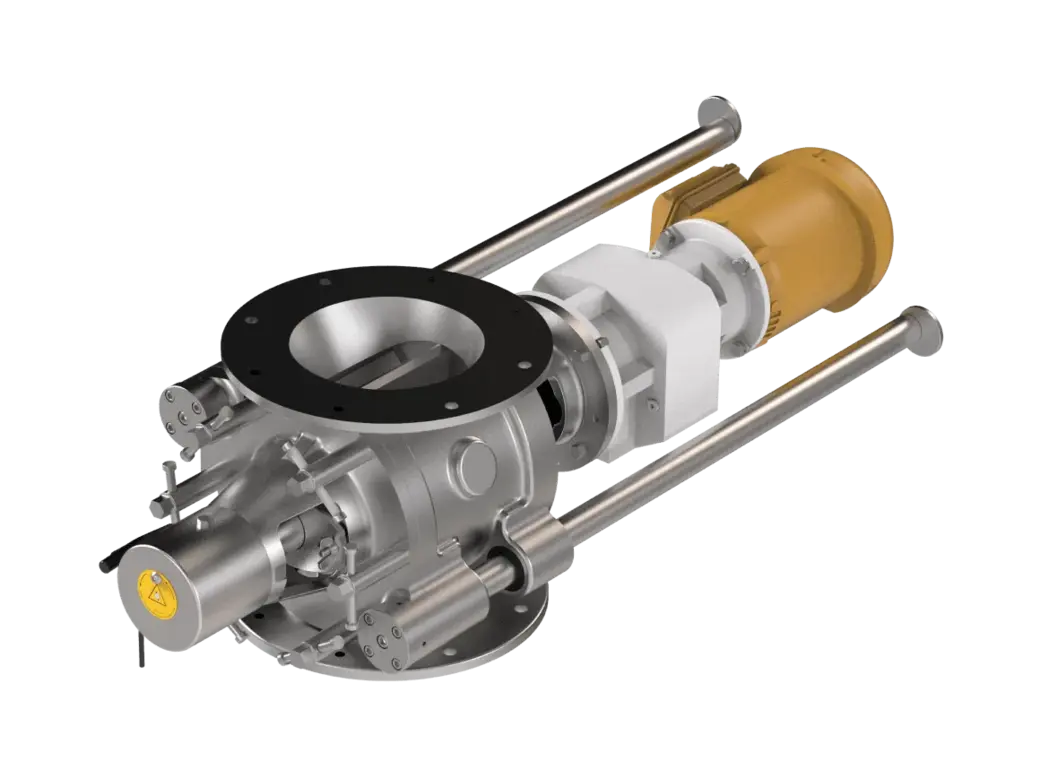
Source: meyerindustrial
Powder behavior can decide the outcome
Food powders vary widely even within the same ingredient category. A flour with a different moisture condition, a sugar with more fines, or a spice blend with a higher oil content can change flow behavior and feeder performance.
Evaluate these material characteristics with representative production material:
- Flowability: Does the powder flow freely, bridge, rathole, or compact under storage pressure?
- Bulk density: Is it stable, or does aeration and settling cause significant variation?
- Particle size and fines: Can fine material leak through clearances, dust excessively, or fluidize?
- Cohesion and stickiness: Could the powder build up in a screw trough, rotor pockets, or inlet transition?
- Abrasiveness: Will it wear rotor clearances, screw flights, or housing surfaces?
- Fragility: Is breakage, attrition, or loss of particle appearance unacceptable?
- Segregation tendency: Could vibration, uneven hopper withdrawal, or changing feed conditions separate a blend?
A screw feeder can compact material as it moves it, particularly if the powder is cohesive or if the screw operates in a restrictive geometry. A rotary valve can shear particles at the inlet or between rotor and housing if material is caught in clearances. Neither effect should be assumed acceptable for a sensitive ingredient without trials or supplier evaluation.
Hygiene and changeover requirements
For food processing, the cleanability of the complete installation matters more than a stainless exterior alone. Ask how operators will access, inspect, clean, and reassemble the product-contact areas.
For a screw feeder, inspect the trough or tube, screw flight, inlet area, discharge, seals, shaft ends, and any locations where powder can remain after normal discharge. Removable covers and quick-access arrangements may simplify dry cleaning, but the design must still prevent reassembly errors and protect the product zone from contamination.
For a rotary valve, focus on rotor pockets, the housing interior, end covers, seals, and rotor-to-housing clearances. Fine powder retained in pockets or around end clearances can complicate changeover. Where wet cleaning or clean-in-place operation is proposed, verify that the design, seals, drainage, cleaning sequence, and post-cleaning inspection are appropriate for the ingredient and the plant sanitation program.
Allergen changeovers require particular care. Equipment selection should align with the facility’s validated allergen-control procedures rather than relying on a general claim that a feeder is “easy to clean.”
Common selection mistakes
Expecting a screw feeder to serve as an airlock
A screw may feed product into a pneumatic line, but it does not inherently isolate pressure zones. If pressure control is necessary, specify the airlock function separately.
Selecting a rotary valve solely by throughput
A valve sized only for nominal capacity may perform poorly if pockets do not fill, if the powder bridges at the inlet, or if pressure differential and leakage were not considered. Capacity, pocket fill, and airlock performance are connected but distinct questions.
Ignoring the upstream hopper
Many apparent feeder problems begin above the feeder. An oversized hopper outlet, a poorly shaped transition, uncontrolled refill conditions, or non-uniform withdrawal can cause surging and inconsistent dosing.
Treating speed control as proof of accuracy
Variable speed changes the intended volumetric rate. It does not guarantee a stable mass rate when bulk density or fill efficiency changes.
Underestimating maintenance access
Rotary valves depend on controlled clearances, which wear over time. Screw feeders have bearings, seals, shafts, and flight surfaces that require inspection. Choose a layout that permits safe access for cleaning, inspection, and component replacement.
A practical bulk solids feeder selection checklist
Use this sequence before requesting quotations or approving a design:
- Name the governing duty. Is the priority extraction, dosing, transfer, airlock performance, or a combination?
- Document the powder. Include bulk density range, flow behavior, particle size, moisture sensitivity, stickiness, abrasiveness, and fragility.
- Define operating rates. Identify expected minimum, normal, and maximum rates, plus the consequences of feed variation.
- Map the pressure conditions. Confirm whether the feeder crosses a vacuum or pressure boundary and whether air leakage is acceptable.
- Review the hopper-feeder interface. Consider outlet geometry, flow pattern, refill behavior, and the risk of segregation or bridging.
- Set sanitation and changeover needs. Specify dry cleaning, wet cleaning, allergen procedures, inspection access, and product-contact requirements.
- Check downstream integration. Confirm the receiving machine, pneumatic line, mixer, scale, or packaging system can accept the selected feed method.
- Plan maintenance. Include wear parts, clearance checks, access space, drives, controls, and the effect of downtime on production.
Which option fits typical food-powder applications?
A screw feeder is generally the better choice when flour, starch, sugar, seasoning, or a premix must be withdrawn in a controlled manner from an elongated outlet and positively delivered to a nearby process. It is also a strong starting point where rate turndown matters and the system is not relying on the feeder to hold back conveying air.
A rotary valve is generally the better choice when powder must leave a hopper, receiver, cyclone, or collector while maintaining a practical airlock across a pressure difference. It is particularly common at pneumatic conveying interfaces, provided the valve is sized for the powder, pressure condition, inlet flow, and sanitation requirement.
Some systems need both. For example, a rotary valve may discharge powder from a pneumatic receiver, while a downstream screw feeder provides controlled dosing into a mixer. In another layout, a screw feeder may meter ingredient from a small day bin, while a separate rotary valve handles pneumatic transfer elsewhere in the process.
The reliable choice is therefore not simply “screw versus rotary.” It is the equipment arrangement that matches the ingredient’s flow behavior, hopper design, required feed control, pressure boundary, and cleaning method. Defining those conditions before selecting a machine reduces the risk of unstable flow, air leakage, difficult changeovers, and unnecessary modifications after installation.
Frequently asked questions
Can a rotary valve accurately dose food powder?
It can provide controlled volumetric feed when rotor pockets fill consistently. However, actual mass flow can vary with bulk density, aeration, and powder flow behavior. Applications with critical formula accuracy should evaluate a mass-based dosing approach.
Can a screw feeder feed a pneumatic conveying system?
A screw feeder can introduce powder to a process, but it does not inherently provide the airlock function needed where pressure separation is important. Review the conveying pressure conditions and use an appropriate airlock arrangement where required.
Is a rotary valve easier to clean than a screw feeder?
Neither is automatically easier. Rotary valves require access to rotor pockets, housing surfaces, and clearances. Screw feeders require access to the screw, trough or tube, shaft seals, and discharge areas. The better option depends on the hygienic design and the plant’s cleaning and allergen-control procedures.
What causes inconsistent output from either feeder?
Common causes include bridging or ratholing in the hopper, changing bulk density, unstable refill conditions, poor inlet geometry, powder buildup, worn components, and inadequate control of the feeder speed or weighing system.
References
- Rotary Valve vs Screw Feeder: Which One Is Better for Powder Handling Systems? | Doebritz. (n.d.). https://www.ecer.com/corp/uuuf83s-doebritz-tec/news-uud21z-rotary-valve-vs-screw-feeder-which-one-is-better-for-powder-handling-systems.html
- How Do I Choose Between a Rotary Valve or Screw Feeder. (n.d.). https://event.on24.com/wcc/r/2074719/D90EAFD88768052FAB21841BD6971570?partnerref=PBSBlog
- Rotary Valve vs. Screw Feeder: Which Is Best for Your Application?. (n.d.). https://www.ecer.com/corp/uuuf83s-doebritz-tec/news-uud2g8-rotary-valve-vs-screw-feeder-which-is-best-for-your-application.html
- Rotary Valve vs Screw Feeder for Bulk Solids | PowderBulkVideos. (n.d.). https://powderbulkvideos.com/compare/rotary-valve-vs-screw-feeder
- How to Select a Rotary Airlock/Feeder Valve for Your Powder Processing Needs. (n.d.). https://www.powder-solutions.com/2017/10/18/how-to-select-a-rotary-airlock-feeder-valve-for-your-powder-processing-needs
- Webinar: How to Choose Between a Rotary Valve and Screw Feeder. (n.d.). https://www.powderbulksolids.com/industrial-feeders/webinar-how-to-choose-between-a-rotary-valve-and-screw-feeder
- Food Processing Material Handling Equipment | Meyer. (n.d.). https://www.meyerindustrial.com/industry/food
- [PDF] Innovative food and pet food processing solutions.. (n.d.). https://shamrock-systems.com/wp-content/uploads/600203-en_Food_Systems_C_CK-2.pdf