For most food plants, sodium hydroxide vs potassium hydroxide CIP is not a question of which chemical is universally stronger. Both are strong alkalis that can remove many organic food soils when concentration, temperature, circulation, contact time, and mechanical action are properly controlled. Sodium hydroxide (NaOH) is generally the conventional starting point because it is widely used, readily available, and commonly cost-effective. Potassium hydroxide (KOH) can be a valid alternative where its formulation behavior, solubility, wastewater considerations, or supplier-supported cleaning results offer a practical advantage.
The right choice should be based on a documented cleaning trial and the whole CIP system—not the hydroxide name alone. Product residues, water minerals, stainless-steel condition, elastomers, heat load, reuse practices, wastewater limits, and the plant’s ability to dose and rinse consistently all affect the outcome.
The core difference between NaOH and KOH
NaOH and KOH both supply hydroxide ions in water. Those hydroxide ions create the high-alkaline conditions used to break down and lift many fats, proteins, and other organic deposits. The difference is the associated cation: sodium in NaOH and potassium in KOH.
That difference matters operationally because the products have different molecular weights, solution behavior, commercial forms, storage characteristics, and costs. Equal weight percentages of NaOH and KOH do not provide the same molar amount of hydroxide. A plant therefore should not substitute one for the other on a simple pound-for-pound or percent-by-weight basis without reviewing the supplier’s dosing recommendation, titration method, conductivity curve, and cleaning validation data.
| Selection factor | Sodium hydroxide (NaOH) | Potassium hydroxide (KOH) | What the plant should confirm |
|---|---|---|---|
| Typical CIP role | Common base alkali for organic soil removal | Alternative strong alkali for CIP formulations | Performance against the actual product soil |
| Procurement | Often broadly available and familiar to plants | May be a specialty or premium option, depending on market | Delivered cost, supply reliability, and storage arrangement |
| Control setup | Often supported by established conductivity and titration methods | Requires its own verified concentration-control relationship | Instrument calibration and concentration verification |
| Formulation behavior | Used alone or in blended alkaline detergents | Used alone or in blended alkaline detergents | Foam control, sequestrants, surfactants, and other additives |
| Wastewater impact | Adds sodium to the effluent stream | Adds potassium to the effluent stream | Local discharge limits and treatment capability |
| Changeover risk | Existing NaOH systems may already be configured around it | Conversion may require revised procedures and setpoints | Chemical compatibility, records, training, and revalidation |
Cleaning performance: soil and process conditions come first
Alkaline CIP detergents are commonly used to remove organic soils. In food processing, these may include fats, oils, proteins, carbohydrates, and product films. Strong alkali can support fat saponification and protein removal, but the cleaning result still depends on the complete cleaning mechanism.
A useful way to assess performance is to review the main variables together:
- Soil type and age: Fresh residues may behave differently from dried, baked-on, or repeatedly heat-treated deposits.
- Surface and equipment geometry: Weld quality, dead legs, valves, gaskets, spray devices, heat exchangers, and long return circuits affect mechanical cleaning action.
- Chemical concentration: More chemical is not automatically better. Excess concentration can increase cost, make rinsing more difficult, and create compatibility concerns.
- Temperature and circulation: These must match the chemical supplier’s recommendation and the limits of equipment materials and seals.
- Water chemistry: Calcium and magnesium can contribute to mineral films, particularly in hot alkaline conditions. An alkaline cleaner may need sequestrants or a separate acid-cleaning step, depending on the deposit.
- Additives: Low-foam surfactants, chelants, antifoam agents, and other ingredients may have more influence on a difficult cleaning job than choosing NaOH rather than KOH alone.
This is why a blended alkaline CIP detergent may outperform a commodity hydroxide solution on a particular line. The benefit may come from the formulation’s ability to wet the soil, control foam, manage minerals, or keep loosened soil dispersed—not from a claim that one hydroxide is inherently better at every task.
NaOH CIP cleaner: when it is usually the practical baseline
A NaOH CIP cleaner is often the default option for plants handling proteinaceous or fatty food residues. It is commonly used in recirculated alkaline cleaning stages and is compatible with many hygienic stainless-steel systems when operated within a validated chemical and temperature range.
NaOH is a sensible starting point when the plant already has:
- Existing bulk storage, transfer, dosing, and containment designed for sodium hydroxide;
- Established conductivity or titration controls for the NaOH concentration range in use;
- Validated cleaning procedures and rinse criteria;
- A wastewater program that can accommodate sodium loading; and
- A cleaning supplier that can support soil-specific formulation and troubleshooting.
However, familiarity should not be mistaken for proof of performance. A line with recurring protein films, fat residues, mineral deposits, or foam problems may need a revised detergent formulation, a mechanical review, or a separate acid cycle rather than simply a stronger caustic dose.
KOH CIP cleaner: where it may be worth evaluating
A KOH CIP cleaner uses the same basic alkaline cleaning mechanism but introduces potassium rather than sodium into the system. KOH is highly soluble and is used in applications where liquid formulation behavior is important. In a food plant, its value should be demonstrated against a specific operational need.
Reasons to evaluate KOH can include a supplier’s successful formulation for the plant’s soil, a need to change the ionic load entering wastewater treatment, or an application where the detergent package handles better in the plant’s storage and dosing arrangement. It may also be considered when a chemical supplier has data showing better results in a defined process than the plant’s current NaOH program.
KOH should not be selected solely because it is described as more soluble or because it is associated with soft soaps in other industries. Those properties do not automatically mean a KOH program will clean a food-processing line better, rinse faster, or cost less in a specific CIP system.
Concentration control: do not transfer NaOH setpoints directly to KOH
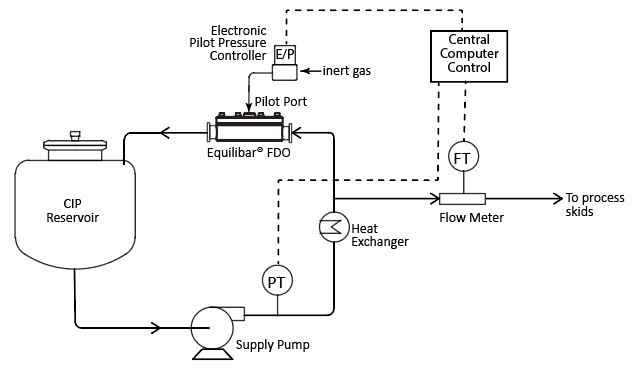
CIP systems often use conductivity as a fast, in-line indication of chemical concentration. That method is useful only when the conductivity relationship has been established for the actual solution. Conductivity is affected by chemical type, concentration, water quality, temperature, additives, and contamination carried back from the circuit.
If a plant moves from NaOH to KOH, or changes from a neat hydroxide to a formulated alkaline CIP detergent, it should establish new controls rather than reuse the old conductivity setpoint. A supplier or qualified laboratory should provide a concentration curve for the actual product and water source. The plant should then verify the curve using its own instruments and an appropriate reference method, such as controlled titration.
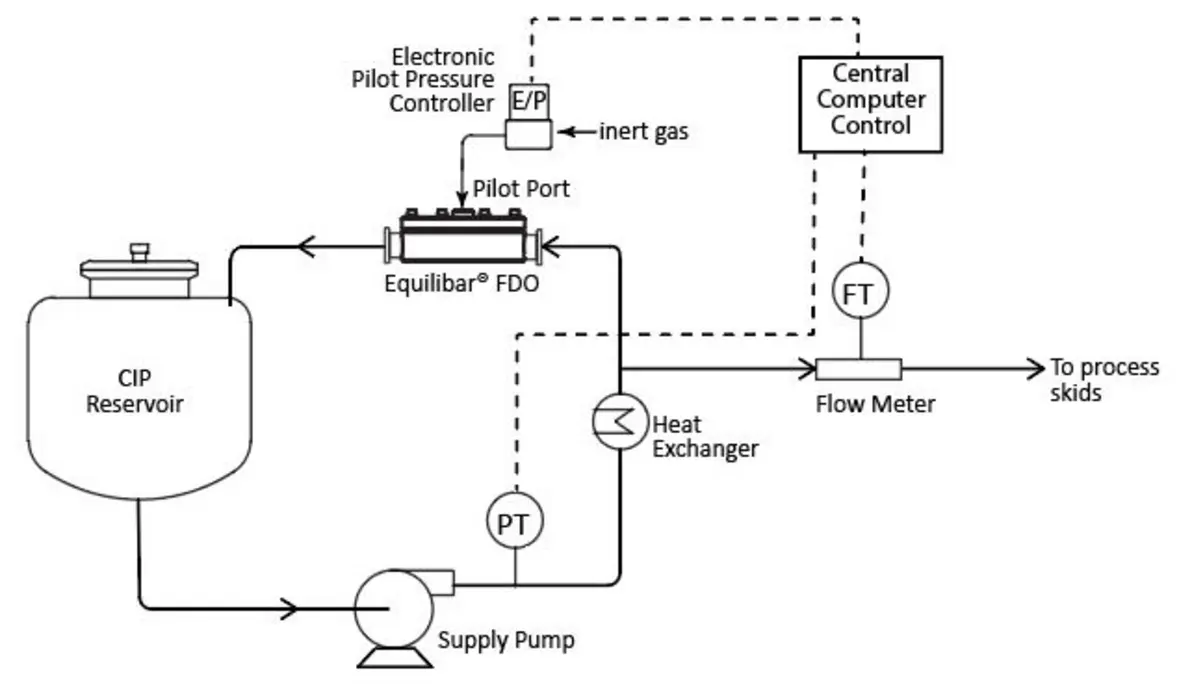
Source: equilibar
Key questions for the validation file include:
- How will the incoming chemical be identified and segregated?
- What concentration measurement is used, and how is it checked?
- What operating range has been demonstrated to clean the target soil?
- How will temperature, flow, return conditions, and cycle completion be monitored?
- What evidence confirms that the post-clean rinse is acceptable for the process?
- What changes are needed to sanitation records, operating instructions, and corrective-action procedures?
Rinsing: chemical choice is only one factor
Adequate rinsing is essential after alkaline cleaning. It protects product quality, supports the next cleaning stage where one is used, and prevents unintended carryover. But rinse effectiveness depends heavily on circuit design and execution: drainability, line volume, valve configuration, flow pattern, trapped pockets, water quality, and how the endpoint is defined.
Neither NaOH nor KOH should be assumed to rinse away acceptably based on a generic rinse time. The facility should define and verify an endpoint appropriate to its process. Depending on the system, this may involve conductivity trends, pH checks, chemical testing, return-water observation, or other validated criteria.
An acid cycle may be included where mineral scale, milkstone, beerstone, or other inorganic deposits are relevant. Acid cleaning has a different purpose from alkaline cleaning. It should be designed as part of the full cleaning program, with appropriate intermediate rinsing and compatibility checks. Cleaning and sanitizing are also distinct steps; an alkaline cleaner is not automatically a sanitizer.
Materials, equipment, and safety review
Both hydroxides are corrosive chemicals. Their safe use requires engineered storage and transfer arrangements, suitable personal protective equipment, emergency response provisions, labeling, employee training, and current safety documentation. Chemical handling procedures should be set by the facility’s safety team, chemical supplier, equipment manufacturer, and applicable local requirements.
For equipment compatibility, review more than the stainless-steel pipework. Confirm the chemical and temperature limits for:
- Elastomer seals, gaskets, valve seats, and hose materials;
- Pump components and mechanical seals;
- Instrument sensors, sight glasses, spray devices, and adhesive-bonded parts;
- Aluminum, zinc, galvanized components, or other non-stainless materials that may be present in peripheral equipment; and
- Chemical storage tanks, vents, transfer lines, and secondary containment.
Do not rely on a general statement that a cleaner is “stainless-safe.” Compatibility depends on alloy, concentration, temperature, exposure time, stress condition, contaminants, and the complete detergent formulation.
A practical selection process
Use this sequence when choosing between NaOH and KOH for a food plant CIP program:
- Define the soil. Identify product residues, mineral contribution, heat exposure, and any recurring deposit locations.
- Map the current CIP performance. Review chemical concentration, return conditions, flow, temperature records, rinse performance, and inspection findings.
- Review constraints. Include wastewater, water quality, chemical storage, worker safety, materials compatibility, and supply continuity.
- Compare complete detergent programs. Evaluate NaOH and KOH as supplied formulations, not only as pure raw materials.
- Run a controlled supplier-supported trial. Use agreed success criteria before changing the routine program.
- Verify cleaning and rinsing. The validation approach should fit the product risk, equipment, and the facility’s food-safety plan.
- Update controls before implementation. Revise conductivity curves, titration methods, operating instructions, training, chemical inventories, and records.
Which one should a food plant choose?
Choose NaOH when it already provides effective, validated cleaning and fits the plant’s cost, supply, equipment, and wastewater conditions. It remains the practical baseline for many alkaline CIP programs.
Evaluate KOH when there is a clear process reason to do so: a supplier formulation that performs better on the plant’s soil, a wastewater-related consideration, a storage or liquid-handling requirement, or a documented total-cost benefit. The case for KOH should come from measured results in the actual CIP circuit, not a generic assumption about chemical strength.
In either case, cleaning success comes from a controlled system: the right chemistry, correct concentration, adequate mechanical action, suitable temperature, complete rinsing, and verification that the cycle performs as intended.
References
- Sodium Hydroxide vs Potassium Hydroxide: NaOH vs KOH. (n.d.). https://basekim.com/en/sodium-hydroxide-vs-potassium-hydroxide
- Guide to Cleaning and Sanitation in the Food Industry. (n.d.). https://www.alleratech.com/blog/cleaning-and-sanitation-in-food-industry
- CIP cleaning in the food industry. (n.d.). https://www.quimidroga.com/en/2022/03/17/cip-cleaning-in-the-food-industry
- Sodium Hydroxide vs Potassium Hydroxide: Differences, Uses, and Applications. (n.d.). https://elchemy.com/blogs/chemical-market/sodium-hydroxide-vs-potassium-hydroxide-differences-uses-and-applications
- How Can I Use Less Caustic in my CIP Cleaning Regime?. (n.d.). https://www.solenis.com/en/resources/blog/how-can-i-use-less-caustic-in-my-cip-cleaning-regime
- CIP Cleaners : r/foodscience. (n.d.). https://www.reddit.com/r/foodscience/comments/1e5hgf6/cip_cleaners
- Potassium and sodium hydroxide in household chemicals. (n.d.). https://centro-chem.com/potassium-hydroxide-sodium-hydroxide-household-chemicals
- Using Sodium Hydroxide (NaOH) in CIP – Balancing Cleaning Power, Safety & Stability. (n.d.). https://suncombe.com/blog/cleaning-in-place-naoh