A spiral freezer vs tunnel freezer decision usually comes down to one practical question: does the product need a long, controlled residence time in a limited floor area, or can the plant accommodate a long, direct conveyor path? Spiral freezers use a continuously moving belt that travels around a vertical drum. Tunnel freezers move product through a straight or multi-pass insulated enclosure.
In general, a spiral freezer is the stronger starting point for products that need substantial dwell time and for plants where floor space is constrained. A tunnel freezer is often easier to place in a linear process, can offer simple access along the product path, and may suit high-volume small-piece products when adequate building length is available. Neither layout is automatically faster, more hygienic, or more economical; the product, required thermal result, loading pattern, and facility constraints determine the result.
The core difference: how the product travels
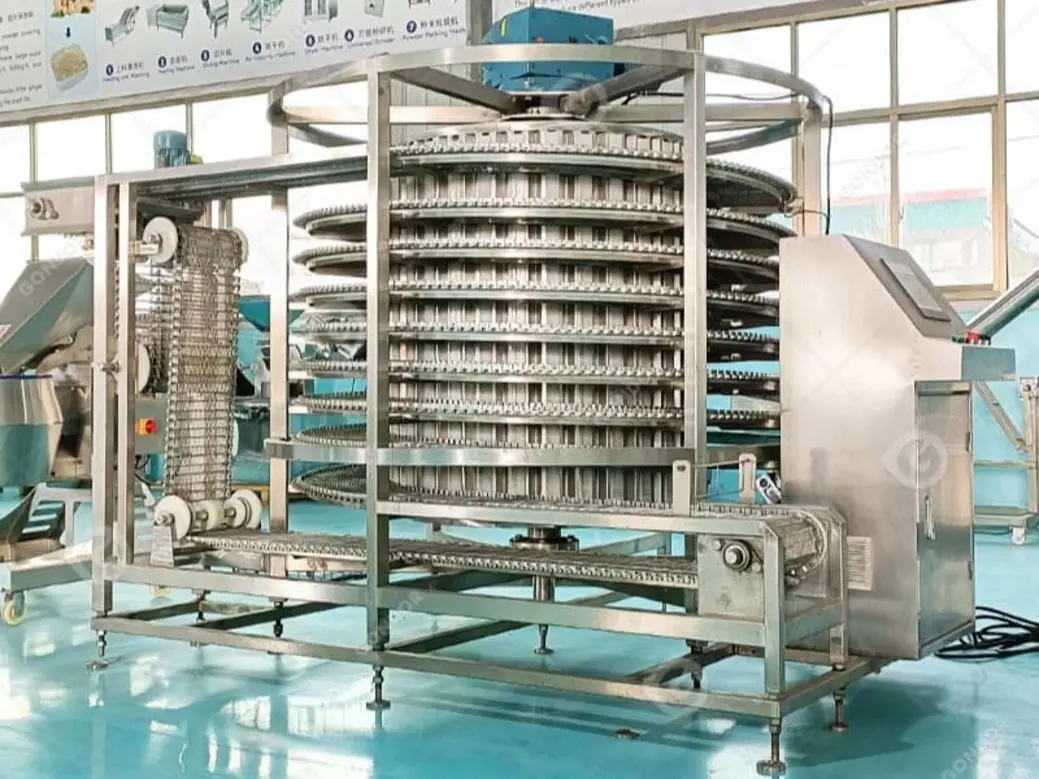
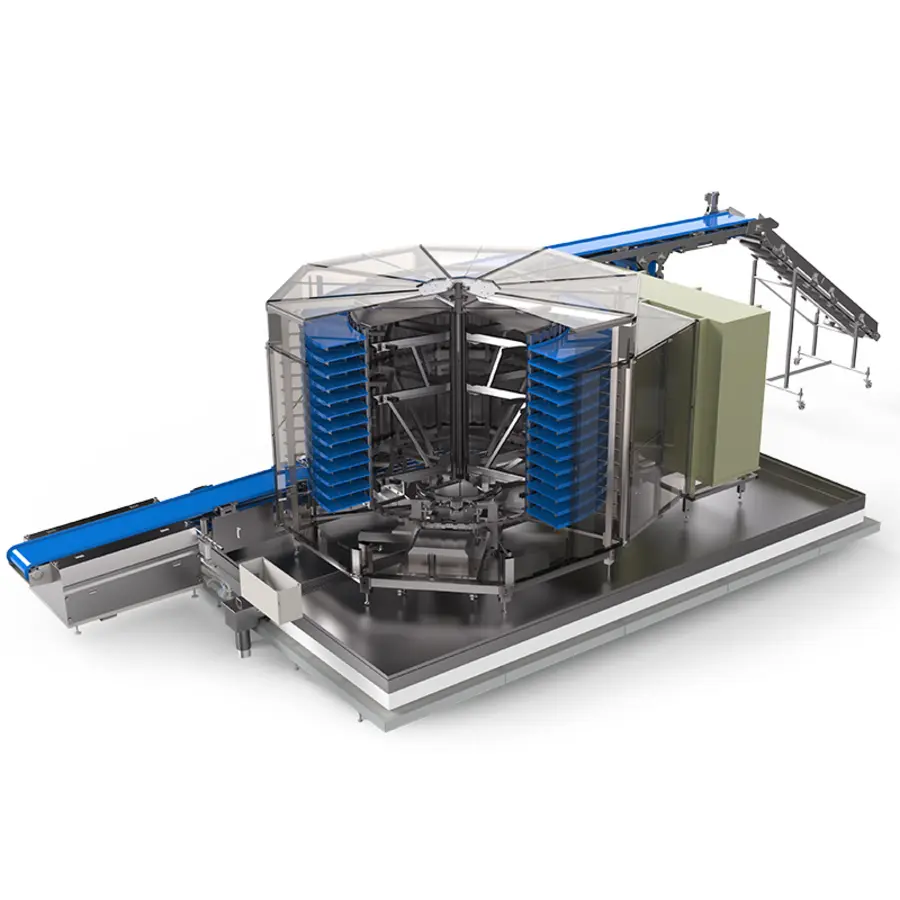
An industrial spiral freezer carries product on a belt that wraps upward or downward around a central drum in multiple tiers. This places a long belt path inside a comparatively compact footprint. Product enters at one elevation and leaves at another, so the freezer must be designed around both its conveyor route and the elevation changes needed upstream and downstream.
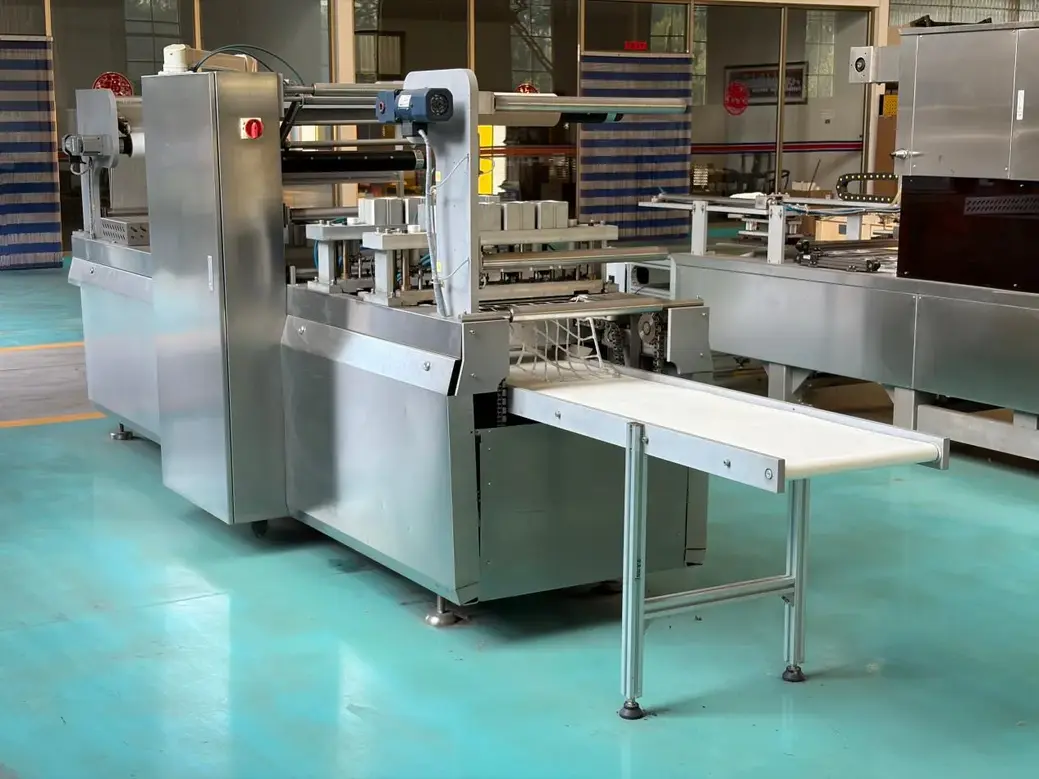
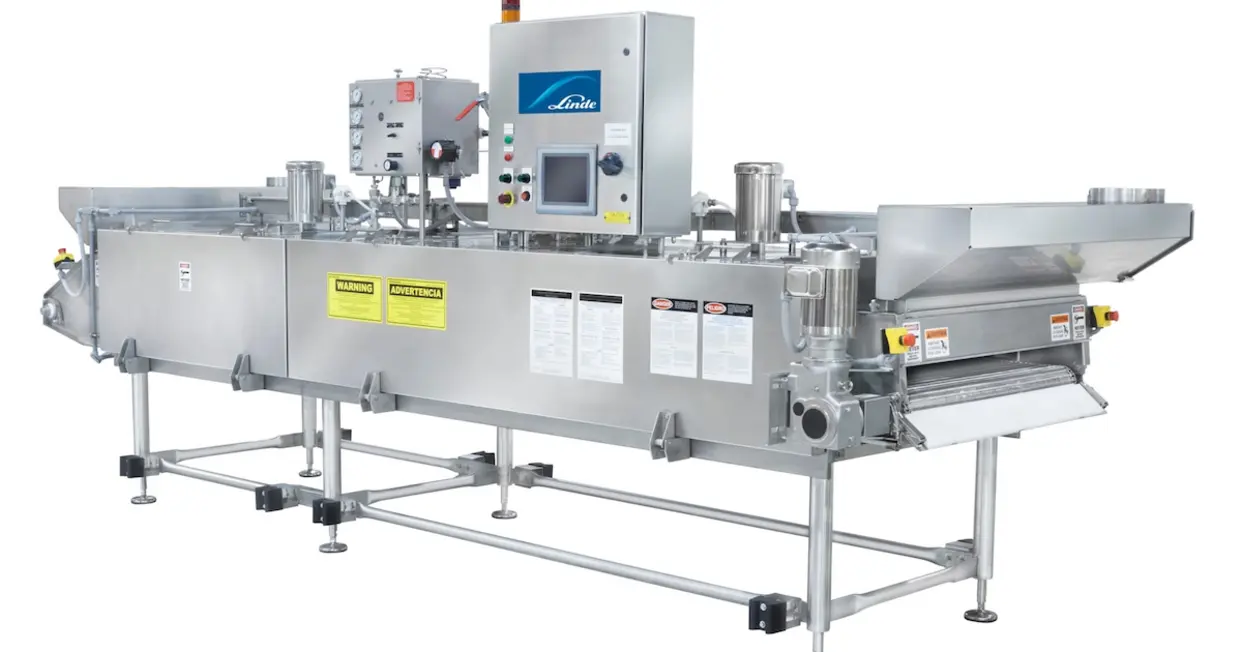
A tunnel freezer for food typically uses a straight belt through an insulated cabinet. Some systems use multi-pass arrangements to increase belt length, but the defining feature is a more linear product flow. The layout can be straightforward to connect to a depositor, breading line, oven, cooler, packaging line, or transfer conveyor.
Both configurations are usually continuous systems. Their actual freezing performance depends on more than cabinet shape: airflow design, refrigerant system, evaporator capacity, belt design, product spacing, product temperature at entry, loading rate, and target condition at discharge all matter.
At-a-glance comparison
| Selection factor | Spiral freezer | Tunnel freezer |
|---|---|---|
| Product path | Helical, multi-tier conveyor | Straight or multi-pass conveyor |
| Floor footprint | Relatively compact for a long belt path | Usually requires more linear building length |
| Available residence time | Can provide long dwell time within a compact area | Depends on tunnel length, belt speed, and pass arrangement |
| Line arrangement | Requires planning for elevation and transfer points | Fits naturally into many straight-through lines |
| Product handling | Good for stable products that travel well on a continuous belt | Can be suitable where a direct, simple transfer path is preferred |
| Access and cleaning | Must be evaluated around belt, drum, enclosure, and washdown design | May offer a more direct linear path, but access still varies by design |
| Best decision basis | Long dwell time, limited floor space, continuous production | Linear layout, product flow simplicity, available building length |
Start with the product, not the freezer type
The first equipment question is not whether the plant wants a spiral or tunnel. It is whether the product can travel reliably through either system.
Define the product condition at freezer entry:
- Is it loose, tray-loaded, packaged, battered, breaded, cooked, raw, sticky, fragile, or deformable?
- Does it need to remain individually separated?
- Can it tolerate belt contact, transfers, turns, vibration, and airflow?
- Does it leave upstream equipment hot, chilled, wet, oily, or coated with loose crumbs or particulates?
- What shape, thickness, and unit weight range will run on the line?
For example, formed products such as burgers, nuggets, meatballs, breaded portions, bakery goods, pizzas, and prepared foods are commonly considered for spiral systems because a long residence time can be accommodated without extending the factory line across a large floor area. However, the product still needs enough stability to travel through the selected belt route without marking, distortion, breakage, or sticking.
Small loose products require a different discussion. Peas, diced vegetables, shrimp, fruit pieces, and similar products may require an IQF approach that keeps pieces separated. A tunnel configuration may be part of that solution, but it should not be assumed that every tunnel freezer provides the same IQF performance. Product separation depends on the freezing method, belt or fluidization approach, airflow, feed distribution, moisture condition, and loading depth.
Residence time and belt loading drive freezer size
Residence time is the time product remains inside the freezing system. It is set through belt length and belt speed, not by cabinet size alone. A processor should provide suppliers with the required entry condition, desired exit condition, product dimensions, and production rate so the supplier can establish the necessary freezing duty and dwell time.
Belt loading is equally important. A freezer can appear large enough on a plan drawing yet perform poorly if product is loaded too densely, overlaps on the belt, or blocks airflow. Conversely, spreading product too widely can waste usable belt area and make the system unnecessarily large.
Ask suppliers to define their proposal assumptions clearly, including:
- Product loading per unit belt area or belt width
- Product spacing and maximum layer depth
- Belt speed range
- Estimated residence time at normal and maximum production rates
- Entry and discharge product conditions
- Expected product temperature uniformity at discharge
- Allowable product size and weight variation
- Effects of partial loading and production interruptions
Do not compare quoted throughput figures unless the products, entry conditions, final product requirements, and loading assumptions are comparable. A stated capacity for a small, thin product does not translate directly to a thick formed item or a tray-loaded meal.
Source: rozfood
When a spiral freezer is usually the better fit
A spiral layout deserves close consideration when the plant has limited floor area but needs a long conveyor path. The vertical arrangement can preserve floor space that would otherwise be consumed by a long straight tunnel.
Spiral freezers are also commonly selected for continuous lines with products that benefit from controlled dwell time, including cooked or baked products that must be chilled or frozen before packaging. Their compact geometry can make them useful where the freezer must be installed between established upstream cooking equipment and downstream packing equipment.
However, compact floor space does not mean a spiral has no facility demands. The plant must allow for freezer height, structural clearances, access platforms, doors, cleaning provisions, refrigeration connections, drainage, and space for belt service. Conveyor elevations also need to work with the surrounding line. A spiral can create difficult integration if the depositor, oven, fryer, cooler, or packaging machine cannot accommodate the required infeed and discharge heights.
When a tunnel freezer is usually the better fit
A tunnel freezer can be a practical choice when the process line is already arranged in a direct, straight path and the facility has sufficient length. Its layout can reduce the need for elevation changes and may simplify product transfers between adjoining equipment.
For high-throughput operations handling suitable small-piece products, a tunnel-style system may provide a direct route through the freezing zone. It can also be useful where the processor wants clear separation between processing stages, with accessible infeed and discharge zones and a simple conveyor sequence.
The main tradeoff is building length. A tunnel that must provide a long residence time can become difficult to fit into an existing factory. Before ruling it out, assess whether the line can use a multi-pass arrangement, whether adjacent equipment can be repositioned, and whether sanitation and maintenance access remain workable once the enclosure is installed.
Source: assets.linde
Sanitation and maintenance: compare the actual design
Sanitation should be evaluated as a machine-specific issue, not a broad assumption about spirals or tunnels. Both designs can be difficult to clean if access, drainage, belt washing, and enclosure detailing are poorly matched to the product.
For either industrial food freezing equipment option, review:
- Access to the belt, support structure, evaporators, fans, and difficult-to-reach surfaces
- Whether the freezer includes an appropriate clean-in-place or belt-wash arrangement
- Drain location, slope, and cleanability around the enclosure
- Ability to inspect areas where crumbs, coatings, product fragments, or ice may accumulate
- Separation between raw and cooked product areas where applicable
- Cleaning time, labor requirement, chemical compatibility, and water use
- Procedures for allergen changeovers, if the line handles allergen-containing products
Ask the supplier to explain the cleaning sequence and identify which work requires manual access. The processor should also verify that the proposed sanitation method fits its site procedures, drainage capacity, water supply, wastewater handling, and production schedule.
Utilities and refrigeration must be part of the decision
The freezer enclosure is only one part of the project. The selected system has to work with the refrigeration plant, electrical infrastructure, compressed air where required, ventilation, condensate and drainage arrangements, and building structure.
A useful proposal comparison includes the expected utility requirements, refrigeration interface, defrost method, control system scope, and responsibilities at the handoff between the freezer supplier and refrigeration contractor. Confirm whether the quoted performance assumes a specific refrigerant system or operating condition.
Also examine how the equipment behaves during normal disruptions: reduced feed, short stops, upstream backlog, belt stoppage, and restart. Product loss during these events can be more consequential than small differences in nominal capacity.
Define integration points before requesting proposals
Many freezer projects become expensive because the freezer is selected before the conveyors, buffers, controls, packaging rate, and room layout are fully understood. Create a line map that shows product direction, elevation, equipment dimensions, operator access, service access, doors, drains, and traffic routes.
Include these interfaces in the request for proposal:
- Infeed condition: Product orientation, belt width, transfer method, temperature condition, and maximum feed rate.
- Product distribution: Whether product arrives in lanes, rows, random bulk flow, trays, pans, or packages.
- Discharge requirement: Required product presentation for packaging, glazing, inspection, metal detection, accumulation, or cartoning.
- Control integration: Signals needed for upstream and downstream speed coordination, fault handling, and product tracking.
- Buffering: Space or controls needed to avoid starving the freezer or overfeeding downstream packaging equipment.
- Access: Clearance for sanitation, maintenance, belt replacement, fan service, and emergency access consistent with site requirements.
Common selection mistakes
The most common mistake is choosing based on headline throughput alone. Freezers should be compared at the same product dimensions, loading pattern, entry state, and required discharge result.
Other frequent errors include:
- Selecting a compact spiral without confirming ceiling height and maintenance clearance
- Selecting a tunnel without allowing enough room for the required dwell time
- Assuming a freezer automatically provides IQF separation without validating the product handling method
- Ignoring product transfer points, where fragile or sticky products may be damaged
- Underestimating sanitation labor, drainage needs, and downtime for cleaning
- Omitting future product sizes or formats from the design basis
- Treating the freezer as an isolated purchase rather than part of a synchronized production line
A practical decision checklist
A spiral freezer is often the better candidate if most of these statements are true:
- Floor space is restricted, but vertical clearance is available.
- The product needs a relatively long residence time.
- The product is stable enough for a helical conveyor route.
- The line can accommodate infeed and discharge elevation changes.
- The operation benefits from a compact continuous freezing stage.
A tunnel freezer is often the better candidate if most of these statements are true:
- The plant has enough linear space for the required conveyor length.
- A straight-through process arrangement is preferred.
- Product transfer simplicity is a priority.
- The intended product and loading method suit the tunnel’s airflow and conveyor design.
- The surrounding line can support the tunnel’s infeed, discharge, sanitation, and service footprint.
The final selection should be based on a documented product test or supplier validation using representative product where possible. Specify the desired product condition at discharge, the normal and peak production rates, the expected product range, cleaning requirements, and the exact layout constraints. That approach turns a broad spiral freezer versus tunnel freezer comparison into a decision that can be engineered, priced, and integrated with fewer surprises.
References
- IQF Tunnel Freezer Market Research Report 2034. (n.d.). https://dataintelo.com/report/global-iqf-tunnel-freezer-market
- Industrial Freezing Equipment: IQF vs Spiral vs Tunnel. (n.d.). https://food-processing-machine.com/industrial-freezing-equipment-guide
- Maximizing Spiral Freezer System Efficiency in Frozen Foods Production. (n.d.). https://veregy.com/maximizing-spiral-freezer-system-efficiency-in-frozen-foods-production
- Spiral Freezer vs. Tunnel Freezer: What’s the Difference? - Conovey. (n.d.). https://www.conovey.com/blogs/spiral-freezer-vs-tunnel-freezer-whats-the-difference
- Spiral vs Tunnel IQF Freezers: Efficiency and Cost Analysis - Arkref. (n.d.). https://blog.arkref.com/spiral-vs-tunnel-iqf-freezers-efficiency-cost-analysis
- Efficient Spiral Freezing Solutions - Advanced Food Equipment. (n.d.). https://www.afellc.com/modern-spiral-freezing-the-science-behind-the-process-5
- Spiral Freezers vs Tunnel Freezers for Food Lines. (n.d.). https://www.globalnexusnews.com/news/Intelligence_Dimension/FMCG_Capital_Shelf_Life_Econ/Spiral_Freezers_vs_Tunnel_Freezers_Which_Fits_High_Volume_Food_Lines_Better.html
- How to Choose the Right IQF Freezer | Food Processors Guide. (n.d.). https://yurnfreeze.com/how-to-choose-the-right-iqf-freezer-for-your-food-processing-line