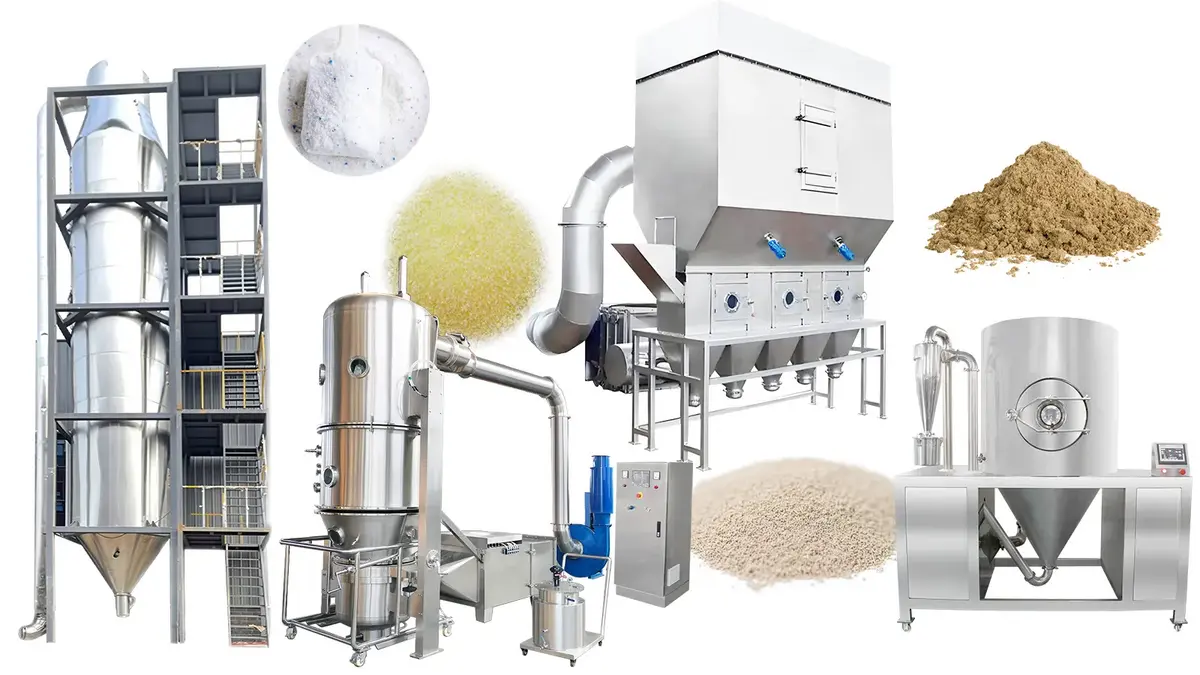
The practical distinction in a spray dryer vs fluid bed dryer decision is the form of material entering the equipment. A spray dryer is built to convert a pumpable liquid, slurry, emulsion, or solution into powder by atomizing it into a drying chamber. A fluid bed dryer is built to dry, cool, condition, coat, or agglomerate particles that already exist as a powder, granule, crystal, or agglomerate.
For many food ingredients, this is not an either-or choice. Spray drying may create the base powder, while a fluid bed completes moisture removal, cools the product before packaging, or helps produce a larger, more readily wettable agglomerated powder. The right line depends on feed behavior, target particle structure, moisture specification, powder handling needs, and the performance expected by the customer.
At a glance: the core differences
| Selection factor | Spray dryer | Fluid bed dryer |
|---|---|---|
| Typical feed | Liquid, slurry, emulsion, solution | Existing powder, granule, crystal, or agglomerate |
| Main action | Atomizes liquid droplets and evaporates moisture | Suspends particles in airflow and removes moisture from the bed |
| Particle formation | Creates particles during drying | Usually retains and conditions existing particles |
| Typical powder outcome | Fine particles, often with relatively high surface area | Drier, cooler, conditioned particles; can support larger agglomerates |
| Residence pattern | Very rapid droplet drying in the chamber | Product remains in the bed for a controlled finishing period |
| Common role | Primary liquid-to-powder conversion | Final drying, cooling, agglomeration, coating, or conditioning |
| Best starting question | Can the product be atomized and dried from liquid form? | Can the existing particles fluidize reliably without damage or excessive loss? |
How spray drying food ingredients works
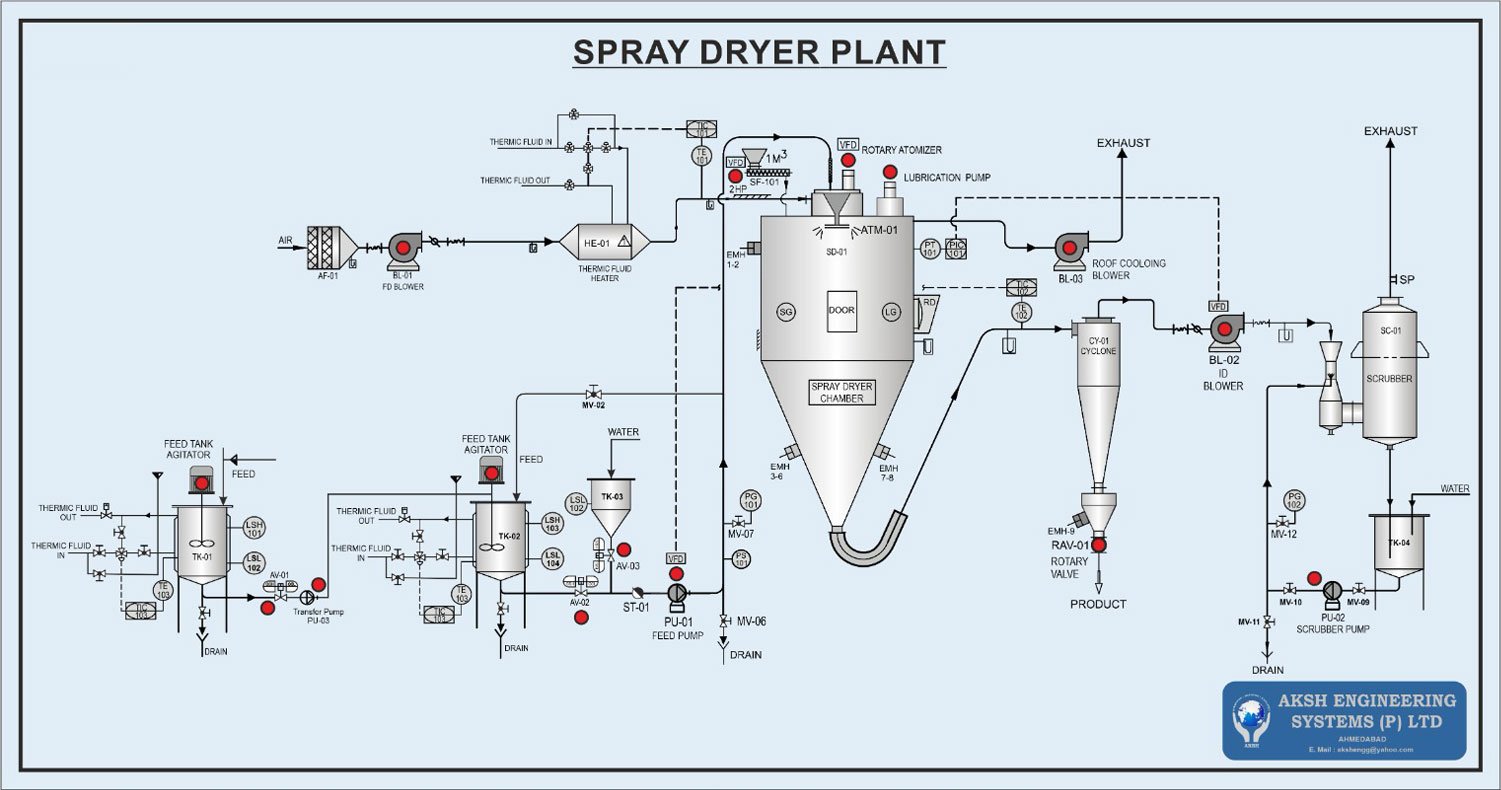
Spray drying begins with feed preparation. The ingredient may be dissolved, blended, emulsified, homogenized, filtered, concentrated, or otherwise conditioned so it can be pumped and atomized consistently. The feed then enters a drying chamber through an atomizer, such as a rotary device or pressure nozzle. Atomization breaks the feed into droplets, greatly increasing surface area for evaporation.
Hot drying gas contacts the droplets in the chamber. Moisture evaporates as the droplets travel through the system, leaving solid particles that are separated from exhaust air and transferred to downstream powder handling equipment.
The atomizer and feed properties strongly affect the starting droplet size. That, in turn, influences final particle size distribution, bulk density, surface character, fines generation, and the way the powder behaves during conveying, filling, and reconstitution. A spray dryer can therefore be more than a moisture-removal machine: it is a particle-forming step.
For food manufacturers, spray drying is commonly considered when the raw material is naturally liquid or can be made into a stable liquid feed. Typical examples include dairy-based ingredients, flavor systems, beverage powders, plant extracts, starch-based preparations, encapsulated oils, and ingredient blends. Actual suitability depends on the formulation and its behavior during pumping, atomization, and drying.
Where spray drying can be limiting
A standalone spray dryer may produce a fine powder with dusting or flow challenges. Some products can also leave deposits in the chamber or associated ducting if the feed becomes tacky during drying. Powder recovery, air handling, and separation equipment are therefore central parts of the system, not minor accessories.
The process also requires stable control of the complete feed system. Changes in solids content, viscosity, temperature, emulsion stability, or incoming moisture can affect atomization and powder quality. Equipment selection should account for upstream mixing, feed tanks, pumps, filtration, and any required concentration step.
How fluid bed drying food powders works
A fluid bed dryer passes conditioned air upward through a distributor beneath a product bed. When airflow is properly matched to the powder, particles become suspended and circulate in a fluidized state. This exposes a large particle surface area to the drying air and promotes relatively even heat and mass transfer.
Unlike a spray dryer, a fluid bed generally does not turn a liquid feed directly into powder. It needs particles capable of forming a stable bed. Those particles might arrive from a spray dryer, granulator, crystallizer, mixer, extruder, or another preceding process.
A fluid bed can be configured as a batch or continuous operation. Its function may include:
- Removing remaining moisture after another drying stage
- Cooling powder before storage or packaging
- Conditioning powder to improve handling consistency
- Supporting agglomeration by applying a binder or liquid while particles fluidize
- Applying coatings where the product and process are suitable
- Reducing temperature differences across a powder stream before downstream handling
The key operating question is whether the powder fluidizes well. Very fine, cohesive, sticky, fragile, broad-distribution, or highly variable powders may be difficult to fluidize consistently. They can form channels, lumps, dead zones, or excessive entrainment, depending on the material and machine design. Product trials are especially valuable where the powder has unusual flow properties or a narrow allowable particle-size range.
Particle control: fine powder versus agglomerated powder
Particle structure is often the decisive issue beyond feed form.
Spray drying can produce relatively fine primary particles. This can be desirable for some applications, including formulations that need a particular bulk density, mouthfeel, dissolution profile, or encapsulation structure. But fine particles may also generate dust, segregate in blends, bridge in hoppers, or wet slowly if air becomes trapped around the powder during addition to liquid.
Fluid-bed agglomeration can join smaller particles into larger porous clusters. For instantized food powder production, this larger, more open structure can improve wetting and dispersibility when the process is properly developed. It can also change bulk density, flow behavior, appearance, and mechanical strength.
Agglomeration is not automatically beneficial. Oversized or weak agglomerates can break during conveying, screening, or packaging. Excess liquid addition can create lumps or deposits, while insufficient bonding may produce a fragile structure that does not survive the rest of the line. The target should be a defined particle-size distribution and performance outcome, not simply “bigger particles.”
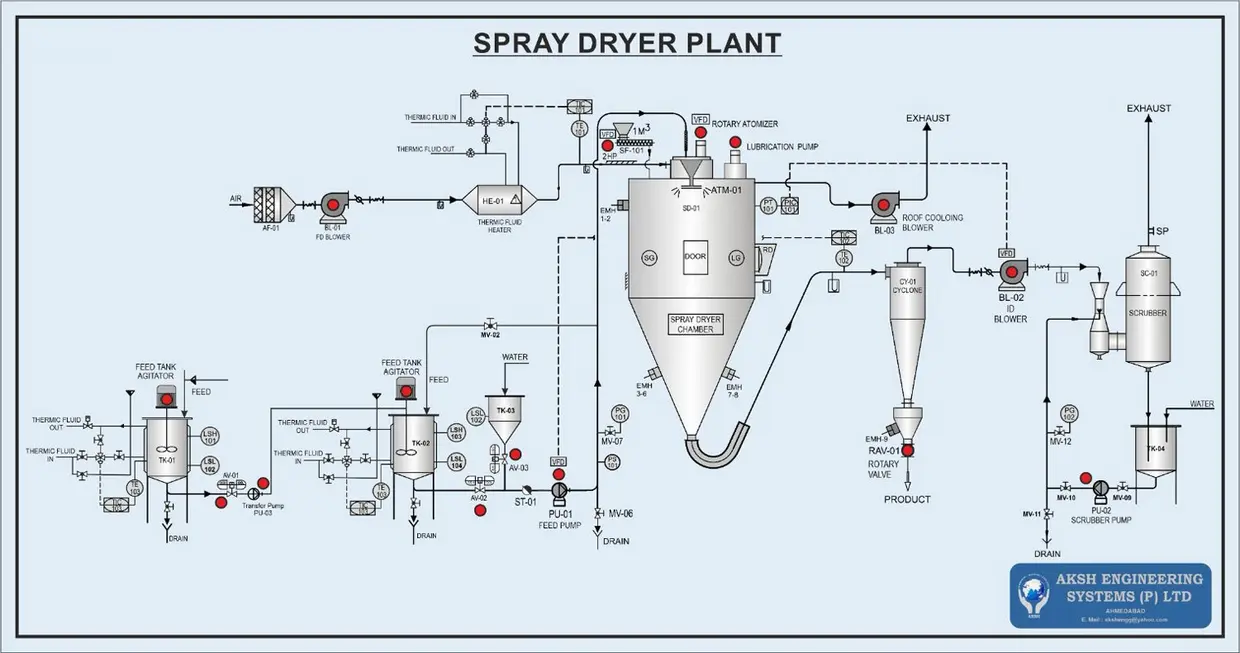
Source: akshengineering
Why combined spray dryer and fluid bed systems are common
A combined system separates the main liquid-to-powder conversion from powder finishing.
In a common arrangement, the spray dryer handles rapid evaporation from atomized droplets. Powder then enters an integrated static bed at the base of the chamber or an external fluid bed downstream. The fluid bed can remove remaining moisture more gently, cool the powder, or support controlled agglomeration.
This arrangement can give process engineers more flexibility than attempting to achieve every requirement inside the spray-drying chamber. It may also allow the chamber to focus on forming particles while the downstream bed manages final powder condition.
An integrated bed can reduce transfer steps, while an external fluid bed may offer greater separation between functions and easier access for some operating or maintenance tasks. The better arrangement depends on product sensitivity, required residence control, desired agglomeration, layout, cleaning strategy, and how the powder moves to storage and packaging.
Selecting equipment by process fit
Use the following questions to define the likely direction.
Choose a spray dryer as the primary dryer when
- The feed is a liquid, slurry, emulsion, or solution that must become powder.
- The process needs to form particles rather than only dry particles that already exist.
- Atomization behavior and feed preparation can be controlled consistently.
- The target powder can be achieved as a fine primary powder or will be finished downstream.
Choose a fluid bed dryer when
- The material already enters as particles, granules, crystals, or powder.
- The main need is final moisture adjustment, cooling, conditioning, coating, or agglomeration.
- The product can fluidize without unacceptable breakage, carryover, or nonuniformity.
- The line benefits from a controlled finishing stage before storage or packaging.
Consider a combined system when
- A liquid ingredient must first be converted into powder.
- The final powder needs better flow, lower dusting, improved wetting, or a more controlled agglomerate structure.
- Final drying and cooling need more residence time or control than the spray chamber alone provides.
- Product performance in mixing, filling, transport, or end use is as important as final moisture.
Line design issues that affect the decision
Drying equipment should not be specified in isolation. The practical system includes feed preparation, air supply and treatment, powder separation, conveying, storage, packaging, and cleaning access.
Air management and powder recovery
Both technologies depend on controlled process air. Air temperature, humidity, flow, filtration, and pressure balance affect drying behavior and powder recovery. Exhaust handling and separation equipment must be designed around the expected fines load and product characteristics. Where combustible dust may be present, the facility should complete a dust-hazard assessment and use qualified engineering and applicable local requirements to determine suitable protection and operating controls.
Powder transfer and packaging
A powder that performs well at the dryer outlet can still lose quality during pneumatic conveying, mechanical transfer, screening, or filling. Fragile agglomerates may break down, while warm powder may create handling or package-quality concerns. Map the powder path from dryer discharge to package and identify every point where segregation, attrition, moisture pickup, or buildup could occur.
Cleaning and changeover
Food powder lines need a validated sanitation and allergen-control approach appropriate to the products made. The required method depends on formulation, soil characteristics, equipment design, facility procedures, and applicable regulations. Before selecting a system, review access to the chamber, fluid bed, filters, ducts, cyclones, conveyors, and contact surfaces; clean-in-place capability where relevant; drainage; inspection points; and procedures for verifying cleaning effectiveness.
Do not assume a dryer is suitable for a given food safety or allergen-control requirement based on its general equipment category. Confirm the hygienic design, materials of construction, seals, filter arrangement, cleaning method, and validation expectations with the equipment supplier and the plant’s food safety team.
A practical evaluation sequence
- Define the incoming feed. Document whether it is liquid or particulate, its solids range, viscosity or flow behavior, sensitivity, and batch-to-batch variation.
- Set powder specifications. Include moisture target, particle-size distribution, bulk density, flow, dusting, dispersibility, appearance, and acceptable breakage.
- Identify the true process objective. Decide whether the line must create powder, finish powder, cool it, agglomerate it, or perform several of these functions.
- Evaluate downstream handling. Consider transfer distance, storage time, packaging format, and the customer’s use of the powder.
- Run representative trials. Use production-relevant feed and assess the powder after drying, conveying, and packaging simulation where possible.
- Review the complete utility and air system. Include air treatment, filtration, powder separation, exhaust, controls, and safe dust-management measures.
- Plan cleaning and changeover before purchase. Confirm access, procedures, validation needs, and likely downtime with the intended product portfolio in mind.
The decision in one sentence
Choose spray drying when a liquid must become powder; choose fluid bed drying when existing particles need drying or conditioning; and use both when the product needs liquid-to-powder conversion plus controlled finishing, cooling, or agglomeration.
The strongest equipment choice comes from matching the drying mechanism to the material’s starting form and matching the particle outcome to the realities of handling, packaging, and end use.
References
- Spray Dryer vs Fluid Bed Dryer: Key Differences Explained. (n.d.). https://www.zzkdinstrument.com/news/spray-dryer-vs-fluid-bed-dryer:-key-differences-explained.html
- Spray Dryer vs. Fluidized Bed Dryer: The Difference. (n.d.). https://pulsedry.com/spray-dryer-vs-fluidized-bed-dryer-whats-the-difference
- Spray Dryer vs Fluidized Bed Dryer | PDF. (n.d.). https://www.scribd.com/document/894642702/Spray-Dryer-Fluid-Bed-Dryer-pdf
- Advantages of Spray Drying Over Other Drying Methods. (n.d.). https://spraydryer.com/advantages-of-spray-drying-over-other-drying-methods
- Spray Drying vs. Fluid Bed Drying: When and Why to Use Each - AVEKA. (n.d.). https://www.aveka.com/spray-drying-vs-fluid-bed-drying-when-and-why-to-use-each
- Your Ultimate Guide to Fluid Bed Dryer vs Spray Dryer - Summit Rx. (n.d.). https://summitrxusa.com/blogs/blogs/your-ultimate-guide-to-fluid-bed-dryer-vs-spray-dryer
- Spray drying - Wikipedia. (n.d.). https://en.wikipedia.org/wiki/Spray_drying
- SPRAY DRYER SYSTEM A spray dryer system is an industrial …. (n.d.). https://www.facebook.com/ismail.saad.18/posts/spray-dryer-systema-spray-dryer-system-is-an-industrial-machine-that-rapidly-con/26582333694802691