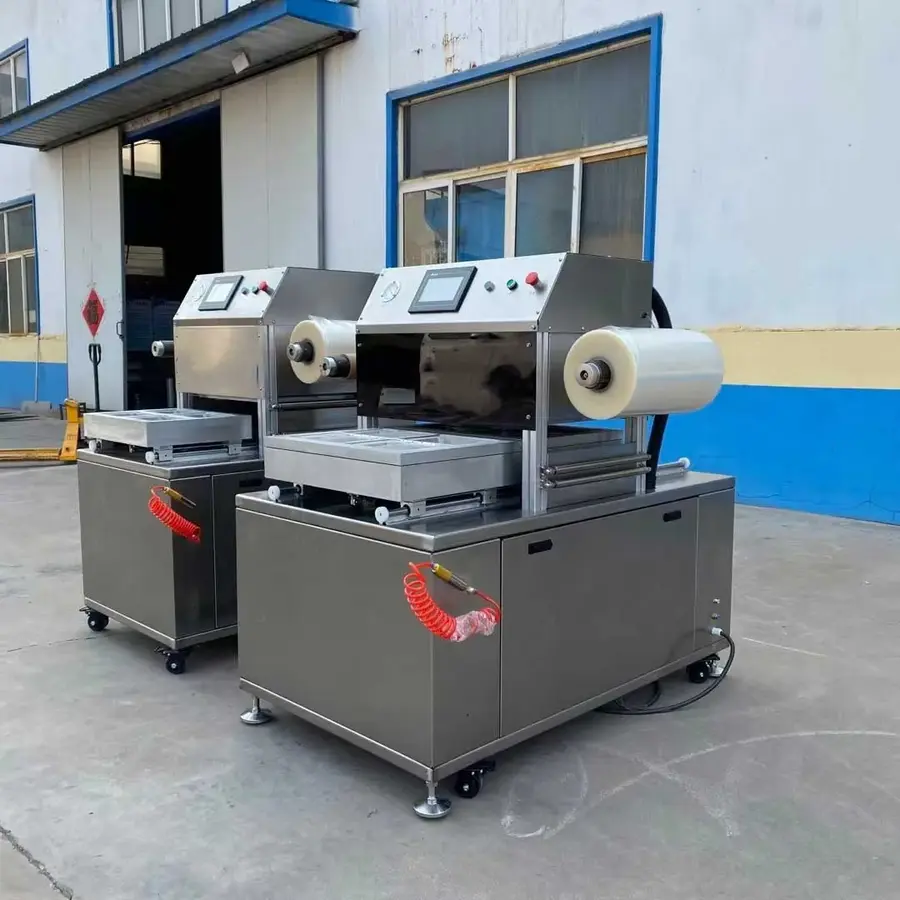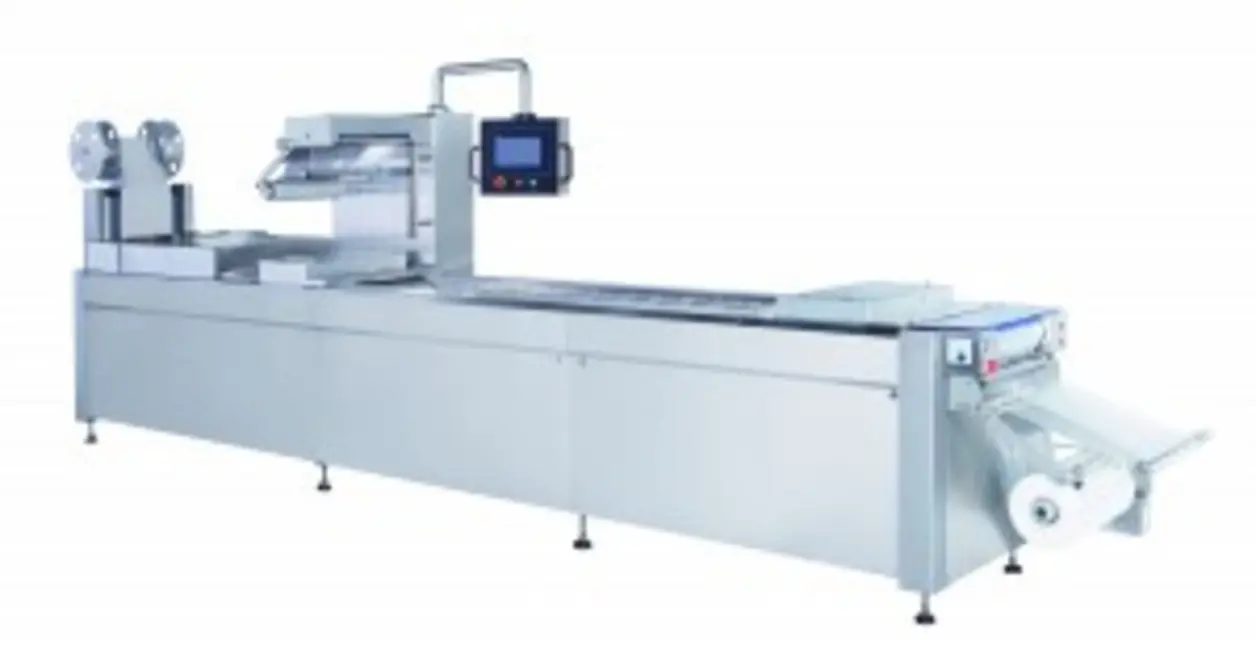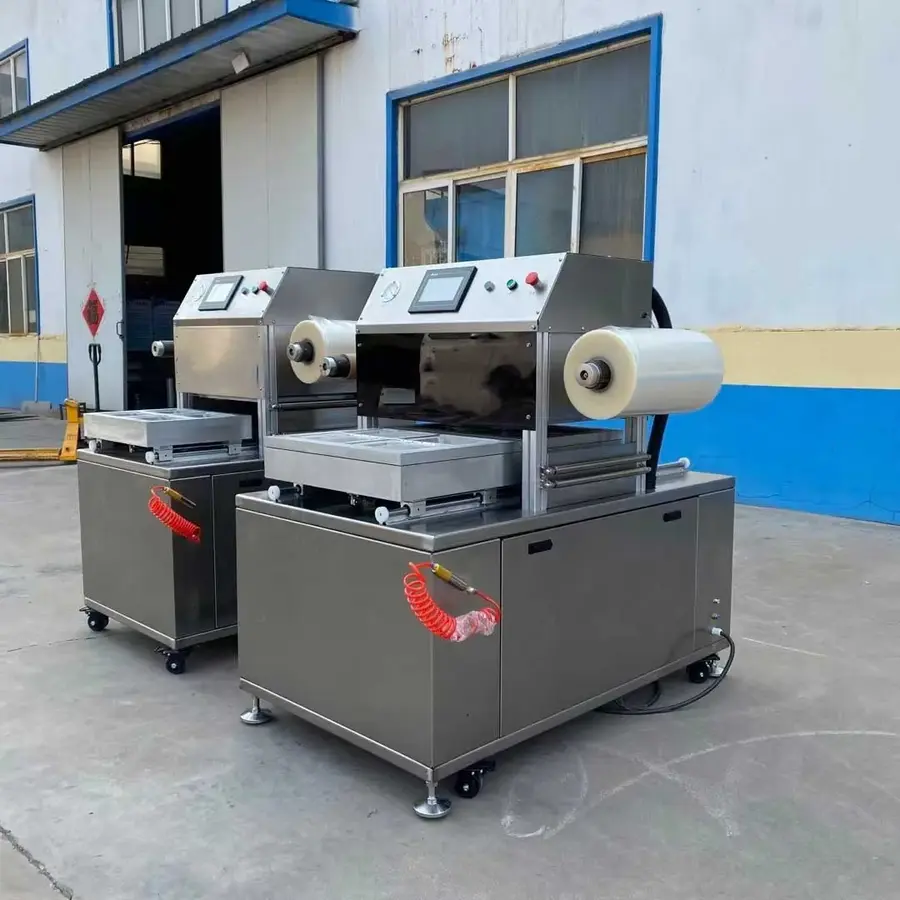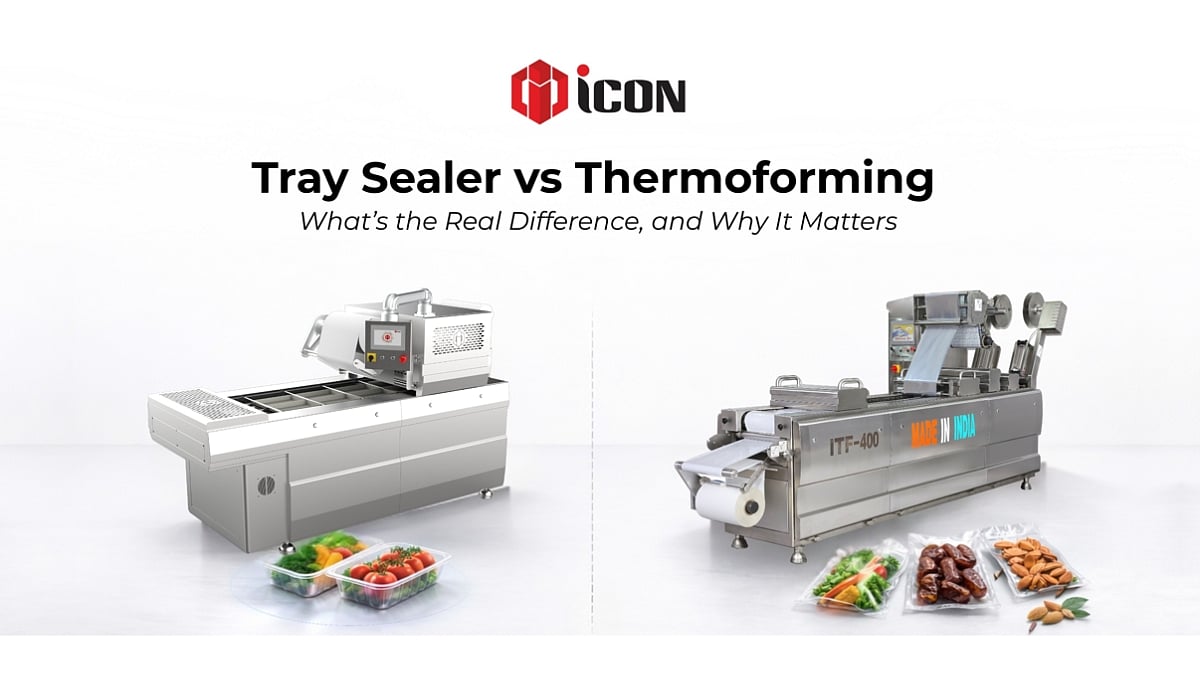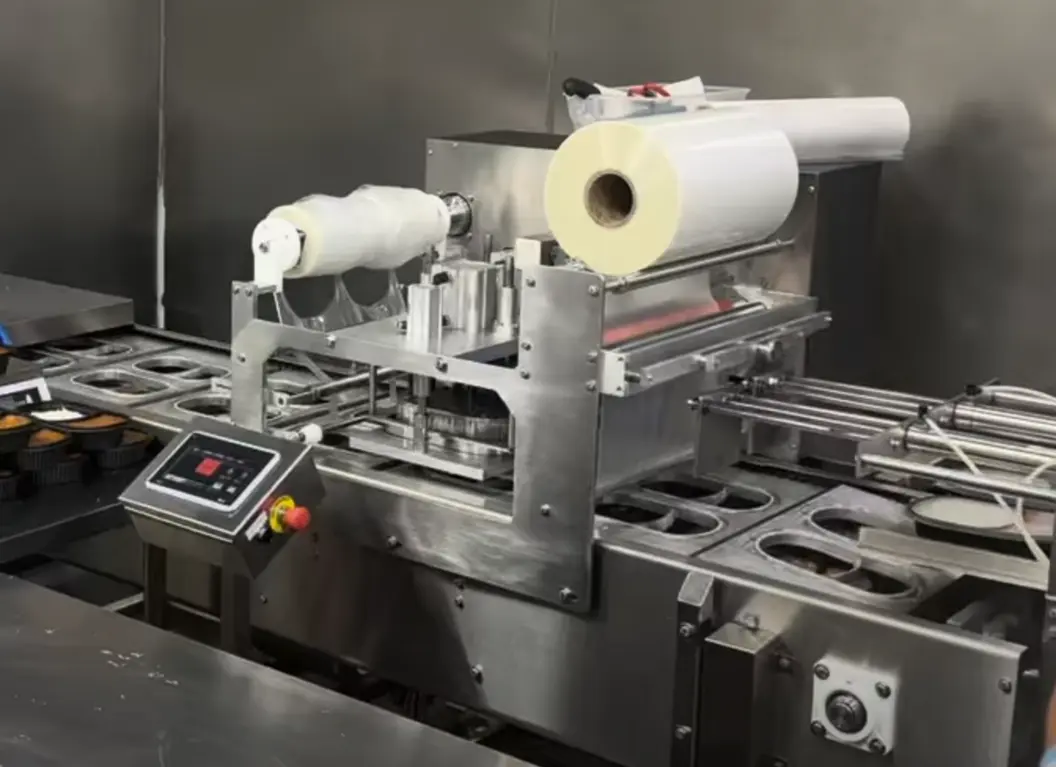
A tray sealer is usually the better fit when a food producer needs frequent format changes, wants to use a distinctive or rigid preformed tray, or runs a broad mix of products and pack sizes. A thermoforming machine is usually stronger for long, stable runs of standardized packs, especially where forming containers from rollstock can simplify high-volume automation and reduce reliance on delivered empty trays.
The important distinction in a tray sealer vs thermoforming machine decision is not simply how each machine seals film. Both can produce sealed packs, and both may be specified for vacuum, modified atmosphere packaging (MAP), or skin-pack applications. The real choice is between two packaging systems: one built around purchased trays, and one built around forming packages in-line from film.
The core difference: preformed trays vs formed web packs
A tray sealer takes a tray that has already been manufactured, filled, and presented to the machine. It applies a lidding film and seals the film to the tray flange. Depending on the machine and packaging specification, the sealing cycle may include gas flushing, vacuum, or a combination of both.
A thermoforming packaging machine unwinds a bottom web of film, heats it, and forms it into cavities. Product is loaded into those cavities, after which the machine applies a top web, seals the pack, and cuts individual packs apart. The package shape is therefore created within the packaging line rather than supplied as an empty tray.
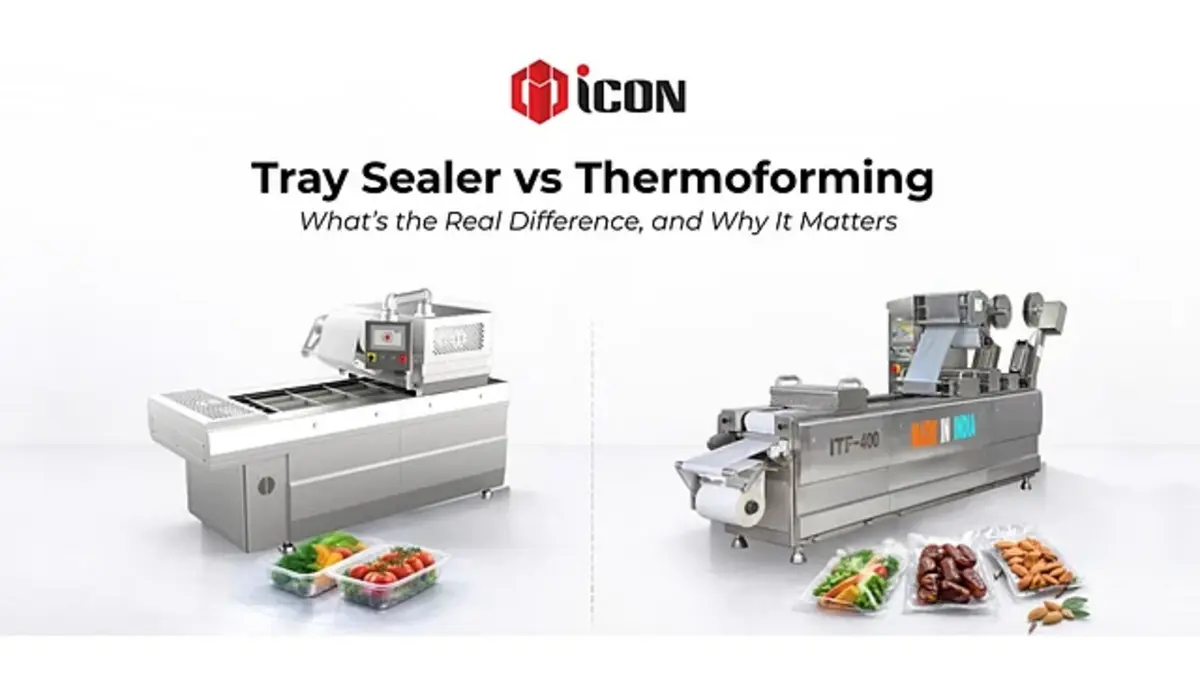
Source: media.assettype
This basic difference affects nearly every practical decision: material purchasing, warehouse space, product loading, tooling, waste handling, format flexibility, and conveyor design after sealing.
Tray sealer vs thermoforming machine at a glance
| Selection factor | Tray sealer | Thermoforming machine |
|---|---|---|
| Pack container | Uses preformed trays | Forms cavities from bottom rollstock film |
| Best general fit | Mixed SKUs, frequent changes, tray-led presentation | Long runs, repeatable formats, integrated automation |
| Format flexibility | Often strong when compatible trays and tooling are available | Best when formats are relatively standardized |
| Changeover work | Usually involves tray, lidding film, guides, and sealing tooling | May involve forming and sealing tooling, films, cutting setup, and loading changes |
| Empty-pack logistics | Requires delivery and storage of empty trays | Requires rollstock film rather than stacks of trays |
| Product loading | Can work well with manual, semi-automatic, or automated loading | Commonly suited to indexed in-line loading systems |
| Material profile | Tray plus lidding film | Bottom forming web plus top web, with trim web where applicable |
| Pack appearance | Supports many tray shapes, materials, colors, and premium formats | Often favors repeatable formed-web pack geometry |
| Downstream handling | Must accommodate the supplied tray dimensions and rigidity | Pack stiffness and geometry depend on the formed structure and product |
The table is a starting point, not a substitute for a line trial. Product behavior, desired shelf life, tray or film specification, and the way the line is staffed can change the answer.
When a tray sealer is usually the better choice
Tray sealers are often selected because the tray itself is part of the product presentation. Ready meals, chilled prepared foods, bakery items, meat cuts, seafood, and foodservice packs may benefit from a rigid, recognizable tray that is easy for consumers to handle and can be specified in several materials or shapes.
You have many SKUs or frequent pack changes
A tray sealer can be a practical choice for producers running different tray footprints, depths, portion sizes, or seasonal products. A format change still needs planning: the correct sealing tool, tray guides, film, recipes, and inspection settings must be installed and verified. But the system does not need to form every new package cavity from rollstock.
This is especially relevant when production schedules include short runs. The lower amount of time spent stabilizing a new format can matter more than maximum theoretical output.
The package design depends on a specific tray
Preformed trays can support features that are difficult or uneconomical to reproduce in a formed-web pack, such as a particular rim profile, high rigidity, compartmented geometry, or an established retail appearance. They may also be selected where the tray needs to withstand subsequent heating or where the product requires robust support through distribution.
The packaging engineer should verify that the tray flange, lidding film, sealing conditions, and intended use are compatible. A visually acceptable seal is not by itself proof that the package will hold its integrity throughout storage and handling.
Manual or semi-automated loading is part of the operation
A food packaging line tray sealer can be configured with manual loading, assisted infeed, or fully automated tray denesting and product loading. That makes it adaptable to products that are difficult to portion automatically, including delicate, irregular, or frequently changing items.
The tradeoff is that tray handling becomes a significant part of the line. Empty trays must be denested reliably, presented in the right orientation, and protected from damage or contamination before filling.
When a thermoforming machine is usually the better choice
A thermoformer is generally most attractive when the producer has sustained volume on a limited number of pack formats and wants a continuous roll-fed process. It can combine package formation, sealing, and cutting in one synchronized machine platform.
You run stable, high-volume formats
Thermoforming becomes easier to justify when a plant repeatedly runs the same cavity layout, pack depth, and web structure. The longer and more predictable the run, the less disruptive the tooling and setup demands become.
The machine can also support tightly coordinated upstream and downstream automation. Product loading systems, checkweighers, labeling, inspection, cartoning, and case packing can be synchronized around the thermoformer’s index motion and pack pitch.
Empty-tray storage is a constraint
Preformed trays consume warehouse and line-side space because they are shipped as three-dimensional items. A thermoformer instead receives rolls of bottom and top film. This can simplify inbound storage and replenishment, although it creates a different requirement: film rolls must be managed carefully by structure, width, gauge, lot, orientation, and approved sealing performance.
Rollstock does not eliminate packaging-material management. It shifts the task from handling stacks of trays to controlling web materials and forming performance.
The product can be loaded reliably into formed cavities
Thermoforming works best where the product can be portioned and placed consistently at the machine’s operating rhythm. Sliced meat, cheese, formed protein portions, prepared components, and other repeatable products are common candidates.
Products that bridge cavity edges, release liquid unpredictably, vary significantly in height, or require gentle hand placement can make the loading and sealing process more difficult. The product, not the machine brochure, should determine whether reliable loading is realistic.
MAP capability: compare the complete pack, not the feature list
Both systems can be designed for modified atmosphere packaging. A MAP tray sealer selection should therefore focus on the complete packaging result rather than assuming that either equipment type will deliver the same shelf-life outcome.
Evaluate these items together:
- Product formulation, moisture, fat content, and surface condition.
- Tray or formed-web barrier properties.
- Top-film barrier and sealant compatibility.
- Headspace geometry and available gas volume.
- Filling accuracy and product position below the sealing area.
- Gas supply, gas-mixing control, and package-integrity verification.
- The validated shelf-life program for the specific product and distribution conditions.
Vacuum and skin-pack formats deserve the same discipline. A tray sealer may produce a skin pack over a rigid tray, while a thermoformer may create a vacuum skin pack from a formed bottom web. The preferred option depends on the desired visual effect, product support, pack rigidity, and downstream handling requirements.
Material use, scrap, and logistics
It is tempting to compare only the purchase price of a tray against the price of rollstock film. That is too narrow for an equipment decision.
With tray sealing, the material system includes the tray, lidding film, tray freight, storage, denesting losses, and the operational effect of changing tray formats. The tray may cost more to transport and store than a roll of film, but it can also provide product protection and shelf appearance that a formed-web pack does not match.
With thermoforming, material use includes the bottom web, top web, edge trim, cutout scrap, and any web losses during setup and changeover. Scrap quantity depends on pack layout, cutting geometry, web width, and the machine’s operating setup. Some material structures can be harder to recycle once different layers are combined, so sustainability decisions should consider the finished pack and the collection route available in the target market.
Ask suppliers to model total material consumption for the intended pack, including normal startup, changeover, and trim losses. Also include freight, storage, and disposal or recycling costs rather than treating film or tray price as the entire answer.
Tooling and changeovers: where selection mistakes begin
Both systems require tooling, but the nature of the commitment differs.
A tray sealer needs tooling that matches the tray flange and cavity arrangement. The producer also needs compatible lidding film and accurate tray control through the infeed and sealing area. Adding a new tray format can require new tools and line adjustments, but the tray supplier handles the physical tray-forming process.
A thermoformer requires forming, sealing, and cutting arrangements suited to the chosen pack format. Changes can affect bottom-web forming behavior, product loading, top-web registration, cutting, discharge, labels, and downstream equipment. A new pack design should be evaluated as a line project, not just a tooling purchase.
Before committing, request a structured changeover review for the formats you expect to run. Identify every task, component, recipe, film roll, guide rail, inspection setting, and validation check. The best machine is not necessarily the one with the shortest advertised changeover; it is the one your team can repeat accurately during normal production.
Footprint and line integration
A tray sealer may have a shorter core machine footprint, but the total system can include tray denesting, conveyors, accumulation, filling stations, lidding-film handling, labeling, and pack-out equipment. The full layout matters more than the sealer alone.
A thermoforming line is often longer because it incorporates web unwind, forming, loading, sealing, cutting, and discharge sections. It may reduce the need for tray denesting, but it needs sufficient access for film loading, tooling service, cleaning, and maintenance.
For either system, map these interfaces before purchase:
- Product delivery from cooling, portioning, slicing, depositing, or manual preparation.
- Space for operators to load materials and remove waste safely.
- Infeed accumulation and handling of production interruptions.
- Labeling, date coding, inspection, checkweighing, and reject handling.
- Cartoning or case packing requirements.
- Utility availability and site requirements for the selected configuration.
- Cleaning access, drainage conditions, and separation of raw and ready-to-eat operations where relevant.
A practical selection checklist
A tray sealer is likely the leading option if most answers below are yes:
- Do you run many tray sizes, product variants, or short production campaigns?
- Is the tray shape, rigidity, or visual presentation central to the product?
- Do you need an approachable path from manual loading to higher automation?
- Are products irregular, delicate, or difficult to place consistently in formed cavities?
- Is a lower-complexity format change more valuable than maximum continuous output?
A thermoforming machine is likely the leading option if most answers below are yes:
- Do you have long, repeatable runs of a limited number of pack formats?
- Can product portioning and loading be synchronized reliably with an indexed line?
- Would reducing empty-tray storage and transport materially improve operations?
- Can your plant support the machine footprint, tooling program, and maintenance approach?
- Is the package geometry suitable for a formed-web structure?
The decision should be made with a representative pack trial
The final choice should be based on the actual product, approved packaging materials, target shelf-life requirements, and intended line layout. Ask equipment and material suppliers to demonstrate a representative package, including the most difficult product condition you expect to run rather than an ideal sample.
Review seal quality, product placement, appearance, package rigidity, coding and labeling, inspection compatibility, and how the finished pack performs through your planned handling process. For MAP, vacuum, or skin-pack applications, confirm the validation responsibilities and test methods before treating any packaging claim as established.
In short, choose a tray sealer when packaging flexibility and tray-led presentation drive the business case. Choose a thermoformer when standardized volume, rollstock-based packaging, and tightly integrated automation drive it. Both can produce effective food packs; the better system is the one that fits the product, operating pattern, material supply chain, and the rest of the line.
References
- Thermoforming Packaging Machine vs Tray Sealer: Which Is Right for Your Food Production Line? - kbtpacking.com. (n.d.). https://kbtpacking.com/thermoforming-packaging-machine-vs-tray-sealer-which-is-right-for-your-food-production-line
- Tray Sealing vs Thermoforming Packaging Machine - Hualian. (n.d.). https://www.hualianpack.com/blog/tray-sealing-vs-thermoforming-packaging-machine-12-differences
- Vacuum Packaging Machines, Thermoforming &Tray Sealer. (n.d.). https://www.totalpackservice.com/vacuum-packaging-machines-buying-guide
- Utien Pack | Thermoforming Packaging Machine vs. Tray Sealer: Understanding the Difference. (n.d.). https://www.linkedin.com/pulse/utien-pack-thermoforming-packaging-machine-vs-tray-sealer-understanding-cunbc
- differences between tray sealer and thermoforming machine. (n.d.). https://packen.ir/blog/tray-sealer-vs-thermoforming-machine
- Thermoforming vs. Tray Sealing: Best Packaging Methods …. (n.d.). https://www.bengangmachinery.com/thermoforming-vs-tray-sealing-best-packaging-methods-for-seafood-industry
- Thermoformer vs Tray Sealer: Which Is Right for You?. (n.d.). https://www.velecsystems.com/en/smarter-conveyor-design-for-food-packaging-efficiency
- How to Choose Between Tray Sealers and Thermoformers. (n.d.). https://autopackline.com/blog/how-to-choose-between-tray-sealers-and-thermoformers