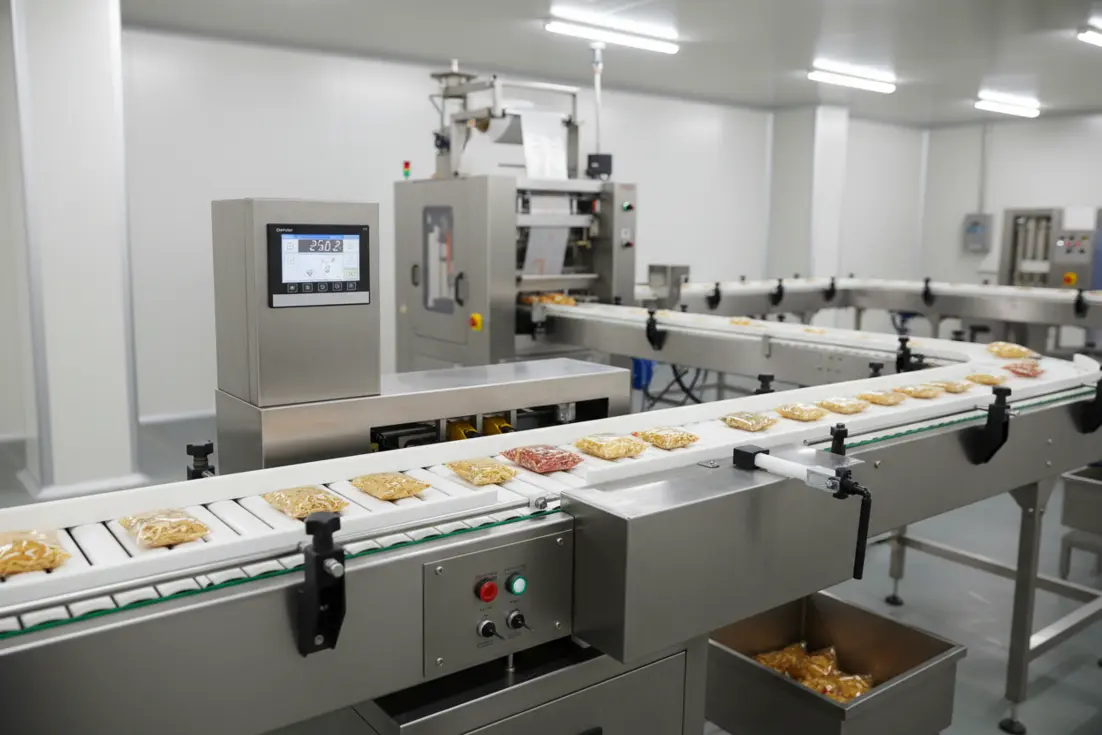
A pack that looks correctly filled can still produce a checkweigher false reject. The problem may be genuine pack-to-pack weight variation, but it can also come from unstable dynamic weighing, inconsistent product presentation, vibration, incorrect speed or spacing, unsuitable settings, or a reject device acting on the wrong pack.
The fastest way to solve the problem is not to widen the acceptance limits immediately. First establish whether the checkweigher measured the pack as out of tolerance, whether the measurement was repeatable, and whether the reject mechanism removed the same pack that was measured. That sequence separates a weighing problem from a product problem and a tracking or rejection problem.
Start by defining the failure
Before adjusting the machine, collect a short, controlled sample of events. For each rejected pack, record the displayed weight, time, product format, line speed, and whether the pack was actually underweight or overweight when checked on an appropriate verified static scale. Keep rejected packs separated from normal production until quality procedures determine their disposition.
Three patterns are especially useful:
| What you observe | Most likely area to investigate |
|---|---|
| Rejected packs are also outside limits on a verified static scale | Filling, portioning, moisture loss, missing components, or an acceptance-limit issue |
| The same pack gives inconsistent results through the checkweigher | Dynamic measurement, pack presentation, vibration, setup, or environmental interference |
| Measured rejects are correct, but good packs are removed | Product tracking, reject timing, sensor position, conveyor speed, or reject-device operation |
A single static check does not prove that a dynamic checkweigher is wrong. Inline equipment weighs a pack while it is moving, so it must contend with belt motion, product transfer, and transient forces that do not exist on a bench scale. Still, a verified static scale is an important independent comparison tool.
Use a controlled troubleshooting workflow
1. Confirm the product and tolerance setup
Verify that the selected product recipe is the one actually running. Check nominal weight, upper and lower limits, units, pack length or pitch settings, conveyor speeds, reject delay, and any filtering or averaging settings available to authorized users.
Also confirm that the stated tolerance is appropriate for the product and the site’s quality and legal-metrology requirements. Do not loosen limits simply to reduce reject counts. A limit change can hide a filling issue, increase giveaway, or allow nonconforming packs to pass. Quality personnel should control and document changes to declared-weight targets and acceptance criteria.
Look at the weight distribution rather than only the reject percentage. If readings cluster just below the lower limit, the issue may be a fill process centered too close to the boundary. If readings jump widely above and below target without a plausible process explanation, instability is more likely.
2. Verify that rejected packs are really out of tolerance
Take a representative group of rejected packs and, where practical, a group of accepted packs. Weigh them on a suitable verified static scale using a consistent method. Compare those results with the recorded dynamic weights, while recognizing that the instruments may have different display resolution and uncertainty.
This check answers two important questions:
- Is the filler or upstream process creating true underweight package rejects?
- Is the dynamic system classifying stable packs inconsistently?
If the static results support the checkweigher results, investigate the filling or assembly process. Check fill-head consistency, dosing controls, missing inclusions, damaged containers, seal-area product loss, and changes in incoming material. For products that lose or gain mass after filling, confirm whether the target setting accounts for normal production conditions.
If static results show that apparently rejected packs are consistently within limits, move to dynamic checkweigher calibration and line-condition checks.
3. Check zero, repeatability, and dynamic performance
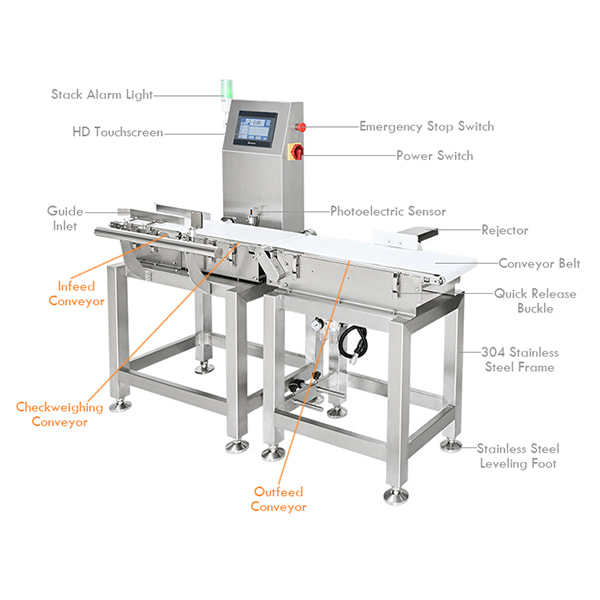
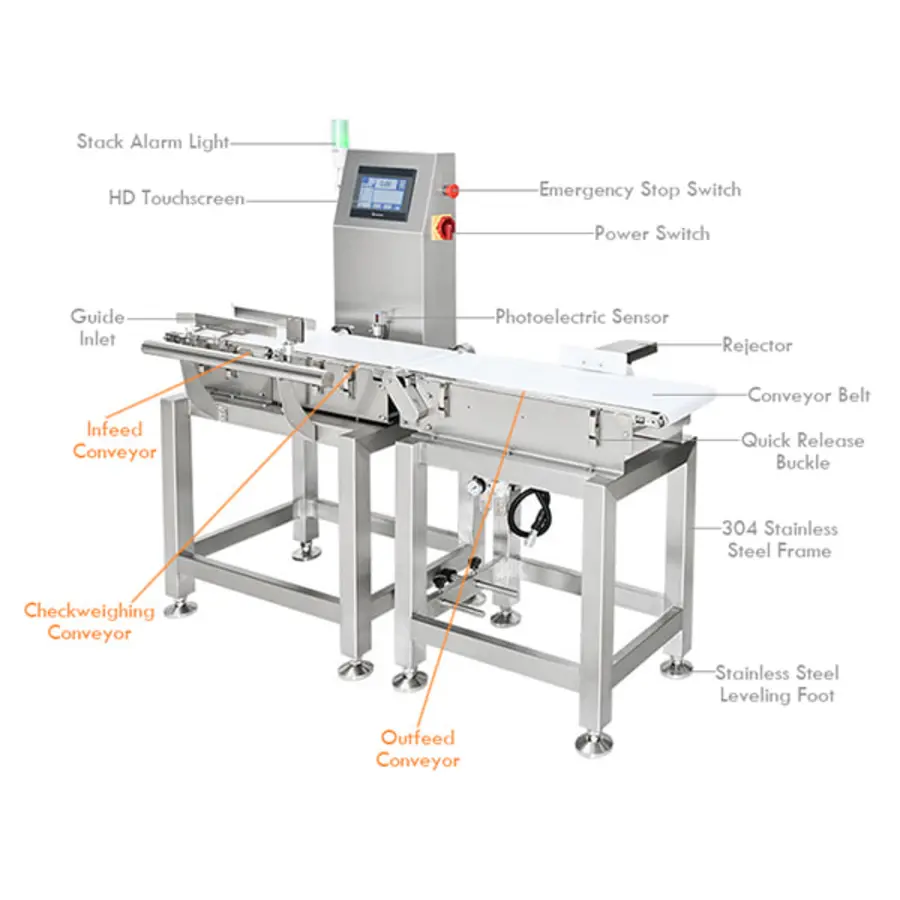
A checkweigher should have a stable zero before meaningful production verification can begin. Follow the equipment manufacturer’s approved procedure to inspect the weigh conveyor with no product present and observe whether zero is steady. Material buildup, a belt rubbing a guard, a trapped package fragment, a cable under tension, or contact between the scale section and a fixed structure can all affect the measurement.
Then run approved test packs or certified test weights according to the site’s verification procedure. Make repeated passes under normal operating conditions, not only at a slow maintenance speed. Observe whether results are consistent and whether there is a directional bias from target.
Source: sirosilo
Useful questions during this stage include:
- Does the reading drift while the line is idle?
- Does repeatability worsen at production speed?
- Does the error begin after a format change, cleaning event, belt replacement, or mechanical adjustment?
- Are results different when a test pack runs alone versus within normal production spacing?
- Does the machine remain stable at the current pack rate and belt-speed combination?
Calibration and verification are related but not identical. Calibration establishes the relationship between the measuring system and known reference values. Routine verification checks whether the installed machine continues to perform acceptably in its operating condition. If results are unstable or outside the site’s approved criteria, involve trained maintenance personnel or the equipment supplier rather than making undocumented parameter changes.
Inspect product presentation before the weigh belt
The pack must transfer onto, travel across, and leave the weighing conveyor cleanly. A pack that is touching another pack, bridging between conveyors, bouncing, tipping, dragging against a side guide, or carrying a loose component can create a false weight signal.
Common presentation faults include:
- Inconsistent gaps between packs
- Packs entering skewed or tilted
- Long, flexible, or unstable packs that oscillate during transit
- Loose caps, labels, inserts, or product moving within a container
- Side guides that contact the pack on the weigh belt
- A pack simultaneously contacting the infeed or discharge conveyor
- Product buildup on belts or transfer plates
Check conveyor transitions carefully while following safe site procedures. The weighing section should be mechanically isolated enough to measure only the pack on its belt. Guides and fixed rails should not load the weigh conveyor or interfere with the package while it is being weighed.
Correct the upstream cause where possible: improve spacing with metering controls, adjust guides for consistent presentation, stabilize the package, or reduce the operating rate to a validated condition. A slower line may be useful as a diagnostic test, but it is not necessarily the final fix.
Look for vibration and external interference
Dynamic scales are sensitive to mechanical disturbance. Vibration may originate from nearby fillers, cartoners, conveyors, pneumatic equipment, worn drive components, or an unstable supporting structure. A problem that appears only when adjacent equipment runs is a strong clue.
Inspect for loose fasteners, worn belts, damaged rollers, misaligned conveyors, poor conveyor tracking, and contact between machine sections. Watch whether the scale behavior changes when a nearby motor starts, an air blast fires, or a conveyor accelerates.
Environmental conditions can also matter. Airflow from fans or open doors can disturb lightweight packs. Product debris or moisture may affect belt travel and transfer behavior. Electrical noise, grounding problems, damaged cables, and incorrect load-cell connections require qualified technical investigation. Do not bypass safety interlocks, guards, or electrical protections during diagnosis.
Separate weighing faults from reject-system problems
A checkweigher may correctly identify an out-of-tolerance pack but reject a different, acceptable pack downstream. This is particularly likely after a speed change, product-length change, sensor adjustment, or modification to the reject station.
Check the complete tracking sequence:
- Confirm the product-detection sensor sees each pack once and reliably.
- Confirm pack spacing remains adequate between weighing and rejection.
- Verify configured product dimensions, conveyor speed, and reject delay match the current format.
- Observe whether the reject action corresponds to the recorded rejected pack.
- Confirm that rejected product clears the line and does not re-enter production.
Air blasts, pushers, flippers, diverters, and drop rejects each have different timing and mechanical requirements. A weak air supply, sticking actuator, obstructed reject lane, or poorly positioned pusher can cause missed rejects, double rejects, or removal of the following pack. Check reject confirmation devices where fitted, and investigate any mismatch between controller records and physical reject events.
A controlled marked-pack trial can be useful when performed under the site’s approved quality procedure. The purpose is to trace individual packs from detection through weighing and rejection, not to defeat the inspection system.
Practical fixes by symptom
| Symptom | Likely corrective action |
|---|---|
| Stable, repeatable underweight readings | Correct fill-process variation; review target setting and upstream dosing controls with quality approval |
| Readings fluctuate widely for similar packs | Inspect zero, belt condition, transitions, vibration, product stability, and dynamic setup |
| False rejects start after a format change | Reconfirm recipe, pack dimensions, guides, speeds, spacing, and reject timing |
| Good pack after a failed pack is rejected | Investigate reject delay, tracking sensor performance, pack spacing, and conveyor-speed synchronization |
| Instability appears when nearby equipment runs | Inspect structural vibration, mechanical contact, drives, airflow, and electrical installation |
| Reject count rises with production rate | Verify that package presentation and weigh time remain suitable at that rate; correct spacing or validate a lower operating speed |
When to escalate
Escalate to maintenance or the equipment supplier when zero will not stabilize, test results are not repeatable, a load-cell or control-system fault is indicated, a conveyor structure may be contacting the scale, or electrical work is suspected. Escalate to quality when static checks identify real weight nonconformance, limits need review, or product must be assessed for disposition.
If the line cannot demonstrate reliable detection, weighing, and rejection under the site’s required control plan, follow the site’s procedure for holding affected production rather than relying on visual pack appearance.
Prevent repeat false rejects
The most effective prevention is a routine that treats the checkweigher as part of the production process, not as an isolated final inspection device. Include approved start-up checks, routine verification with suitable test items, inspection of belts and transfers, confirmation after format changes, and review of reject logs by product and shift.
Trend both average weight and variation. An increase in false rejects may be the first visible sign of a worn conveyor component, a deteriorating filler, poorer pack spacing, or a setup change that was never fully validated. By identifying whether the fault lies in the product, the measurement, or the reject action, teams can correct the actual cause without creating unnecessary giveaway or weakening weight control.
References
- [PDF] White Paper. (n.d.). https://vertassets.blob.core.windows.net/download/9391e212/9391e212-f29f-401f-a1f7-b3e8eecc5d54/cw_pharma_process_en.pdf
- A Guide to Belt Checkweighers. (n.d.). https://www.sigmaequipment.com/guide/checkweigher-belt
- Why Small Weight Errors Matter in Pharma Packaging. (n.d.). https://ruidapacking.com/checkweigher-guide-pharma
- What Factors Affect Checkweigher Accuracy? - SHIGAN. (n.d.). https://www.sgcheckweigher.com/news/what-factors-affect-checkweigher-accuracy
- What Is a Checkweigher and How Does It Work? Complete Guide for Pharmaceutical Packaging Lines - JinLuPacking-Pharmaceutical Machinery Manufacturer & Supplier In China. (n.d.). https://www.jinlupacking.com/blogs/what-is-a-checkweigher
- Common Errors, Calibration & Repair Tips. (n.d.). https://www.sgweigh.com/checkweigher-maintenance-guide-common-errors-calibration-repair-tips
- Reduce False Rejects: Metal Detector for Food Industry Solutions. (n.d.). https://www.kenweigroup.com/article/reduce-false-rejects-metal-detection.html
- Checkweigher Reject Systems: It’S All In The Reject Device. (n.d.). https://www.all-fill.com/blog/checkweigher-reject-systems